Tag Archives: Intelligent Design

Jason Lisle debates Hugh Ross on the age of the Earth

I found this radio debate about the age of the Earth on the Apologetics 315 Twitter feed.

Speakers:

Jason Lisle

Dr. Lisle graduated summa cum laude from Ohio Wesleyan University where he double-majored in physics and astronomy, and minored in mathematics. He did graduate work at the University of Colorado where he earned a Master’s degree and a Ph.D. in Astrophysics. While there, Dr Lisle used the SOHO spacecraft to investigate motions on the surface of the sun as well as solar magnetism and subsurface weather. His thesis was entitled “Probing the Dynamics of Solar Supergranulation and its Interaction with Magnetism.” Among other things, he discovered a previously unknown polar alignment of supergranules (solar convection cells), and discovered evidence of solar giant cells. He has also authored a number of papers in both secular and creation literature.

Hugh Ross

At age seventeen he became the youngest person ever to serve as director of observations for Vancouver’s Royal Astronomical Society. With the help of a provincial scholarship and a National Research Council (NRC) of Canada fellowship, he completed his undergraduate degree in physics (University of British Columbia) and graduate degrees in astronomy (University of Toronto). The NRC also sent him to the United States for postdoctoral studies. At Caltech he researched quasi-stellar objects, or “quasars,” some of the most distant and ancient objects in the universe.

So both have impeccable scientific credentials.

The MP3 file is here. (This is the updated version that Brian Auten fixed to remove the commercials!)

I don’t always agree with Frank Pastore, (only 95%), but he knows the topic of the debate back to front, and guides the discussion in an incredibly useful, accurate way. This is a fine debate to listen to! You will learn a lot. And you will have fun learning.

The Bible and the early church fathers

Jason Lisle

  • we take Genesis literally
  • the starting point of YEC is Scripture
  • the plain meaning of Scripture is that the earth was made in 6 24-hour days
  • science has to be interpreted in a way that fits a plain reading of Genesis 1
  • the evidence for an old universe and old Earth must be rejected a priori

Hugh Ross

  • we take Genesis literally
  • the Hebrew word for day (yom) can mean 24 hours or a long period of time
  • there are multiple creation accounts in the Bible
  • interpreting yom as long periods of time harmonizes all the accounts
  • the Bible says that the seventh day is not even ended
  • we believe in a literal Adam and Eve living thousands of years ago

Jason Lisle

  • there’s only 1 account of creation in the Bible: Genesis
  • the normal view in church history is 6 24-hour days
  • there are some early church fathers who that the days are long
  • the other places where creation is discussed are not real accounts

Hugh Ross

  • the early church did not spend a lot of time talking about the age of the Earth
  • there is not unanimous agreement about the age of the Earth
  • there is no definitive statement on the age of the Earth until Isaac Newton
  • Newton strongly favored an old earth, hundreds of years before Darwin
  • there are other creation accounts, Job 38-39
  • Pslam 104 is a creation account

Jason Lisle

  • a Psalm is not written in the genre of historical narrative
  • Psalm 104 is not a creation account – it talks about ships, etc
  • it’s talking about the modern era, not a creation account

The evidence from science

Hugh Ross

  • both of us believe in an absolute beginning of time, space and matter
  • both of us believe that space is expanding now
  • stars form as matter coalesces during the expansion of the universe
  • star formation requires a universe aged on the order of billions of years

Jason Lisle

  • if you pre-suppose my interpretation of Genesis, then the universe is young

Hugh Ross

  • the speed of the expansion of the universe proves an old universe
  • the light emitted from the oldest stars also proves an old universe

Jason Lisle

  • if you pre-suppose my interpretation of Genesis, then the universe is young

Was the universe made with the appearance of age

Jason Lisle

  • any evidence for an old universe is wrong
  • stars didn’t form gradually, they were created by God instantly
  • stars have the appearance of age, but they’re actually young

Hugh Ross

  • God doesn’t lie in the Bible or in the book of nature
  • Scientists can look back in time by looking further out into the universe
  • Because light takes a long time to travel to the Earth, we can see the past
  • we can see a time when there were no stars yet
  • stars formed slowly over time, not instantaneously
  • we have photos of the universe before stars and after stars
  • we can see a history of the universe by looking closer and further away

Does nature provide us with knowledge about creation?

They discuss Psalm 19 now, so here’s Psalm 19:1-5:

1 The heavens declare the glory of God; the skies proclaim the work of his hands.

2 Day after day they pour forth speech; night after night they display knowledge.

3 There is no speech or language where their voice is not heard.

4 Their voice goes out into all the earth, their words to the ends of the world.
In the heavens he has pitched a tent for the sun,

5 which is like a bridegroom coming forth from his pavilion, like a champion rejoicing to run his course.

Jason Lisle

  • nature isn’t a book
  • nature doesn’t provide knowledge about God
  • Psalm 19 doesn’t say that nature communicates to us
  • verse 3 says “There is no speech nor language”

Hugh Ross

  • If you read all of verse 3, it says the exact opposite of what you just said it says
  • Verse 1: “The heavens declare the glory of God; the skies proclaim the work of his hands”
  • Verse 2: “Day after day they pour forth speech; night after night they display knowledge.”
  • Verse 3: “There is no speech or language where their voice is not heard.
  • Verse 4: “Their voice goes out into all the earth, their words to the ends of the world.”

Jason Lisle

  • You can’t take the Bible literally all the time

How important is the age of the Earth?

Hugh Ross

  • it’s a non-essential because it has nothing to do with salvation or inerrancy
  • both sides of the debate affirm the same views of salvation and inerrancy
  • professional scientists have multiple lines of evidence saying the universe is old
  • the only reason it matters is that young earth creationism is a barrier to faith
  • if you have to deny science to be a Christian, then it stops people from being saved
  • young earth opposition to science has been used by secularists to marginalize Christianity

Jason Lisle

  • there was no death in the Garden of Eden, animal or human, before the Fall
  • the Bible says that death was a consequence of Adam’s sin
  • so there was no death before the Fall, according to the Bible
  • old earth people believe in death before the Fall

Consider Romans 5:12:

12Therefore, just as sin entered the world through one man, and death through sin, and in this way death came to all men, because all sinned—

Hugh Ross

  • Romans 5:12 says that Adam’s sin caused death to come to all men
  • old earth people believe that only animal death existed before the Fall, not human death
  • plant and animal death existed before the Fall – Adam and Eve were eating!

Jason Lisle

  • I interpret the Bible to say that plants aren’t living creatures

What about dinosaurs, the Flood, and Noah’s ark?

Jason Lisle

  • dinosaurs were created on the 6th day
  • dinosaurs lived alongside humans and were vegetarians before the Fall
  • dinosaurs were on the Ark – they’re not that big – just take baby dinosaurs
  • it’s a global flood

Hugh Ross

  • dinosaurs were created on the 5th day
  • they were extinct before before humans ever appeared
  • nobody in history ever wrote about dinosaurs until 200 years ago
  • it’s a local flood

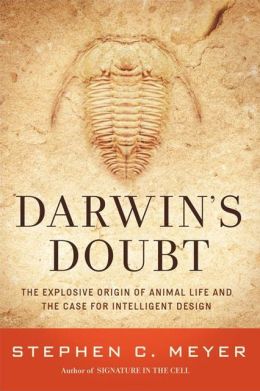
Thinking Christian reviews “Darwin’s Doubt”, a new book by Stephen C. Meyer

Darwin's Doubt: The Explosive Origin of Animal Life and the Case for Intelligent Design
Darwin’s Doubt: The Explosive Origin of Animal Life and the Case for Intelligent Design

NOTE: you can tune in to the Dennis Prager radio show  at 2 PM Eastern today in order to hear Dr. Meyer discuss the new book.

I found a book review of the new book on intelligent design by Dr. Stephen C. Meyer. This book is concerned with the fossil record, and it is the sequel to the highly acclaimed “Signature in the Cell“, which dealt with the origin of biological information in the first living cell.

Excerpt:

The title of the book refers to the difficulty [Charles Darwin] had in explaining the “Cambrian Explosion,” the vast proliferation of new animal body plans (new “phyla” or major animal groupings) that appears in fossils in the Cambrian strata, deposited some 530 million years ago. These animals appear suddenly in the fossil record, without any plausible predecessor such as Darwin’s theory predicted. Darwin wrote,

The difficulty of understand the absence of vast piles of fossiliferous strata, which on my theory were no doubt somewhere accumulated before the Silurian [i.e., Cambrian] epoch, is very great. I allude to the manner in which numbers of species of the same group suddenly appear in the lowest known fossiliferous rocks.

Darwin saw this accurately as a challenge to his theory. It remains one still. The animals appear too quickly in the record to be explained through his gradualistic theory.

And it remains a challenge from the perspective of mainstream science. Various theories have been proposed in explanation of the suddenness with which these new phyla came on the scene. Perhaps selective fossilization caused their predecessors to disappear from paleontologists’ view. Mainstream science casts serious doubt on that view. Statistical paleontology renders it deeply improbable. The soft-body hypothesis appears unlikely to succeed, since the evidence shows soft-bodied organisms have been frequently fossilized.

Or maybe the Cambrian animals’ precursors really are there in the record, in the form of exotic Ediacaran fossils. But these organisms are not clearly animals of any sort, and what they are is so in confusion that they could hardly be considered evidence for anything. Further,

As Nature recently noted, if the Ediacaran fauna “were animals, they bore little or no resemblance to any other creatures, either fossil or extant.” … This absence of clear affinities has led an increasing number of paleontologists to reject an ancestor/dependent relationship between the Ediacaran and Cambrian fauna.

Scientists have proposed genetic histories for these phyla, but as Meyer pointedly puts it, these scenarios all “assume a gene.” And a lot more besides. That is to say, they beg the question of evolution’s explanatory adequacy by assuming that it must be true. From there they suggest pathways according to which genes “must have” evolved. But there’s no evidence of it in the record.

Now the exciting thing is that at the time of writing (Monday night), the book is number one on Barnes and Noble:

Darwin's Doubt #1 at Barnes and Noble
Darwin’s Doubt #1 at Barnes and Noble

And number ten on Amazon:

Darwin's Doubt #10 at Amazon.com
Darwin’s Doubt #10 at Amazon.com

Now is this a book for the layman? Well, I’ve met the guy who wrote the book review above face-to-face, and his background is not in biology. I think if he can struggle through it, then I could do it too. And so could you. I think that both of Dr. Meyer’s books are must-read books for anyone interested in knowing how well the presumption of naturalism succeeds when confronted with the latest scientific evidence. These are the books you need to buy and read if you are serious about integrating science and religion. The thing to realize is that naturalists and atheists and materialists have no answer to these books. None. Do you like winning? Then spend the money and time on the books that are unstoppable in a debate.

Zack Kopplin debates Casey Luskin on the Louisiana Science Education Act on the Michael Medved show

The Michael Medved show is a national radio show broadcast out of Seattle, Washington. According to Talkers magazine, he has the fifth largest radio audience. He has a regular weekly segment on science and culture featuring  scholars from the Discovery Institute.

Here is the seventh segment from this past week, courtesy of the Intelligent Design: The Future podcast.

The MP3 file is available for download. (38 minutes)

The description is:

On this episode of ID the Future, the Medved Show hosts the CSC’s Casey Luskin and student Zack Kopplin, a leading activist in the effort to repeal the Louisiana Science Education Act. Luskin and Kopplin debate the implications of the Louisiana law for science education standards and whether or not the law promotes the teaching of creationism.

Each week, leading fellows from Discovery Institute will join Michael Medved to talk about the intersection of science and culture. Listen in live online or on your local Medved station, or stay tuned at ID the Future for the weekly podcast.

Topics: (I tried harder to get Kopplin’s statements right than with Dan Barker last week, because Kopplin isn’t as much a jerk as Barker)

  • Medved: Should teachers be forced to teach creationism in public schools?
  • Luskin: The Discovery Institute has never advocated that creationism be taught in public schools
  • Medved: Does the Louisiana law mandate that creationism be taught in public schools
  • Kopplin: Yes, the bill does because Bobby Jindal said that the bill teaches creationism
  • Luskin: (Reads the actual text of the law) the law EXPLICITLY STATES that teaching creationism is forbidden
  • Luskin: Governor Jindal is misinfored about the law, but if you look at the law it says NO CREATIONISM
  • Kopplin: I don’t care about what the law actually says, I’ll just repeat that Bobby Jindal thinks it’s creationism
  • Kopplin: Thirty years ago, there was an attempt to mandate creationism, therefore this law is doing the same thing
  • Medved: Are there any complaints that creationism is being taught in any schools after this law has been passed
  • Kopplin: No, I don’t know of any, but that’s not because there are none! Maybe there are some that I haven’t heard about yet
  • Medved: If you are taught something that you think is stupid, then is that automatically a violation of your rights?
  • Kopplin: Because you cannot allow the progress of science to call the religion of naturalism into question
  • Luskin: About that Jindal quote – he was talking about what he wanted to pass, not the law that actually passed
  • Luskin: (reads the text of the law again) The law explicitly says that teachign creationism in the classroom is prohibited
  • Luskin: Intelligent design is not creationism. Creationism starts with the Bible. Intelligent Design starts with science
  • Luskin: The law only supports teaching both sides of things that are already in the curriculum
  • Luskin: ID is not already in the curriculum, therefore, the law does not allow it to be discussed
  • Medved: Take Stephen C. Meyer’s book on the origin of life, could that be used in the classroom?
  • Kopplin: I am not very familiar with Meyer’s book, but if it is critical of Darwinism and naturalism, then it should not be taught. I don’t need to read it before I can censor it
  • Luskin: Meyer’s book advocates for ID, so it should not be taught in science classrooms
  • Luskin: non-ID science papers that are critical of Darwinism should be allowed in science classroom so students get both sides
  • Medved: Consider this brand new Oxford University Press book that is critical of Darwinian mechanisms, authored by Masatoshi Nei who is at Penn State University professor (written up on Evolution News)
  • Medved: Should this research critical of Darwinism be allowed in science classrooms?
  • Kopplin: I don’t know if this book should be allowed in science classrooms
  • Kopplin: I already know without reading anything though that there will never be evidence that supports intelligent design
  • Kopplin: There is no evidence against Darwinism and there is no controversy and there is no disagreement among scientists
  • Luskin: There are hundreds of papers in mainstream science peer-reviewed publications critical of Darwinism
  • Luskin: (lists a stack of papers critical of core tenets of Darwinian theory from respect science journals in the last few years)
  • Luskin: Masatoshi Nei recently posted a comment critical of the usefulness of the mutation-selection mechanism
  • Luskin: The real issue is whether students are allowed to hear mainstream scientific criticisms of Darwinism in the science classroom
  • Medved: Is it OK for a teacher to admit that on a specific issue in science, that there is no credible naturalistic explanation?
  • Kopplin: I am a history major, so I don’t want to comment on whether it is OK to admit that naturalism doesn’t explain everything
  • Luskin: A Harvard chemist says that the origin of life is an open issue in this peer-reviewed journal article
  • Luskin: Teachers should be allowed to say that there is no accepted naturalistic explanation for the origin of life
  • Luskin: teachers should NOT be teaching religion, or creationism, or even intelligent design in science classrooms
  • Luskin: but teachers should be allowed to say what the Harvard chemist said in that peer-reviewed article in the science classroom
  • Kopplin: there was a creationist woman who sat next to the Discovery Institute person when the law was being debated
  • Kopplin: so based on that there is a scary hidden creationist agenda behind the law which is not reflected in the actual text law
  • Luskin: Um, that woman has no connection to the Discovery Institute
  • Luskin: seating arrangement at the hearings were pre-determined, not selected by those in attendance
  • Luskin: what about people who are pushing Darwinism, who are anti-religious atheists and humanists? should they be disqualified?
  • Luskin: we should not discredit the arguments of either side based on speculations about their motives – what counts is the evidence
  • Kopplin: but I have a letter signed by lots of Nobel-prize winning scientists that opposes the Lousiana science education law
  • Luskin: but that letter never actually quotes from the law, it is critiquing views that have nothing to do with the actual law
  • Medved: Summarize your views
  • Kopplin: Criticism of Darwinism and naturalism using mainstream scientific evidence SHOULD NOT be allowed in the science classroom
  • Liskin: Criticism of Darwinism and naturalism using mainstream scientific evidence SHOULD be allowed in the science classroom

And there is a period of questions from the callers.

This episode features a debate, so it is not to be missed. it is always a good idea to hear both sides. Unfortunately, ID people are the only ones who think that both sides should be heard.

I subscribe to the ID the Future podcast, and I really recommend that you do as well!

Previous entries