Tag Archives: Intelligent Design

New study: parrots capable of using and sharing tools

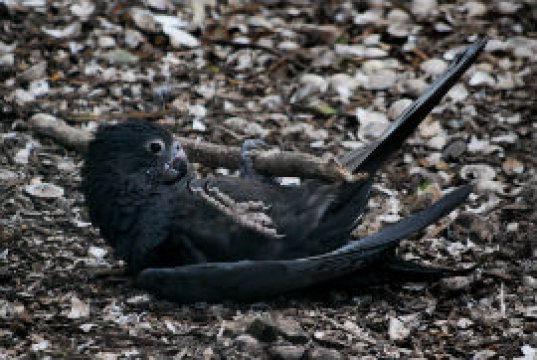
Greater vasa parrot using a tool to extract calcium
Greater vasa parrot using a tool

All right, well, awareness of my tremendous affection for all things bird-related has spread to all my friends, and now whenever there is an interesting bird study, (or funny video of owls blinking), I can expect to be informed about it.

My friend Melissa, who is doing a degree in STEM, and just got all As, sent me this new study from Science Daily.

It says:

Psychologists at the University of York and University of St Andrews have uncovered the first evidence of tool use by greater vasa parrots (Coracopsis vasa).

Studying ten captive parrots, researchers in the Department of Psychology at York observed the birds adopt a novel tool-using technique to acquire calcium from seashells and also the active sharing of tools among themselves.

The birds used small pebbles or date pits to grind calcium powder from the shells or to break off small pieces of shell to ingest. This behaviour, never before seen in this species, is the first evidence of a nonhuman using tools for grinding, and one of the few reports of nonhuman animals sharing tools directly.

Observing and filming the parrots over an eight month period (March to October), researchers documented their interactions with cockle shells on the floor of their aviary. Shells are a known source of calcium for birds.

Five out of ten birds were documented using tools, placing either pebbles or date pits inside shells to grind against the shell, or using them as a we

Yes, this is actually really important if you are a bird owner, as I am. Male parrots tend to have problems that are specific to their breed, but female parrots of any breed seem to run into this egg-laying problem where they law so many eggs, that they run out of calcium to make the eggshells. This is called “egg binding” and it can kill your bird if it’s not caught early.

Now, what do you think that a ambitious and chivalrous male parrot would do about egg binding when courting a delightful female parrot?

This:

Interest in the shells was greatest from March to mid-April, just before the breeding season — this may be due to calcium supplementation being critical for egg-laying. Researchers were therefore initially surprised to find that it was the males, not the females who showed the greatest interest in shells.

However, observation of the parrots’ breeding behaviour showed that males often engaged in regurgitative feeding of females before copulating with them, thus potentially passing on the calcium benefits.

Megan Lambert, PhD student in York’s Department of Psychology and lead author on the study, said: “The use of tools by nonhuman animals remains an exceedingly rare phenomenon. These observations provide new insights into the tool-using capabilities of parrots and give rise to further questions as to why this species uses tools.

“Tool use could reflect an innate predisposition in the parrots, or it could be the result of individual trial and error learning or some form of social learning. Whether these birds also use tools in the wild remains to be explored, but ultimately these observations highlight the greater vasa parrot as a species of interest for further studies of physical cognition.”

That’s right!

Here is a video linked in the article:

Now, do you know what this reminds me of? It reminds me of that post on love that I wrote a while back. When a man loves a woman, he tries to take away her trouble, or to take trouble for her, so that she is protected and her life is easier. He does things that will help her because he cares about her. It would be nice if more men acted like these birds, and tried to show that they cared by protecting and providing. And it would be nice if more women looked for protecting and providing, and were attracted by them.

New study: fossil discovery adds a new phyla to the explosive Cambrian explosion

Apologetics and the progress of science

It’s Wednesday, so that means another scientific discovery has been made to falsify atheism. Put it on the pile with the others, I guess.

The story from Science Daily reads like Darwinist propaganda, but you can get the main idea if you ignore the fawning naturalistic bias.

Excerpt:

A team of Virginia Tech researchers have discovered fossils of kinorhynch worms — commonly known as mud dragons — dating back more than 530 million years.

The historic find — made in South China — fills a huge gap in the known fossil record of kinorhynchs, small invertebrate animals that are related to arthropods, featuring exoskeletons and segmented bodies, but not jointed legs.

The first specimen was unearthed in rocks in Nanjiang, China, in 2013 and more fossils were found later that year and in 2014.

Helping lead the international team of scientists and biomedical engineers who unearthed, studied, and imaged the ancient, armored, worm-like creature is Shuhai Xiao, a professor of geobiology in the Department of Geosciences, part of the College of Science at Virginia Tech.

Dubbed Eokinorhynchus rarus — or rare ancient mud dragon, the newly discovered animal dates back from the Cambrian period and contains five pairs of large bilaterally placed spines on its trunk. It is believed to be related to modern kinorhynchs.

The group’s findings were published in Scientific Reports, a Nature family journal.

“Kinos represent an animal group that is related to arthropods — insects, shrimps, spiders, etc. — which are the most diverse group of animals on the planet,” said Xiao, who refers to kinorhynchs as “kinos” for short. “Although arthropod fossils date back to more than 530 million years ago, no kino fossils have ever been reported. This is a huge gap in the fossil record, with more than 540 million years of evolutionary history undocumented. Our discovery is the first report of kino fossils.”

I took a quick peek at Wikipedia to make sure, and yes, they really are their own phylum. So, brand new phylum.

Evolution News comments on the discovery:

In Figure 2.5 of Darwin’s Doubt, Steve Meyer reports that about 20 of 27 animal phyla with known fossil records appear in the Cambrian period. Prior to this find, phylum Kinorhyncha was not known to have a fossil record. Now we can update Meyer’s tabulation to report that 21 of the 28 phyla with known fossil records apparently first appear — abruptly no less — in the Cambrian explosion of animal body plans.

Despite this non-Darwinian pattern of origin, the papers’ authors speculate that these ancient (and extant) kinorhynchs might shed light on the origin of arthropods, but that’s largely only because they are segmented — as various other living phyla are as well. Given that kinorhynchs entirely lack limbs and also lack arthropod-like eyes, it seems that they aren’t going to help us much towards understanding the unique defining characteristics of arthropods.

The paper also explains that these fossils come from about 535 million years ago in a section of strata bearing the “small shelly fossils,” in the early Cambrian period. As Meyer and I have discussed, some mistakenly cite the “small shelly fossils” (SSFs) as possible evidence of a gradual evolution of the Cambrian animals. But in this case, studies of the SSFs are showing the Cambrian explosion to be more explosive.

I blogged before about the Small Shelly Fossils that are hoped (by naturalists) to be ancestors of the Cambrian phyla, but as the Evolution News article stated, they’re not. Too bad Darwinists!

Positive arguments for Christian theism

New study: evolutionary algorithms fail to produce meaningful change

Apologetics and the progress of science

Dr. Ann Gauger has a short post at Evolution News about a new paper in the peer-reviewed journal BIO-Complexity.

She writes:

Winston Ewert of Biologic Institute has just published a new article in the peer-reviewed journal BIO-Complexity (“Overabundant mutations help potentiate evolution: The effect of biologically realistic mutation rates on computer models of evolution”).

He and his colleagues have been engaged in a series of critiques of evolutionary algorithms for the last several years.

[…]The advantage of these computer simulations is that they can be run many, many times and thus approximate the long time necessary for biological evolution. The disadvantage is that they do not replicate true biological evolutionary processes, but use “analogous” algorithms. Typically these models, such as Ev and Avida, are purported to solve complex problems.

Yet Ewert and his colleagues have shown that in every case the necessary information for the models to find their targets was smuggled in, whether intentionally or not, by the respective programmers.

[…]Ewert shows that even taking the models as they are, when they are tested using realistic scenarios they fail to accomplish their goals. In fact, they accomplish little beyond their starting positions. He determines the reason for this failure — the models can only go as far as one step will take them. They can’t evolve anything that requires two or more mutations, unless mutation rates are unrealistically high.

Here’s the abstract of the new paper:

Various existing computer models of evolution attempt to demonstrate the efficacy of Darwinian evolution by solving simple problems. These typically use per-nucleotide (or nearest analogue) mutation rates orders of magnitude higher than biological rates. This paper compares models using typical rates for genetic algorithms with the same models using a realistic mutation rate. It finds that the models with the realistic mutation rates lose the ability to solve the simple problems. This is shown to be the result of the difficulty of evolving mutations that only provide a benefit in combination with other mutations.

This reminds me of William Dembski’s “No Free Lunch” theorems, which show that you can never get information for free, through simple mechanisms like genetic algorithms. The only proven source of functional information is an intelligent agent.