
Tag Archives: Intelligent Design

Information Enigma: 21-minute video explains intelligent design

Can random mutation and natural selection create new functional information?

The video is here:

I have read and listened and watched a lot of material on intelligent design, but I have never seen so much value packed into such a short lecture. I really hope you’ll watch this and that it’s helpful to you.

Summary:

  • the big question when discussing the origin of life: where did the information in living systems come from?
  • Until 530 million years ago, the oceans were largely devoid of life
  • In a 10 million year period, many new forms of animal life emerged
  • New biological forms of life require new information
  • the discovery of DNA shows that living systems work because cells have information that allows them to build the components of molecular machines: cell types, proteins, etc.
  • can random mutation and natural selection create new functional information?
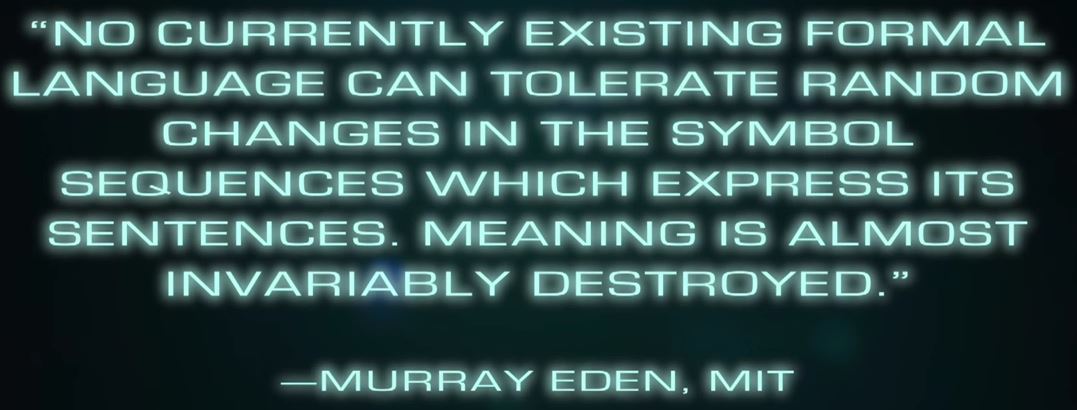
  • normally, random mutations tend to degrade the functionality of information, e.g. – randomly changing symbols in an applications code does not usually introduce useful new functions, it usually renders what is there non-functional
  • the majority of possible sequences will NOT have functions, so random mutations will more likely give you non-functional code, rather than functional code
  • example: a bicycle lock  with 4 numbers has many possible sequences for the 4 numbers, and only one of them has unlock functionality, the rest have no functionality
  • if you have lots of time, then you might be able to guess the combination, but if the lock as has 10 billion numbers, and only one combination that unlocks, you can spend your whole life trying to unlock it and won’t succeed
  • how likely is it to arrive at a functional protein or gene by chance? Is it more like the 4-dial lock (can be done with lots of time) or the 10 billion dial lock (amount of time required exceeds the time available)?
  • the probability is LOW because there is only one sequence of numbers that has unlock function
  • consider a short protein of 150 amino acids has 10 to the 195th power possible sequences
  • if many of these sequences of amino acides had biological function, then it might be easier to get to one by random mutation and selection than it is with a lock that only unlocks for ONE sequence
  • how many of the possible sequences have biological function?
  • Thanks to research done by Douglas Axe, we now know that the number of functional amino acid sequences for even a short protein is incredibly small…
  • Axe found that the odds of getting a functional sequence of amino acids that will fold and have biological function is 1 in 10 to the 77th power
  • Is that number too improbable to reach by chance? well, there are 10 to 65th atoms in the entire Milky Way galaxy… so yes, this is a very improbable outcome
  • can random genetic mutations search through all the sequences in order to find the one in 10 to the 77th power one that has biological function? It depends on how much guessers we have and how many guesses we get in the time available
  • even with the entire 3.5 billion year history of life on Earth, only about 10 to the 40th organisms have ever lived, which far smaller fraction of the 10 to the 77th total sequences
  • even with a very fast mutation rate, you would not be able to reach a functional protein even with all that time, and even with all those organisms

I was once having a discussion with a woman about the research that Axe did at the Cambridge University lab. He published four articles in the Journal of Molecular Biology. I held out one of the papers to her and showed her the numbers. She said over and over “I hate the Discovery Institute! I hate the Discovery Institute!” Well, yeah, but you can’t make the Journal of Molecular Biology go away with hating the Discovery Institute. JMB is peer-reviewed, and this was experimental evidence – not a theory, not a hypothesis.

We have been blessed by the Creator and Designer of the universe in this time and place with overwhelming evidence – an abundance of riches. For those who have an open mind, this is what you’ve been waiting for to make your decision. For the naturalists who struggle so mightily to block out the progress of experimental science, they’ll need to shout louder and shut their eyes tighter and push harder to block their ears. Maybe if they keep screaming “Star Trek” and “Star Wars” over and over to themselves, they will be able to ignore the real science a little longer.
New study: birds are as intelligent as macaques and other mammals

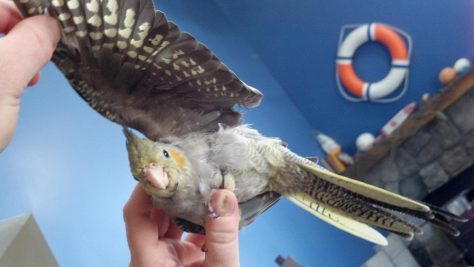
Cockatiel lets a trusted friend see her wing
Female cockatiel lets a trusted friend spread her wing for inspection

Evolution News reports on a new study about my favorite creatures of all: birds!

It says:

Next time someone calls you a birdbrain, smile and say “thank you.” Our feathered friends come well equipped with hardware and software for complex behaviors. A new study published in the Proceedings of the National Academy of Sciences puts birds on par with macaques and other mammals, and even suggests they can think.

Here’s what the news from Vanderbilt University says about the results of a detailed study by researchers primarily from the University of Prague, with additional team members from Austria, Brazil, and the United States:

The macaw has a brain the size of an unshelled walnut, while the macaque monkey has a brain about the size of a lemon. Nevertheless, the macaw has more neurons in its forebrain — the portion of the brain associated with intelligent behavior — than the macaque.

That is one of the surprising results of the first study to systematically measure the number of neurons in the brains of more than two dozen species of birds ranging in size from the tiny zebra finch to the six-foot-tall emu, which found that theyconsistently have more neurons packed into their small brainsthan are stuffed into mammalian or even primate brains of the same mass. [Emphasis added.]

How is this possible? The answer includes miniaturization and efficient packaging:

That is possible because the neurons in avian brains are much smaller and more densely packed than those in mammalian brains, the study found. Parrot and songbird brains, for example, contain about twice as many neurons as primate brains of the same mass and two to four times as many neurons as equivalent rodent brains.

Not only are neurons packed into the brains of parrots and crows at a much higher density than in primate brains, but the proportion of neurons in the forebrain is also significantly higher, the study found.

The scientists note that even despised birds like pigeons show much the same brain power. Powered flight, obviously, takes a lot of hardware and software to operate in any bird; how much so in the supreme flyers Illustra Media showed in Flight: The Genius of Birds: starlings, Arctic terns, and especially the tiny hummingbirds? […]The small heads of birds belie the observations of complex behaviors they perform.

But it’s not just routine tasks the brains must perform. Some birds can remember where they stored hundreds of seeds. Birds have been observed to hide a seed while another bird is watching, then move it when the neighbor is gone — indicative of a possible ‘theory of mind’ that shows planning and recognizing what the other bird is thinking.

The study provides a straightforward answer to a puzzle that comparative neuroanatomists have been wrestling with for more than a decade: how can birds with their small brains perform complicated cognitive behaviors?

The conundrum was created by a series of studies beginning in the previous decade that directly compared the cognitive abilities of parrots and crows with those of primates. The studies found that the birds could manufacture and use tools, use insight to solve problems, make inferences about cause-effect relationships,recognize themselves in a mirror and plan for future needs, among other cognitive skills previously considered the exclusive domain of primates.

Indeed, crows have shown the ability to solve a puzzle made famous in an Aesop’s fable (Reuters): dropping stones in a pitcher to raise the water level in order to get a drink. New Caledonian crows have shown the ability to use three tools in succession to reach a food source (BBC News). Owners of parrots know the cleverness of their pets; their ability to mimic human speech and singing is astonishing. Some cockatiels can even do the Riverdance.

I love cockatiels and green cheek conures, they are my absolute favorite birds. Absolutely adorable creatures!

Anyway, the rest of the Evolution News post notes that this intelligence is a problem for naturalistic evolution. Specifically, it’s a convergence problem – the same capabilities being evolved independently, without recent shared common ancestry. How can birds and mammals, who don’t share recent common ancestors, have evolved the same capabilities, e.g. – vocal learning pathways, by chance? There is an explanation that does explain the observations, however – common designs made by a single designer.

Related posts

New study: DNA requires maintenance from surrounding cell

Christianity and the progress of science

My friend Bruce shared this post from Reasons to Believe about some recent research on DNA.

Naturalists like to argue that DNA somehow came into existence randomly, but it turns out that not only is DNA marvelously improbable for even the simplest living organism, but it also requires a lot of support from other areas of the cell in order to remain stable.

It says:

In 2015, three scientists won the Nobel Prize in Chemistry for decades of research into DNA—research that reinforces the idea that evolution is mythology and makes the modern evolutionary theory of abiogenesis seem more and more indefensible. It turns out that DNA is inherently unstable, and the preservation of genetic information requires a complex symbiotic relationship between the cell and DNA that is so interdependent that neither could have arisen independently of the other.

DNA (deoxyribonucleic acid) is the giant organic molecule which carries and preserves an organism’s genetic information. DNA is essential to the growth and reproduction of life-forms because precise copying and self-replication of DNA is a critical part of the process of cell division.

Tomas Lindahl, the first Nobel laureate, has demonstrated that the rate at which DNA decays should have made the development of life on Earth impossible.1 The Nobel Committee expresses this on a personal level: “you ought to have been a chemical chaos long before you even developed into a foetus.”2

So why doesn’t our genetic material disintegrate into complete chemical chaos? It is because of molecular repair mechanisms within the cell. The three Nobel laureates “mapped, at a molecular level, how cells repair damaged DNA and safeguard the genetic information.”3 They found that a multitude of molecular systems constantly monitor the genome and repair any damage.

One such mechanism discovered by Lindahl is base excision repair, which explains why our DNA doesn’t collapse. A base of a nucleotide often loses an amino group and becomes unable to form a base pair, thus breaking the DNA chain. But an enzymedetects the error, and other enzymes repair it so that the DNA can replicate properly.

Paul Modrich, the second laureate, discovered another molecular mechanism calledmismatch repair. Replication errors often occur as the DNA is copied, but Modrich found that enzymes continually detect most of these errors, and other enzymes repair them. The Nobel Committee says this “reduces the error frequency during DNA replication by about a thousandfold.”4

One further issue that DNA must contend with is mutations, caused by DNA damage due to radiation and a variety of mutagenic substances. For example, radiation might make two base pairs bind to one another incorrectly. But the third laureate, Aziz Sancar, discovered that through a mechanism called nucleotide excision repair, enzymes will cut out, remove, and replace a damaged DNA strand.

We have long known that the cell could not reproduce without DNA, but we now know that DNA would self-destruct without the cell. It is this complex symbiotic relationship between a cell and its DNA that makes the modern evolutionary theory more difficult to defend.

[…]This research shows that for abiogenesis to occur, undirected, random processes must have anticipated the inherent instability of DNA and assembled the cell with the variety of enzymes necessary to prevent the self-destruction of DNA. Additionally, the cell’s chemistry, the self-preservation instinct, and anticipatory DNA repair mechanisms must have all come together at the same instant in time within only 1 billion years; otherwise, any nascent life could not have survived. If the probability barrier to evolution seemed like climbing Mount Improbable before, it has now become climbing Mount Impossible.

Could simple single-celled life-forms emerge and evolve into more complex life? Single-celled life-forms are not so simple. For example, the genome of an aerobic hyper-thermophilic crenarchaeon (a thermophilic archaea, a type of bacteria) consists of 1.7 billion base pairs, which is almost 60 percent of the 2.9 billion base pairs in thehuman genome.5

So, not only is it fantastically improbably to 1) get the building blocks of life, and 2) build the sequence of base pairs in DNA, but 3) you also have to have supporting systems to maintain the DNA in the cell: even more specified complexity.