Tag Archives: Intelligent Design

Harvard astrophysicist backs the Rare Earth hypothesis

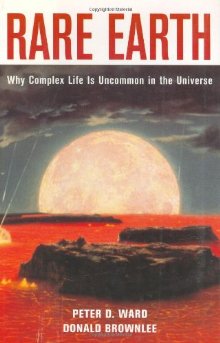
What is the Rare Earth hypothesis?

It’s the thesis of a recent book written by two scientists at the University of Washington.

Here’s the blurb:

What determines whether complex life will arise on a planet? How frequent is life in the Universe?

In this exciting new book, distinguished paleontologist Peter D. Ward and noted astronomer Donald Brownlee team up to give us a fascinating synthesis of what’s now known about the rise of life on Earth and how it sheds light on possibilities for organic life forms elsewhere in the Universe.

Life, Ward and Brownlee assert, is paradoxically both very common and almost nowhere. The conditions that foster the beginnings of life in our galaxy are plentiful. But contrary to the usual assumption that if alien life exists, it’s bound to be intelligent, the authors contend that the kind of complex life we find on Earth is unlikely to exist anywhere else; indeed it is probably unique to our planet.

With broad expertise and wonderful descriptive imagery, the authors give us a compelling argument, a splendid introduction to the emerging field of astrobiology, and a lively discussion of the remarkable findings that are being generated by new research. We learn not only about the extraordinary creatures living in conditions once though inimical to life and the latest evidence of early life on Earth, but also about the discoveries of extrasolar planets, the parts Jupiter and the Moon have played in our survival, and even the crucial role of continental drift in our existence.

Insightful, well-written, and at the cutting edge of modern scientific investigation, Rare Earth should interest anyone who wants to know about life elsewhere and gain a fresh perspective on life at home which, if the authors are right, is even more precious than we may ever have imagined.

And here’s a review by Library Journal:

“Renowned paleontologist Ward (Univ. of Washington), who has authored numerous books and articles, and Brownlee, a noted astronomer who has also researched extraterrestrial materials, combine their interests, research, and collaborative thoughts to present a startling new hypothesis: bacterial life forms may be in many galaxies, but complex life forms, like those that have evolved on Earth, are rare in the universe. Ward and Brownlee attribute Earth’s evolutionary achievements to the following critical factors: our optimal distance from the sun, the positive effects of the moon’s gravity on our climate, plate tectonics and continental drift, the right types of metals and elements, ample liquid water, maintainance of the correct amount of internal heat to keep surface temperatures within a habitable range, and a gaseous planet the size of Jupiter to shield Earth from catastrophic meteoric bombardment. Arguing that complex life is a rare event in the universe, this compelling book magnifies the significance — and tragedy — of species extinction. Highly recommended for all public and academic libraries.”

Note that Peter Ward is a militant atheist (he has debated against Stephen C. Meyer), and Donald Brownlee is an agnostic. These are not Christians, nor are they even theists. However, I have the book, I have read the book, and I recommend the book. I usually have this book on my shelf at work for show-and-tell.

Now for the latest news about the hypothesis of the book. (H/T Brian Auten of Apologetics 315)

There are always going to be optimistic predictions by scientists who need to attract research funding, but those are hopes and speculations. The data we have today says Earth is rare. The number of conditions required for complex life of any kind is too high for us to be optimistic about alien life in this galaxy, at least. And as the number of requirements for life roll in, the odds of finding alien life that can contact us get slimmer and slimmer.

From the UK Daily Mail. (H/T Peter S. Williams)

Excerpt:

Dr Howard Smith, a senior astrophysicist at Harvard University, believes there is very little hope of discovering aliens and, even if we did, it would be almost impossible to make contact.

So far astronomers have discovered a total of 500 planets in distant solar systems – known as extrasolar systems – although they believe billions of others exist.

But Dr Smith points out that many of these planets are either too close to their sun or too far away, meaning their surface temperatures are so extreme they could not support life.

Others have unusual orbits which cause vast temperature variations making it impossible for water to exist as a liquid – an essential element for life.

Dr Smith said: ‘We have found that most other planets and solar systems are wildly different from our own.

‘They are very hostile to life as we know it.’

‘The new information we are getting suggests we could effectively be alone in the universe.

‘There are very few solar systems or planets like ours. It means it is highly unlikely there are any planets with intelligent life close enough for us to make contact.’ But his controversial suggestions contradict other leading scientists – who have claimed aliens almost certainly exist.

These arguments are actually quite useful, and I include them in my standard list of scientific arguments for theism. (See below) You have to know this stuff cold. Most people believe in aliens because they watched movies made by artists. As a result, they think that humans are nothing special and that God is not interested in us in particular. Which is very convenient for them, because it means they can do whatever they want and not care what God thinks about what they are doing. If you want to defend against the idea that humans are nothing special, and that we were not placed here for a purpose, and that we are not accountable and obligated to seek and know the Creator/Designer, then you’ll need more than feelings. You’ll need science. You’ll need the best science available.

Related posts

Do you ever wish that your co-workers took your faith seriously?

This is a problem that I used to have in the very beginning of my career, when I was still doing my undergraduate degree and working summer jobs and internships with software development companies. I was just in my early 20s, and was having to deal with being a Christian in the university and in the workplace. It’s very difficult to do it when you are young – everyone thinks that they know more than you do just because they are older – whether they have studied the issues or not. Not only that, but you have deal with the pre-conceptions that people have about Christianity from watching anti-Christian movies and televangelists, etc.

What a mess. So what is the way forward?

The way forward is for you to take Christianity OUT of the realm of private faith, Sunday singing, emotions and feelings, personal testimony, miraculous healings, apparations (if you’re Catholic), end times, Bible prophecies, and other stuff that scares non-Christians. And then you put Christianity INTO the realm of science, history, analytical philosophy, social science, economics, politics, law, and other public, testable, areas of knowledge.

After you’ve studied Chrsitianity and how it relates to public, testable areas of knowledge, it is easy to communicate your knowledge of things like the galactic habitability constraints, amino acid sequence specificity probabilities, minimal facts criteria for the historicity of the empty tomb, the grounding objection to middle knowledge, and the Laffer curve to other people. You are an expert at dumping the burden of proof on your opponent, every attempt by your opponent to make self-refuting statements is met with a whistle blow and a yellow card, and you wield Occam’s Razor like a samurai warrior.

Great! It all works great on people who will give you an hour at lunch to listen to your case. But what about the people who have heard through the grapevine that you are a Christian, identify you with Joel Osteen, and are snickering at you behind your back every time you walk by?

Decorating your cube at work

The solution is to decorate your cube at work.

Here is what you will need:

  1. a peer-reviewed paper on from a scientific journal (like this one, free version here)
  2. a peer-reviewed paper on from a social science journal (like this one)
  3. a news article on some foreign policy issue (like this one)
  4. a publication from a think tank on economic or social policy (like this one)
  5. a textbook on economics (like this one)
  6. a schedule of events from an apologetics event (like this one)
  7. a DVD of a William Lane Craig debate at a big university (like this one)
  8. a debate book from a big academic press (like this one)

Just print these out and read them, and then put them on your desk. That should get you some attention and end the snickering.

Ho-hum… more pro-intelligent design peer-reviewed papers

I read Evolution News when I need to feel sleepy. It’s always the same old thing… more peer-reviewed papers friendly to intelligent design being published in more prestigious science journals. (Yawn!) Time for me to go to bed. So sleepy…

Here’s the first one:

A peer-reviewed scientific paper published in 2010 by William Dembski and Robert Marks of the Evolutionary Informatics Lab supports no free lunch theorems. Published in Journal of Advanced Computational Intelligence and Intelligent Informatics and titled “The Search for a Search: Measuring the Information Cost of Higher Level Search,” the paper’s abstract states that unless one has information about a target, search engines often fail: “Needle-in-the-haystack problems look for small targets in large spaces. In such cases, blind search stands no hope of success.” Their principle of Conservation of Information holds that “any search technique will work, on average, as well as blind search.” However, in such a case “[s]uccess requires an assisted search. But whence the assistance required for a search to be successful?”

Dembski and Marks thus argue that “successful searches do not emerge spontaneously but need themselves to be discovered via a search.” However, without information about the target, the search for a search itself is still no better than a blind search:

We prove two results: (1) The Horizontal No Free Lunch Theorem, which shows that average relative performance of searches never exceeds unassisted or blind searches, and (2) The Vertical No Free Lunch Theorem, which shows that the difficulty of searching for a successful search increases exponentially with respect to the minimum allowable active information being sought.The implication of course, is that without the ultimate input from an intelligent agent–active information–such searches will fail.

Booooring.

Here’s an excerpt from another one:

The remarkable properties of water are numerous. Its very high specific heat maintains relatively stable temperatures both in oceans and organisms. As a liquid, its thermal conductivity is four times any other common liquid, which makes it possible for cells to efficiently distribute heat. On the other hand, ice has a low thermal conductivity, making it a good thermal shield in high latitudes. A latent heat of fusion only surpassed by that of ammonia tends to keep water in liquid form and creates a natural thermostat at 0°C. Likewise, the highest latent heat of vaporization of any substance – more than five times the energy required to heat the same amount of water from 0°C-100°C – allows water vapor to store large amounts of heat in the atmosphere. This very high latent heat of vaporization is also vital biologically because at body temperature or above, the only way for a person to dissipate heat is to sweat it off.Water’s remarkable capabilities are definitely not only thermal. A high vapor tension allows air to hold more moisture, which enables precipitation. Water’s great surface tension is necessary for good capillary effect for tall plants, and it allows soil to hold more water. Water’s low viscosity makes it possible for blood to flow through small capillaries. A very well documented anomaly is that water expands into the solid state, which keeps ice on the surface of the oceans instead of accumulating on the ocean floor. Possibly the most important trait of water is its unrivaled solvency abilities, which allow it to transport great amounts of minerals to immobile organisms and also hold all of the contents of blood. It is also only mildly reactive, which keeps it from harmfully reacting as it dissolves substances. Recent research has revealed how water acts as an efficient lubricator in many biological systems from snails to human digestion. By itself, water is not very effective in this role, but it works well with certain additives, such as some glycoproteins. The sum of these traits makes water an ideal medium for life. Literally, every property of water is suited for supporting life. It is no wonder why liquid water is the first requirement in the search for extraterrestrial intelligence.

All these traits are contained in a simple molecule of only three atoms. One of the most difficult tasks for an engineer is to design for multiple criteria at once. … Satisfying all these criteria in one simple design is an engineering marvel. Also, the design process goes very deep since many characteristics would necessarily be changed if one were to alter fundamental physical properties such as the strong nuclear force or the size of the electron.

(D. Halsmer, J. Asper, N. Roman, T. Todd, “The Coherence of an Engineered World,” International Journal of Design & Nature and Ecodynamics, Vol. 4(1):47-65 (2009) (internal citations removed).)

And it’s only Wednesday.

UPDATE: It’s Thursday morning, so that means another peer-reviewed scientific publication supporting ID.

UPDATE: It’s Thursday afternoon, so that means another peer-reviewed scientific publication supporting ID.