Tag Archives: Intelligent Cause

Is the argument for intelligent design based on ignorance?

From Uncommon Descent. (IC = irreducible complexity, FSCI = functional specific complex information)

Excerpt:

First, ID is not, as its opponents suggest, a purely negative argument that material forces are insufficient to account for IC and FSCI.  At its root ID is an abductive conclusion (i.e., inference to best explanation) concerning the data.  This conclusion may be stated in summary as follows:

1.  Living things display IC and FSCI.

2.  Material forces have never been shown to produce IC and FSCI.

3.  Intelligent agents routinely produce IC and FSCI.

4.  Therefore, based on the evidence that we have in front of us, the best explanation for the presence of IC and FSCI in living things is that they are the result of acts of an intelligent agent.

The second reason the “argument from ignorance” objection fails is that the naysayers’ assertion that ID depends on an “absence of evidence” is simply false.  In fact, ID rests on evidence of absence.  In his Introduction to Logic Irving Marmer Copi writes of evidence of absence as follows:

In some circumstances it can be safely assumed that if a certain event had occurred, evidence of it could be discovered by qualified investigators. In such circumstances it is perfectly reasonable to take the absence of proof of its occurrence as positive proof of its non-occurrence.

How does this apply to the Neo-Darwinian claim that undirected material forces can produce IC and FSCI?  Charles Darwin published Origin of Species in 1859.  In the 152 years since that time literally tens of thousands of highly qualified investigators have worked feverishly attempting to demonstrate that undirected material forces can produce IC and FSCI.  They have failed utterly.

Has there been a reasonable investigation by qualified investigators?  By any fair measure there has been.  Has that 152 year-long investigation shown how undirected material forces can account for IC or FSCI?  It has not.

Therefore, simple logic dictates that “it is perfectly reasonable to take the absence of proof” that undirected material forces can account for IC and FSCI as “positive proof of its non-occurrence.”

The argument from intelligent design is based on what we know. The hope that biological information has a naturalistic cause is based on what we don’t know. As science progresses, the evidence for intelligent causes in biology becomes more clear.

Related posts

Stephen C. Meyer in FOUR John Ankerberg online videos

From Evolution News. (H/T Stephen C. Meyer)

Excerpt:

In four television episodes of the John Ankerberg Show broadcast across the US and over 200 nations worldwide, Dr. John Ankerberg interviewed Dr. Stephen C. Meyer, author of the groundbreaking book Signature in the Cell: DNA and the Evidence for Intelligent Design. The series will begin broadcasting on April 3 at 5:30pm EDT on the Daystar Network and on April 10 at 9:30pm EDT on the INSP Network.

In the interviews Dr. Meyer explains how even Charles Darwin, in his book The Origin of Species, admitted he did not know how the first cell came into being, or how life came to be.

Scientists in Darwin’s day thought the cell was a simple glob of plasm, but today we have discovered that the cell is an almost unimaginably complex system of molecular machines and rich in digital code.

Where did this high-tech in low life come from? Ankerberg and Meyer explore the mystery surrounding this question, which Meyer calls the DNA enigma. Click on the links below to watch full episodes of the show online!

  • Week 1: Every person’s body consists of over a trillion cells. Almost every one of these cells includes a DNA molecule. What is DNA? Why is it so special? What does it do? Where did the digital code embedded in DNA originate? Why does the specified information in DNA point to a designing intelligence?
  • Week 2: As scientific technology has progressed, scientists have realized the cell is more and more complex. According to Microsoft’s Bill Gates, the DNA within each cell is far more complex than any computer software ever created. Where did the coded information within DNA come from? What naturalistic theories have been proposed? What is the possibility of the precise genetic information in DNA evolving by chance?
  • Week 3: In addition to chance, scientists have offered other answers to the origin of the precise genetic information found in DNA. Why is it that natural selection, self-organizing natural laws, or some combination of these with chance cannot explain where the information originated? We’ll also see why DNA exhibits signs of a designing intelligence.
  • Week 4: What is the scientific theory of Intelligent Design (ID)? Is ID true science or just religion masquerading as science? We’ll also answer the objections to ID such as, “Is ID just an argument from ignorance?” (“We don’t know what the naturalistic causes are right now for the origin of life.”) We’ll also see why ID is based on scientific reasoning but may have larger religious implications.

And Meyer is not making this up. This is the state of science today.

From Scientific American.

Excerpt:

As recently as the middle of the 20th century, many scientists thought that the first organisms were made of self-replicating proteins. After Francis Crick and James Watson showed that DNA is the basis for genetic transmission in the 1950s, many researchers began to favor nucleic acids over proteins as the ur-molecules. But there was a major hitch in this scenario. DNA can make neither proteins nor copies of itself without the help of catalytic proteins called enzymes. This fact turned the origin of life into a classic chicken-or-egg puzzle: Which came first, proteins or DNA?

RNA, DNA’s helpmate, remains the most popular answer to this conundrum, just as it was when I wrote “In the Beginning…” Certain forms of RNA can act as their own enzymes, snipping themselves in two and splicing themselves back together again. If RNA could act as an enzyme, then it might be able to replicate itself without help from proteins. RNA could serve as gene and catalyst, egg and chicken.

But the “RNA-world” hypothesis remains problematic. RNA and its components are difficult to synthesize under the best of circumstances, in a laboratory, let alone under plausible prebiotic conditions. Once RNA is synthesized, it can make new copies of itself only with a great deal of chemical coaxing from the scientist. Overbye notes that “even if RNA did appear naturally, the odds that it would happen in the right sequence to drive Darwinian evolution seem small.”

The RNA world is so dissatisfying that some frustrated scientists are resorting to much more far out—literally—speculation. The most startling revelation in Overbye’s article is that scientists have resuscitated a proposal once floated by Crick. Dissatisfied with conventional theories of life’s beginning, Crick conjectured that aliens came to Earth in a spaceship and planted the seeds of life here billions of years ago. This notion is called directed panspermia. In less dramatic versions of panspermia, microbes arrived on our planet via asteroids, comets or meteorites, or drifted down like confetti.

John Horgan is not a Christian, nor even a theist. The origin of life is not explainable on the basis on unintelligent causes. But it is perfectly explainable as the result of intelligent causes. Just like the sequence of letters arranged in this blog post to have meaning are best explained as the result of an intelligence.

Can intelligent design be front-loaded at the creation of the universe?

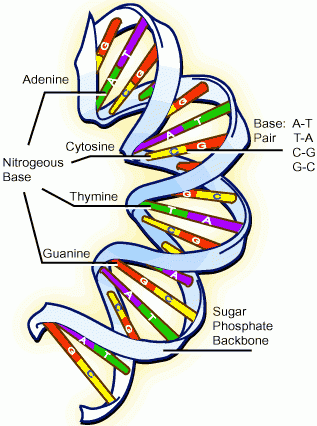
Structure of DNA
Structure of DNA

This video introduction to intelligent design packs a lot of information into a very small video. (H/T Brian Auten from Apologetics 315)

When it comes to the science of DNA, theistic evolutionists and atheists agree: matter, law and chance are sufficient to evolve DNA. No intelligence is needed to sequence the base pairs or the amino acids. That agreement that intelligent causes are not needed to explain DNA is why I call theistic evolution “functional atheism”.

Theistic evolutionists express subjective opinions about God that no one can investigate using science. These untestable opinions about God are similar to the opinions of little children about Santa Claus. And yet they insist that they be taken seriously alongside the people who actually think Christianity is objective knowledge, not subjective opinion.

To defuse a theistic evolutionist, simply ask them for  fully materialistic and naturalistic explanation for the first living organism – the origin of life. And then watch how they avoid answering the question. For even Richard Dawkins has no idea how life could begin, if only purely naturalistic, materialistic causes are allowed in the explanation.

Theistic evolutionists hate talking about evidence. They want to talk their private feelings and beliefs and experiences in order to reassure you that they are just like you. Don’t let them talk about religion – stick to what science can show. Demand evidence that the material processes can do the creating that the theistic evolutionists think that material processes can do.

Here’s an easy article that you can read that explains a bit more about what the video discussed. Here is one is a bit more difficult. These are mentoring articles for Christians.

If you want to read some serious research, then read this post and listen to this interview which are both about the work of Doug Axe.