
Tag Archives: Information

Does intelligent design commit the “God-of-the-gaps” fallacy?

Stephen C. Meyer explains, with reference to his newest book “Darwin’s Doubt”. He is responding to a critical review of the book published in Science.

Here’s the relevant part of the review:

Meyer’s scientific approach is purely negative. He argues that paleontologists are unable to explain the Cambrian explosion, thus opening the door to the possibility of a designer’s intervention. This, despite his protest to the contrary, is a (sophisticated) “god of the gaps” approach, an approach that is problematic in part because future developments often provide solutions to once apparently difficult problems.

And here’s part of Meyer’s response:

[B]y claiming that my approach is a purely negative one based solely upon “gaps” in our knowledge or in the evolutionary account of the Cambrian explosion, Marshall implies that Darwin’s Doubt makes a fallacious kind of argument known to logicians as an “argument from ignorance.” Arguments from ignorance occur when evidence against a proposition X is offered as the sole (and conclusive) grounds for accepting some alternative proposition Y. Arguments from ignorance make an obvious logical error. They omit a necessary kind of premise, a premise providing positive support for the conclusion, not just negative evidence against an alternative conclusion. In an explanatory context, arguments from ignorance have the form:

Premise One: Cause X cannot produce or explain evidence E.

Conclusion: Therefore, cause Y produced or explains E.

Critics of intelligent design often claim that the case for intelligent design commits this fallacy. They claim that design advocates use our present ignorance of any materialistic cause of specified or functional information (for example) as the sole basis for inferring an intelligent cause for the origin of such information in biological systems. For example, Michael Shermer represents the case for intelligent design as follows: “Intelligent design … argues that life is too specifically complex (complex structures like DNA) … to have evolved by natural forces. Therefore, life must have been created by. . . an intelligent designer.” In short, Shermer claims that ID proponents argue as follows:

Premise: Materialistic causes or evolutionary mechanisms cannot produce novel biological information.

Conclusion: Therefore, an intelligent cause produced specified biological information.

Marshall echoes Shermer’s criticism. But the inference to design as developed in Darwin’s Doubt does not commit this fallacy.

Why not? Because it argues that the best explanation of an effect in nature – new information -is an intelligent cause, and that we are familiar with how these intelligent causes operate already.

More:

[T]he book makes a positive case for intelligent design as an inference to the best explanation for the origin of the genetic (and epigenetic) information necessary to produce the first forms of animal life (as well as other features of the Cambrian animals such as the presence of genetic regulatory networks that function as integrated circuits during animal development). It advances intelligent design as the best explanation not only because many lines of evidence now cast doubt on the creative power of unguided evolutionary mechanisms, but also because of our positive, experience-based knowledge of the powers that intelligent agents have to produce as digital and other forms of information as well as integrated circuitry. As I argue in Chapter 18 of Darwin’s Doubt:

Intelligent agents, due to their rationality and consciousness, have demonstrated the power to produce specified or functional information in the form of linear sequence-specific arrangements of characters. Digital and alphabetic forms of information routinely arise from intelligent agents. A computer user who traces the information on a screen back to its source invariably comes to a mind — a software engineer or programmer. The information in a book or inscription ultimately derives from a writer or scribe. Our experience-based knowledge of information flow confirms that systems with large amounts of specified or functional information invariably originate from an intelligent source. The generation of functional information is “habitually associated with conscious activity.” Our uniform experience confirms this obvious truth.

Thus, the inadequacy of proposed materialistic evolutionary causes or mechanisms forms only part of the basis of the argument for intelligent design. We also know from broad and repeated experience that intelligent agents can and do produce information-rich systems and integrated circuitry. We have positive experience-based knowledge of a cause sufficient to generate new specified information and integrated circuitry, namely, intelligence. We are not ignorant of how information or circuitry arises. We know from experience that conscious, rational agents can create such information-rich structures and systems. To again quote information theorist Henry Quastler: “creation of new information is habitually associated with conscious activity.” Indeed, whenever large amounts of specified or functional information are present in an artifact or entity whose causal story is known, invariably creative intelligence — intelligent design — played a role in the origin of that entity. Thus, when we encounter a large discontinuous increase in the functional information content of the biosphere as we do in the Cambrian explosion, we may infer — based on our knowledge of established cause-effect relationships — that a purposive intelligence operated in the history of life to produce the functional information necessary to generate those forms of animal life.

Instead of exemplifying a fallacious form of argument in which design is inferred solely from a negative premise, the argument for intelligent design formulated in Darwin’s Doubt takes the following form:

Premise One: Despite a thorough search and evaluation, no materialistic causes or evolutionary mechanisms have demonstrated the power to produce large amounts of specified or functional information (or integrated circuitry).

Premise Two: Intelligent causes have demonstrated the power to produce large amounts of specified/functional information (and integrated circuitry).

Conclusion: Intelligent design constitutes the best, most causally adequate, explanation for the specified/functional information (and circuitry) that was necessary to produce the Cambrian animals.

I do think it’s very important for Christians to make their case for God based on the progress of science.

If you are going to argue for God, you want to use arguments like these:

  1. origin of the universe
  2. cosmic fine-tuning
  3. origin of life building blocks
  4. biological information at origin of life
  5. biological information at Cambrian explosion
  6. galactic fine-tuning
  7. stellar fine-tuning
  8. observed limits to mutation-driven change
  9. mental effort studies
  10. corroborated NDEs

And so on.

Each of these arguments is based on what we know about nature. They are not based on gaps in our knowledge at all. The more we do science, the more evidence we get for each argument. For example, at one point we only had redshift for the beginning of the universe (#1), but then we added light element abundance predictions and the cosmic microwave background radiation. For the cosmic fine-tuning (#2), we started with the fine-tuning of gravity, and then added more examples, like the cosmological constant. In each case, the continuous progress of science strengthened the need for a Creator/Designer. The more we know from science about how nature works, the stronger the case for Christian theism gets.

It’s the atheists who are now taking refuge in the gaps and holding out speculations as a way of maintaining their atheism against the science. It’s the atheists who are hoping for aliens, multiverses, undiscovered fossils, and so on. There is no God-of-the-Gaps anymore. There’s only Atheism-of-the-Gaps.
Obamacare web site hides health insurance costs until users apply for subsidies

Another article from health care policy expert Avik Roy in Forbes magazine.

Excerpt:

A growing consensus of IT experts, outside and inside the government, have figured out a principal reason why the website for Obamacare’s federally-sponsored insurance exchange is crashing. Healthcare.gov forces you to create an account and enter detailed personal information before you can start shopping. This, in turn, creates a massive traffic bottleneck, as the government verifies your information and decides whether or not you’re eligible for subsidies. HHS bureaucrats knew this would make the website run more slowly. But they were more afraid that letting people see the underlying cost of Obamacare’s insurance plans would scare people away.

“Healthcare.gov was initially going to include an option to browse before registering,” report Christopher Weaver and Louise Radnofsky in the Wall Street Journal. “But that tool was delayed, people familiar with the situation said.” Why was it delayed? “An HHS spokeswoman said the agency wanted to ensure that users were aware of their eligibility for subsidies that could help pay for coverage, before they started seeing the prices of policies.” (Emphasis added.)

As you know if you’ve been following this space, Obamacare’s bevy of mandates, regulations, taxes, and fees drives up the cost of the insurance plans that are offered under the law’s public exchanges. AManhattan Institute analysis I helped conduct found that, on average, the cheapest plan offered in a given state, under Obamacare, will be 99 percent more expensive for men, and 62 percent more expensive for women, than the cheapest plan offered under the old system. And those disparities are even wider for healthy people.

That raises an obvious question. If 50 million people are uninsured today, mainly because insurance is too expensive, why is it better to make coverage even costlier?

The answer is that Obamacare wasn’t designed to help healthy people with average incomes get health insurance. It was designed to force those people to pay more for coverage, in order to subsidize insurance for people with incomes near the poverty line, and those with chronic or costly medical conditions.

But the laws’ supporters and enforcers don’t want you to know that, because it would violate the President’s incessantly repeated promise that nothing would change for the people that Obamacare doesn’t directly help. If you shop for Obamacare-based coverage without knowing if you qualify for subsidies, you might be discouraged by the law’s steep costs.

So, by analyzing your income first, if you qualify for heavy subsidies, the website can advertise those subsidies to you instead of just hitting you with Obamacare’s steep premiums. For example, the site could advertise plans that cost “$0″ or “$30″ instead of explaining that the plan really costs $200, and that you’re getting a subsidy of $200 or $170. But you’ll have to be at or near the poverty line to gain subsidies of that size; most people will either not qualify for a subsidy, or qualify for a small one that, net-net, doesn’t make up for the law’s cost hikes.

This political objective—masking the true underlying cost of Obamacare’s insurance plans—far outweighed the operational objective of making the federal website work properly. Think about it the other way around. If the “Affordable Care Act” truly did make health insurance more affordable, there would be no need to hide these prices from the public.

The plain truth of the matter is that you can’t lower the costs of health care by covering more people or by covering more treatments or by regulating more doctors. All of those things don’t lower the cost of health insurance – they raise it. The subsidies that the Democrats are offering are costs that are being added to the deficit. They will have to be paid by job creators and their employees through higher taxes later. Obamacare didn’t solve a thing. It just adds costs and complexity. It’s the equivalent of shuffling deck chairs on the Titanic.

Related posts

How many people have signed up for Obamacare?

The Weekly Standard reports.

Excerpt:

Treasury Secretary Jack Lew refused to answer Fox host Chris Wallace’s simple question this morning: How many people have signed up for Obamacare?

“I’m going to ask you one last time,” said Wallace, “because, forgive me sir, you haven’t answered it: do you not know how many people signed up, which would seem to indicate another major software glitch, or is it that the numbers are embarrassingly small?”

“Chris, our metric for this week was, could people get online, get the information they need to make an informed,” said Lew, sidestepping the straightforward question. “They have been getting that information. We are confident that they are going to make the decision — they have 6 months to make the decision.”

Wallace tried again: “So do you not know or is that the number is –”

“Well, it’s obviously not my primary area of responsibility,” said the treasury secretary.

I have a more important question. Why did we elect a community organizer to make health care policy?

Reuters says that the IT architecture for the web application stinks.

Excerpt:

Days after the launch of the federal government’s Obamacare website, millions of Americans looking for information on new health insurance plans were still locked out of the system even though its designers scrambled to add capacity.

[…]Five outside technology experts interviewed by Reuters, however, say they believe flaws in system architecture, not traffic alone, contributed to the problems.

[…]”Adding capacity sounds great until you realize that if you didn’t design it right that won’t help,” said Bill Curtis, chief scientist at CAST, a software quality analysis firm, and director of the Consortium for IT Software Quality. “The architecture of the software may limit how much you can add on to it. I suspect they’ll have to reconfigure a lot of it.”

[…]One possible cause of the problems is that hitting “apply” on HealthCare.gov causes 92 separate files, plug-ins and other mammoth swarms of data to stream between the user’s computer and the servers powering the government website, said Matthew Hancock, an independent expert in website design. He was able to track the files being requested through a feature in the Firefox browser.

[…]”They set up the website in such a way that too many requests to the server arrived at the same time,” Hancock said.

He said because so much traffic was going back and forth between the users’ computers and the server hosting the government website, it was as if the system was attacking itself.

Hancock described the situation as similar to what happens when hackers conduct a distributed denial of service, or DDOS, attack on a website: they get large numbers of computers to simultaneously request information from the server that runs a website, overwhelming it and causing it to crash or otherwise stumble. “The site basically DDOS’d itself,” he said.

[…]The government official blamed the glitch on massive traffic, but outside experts said it likely reflected programming choices as well.

Obama doesn’t know anything about software engineering. And all his appointees are radical leftist political hacks. Obama’s administration has the least private sector experience of any recent administration. These people have no idea how to design large-scale web applications. They outsourced the whole thing and it blew up in their faces.

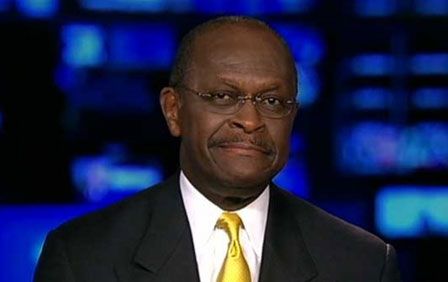
But do you know who does understand information technology? Someone with a Bachelor’s degree in mathematics and a Master’s degree in computer science from Purdue University would.

Presidential candidate Herman Cain

A while back, we had an opportunity to elect a software engineer who is also one of the country’s most successful businessmen – Herman Cain. His massive company had a huge IT infrastructure. But we didn’t vote for Herman Cain, we voted for Obama. If we had voted for Herman Cain, then IT would be leveraged successfully to support whatever government involvement in health care was appropriate. If you want software done right, then elect a software engineer. If you want to run the country like a successful business, elect a successful businessman.