
Tag Archives: Inflation

How well did Obama’s green jobs spending work out for taxpayers?

From Investor’s Business Daily.

Excerpt:

As solar panel manufacturer Solyndra was sliding into a long-predicted bankruptcy, Energy Department officials began negotiations with the company and two of its main investors about restructuring its $535 million loan to keep afloat the business that was supposed to be a good investment.

Under the restructuring agreement, Solyndra’s private investors were moved to the front of the line and taxpayers were put on the hook for at least the first $75 million if the company should default. Subordinating taxpayers to private investors in recovering loan money is an “apparent violation of the law,” according to Fred Upton, R-Mich., chairman of the House Energy and Commerce Committee.

During hearings last week, Rep. Steve Scalise, R-La., and other Republicans noted that the Energy Policy Act of 2005 says obligations, or loan guarantees, shall not be subordinated to other financing.

In other words, taxpayers get first dibs on any money recovered and private investors take a number.

Why was the Solyndra loan restructured in this way? Was it because a major donation bundler for President Obama’s 2008 campaign was also a principal investor in Solyndra? Is that why the administration ignored repeated warning’s of Solyndra’s insolvency?

A 2009 report by the Energy Department’s inspector general warned that DOE lacked the necessary quality control for the $38.6 billion loan-guarantee program. In July 2010, the Government Accountability Office said DOE had bypassed required steps for funding awards to five of 10 loan recipients.

[…]Solyndra was the third U.S. solar manufacturer to fail in a month. SpectraWatt Inc., a solar company backed by units of Intel Corp. and Goldman Sachs Group Inc., filed for bankruptcy protection Aug. 19, and Evergreen Solar filed Chapter 11 on Aug. 15.

Other failed companies receiving stimulus funds include Mountain Plaza Inc., which took $424,000 in grants to install “truck stop electrification systems” so truckers could plug in and shut off their idling diesel engines, and Olsen’s Crop Service and Olsen’s Acquisition Co., which were handed $10 million.

[…]The administration claims that as a whole this loan guarantee program, which was supposed to create 65,000 jobs, was a success, creating or “saving” some 44,000 jobs. An analysis by the Washington Post says the actual number of permanent jobs created is 3,545.

[…]Even if you accept the administration’s questionable job accounting, divide the $38.6 billion by 65,000 and ask yourself if the administration is spending your money wisely — or honestly.

The Obama administration has already spent about half of the 38.6 billion set aside for Democrat cronies. I mean green energy. If you divide 17.5 billion by 3,545 jobs created, that’s $5 million per job. That’s sound Democrat fiscal policy. Bible-thumping morons like Sarah Palin and Michele Bachmann could never think of intelligent policies like spending $5 million per job created. To get to that level of intelligence, you need to have degrees from Columbia and Harvard Law School (grades never released). And to vote for Obama’s policies, you need to be smart enough to watch the Jon Stewart and Stephen Colbert on the Comedy Channel, and think that it’s news.

So we took billions of dollars out of the private economy, in order to punish those evil oil companies and coal companies, and we spent it on magic beans – sold to us by Obama’s Democrat cronies. Instead of lowering energy prices, Obama’s policies have resulted in higher energy prices. Was this unexpected?

Actually, for anyone who was paying attention, Obama made clear that he was OK with higher energy prices before he was elected in 2008.

And that’s what we got:
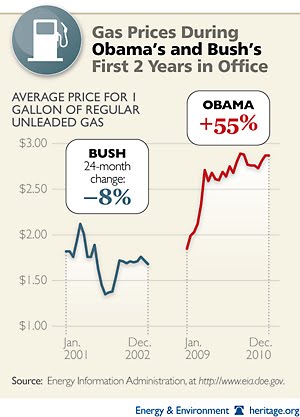
Gas Prices under Obama and Bush

Only two kinds of people voted for Obama in 2008 – the people who were informed about Obama’s record by watching Ed Schultz and Rachel Maddow on MSNBC, and the people who were about to receive stimulus grants for the green energy companies. The people who think that Michael Moore tells the truth about health care, and that Al Gore is an authority on climate science. The people who think that the New York Times is unbiased news.

Thomas Sowell explains the historical effects of tax cuts

Thomas Sowell
Thomas Sowell

Here’s part 1 of 3.

Excerpt:

The actual results of the cuts in tax rates in the 1920s were very similar to the results of later tax-rate cuts during the Kennedy, Reagan and George. W. Bush administrations — namely, rising output, rising employment to produce that output, rising incomes as a result and rising tax revenues for the government because of the rising incomes, though the tax rates had been lowered.

Another consequence was that people in higher-income brackets paid not only a larger total amount of taxes, but a higher percentage of all taxes, after what were called “tax cuts for the rich.” It was not simply that their incomes rose, but that this was not taxable income, since the lower tax rates made it profitable to get higher returns outside of tax shelters.

The facts are unmistakably plain, for those who bother to check the facts. In 1921, when the tax rate on people making over $100,000 a year was 73%, the federal government collected a little over $700 million in income taxes, of which 30% was paid by those making over $100,000.

[…]By 1929, after a series of tax-rate reductions had cut the tax rate to 24% on those making over $100,000, the federal government collected more than a billion dollars in income taxes, of which 65% was collected from those making over $100,000.

There is nothing mysterious about this. Under the sharply rising tax rates during the Wilson administration, fewer and fewer people reported high taxable incomes, whether by putting their money into tax-exempt securities or by any of the other ways of rearranging their financial affairs to minimize their tax liability.

Under Wilson’s escalating income-tax rates to pay for the high costs of the First World War, the number of people reporting taxable incomes of more than $300,000 — a huge sum in the money of that era — declined from well over a thousand in 1916 to fewer than three hundred in 1921. The total amount of taxable income earned by people making over $300,000 declined by more than four-fifths in those years.

Secretary Mellon estimated in 1923 that the money invested in tax-exempt securities had tripled in a decade, and was now almost three times the size of the federal government’s annual budget and nearly half as large as the national debt. “The man of large income has tended more and more to invest his capital in such a way that the tax collector cannot touch it,” he pointed out.

Getting that money moved out of tax shelters was the whole point of Mellon’s tax-cutting proposals. He also said: “It is incredible that a system of taxation which permits a man with an income of $1,000,000 a year to pay not one cent to the support of his government should remain unaltered.”

Here’s part 2 of 3.

Excerpt:

Empirical evidence on what happened to the economy in the wake of those tax cuts in four different administrations over a span of more than 80 years has also been largely ignored by those opposed to what they call “tax cuts for the rich.”

Confusion between reducing tax rates on individuals and reducing tax revenues received by the government has run through much of these discussions over these years.

Famed historian Arthur M. Schlesinger Jr., for example, said that although Andrew Mellon, secretary of the treasury from 1921 to 1932, advocated balancing the budget and paying off the national debt, he “inconsistently” sought “reduction in tax rates.”

Nor was Schlesinger the only highly regarded historian to perpetuate economic confusion between tax rates and tax revenues. Today, widely used textbooks by various well-known historians have continued to misstate what was advocated in the 1920s and what the actual consequences were.

According to the textbook “These United States” by Irwin Unger, Mellon, “a rich Pittsburgh industrialist,” persuaded Congress to “reduce income tax rates at the upper-income levels while leaving those at the bottom untouched.”

Thus “Mellon won further victories for his drive to shift more of the tax burden from the high-income earners to the middle and wage-earning classes.”

But hard data show that, in fact, both the amount and the proportion of taxes paid by those whose net income was no higher than $25,000 went down between 1921 and 1929, while both the amount and the proportion of taxes paid by those whose net incomes were between $50,000 and $100,000 went up — and the amount and proportion of taxes paid by those whose net incomes were over $100,000 went up even more sharply.

And here’s part 3 of 3.

Excerpt:

President Kennedy, like Andrew Mellon decades earlier, pointed out that “efforts to avoid tax liabilities” make “certain types of less-productive activity more profitable than other more valuable undertakings” and “this inhibits our growth and efficiency.” Therefore the “purpose of cutting taxes” is “to achieve a more prosperous, expanding economy.”

“Total output and economic growth” were italicized words in the text of Kennedy’s address to Congress in January 1963, urging cuts in tax rates. Much the same theme was repeated yet again in President Reagan’s February 1981 address to a joint session of Congress, pointing out that “this is not merely a shift of wealth between different sets of taxpayers.”

Instead, basing himself on a “solid body of economic experts,” he expected that “real production in goods and services will grow.”

Even when empirical evidence substantiates the arguments made for cuts in tax rates, such facts are not treated as evidence relevant to testing a disputed hypothesis, but as isolated curiosities. Thus, when tax revenues rose in the wake of the tax-rate cuts made during the George W. Bush administration, the New York Times reported:

“An unexpectedly steep rise in tax revenues from corporations and the wealthy is driving down the projected budget deficit this year.”

Expectations, of course, are in the eye of the beholder. However surprising these facts may have been to the New York Times, they are exactly what proponents of reducing high tax rates have been expecting, not only from these particular tax rate cuts, but from similar reductions in high tax rates at various times going back more than three-quarters of a century.

It’s Thomas Sowell – the official economist of the Tea Party.

Is the Euro aggravating the European debt crisis?

ECM sent me this story from the liberal German newspaper “Der Spiegel”.

Here’s the thesis of the article:

In the past 14 months, politicians in the euro-zone nations have adopted one bailout package after the next, convening for hectic summit meetings, wrangling over lazy compromises and building up risks of gigantic dimensions.

For just as long, they have been avoiding an important conclusion, namely that things cannot continue this way. The old euro no longer exists in its intended form, and the European Monetary Union isn’t working. We need a Plan B.

Instead, those in responsible positions are getting bogged down in crisis management, as they seek to placate the public and sugarcoat the problems. They say that there is only a government debt crisis in a few euro countries but no euro crisis, citing as evidence the fact that the value of the European common currency has remained relatively stable against other currencies like the dollar.

But if it wasn’t for the euro, Greece’s debt crisis would be an isolated problem — one that was tough for the country, but easy for Europe to bear. It is only because Greece is part of the euro zone that Athens’ debts are a problem for all of its partners — and pose a threat to the common currency.

If the rest of Europe abandons Greece, the crisis could spin out of control, spreading from one weak euro-zone country to the next. Investors would have no guarantees that Europe would not withdraw its support from Portugal or Ireland, if push came to shove, and they would sell their government bonds. The prices of these bonds would fall and risk premiums would go up. Then these countries would only be able to drum up fresh capital by paying high interest rates, which would only augment their existing budget problems. It’s possible that they would no longer be able to raise any money at all, in which case they would become insolvent.

Well, the article talks about how economically productive counties like Germany are on the hook for the bailouts to underperforming countries like Greece and Portugal. That will happen unless Greece reverts to the drachma and stops dragging down the Euro. But the strong European countries are not the only source of bailout funds – there’s also the International Monetary Fund. And guess who funds them?

Consider this article by John Bolton in the New York Post.

Excerpt:

Most Americans had barely heard of the International Monetary Fund before the arrest of its managing director, Dominique Strauss-Kahn, for sexually assaulting a hotel housekeeper. Yet the race to replace him offers a chance to rethink everything about what the real American interest is in the IMF — including whether its continued existence is beneficial.

The top contenders for Strauss-Kahn’s job are French Finance Minister Christine Lagarde and Bank of Mexico Governor Agustin Carstens. Europeans have headed the IMF since its founding, as Americans have led the World Bank — prerogatives that Third World countries increasingly resent as vestiges of colonialism. Carstens’ candidacy is the most visible manifestation of this rising discontent.

[…]Europe is eager to keep the top IMF job not simply because of geographical chauvinism but because continued IMF assistance is critical to European Union efforts to bail out the fractured economic and fiscal system in Greece and several other EU countries. Lurking behind the bailout crisis is the EU’s growing panic over the viability of its currency, the euro. Having a sympathetic ear at the IMF’s pinnacle seems absolutely critical to protect Europe’s parochial interests.

What of America’s interests? We should have long ago resisted throwing our scarce resources, through the IMF or otherwise, into the sinkhole of defending the euro. The currency was always conceived to be as much a political statement as an economic policy: Its European proponents believed the euro would enhance Europe’s strength as an alternative and perhaps rival to America.

If the United States and a few other developed countries like Japan decide to break with Europe over this vote, the IMF’s voting system, based on world-wide economic strength, makes defeating Lagarde a real possibility.

Today’s IMF does little or nothing for US national interests, especially when we face enormous domestic economic challenges. Why should Washington not support Carstens, break the EU hold on the IMF and stop IMF support for the euro?

We can barely afford us, and yet we have to bailout these profligate European nations? Give me a break.