
Everyone knows that blog posts and Java programs are the result of an intelligent agent, who arranges symbols into long, improbable sequences that have function. I write blog posts and I write Java programs, and both are the result of my intelligence sequencing letters by typing into my keyboard. Now what should we infer if we look at the universe and we see similar sequences that have functions?
This article from Evolution News explains how a person can look at the universe, find functional sequences of symbols, and infer a designer. (H/T J Warner Wallace of Please Convince Me)
Excerpt:
Intelligent design is a scientific theory that holds some aspects of life and the universe are best explained by reference to an intelligent cause. Why? Because they contain the type of complexity and information that in our experience comes only from intelligence.
As a result, intelligent-design theorists begin by studying how intelligent agents act when they design things. Intelligence is a process, or a mechanism, which we can observe at work in the world around us. Human designers make a great dataset for studying how intelligent agency works.
When we study the actions of humans, we learn that intelligent agents produce high levels of complex and specified information (CSI). Something is complex if it’s unlikely, and specified if it matches some independent pattern. William Dembski and Stephen Meyer explain that in our experience, only intelligent agents produce this type of information:
- “[T]he defining feature of intelligent causes is their ability to create novel information and, in particular, specified complexity.” (William A. Dembski, No Free Lunch: Why Specified Complexity Cannot Be Purchased without Intelligence, p. xiv (Rowman & Littlefield Publishers 2002).)
- “Agents can arrange matter with distant goals in mind. In their use of language, they routinely ‘find’ highly isolated and improbable functional sequences amid vast spaces of combinatorial possibilities.” (Stephen C. Meyer, “The Cambrian Information Explosion,” inDebating Design (edited by Michael Ruse and William Dembski; Cambridge University Press 2004).)
Meyer further explains that in our experience, only intelligence produces high levels of CSI:
[W]e have repeated experience of rational and conscious agents — in particular ourselves — generating or causing increases in complex specified information, both in the form of sequence-specific lines of code and in the form of hierarchically arranged systems of parts. … Our experience-based knowledge of information-flow confirms that systems with large amounts of specified complexity (especially codes and languages) invariably originate from an intelligent source, from a mind or personal agent.” (Stephen C. Meyer, “The origin of biological information and the higher taxonomic categories,” Proceedings of the Biological Society of Washington, Vol. 117(2):213-239 (2004).)Thus, in our experience, high levels of complex and specified information — such as in codes and languages — arise only from intelligence. By assessing whether natural structures contain the type of complexity — high CSI — that in our experience comes only from intelligence, we can construct a positive, testable case for design.
And what happens when we study nature? Well, the past 60 years of biology research have uncovered that life is fundamentally based upon:
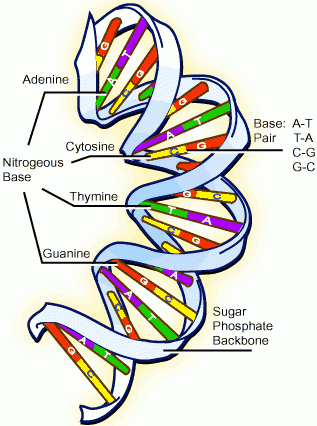
- A vast amount of complex and specified information encoded in a biochemical language;
- A computer-like system of commands and codes that processes the information.
- Molecular machines and multi-machine systems.
But where in our experience do things like language, complex and specified information, programming code, or machines come from? They have one and only one known source: intelligence.
One of the strangest things about intelligent design is how many people use the phrase without even being able to define it or point to an academic book or paper where the concept is defined. There are several places where information is found in nature: the origin of life (“biological information”) and Cambrian explosion (“higher taxonomic categories”) are two of them. There is no known naturalistic method of producing large amounts of functional information in these two areas. But we know that human intelligence are capable of creating the sequences – we’ve seen it done. Intelligent design is the view that functional information sequences in nature are the result of intelligence. That’s all we know that can produce it.
 WINTERY KNIGHT