Tag Archives: Government

Last US-based lightbulb factory closes because of green regulations

Story here from the leftist Washington Post. (H/T Wes Widner)

Excerpt:

The last major GE factory making ordinary incandescent light bulbs in the United States is closing this month, marking a small, sad exit for a product and company that can trace their roots to Thomas Alva Edison’s innovations in the 1870s.

[…]What made the plant here vulnerable is, in part, a 2007 energy conservation measure passed by Congress that set standards essentially banning ordinary incandescents by 2014. The law will force millions of American households to switch to more efficient bulbs.

[…]Rather than setting off a boom in the U.S. manufacture of replacement lights, the leading replacement lights are compact fluorescents, or CFLs, which are made almost entirely overseas, mostly in China.

Consisting of glass tubes twisted into a spiral, they require more hand labor, which is cheaper there. So though they were first developed by American engineers in the 1970s, none of the major brands make CFLs in the United States.

Lights out on American jobs – not because of competitive pressure from free market competitors, but because of government regulators who probably have money invested in the companies that stand to benefit from this outrageous government intervention into the free market. The green movement is a scam. It costs jobs when you take money out of the private sector and put into environmentalist scams.

You can read about Al Gore’s profiteering here, for example. And you can read more about what happens when governments waste money on green jobs programs. Or read about the Finnish car company backed by Al Gore that got US government loans. Or the US government money funneled to pay for a George Soros-backed oil drilling firm – in BRAZIL.

Stephen Baskerville’s new academic paper on the family

An excellent paper explaining how the breakdown on the family isn’t caused by fathers abandoning their posts. It’s caused by specific government policies. And the conseequence of this crisis is that government size and power increases to deal with the problems.

Here is the PDF.

Excerpt:

Unilateral divorce involves government agents forcibly removing legally innocent people from their homes, seizing their property, and separating them from their children. It inherently abrogates not only the inviolability of marriage but the very concept of private life.

If marriage is not a wholly private affair, as today’s marriage advocates insist, involuntary divorce by its nature requires constant government supervision of family life. Far more than marriage, divorce mobilizes and expands government power. Marriage creates a private household, which may or may not require signing some legal documents. Divorce dissolves a private household, usually with one spouse having done nothing legally wrong. It inevitably involves state functionaries—including police and jails—to enforce the divorce and the post-marriage order. Otherwise, the involuntarily divorced spouse will continue to enjoy the protections and prerogatives of private life: the right to live in the common home, to possess the common property, or—most vexing of all—to parent the common children. These claims must be expunged by force, using the penal system if necessary.

Given that 80 percent of divorces are unilateral, divorce today seldom involves two people simply parting ways.10 Under “nofault” rules divorce often becomes a power grab by one spouse, assisted by people who profit from the ensuing litigation: judges, lawyers, psychotherapists, counselors, mediators, and social workers.

The most serious consequences involve children. The first action in a divorce is typically to separate the children from one parent, usually the father. Even if he is innocent of any legal wrongdoing and did not agree to the divorce, the state seizes his children with no burden of proof to justify its action. The burden of proof (and the financial burden) to demonstrate that they should be returned falls on him.

A legally unimpeachable parent can thus be arrested for associating with his own children without government authorization. He can also be arrested through additional judicial directives that apply to no one but him. He can be arrested for domestic violence or child abuse, even without evidence that he has committed any such acts. He can be arrested for not paying child support, even without proof that he actually owes it. He can even be arrested for not paying an attorney or psychotherapist whom he has not hired. In each case there is no formal charge, no jury, no trial. The parent is simply incarcerated.

And another one:

The growing confrontation between the family and the state reveals that the relationship between personal morality and freedom is more than a cliché. It illustrates the direct connection between the breakdown of traditional morality and tolerance of governmental intrusion and control.

Sacrifice for others begins in the family. The family is where both parents and children learn to love sacrificially, to put others’ needs before their own desires, and to sacrifice for the wellbeing and protection of the whole. If such responsibility does not begin in one’s own home among loved ones, it is not likely to begin at all. People unwilling to sacrifice for their own flesh and blood are not likely do so for the strangers who constitute their fellow citizens and country.

Linda McClain writes that families are “seedbeds of civic virtue” and “have a place in the project of forming persons into capable, responsible, self-governing citizens.”12 For the American founding fathers, argues David Forte, “The bridge from reining in ‘private passions’ to producing a ‘positive passion for the public good’ was the family’s inculcation of public virtue.”13

But we can say more. In the family, children learn to obey and respect authorities other than the state—God, parents, extended family, and others who are not government officials: pastors and priests, teachers, neighbors, coaches, and other figures of civil society. By accepting these authorities, the bonds to which often are reinforced with love, children learn that government is not the sole authority and claim on their allegiance and that it is an institution that can and must be limited.

And another:

When fathers protect and provide for their families, they will resist the state’s efforts to usurp those roles. Under their leadership, families are a force for limiting state power.

The single mother, by contrast, is ordinarily not predisposed to resist the state’s encroachment into her family. On the contrary, she usually demands it. She is our society’s principal claimant on a vast array of state “services” without which she cannot manage her children: services to keep the father away and extract money from him, services to feed and house and clothe the children, to baby-sit them, to educate them, and to control their misbehavior and criminality. As the state usurps the roles of protector and provider and disciplinarian, it becomes husband and father, and it has no incentive to limit its own power. Henceforth the state protects and provides. And the state demands obedience.

And one last one:

Under the divorce regime the authority of fathers and parents generally is fragile, because court orders can readily be obtained to undermine or countermand it. Family wealth—traditionally used by fathers to obtain obedience from children and put limits on government—is increasingly useless for both purposes, because it can be simply confiscated by the court and handed to whomever the court chooses: the wife or children or lawyers or government. Children need not learn responsibility with money, because the government hands it to them unconditionally after confiscating it from their fathers. Differences within the family are settled, not by negotiation or compromise or intervention by relatives or church, but by government orders.

It’s 17 pages of pure goodness. Marriage is better when you understand how subversive it is. Once you get away from the idea that it’s not about you having fun, it’s really quite an enterprise – a way of serving God by being unselfish and loving others.

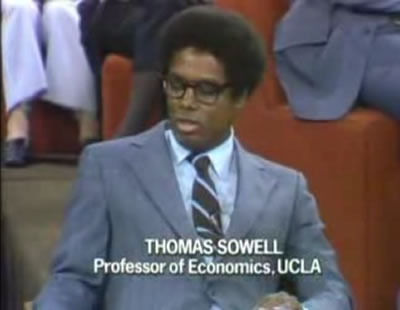
Thomas Sowell explains the concept of “moral hazard”

Young Thomas Sowell

From Real Clear Politics. (H/T Jojo)

Excerpt:

One of the things that makes it tough to figure out how much has to be charged for insurance is that people behave differently when they are insured from the way they behave when they are not insured.

In other words, if one person out of 10,000 has his car set on fire, and it costs an average of $10,000 to restore the car to its previous condition, then it might seem as if charging one dollar to all 10,000 people would be enough to cover the cost of paying $10,000 to the one person whose car that will need to be repaired. But the joker in this deal is that people whose cars are insured may not be as cautious as other people are about what kinds of neighborhoods they park their car in.

[…]Although “moral hazard” is an insurance term, it applies to other government policies besides insurance. International studies show that people in countries with more generous and long-lasting unemployment compensation spend less time looking for jobs. In the United States, where unemployment compensation is less generous than in Western Europe, unemployed Americans spend more hours looking for work than do unemployed Europeans in countries with more generous unemployment compensation.

People change their behavior in other ways when the government pays with the taxpayers’ money. After welfare became more readily available in the 1960s, unwed motherhood skyrocketed. The country is still paying the price for that– of which the money is the least of it. Children raised by single mothers on welfare have far higher rates of crime, welfare and other social pathology.

San Francisco has been one of the most generous cities in the country when it comes to subsidizing the homeless. Should we be surprised that homelessness is a big problem in San Francisco?

[…]We also hear a lot of talk about “the uninsured,” for whose benefit we are to drastically change the whole medical-care system. But income data show that many of those uninsured people have incomes from which they could easily afford insurance. But they can live it up instead, because the government has mandated that hospital emergency rooms treat everyone.

And here’s another Tom Sowell column making a related point.

Excerpt:

Much has been made of the fact that families making less than $250,000 a year will not see their taxes raised. Of course they won’t see it, because what they see could affect how they vote.

But when huge tax increases are put on electric utility companies, the public will see their electricity bills go up. When huge taxes are put on other businesses as well, they will see the prices of the things those businesses sell go up.

If you are not in that “rich” category, you will not see your own taxes go up. But you will be paying someone else’s higher taxes, unless of course you can do without electricity and other products of heavily taxed businesses. If you don’t see this, so much the better for the Obama administration politically.

This country has been changed in a more profound way by corrupting its fundamental values. The Obama administration has begun bribing people with the promise of getting their medical care and other benefits paid for by other people, so long as those other people can be called “the rich.” Incidentally, most of those who are called “the rich” are nowhere close to being rich.

[…]There was a time when most Americans would have resented the suggestion that they wanted someone else to pay their bills. But now, envy and resentment have been cultivated to the point where even people who contribute nothing to society feel that they have a right to a “fair share” of what others have produced.

The most dangerous corruption is a corruption of a nation’s soul. That is what this administration is doing.

Republicans prefer private voluntary charity as the best way to provide a safety net. Just because people on the left give less to charity than people on the right, it doesn’t mean that no one one gives to charity. Europe has the highest taxes, and they give the least in charity. Why not LOWER taxes for people who want to give MORE in charity? When government hands out money, it encourages people to be more dependent. But when a person in trouble has to go to a neighbor or a charity in their own community, it sends the right message – “this should be temporary – don’t let this become a habit”. It’s not GOOD for someone to depend on the government. People need to work in order to be happy.

Having the government take over the role of provider in the home is an insult to men. It’s not government’s job to replace men. They ought to stay right out of it. Leave money in the pockets of the working man so he can save for a rainy day himself. If you subsidize a behavior, you get more of it. If you tax a behavior, you get less of it. It makes no sense to subsidize irresponsible lifestyle choices and tax productive and moral lifestyle choices. You don’t want to make the rescue from bad decisions an anonymous and automatic affair. You want people to worry, so that they won’t want to make risky and irresponsible choices. Everybody goes through though times, but we shouldn’t make it normal. People ought to know that it’s not normal.

You may want to read about how government dependence makes people less happy than having a job. Don’t make people depend on government by taxing businesses and investment. We need more companies hiring – not less. And that means letting the profit motive provide an incentive for entrepreneurs to engage in more risk-taking and enterprise.