Tag Archives: Government

Ryan T. Anderson lectures on marriage and why it matters

Marriage and family
Marriage and family

Here’s the lecture:

About the speaker:

Ryan T. Anderson researches and writes about marriage and religious liberty as the William E. Simon Fellow at The Heritage Foundation. He also focuses on justice and moral principles in economic thought, health care and education, and has expertise in bioethics and natural law theory.

Anderson, who joined the leading Washington think tank’s DeVos Center for Religion and Civil Society in 2012, also is the editor of Public Discourse, the online journal of the Witherspoon Institute of Princeton, N.J.

Anderson’s recent work at Heritage focuses on the constitutional questions surrounding same-sex “marriage.” He is the co-author with Princeton’s Robert P. George and Sherif Girgis of the acclaimed book “What Is Marriage? Man and Woman: A Defense” (Encounter Books, December 2012).

The lecture starts at 7:20 in. The lecture ends at 49:35. There are 32 minutes of Q&A.

Introduction:

  • When talking about marriage in public, we should talk about philosophy, sociology and public policy
  • Gay marriage proponents need to be pressed to define what marriage is, on their view
  • Every definition of marriage is going to include some relationships, and exclude others
  • It’s meaningless to portray one side as nice and the other mean
  • Typically, marriage redefiners view marriage as a more intense emotional relationship
  • Marriage redefiners should be challenged in three ways:
  • 1) Does the redefined version of marriage have a public policy reason to prefer only two people?
  • 2) Does the redefined version of marriage have a reason to prefer permanence?
  • 3) Does the redefined version of marriage have a reason to prefer sexual exclusivity?
  • Also, if marriage is just about romance, then why is the state getting involved in recognizing it?
  • The talk: 1) What marriage is, 2) Why marriage matters, 3) What are the consequences of redefining marriage?

What marriage is:

  • Marriage unites spouses – hearts, minds and bodies
  • Marriage unites spouses to perform a good: creating a human being and raising that human being
  • Marriage is a commitment: permanent and exclusive
  • Male and female natures are distinct and complementary

The public purpose of marriage:

  • to attach men and women to each other
  • to attach mothers and fathers to their children
  • there is no such thing as parenting, there is only mothering and fathering
  • the evidence shows that children benefit from mothering and fathering
  • boys who grow up without fathers are more likely to commit crimes
  • girls who grow up without fathers are more likely to have sex earlier
  • Children benefit from having a mother and a father
  • can’t say that fathers are essential for children if we support gay marriage, which makes fathers optional
  • without marriage: child poverty increases, crime increases, social mobility decreases, welfare spending increases
  • when government encourages marriage, then government has less do to – stays smaller, spends less
  • if we promote marriage as an idea, we are not excluding gay relationships or even partner benefits
  • finally, gay marriage has shown itself to be hostile to religious liberty

Consequences redefining marriage:

  • it undermines the norm in public like that kids deserve a mom and a dad – moms and dads are interchangeable
  • it changes the institution of marriage away from the needs of children, and towards the needs of adults
  • it undermines the norm of permanence
  • we learned what happens when marriage is redefined before: with no-fault divorce
  • no-fault divorce: after this became law, divorce rates doubled – the law changed society
  • gay marriage would teach society that mothers and fathers are optional when raising children
  • if marriage is what people with intense feelings do, then how can you rationally limit marriage to only two people?
  • if marriage is what people with intense feelings do, then if other people cause intense feelings, there’s no fidelity
  • if marriage is what people with intense feelings do, then if the feelings go away, there is no permanence
  • the public policy consequences to undermining the norms of exclusivity and permanence = fatherless children and fragmented families
  • a final consequences is the decline and elimination of religious liberty – e.g. – adoption agencies closing, businesses being sued

We’re doing very well on abortion, but we need to get better at knowing how to discuss marriage. If you’re looking for something short to read, click here. If you want to read a long paper that his book is based on.

Related posts

Report: Women more likely to live in poverty than men

Here's the left-wing media
Young women vote overwhelmingly for Democrats – is it working for them?

Brad Wilcox tweeted this article from the leftist The Daily Progress. Let’s see what it says, then I’ll comment.

The article identifies three reasons why women are poorer than men: single motherhood, divorce and the “pay gap”.

Look:

During their working years, women tend to earn less than men, and when they retire, they’re more likely to live in poverty.

These are women who raised children and cared for sick and elderly family members, often taking what savings and income they had and spending it on things besides their own retirement security.

The National Institute on Retirement Security, a nonprofit research center, reports that women are 80 percent more likely than men to be impoverished at age 65 and older. Women age 75 to 79 are three times more likely.

While experts cite a pay gap as a major cause for retirement insecurity, other factors play a role, from single parenthood and divorce to the fact that women typically live longer than men.

Dr. Wilcox makes the point that this poverty is due to a retreat from marriage. That’s true. But look at the three factors the left-wing article itself cites: single motherhood, divorce and pay gap. Are these policies instances of women being victimized, or are their problems self-inflicted?

1) Single motherhood is caused by the welfare policies that young women favor when they vote overwhelmingly for bigger government. If we take money from working taxpayers, or borrow it from the next generation, and we give it to women to pay them to have fatherless children, then more women will do this. And of course this is a path to poverty. There just isn’t enough money to steal from taxpayers or borrow from future taxpayers to pay for women to have children with no man in the home who can provide for those children. People do more of what you pay them to do. The more money we give to single mothers, the more fatherless children we get, and it creates a host of problems that we can’t continue to pay for as a society, e.g. – crime. The mistake was paying women to make poor decisions in the first place, but welfare spending a policy that most young, unmarried women support. They’re not victims, they’re doing this to themselves.

This new Prager University video from Larry Elder explains why women embrace single motherhood:

We’re paying them to make bad decisions, and it creates more poverty.

2) No-fault divorce was caused by the radical feminism that many young, unmarried women support. This policy was brought in to make it easy for women to divorce without having to have a good reason (70% of divorces are initiated by women, mostly over “unhappiness”). Feminists don’t like the idea of being “constrained” to marry a man because he is a good provider, protector and moral/spiritual leader. A strong man is intimidating – he will want to make decisions and lead, and we can’t let him do that. A better idea is to marry a man who doesn’t provide, protect or lead – that way, we don’t have to respect him or let him lead. Naturally, when this entertaining, irresponsible man is unable to provide, then women divorce him and find themselves poor and unable to remarry – having lost their youth and beauty to “fun” men. No-fault divorce is not a policy that men supported. It is a policy that feminists supported, because they want to be able to nuke relationships that don’t make them feel happy. The most volatile, short-lived relationships are lesbian relationships, because women naturally expect relationships to fulfill them instead of expecting relationships to be tough and challenging. There just isn’t a path to prosperity for women into old age if they value feeling happy over self-sacrificial love and moral obligations. We need to teach women to prefer marriage-capable of men instead of fun, entertaining, no-leadership men. We need to teach women to make commitments that override their changing feelings. The problem of divorce is self-inflicted.

3) Lastly, the pay gap. I have written before about how the pay gap is largely related to women’s own choices about what to study, what job to take, and how many hours to work. It is simply not possible for a woman to earn as much as a man when she does a degree in English, women’s studies or other nonsense. Men don’t study what we want to study. We study things we hate – like petroleum engineering and software engineering. We do this so that we can provide for a wife and children, so that we can get what we we want most: respect and the (earned) authority to lead a home. Most men are commitment machines. We hate fun, we want to do hard things, and to be respected for being reliable and steady. The problem of the “pay gap” is self-inflicted.

So, in conclusion, yes – many women are poorer than men, especially as they age. But their poverty is self-inflicted. They are poor because they embraced ideas that would make them poorer. Three ideas destroyed their prosperity: single mother welfare, no-fault divorce, and following your heart in education and career. None of these things will provide women with security or prosperity – especially now that the debt has doubled to $20 trillion, and there is no more to borrow to continue the government-as-sugar-daddy plan of feminists. No amount of reassurance from pious pastors and permissive parents can save women from the consequences of their own irrational embrace of radical feminism. It turns out that there is no escape from economics, and the universe does not magically adjust to make the feelings and intuitions of entitled Disney princesses “work out”.

New study: cohabitating parents twice as likely to split up as married parents

SurveyMonkey election poll cross tabs for unmarried women Nov 2016

This was reported by the Daily Signal.

It says:

Children born to unmarried, cohabiting parents—both in the United States and across Europe—are nearly twice as likely to see their parents split up, compared to children born to married parents.

A new study from the Institute for Family Studies and Social Trends Institute examines family stability among cohabiting and married-parent families from numerous countries across the world. The findings provide evidence against some common myths about cohabitation and children’s family stability.

One of these myths claims that cohabitation is less stable than marriage simply because low-income individuals are more likely to choose to cohabit. However, researchers find that in the majority of countries studied, cohabitation is less stable even among the highly educated.

The authors note, “In the overwhelming majority of countries, the most educated cohabiting parents still have a far higher rate of break-up than the lowest educated married couples.”

For example, in the United States, 49 percent of children born to highly-educated cohabiting mothers experienced at least one union disruption by age 12, compared to just 26 percent of children born to lower-educated married mothers. In the United Kingdom, the percentages are 53 percent and 39 percent, respectively.

A second common argument is that cohabitation becomes more stable (begins to look more like marriage) as it becomes more common in a society.

However, the findings did not support this notion. As the share of children born to cohabiting couples increased in a country, family instability also increased.

Laurie DeRose, one of the authors of the study, explains:

We find no evidence in this report to support the idea that as births to cohabiting parents become more common, as they have in the United States, marriage and cohabitation resemble each other in terms of stability for children. On average, marriage is associated with more family stability for children across the globe—even in countries where it is in retreat.

[…]A 2011 report from the Institute for American Values calls “the rise of cohabiting households with children … the largest unrecognized threat to the quality and stability of children’s family lives.”

Research shows that children in cohabiting households are more likely to be physically, sexually, and emotionally abused, and to be aggressive or display delinquent behaviors (such as substance abuse or committing property crime). They are also more likely to experience poverty and have poorer health.

It should be noted that Democrats favor policies that punish people who want to marriage, e.g. – no-fault divorce, marriage tax penalty, single mother welfare, etc.

Dennis Prager explains why the Democrats oppose marriage:

It takes a particularly noble Democrat to promote marriage and family. The strengthening of these institutions is not in the Democratic Party’s self-interest. The more people marry, and especially the more they have children after they marry, the more likely they are to hold conservative values and vote Republican.

That is why it is inaccurate to speak of a “gender gap” in Americans’ voting. The gap is between married and unmarried women. Single women, especially single women with children, tend to vote Democratic, while married women, especially married women with children, tend to vote Republican.

Why is this?

There are two primary reasons.

One is that women’s nature yearns for male protection. This is a heretical idea among the well educated whose education is largely devoted to denying the facts of life. But it is a fact of life that can easily be proven: Extremely wealthy women almost always seek to marry men who are even wealthier than they are.

[…]Given women’s primal desire to be protected, if a woman has no man to provide it, she will seek security elsewhere — and elsewhere today can only mean the government. In effect, the state becomes her husband. This phenomenon has frequently been commented on with regard to the breakdown of many black families. The welfare state simply rendered many black men unnecessary and therefore undesirable as spouses: Why marry when you can get more benefits from the state while remaining single (and get even more money if you have children while remaining single)?

Once a woman does marry, however, her need for the state not only diminishes, she now begins to view the state as inimical to her interests. For the married woman, especially if she has children, two primal urges work against her having a pro-big government attitude. Her urge to be protected, which is now fulfilled by her husband, and her primal urge to protect her nest are now endangered by the government, which as it grows, takes away more and more of her family’s money.

Once a woman marries and has children, therefore, her deepest desires — to be protected and to protect her family — work as strongly on behalf of conservative values and voting Republican as they did on behalf of liberalism and the Democratic Party when she was single.

The other reason married women are less likely to be liberal and vote Democratic relates to maturity and wisdom.

Just about everyone — a man as much as a woman — is rendered more mature and wiser after marrying. This is not an insult to singles. It was as true of me as of anyone else. If you’re single, ask any married person — happily or unhappily married — whether or not marriage has matured them.

The single biggest change induced by marriage is that you can no longer think only about yourself. “I” becomes “we.” Narcissism becomes far less possible in marriage than in the single state. And just as marriage decreases narcissism, it increases wisdom. Having to relate to another human being (especially of the opposite sex) to whom you have made a lifelong commitment (even if it ends in divorce) vastly increases your wisdom. And if you have children, your wisdom increases exponentially. Again, ask any parent if they are wiser since becoming a parent.

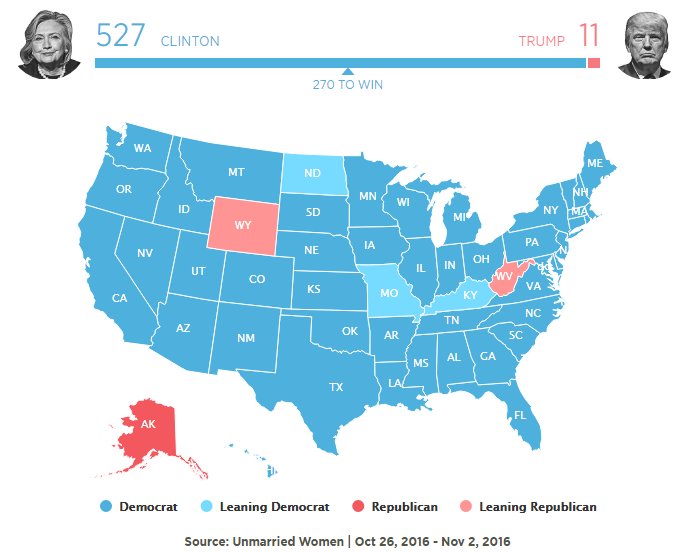
If you take a look at the map above, you’ll see that unmarried women vote overwhelmingly Democrat, because they want to be able to follow their hearts without having to be responsible about finding a husband and raising children. They vote for big government to make their self-centeredness “work out”. Why have a husband when you can get his money by taxing him? Single women think it’s better to tax a man and not have to respect him. That’s why they vote Democrat. And as taxes go higher and higher, what you’ll find is that many single men who might like to marry can no longer afford to marry – because they are paying for the upkeep of millions of single women already.