Tag Archives: God

Why doesn’t God make his existence more obvious to people?

Have you ever heard someone say that if God existed, he would give us more evidence? This is called the “hiddenness of God” argument. It’s also known as the argument from “rational non-belief”. You have have seen Dr. Theodore Drange use the argument in his debate with Dr. William Lane Craig.

Basically the argument is something like this:

  1. God is all powerful
  2. God is all loving
  3. God wants all people to know about him
  4. Some people don’t know about him
  5. Therefore, there is no God.

In this argument, the atheist is saying that he’s looked for God real hard and that if God were there, he should have found him by now. After all, God can do anything he wants that’s logically possible, and he wants us to know that he exists. To defeat the argument we need to find a possible explanation of why God would want to remain hidden.

What reason could God have for remaining hidden?

Christian scholar Dr. Michael Murray has found a reason for God to remain hidden.

His paper on divine hiddenness is here:
Coercion and the Hiddenness of God“, American Philosophical Quarterly, Vol 30, 1993.

He argues that if God reveals himself too much to people, he takes away our freedom to make morally-significant decisions, including responding to his self-revelation to us. Murray argues that God stays somewhat hidden, so that he gives people space to either 1) respond to God, or 2) avoid God so we can keep our autonomy from him. God places a higher value on people having the free will to respond to him, and if he shows too much of himself he takes away their free choice to respond to him, because once he is too overt about his existence, people will just feel obligated to belief in him in order to avoid being punished.

But believing in God just to avoid punishment is NOT what God wants for us. If it is too obvious to us that God exists and that he really will judge us, then people will respond to him and behave morally out of self-preservation. But God wants us to respond to him out of interest in him, just like we might try to get to know someone we admire. God has to dial down the immediacy of the threat of judgment, and the probability that the threat is actual. That leaves it up to us to respond to God’s veiled revelation of himself to us, in nature and in Scripture.

(Note: I think that we don’t seek God on our own, and that he must take the initiative to reach out to us and draw us to him. But I do think that we are free to resist his revelation, at which point God stops himself short of coercing our will. We are therefore responsible for our own fate).

The atheist’s argument is a logical/deductive argument. It aims to show that there is a contradiction between God’s will for us and his hiding from us. In order to derive a contradiction, God MUST NOT have any possible reason to remain hidden. If he has a reason for remaining hidden that is consistent with his goodness, then the argument will not go through.

When Murray offers a possible reason for God to remain hidden in order to allow people to freely respond to him, then the argument is defeated. God wants people to respond to him freely so that there is a genuine love relationship – not coercion by overt threat of damnation. To rescue the argument, the atheist has to be able to prove that God could provide more evidence of his existence without interfering with the free choice of his creatures to reject him.

Murray has defended the argument in works published by prestigious academic presses such as Cambridge University Press, (ISBN: 0521006104, 2001) and Routledge (ISBN: 0415380383, 2007).

Positive arguments for Christian theism

Alexander Vilenkin: “All the evidence we have says that the universe had a beginning”

I’ve decided to explain why physicists believe that there was a creation event in this post. That is to say, I’ve decided to let famous cosmologist Alexander Vilenkin do it.

From Uncommon Descent.

Excerpt:

Did the cosmos have a beginning? The Big Bang theory seems to suggest it did, but in recent decades, cosmologists have concocted elaborate theories – for example, an eternally inflating universe or a cyclic universe – which claim to avoid the need for a beginning of the cosmos. Now it appears that the universe really had a beginning after all, even if it wasn’t necessarily the Big Bang.

At a meeting of scientists – titled “State of the Universe” – convened last week at Cambridge University to honor Stephen Hawking’s 70th birthday, cosmologist Alexander Vilenkin of Tufts University in Boston presented evidence that the universe is not eternal after all, leaving scientists at a loss to explain how the cosmos got started without a supernatural creator. The meeting was reported in New Scientist magazine (Why physicists can’t avoid a creation event, 11 January 2012).

[…]In his presentation, Professor Vilenkin discussed three theories which claim to avoid the need for a beginning of the cosmos.

The three theories are chaotic inflationary model, the oscillating model and quantum gravity model. Regular readers will know that those have all been addressed in William Lane Craig’s peer-reviewed paper that evaluates alternatives to the standard Big Bang cosmology.

But let’s see what Vilenkin said.

More:

One popular theory is eternal inflation. Most readers will be familiar with the theory of inflation, which says that the universe increased in volume by a factor of at least 10^78 in its very early stages (from 10^−36 seconds after the Big Bang to sometime between 10^−33 and 10^−32 seconds), before settling into the slower rate of expansion that we see today. The theory of eternal inflation goes further, and holds that the universe is constantly giving birth to smaller “bubble” universes within an ever-expanding multiverse. Each bubble universe undergoes its own initial period of inflation. In some versions of the theory, the bubbles go both backwards and forwards in time, allowing the possibility of an infinite past. Trouble is, the value of one particular cosmic parameter rules out that possibility:

But in 2003, a team including Vilenkin and Guth considered what eternal inflation would mean for the Hubble constant, which describes mathematically the expansion of the universe. They found that the equations didn’t work (Physical Review Letters, DOI: 10.1103/physrevlett.90.151301). “You can’t construct a space-time with this property,” says Vilenkin. It turns out that the constant has a lower limit that prevents inflation in both time directions. “It can’t possibly be eternal in the past,” says Vilenkin. “There must be some kind of boundary.”

A second option explored by Vilenkin was that of a cyclic universe, where the universe goes through an infinite series of big bangs and crunches, with no specific beginning. It was even claimed that a cyclic universe could explain the low observed value of the cosmological constant. But as Vilenkin found, there’s a problem if you look at the disorder in the universe:

Disorder increases with time. So following each cycle, the universe must get more and more disordered. But if there has already been an infinite number of cycles, the universe we inhabit now should be in a state of maximum disorder. Such a universe would be uniformly lukewarm and featureless, and definitely lacking such complicated beings as stars, planets and physicists – nothing like the one we see around us.

One way around that is to propose that the universe just gets bigger with every cycle. Then the amount of disorder per volume doesn’t increase, so needn’t reach the maximum. But Vilenkin found that this scenario falls prey to the same mathematical argument as eternal inflation: if your universe keeps getting bigger, it must have started somewhere.

However, Vilenkin’s options were not exhausted yet. There was another possibility: that the universe had sprung from an eternal cosmic egg:

Vilenkin’s final strike is an attack on a third, lesser-known proposal that the cosmos existed eternally in a static state called the cosmic egg. This finally “cracked” to create the big bang, leading to the expanding universe we see today. Late last year Vilenkin and graduate student Audrey Mithani showed that the egg could not have existed forever after all, as quantum instabilities would force it to collapse after a finite amount of time (arxiv.org/abs/1110.4096). If it cracked instead, leading to the big bang, then this must have happened before it collapsed – and therefore also after a finite amount of time.

“This is also not a good candidate for a beginningless universe,” Vilenkin concludes.

So at the end of the day, what is Vilenkin’s verdict?

“All the evidence we have says that the universe had a beginning.”

This is consistent with the Borde-Guth-Vilenkin Theorem, which I blogged about before, and which William Lane Craig leveraged to his advantage in his debate with Peter Millican.

The Borde-Guth-Vilenkin (BGV) proof shows that every universe that expands must have a space-time boundary in the past. That means that no expanding universe, no matter what the model, can be eternal into the past. No one denies the expansion of space in our universe, and so we are left with a cosmic beginning. Even speculative alternative cosmologies do not escape the need for a beginning.

Conclusion

If the universe came into being out of nothing, which seems to be the case from science, then the universe has a cause. Things do not pop into being, uncaused, out of nothing. The cause of the universe must be transcendent and supernatural. It must be uncaused, because there cannot be an infinite regress of causes. It must be eternal, because it created time. It must be non-physical, because it created space. There are only two possibilities for such a cause. It could be an abstract object or an agent. Abstract objects cannot cause effects. Therefore, the cause is an agent.

Now, let’s have a discussion about this science in our churches, and see if we can’t train Christians to engage with non-Christians about the evidence so that everyone accepts what science tells us about the origin of the universe.

Study: non-STEM college programs make students less religious

Lets take a closer look at a puzzle

Why do students turn away from Christianity in college? It might have something to do with what they choose to study.

Rice University reports on a new study conducted by sociologist Elaine Howard Ecklund.

Excerpt:

The public’s view that science and religion can’t work in collaboration is a misconception that stunts progress, according to a new survey of more than 10,000 Americans, scientists and evangelical Protestants. The study by Rice University also found that scientists and the general public are surprisingly similar in their religious practices.

The study, “Religious Understandings of Science (RUS),” was conducted by sociologist Elaine Howard Ecklund and presented today in Chicago during the annual American Association for the Advancement of Science (AAAS) conference. Ecklund is the Autrey Professor of Sociology and director of Rice’s Religion and Public Life Program.

“We found that nearly 50 percent of evangelicals believe that science and religion can work together and support one another,” Ecklund said. “That’s in contrast to the fact that only 38 percent of Americans feel that science and religion can work in collaboration.”

The study also found that 18 percent of scientists attended weekly religious services, compared with 20 percent of the general U.S. population; 15 percent consider themselves very religious (versus 19 percent of the general U.S. population); 13.5 percent read religious texts weekly (compared with 17 percent of the U.S. population); and 19 percent pray several times a day (versus 26 percent of the U.S. population).

[…]RUS is the largest study of American views on religion and science.

Meanwhile, Reasonable Faith has a podcast about the study, and what they discuss is how students who go into non-STEM university programs lose their interest in religion at a much higher rate than people who study STEM.

Here is the MP3 file.

And the relevant portion of the transcript:

DR. CRAIG: Right. If you look at their chart they give, where it shows the changes in religiosity by college major, it shows that in biology, engineering, and physical science and math they were mixed. The overall effect was neither negative nor positive. For some it was positive, some negative. But those majors did not seem to have a very significant effect upon the person’s religious behavior. The majors that had a very positive impact on religiosity were education, vocational or clerical education, business, and what is classified as “other.” All of those majors – whatever those are – have an overall positive impact upon students’ religiosity.

KEVIN HARRIS: And attendance as well – attendance to church services.

DR. CRAIG: Yes.

KEVIN HARRIS: The big fly in the ointment here is that “both the Humanities and the Social Sciences see dramatic declines in attendance and even more in religious beliefs.” It lowers church attendance, synagogue attendance, and even more in religious beliefs. What do we mean by the humanities and the social sciences?

DR. CRAIG: Humanities would include your non-scientific areas; for example, literature (hence the title of the article), politics.[3] I don’t know if they would include economics in this or not. Religious studies. In the social sciences are things like anthropology and sociology would be included there.

KEVIN HARRIS: The study of art?

DR. CRAIG: Yes, I suppose the arts would be in the humanities – that would be music and graphic arts. It is a big, big catch-all category.

And why does Dr. Craig think this is happening?

DR. CRAIG: […]It could well be that it is because it is in the humanities that the radicals of the 1960s were able to find a place in the university and become ensconced as professors with the relativism that they were championing. In areas like anthropology and sociology you find tremendous relativism where you simply study these cultures and societies without making any sort of judgment as to truth with regard to what they believe. This leads to the belief that it is all relative; there isn’t anything that is objectively true. John Searle is a very prominent philosopher at the University of California, Berkeley. Searle says that he believes that because of the commitment to the objectivity of truth and logic and the scientific method the hard sciences were barred to these radicals of the 1960s – getting into them and influencing them. But where they found an opening was in things like the Women’s Studies Department, Religious Studies, Anthropology, Sociology. These soft sciences. He says the professors in these disciplines are the children of the 1960s that have carried into it their relativistic views of truth. I noticed here the conclusion by the researchers of the University of Michigan (apparently who did this study), “Our results suggest that it is Postmodernism, not Science, that is the bête noir [the black beast or the hated thing] of religiosity.” The enemy of religiosity is postmodernism, not science.

KEVIN HARRIS: Postmodernism, as you’ve pointed out, was mainly a thing confined to literature and the soft sciences.

DR. CRAIG: Right. Women’s Studies, Religious Studies is rampant with Postmodernist perspectives. That has a real ring of truth to it, and could be the reason behind these statistics.

And this is why I recommend that people not drop math in high school, and pick a STEM field to study in college (or a trade in trade school). You are wasting your money when you let people in non-STEM areas indoctrinate you in fact-free irrationality. By the way, I love business administration as a major, for those who do not want to do the lab work. It attracts a lot of conservatives and entrepreneurs.

If you’re not worried about your faith, then you should at least be worried about your wallet:

Should you study philosophy?
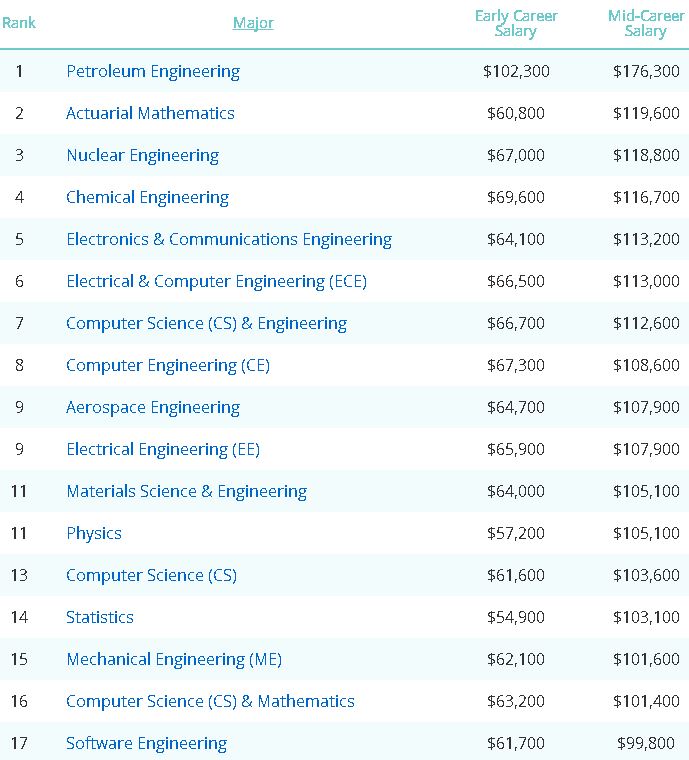
STEM degrees are good for your finances as well

It’s much easier to have an influence as a Christian if you get your financial house in order. Having a degree that leads to a good paying job is certainly a good way to fund your life plan. Money also helps you to not worry too much about what the secular left can do to you. It’s good for offense and defense, in short.