Tag Archives: Free Trade

Fiscal and social conservatives unite in new free e-book “Indivisible”

There’s a new book that just came out from the Heritage Foundation, my favorite think tank.

Here’s an excerpt from the introduction by Jay Richards:

To listen to media and political strategists is to get the impression that American public life is a checklist of issues. Some are known as “social” issues (marriage, family) and some are known as “economic” (international trade, wages). There may be some good reasons for this distinction, but when we itemize and divide these topics into two separate categories, we fail to convey the underlying unity of the principles behind the American Experiment in ordered liberty. In reality, the two groups of issues are interdependent. For instance, a free economy cannot long exist in a culture that is hostile to it. The success of free market economic policies depends on important cultural and moral factors such as thrift, delayed gratification, hard work, and respect for the property of others. A virtuous and responsible populace derives, in turn, from strong families, churches, and other civil institutions.

Conversely, economic issues have a strong influence on culture and the institutions of civil society. High taxes, for example, put pressure on families and force parents to spend more time in the workforce, leaving less time to devote to their spouses and children. When government expands spending and control in education, it crowds out parental responsibility; when it expands its role in providing social welfare services, it tends to erode a sense of responsibility among churches and other groups doing good work to help neighbors in need.

The connections are such that the individual issues rarely fit neatly and exclusively into one set or the other. An “economic” issue is rarely exclusively about economics. For instance, poverty in America is often as much a moral and cultural problem as an economic problem. Reducing such poverty depends on civil institutions that inculcate virtue and responsibility as well as policies that promote economic freedom and discourage dependency. Most poverty among children in America is not caused by a lack of jobs but rather by factors such as family breakdown, negligent or absentee parents, substance abuse, or other social pathologies. To consider American poverty in strictly economic terms is to fail to see the full scale of issues involved in this problem.

[…]The following essays are intended as a concise exploration of the link between liberty and human dignity and of the policy issues that tend to cluster around these two themes in American life. This collection brings together a number of well-known social and economic conservatives. To encourage cross-fertilization of their ideas, those known as social conservatives have written on themes normally identified with economic conservatives, and vice versa. The authors highlight economic arguments for issues typically categorized as “social” and social/moral arguments for “economic” issues. Each author focuses on a single topic, briefly summarized below, that is associated with either social or economic conservatives or, in some cases, both.

That’s also one of the main purposes of my blog, to show how fiscal conservatives and social conservatives depend on each other.

Here are the essays and authors:

  • Civil Society: Moral Arguments for Limiting Government – Joseph G. Lehman
  • Rule of Law: Economic Prosperity Requires the Rule of Law – J. Kenneth Blackwell
  • Life: The Cause of Life Can’t be Severed from the Cause of Freedom – Representative Paul Ryan
  • Free Exchange: Morality and Economic Freedom – Jim Daly with Glenn T. Stanton
  • Marriage: The Limited-Government Case for Marriage – Jennifer Roback Morse, Ph.D.
  • Profit: Prophets and Profit – Marvin Olasky, Ph.D.
  • Family: Washington’s War on the Family and Free Enterprise – Stephen Moore
  • Wages: The Value of Wages – Bishop Harry R. Jackson, Jr.
  • Religion:  Why Faith Is a Good Investment – Arthur Brooks, Ph.D., and Robin Currie
  • International Trade: Why Trade Works for Family, Community, and Sovereignty – Ramesh Ponnuru
  • Culture: A Culture of Responsibility – Edwin J. Feulner, Ph.D.
  • Property: Property and the Pursuit of Happiness – Representative Michele Bachmann
  • Environment: Conserving Creation – Tony Perkins
  • Education: A Unified Vision for Education Choice – Randy Hicks

Seeing the names of people paired with these topics just blows my mind. It would be as though William Lane Craig were suddenly to write a book defending free market capitalism or the war on Islamic terrorism. It’s just WEIRD. And you’ll notice that many of the Wintery Knight’s favorite people are in there; Paul Ryan, Michele Bachmann, Jennifer Roback Morse.  I also like Stephen Moore’s writing a lot.

The entire book is available for free as a PDF download, or you can order it from the Heritage Foundation. I ordered 10 copies of everything at the store, because I wanted a bunch to give away to all my friends. I think this is the perfect gift to give someone who doesn’t see the relevance of public policy to Christianity, marriage and parenting. There is no such thing as an informed Christian who is fiscally liberally or socially liberal.

Oh, and by the way: Ryan/Bachmann 2012 for the win!
Socialists defeated by free-market conservative in Chile election

Story from Investors Business Daily.

Excerpt:

Amazingly, Concertacion’s center-left candidate, Eduardo Frei, lost the election… to pro-free-market Sebastian Pinera, a self-made billionaire who vows to expand free markets even more. Following his exuberant 52%-48% victory Sunday, Pinera vowed to make Chile “the best country in the world.”

Saying he meant to be an “entrepreneurial president,” Pinera promised to cut red tape, improve investment, make it easier to hire and fire workers, make bureaucrats accountable and improve the climate for Chileans to start businesses.

He wants to partially privatize state copper giant Codelco to attract investment. He also wants to get tough on crime. Because he’ll have to work with the Concertacion congress, he may not achieve all of it. But given the political winds, he’s sure to achieve some of it.

[…]So instead of the 3%-range economic growth seen lately, Pinera vows to grow in the vicinity of the 7.2% pace Chile racked up in the first heady years after Pinochet’s dictatorship, when economist Milton Friedman’s Chilean Chicago Boys were in charge.

Instead of producing just wine, fruit and fish, Pinera wants new measures to encourage new industries to enrich Chile and its buyers around the world.

Can a billionaire like Pinera lead Chile? His past suggests he won’t rest on his laurels. As a businessman, he liked introducing new things to Chile; during the ’80s he introduced credit cards when these were barely known and made them a fact of life.

He also has a knack for rescuing failing industries and transforming them. In the 1990s he bought Chile’s battered state airline and turned it into LAN Airlines, now South America’s biggest carrier.

Chile’s markets are optimistic. The stock market rose 1% to its highest level ever on news of Pinera’s election.

Although Chile was being run by socialists, they were actually really good on fiscal issues.

I blogged before about how a pro-free-trade economic policy had produced so much economic growth that Chile received an invitation to join the prestigious OECD, an organization of 30 economic super-powers! Well, Chile accepted the invitation – they are the first South American nation to ever be in the OECD!

The Wall Street Journal has the new rankings for the freest economies in the world. Chile is #10! Talk about punching above your weight!

Rank Country Year Score Change
1 Hong Kong 2010 89.7 -0.3
2 Singapore 2010 86.1 -1
3 Australia 2010 82.6 0
4 New Zealand 2010 82.1 0.1
5 Ireland 2010 81.3 -0.9
6 Switzerland 2010 81.1 1.7
7 Canada 2010 80.4 -0.1
8 United States 2010 78 -2.7
9 Denmark 2010 77.9 -1.7
10 Chile 2010 77.2 -1.1

Chile is the number one place I would like to live if I could choose to live anywhere. But they have these terrible earthquakes! I don’t know what to do about that. I have this crazy idea to live in an earth-sheltered house, just to save money on utilities and to lower maintenance costs, so that I have more time for pets and friends. I wonder if they have those in Chile?

I also like Honduras (#99) and Colombia (#58). I was showing off my Honduras-made shirts today at work to one of the atheist-Democrat guys who is suspicious of free trade. I explained the difference between between foreign investment and foreign aid. I prefer foreign investment. The clothes are well-made, and I like to help poorer nations to grow their economy by trading with them – so that they have jobs they can be proud of. Today, clothes, tomorrow, LCD monitors! My parents were born in a poor country, just like Honduras or Colombia.

Indian auto sales surge 71.9% while free trade vaults Chile into the first world

Map of India
Map of India

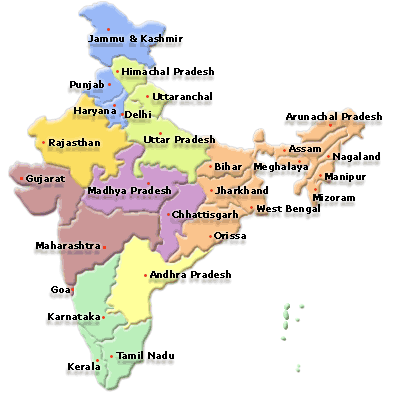
Before, I wrote about India’s election results and the decision of the ruling Congress Party to drastically cut income taxes. And I also wrote about China’s decision to cut taxes on purchases of new automobiles. So did those tax cuts work out for India and China?

Story from the Associated Press

Excerpt:

China extended its lead over the U.S. as the world’s biggest auto market in November, with production and sales both surpassing 1 million vehicles, and India saw sales jump 71.9-percent.

[…]China’s auto market is sizzling, thanks largely to tax cuts and subsidies aimed at supporting the industry and encouraging use of more fuel-efficient vehicles. The boom has clinched China’s status as the world’s biggest vehicle market due to languishing sales in the U.S.

[…]The surge is also a sign of how the Indian consumer — encouraged by government tax cuts, a big disbursement of back pay for government employees and falling interest rates — is fueling economic growth in Asia’s third-largest economy.

As everyone knows, the Democrats chose to bail out auto companies with taxpayer money and reward people with taxpayer money for destroying fully functional vehicles. And we all know how well that has worked out.

Chile poised to jump from the third world to the first world

Check out this editorial from Investors Business Daily. (podcast here)

Excerpt:

Chile is expected to win entry to OECD’s club of developed countries by Dec. 15 — a great affirmation for a once-poor nation that pulled itself up by trusting markets. One thing that stands out here is free trade.

[…]It’s not like Chile was born lucky. Only 30 years ago, it was an impoverished country with per capita GDP of $1,300. Its distant geography, irresponsible neighbors and tiny population were significant obstacles to investment and growth. And its economy, dominated by labor unions, wasn’t just closed, but sealed tight.

In the Cato Institute’s 1975 Economic Freedom of the World Report it ranked a wretched 71 out of 72 countries evaluated.

Today it’s a different country altogether. Embracing markets has made it one of the most open economies in the world, ranking third on Cato’s index, just behind Hong Kong and Singapore. Per capita GDP has soared to $15,000.

Besides its embrace of free trade, other reforms — including pension privatization, tax cuts, respect for property rights and cutting of red tape helped the country grow not only richer but more democratic, says Cato Institute trade expert Daniel Griswold.

But the main thing, Griswold says, is that the country didn’t shift course. “Chile’s economy is set apart from its neighbors, because they have pursued market policies consistently over a long period,” he said. “Free trade has been a central part of Chile’s success.”

Democrats oppose free trade, and their hostility to free trade angers many other countries in the world.

What does it take for a country to succeed?

I gave my Dad my copy of “Money, Greed and God” by Jay Richards, and although he thought that it started out slow, he’s warmed up to it. He calls me on the phone at least twice a day, and last night he alerted me to this web site, where you can track each countries average citizen’s life span and per-capita GDP over time. My Dad was pretty liberal on economics before, so naturally I’ve been working on him with lots of introductory books on economics. He’s read about a dozen now, and Thomas Sowell is his favorite.

Anyway, my Dad says that this is what a country needs to succeed:

  • free trade with other nations
  • the rule of law
  • low judicial activism
  • low tax rates
  • private property protections
  • currency not threatened by inflation
  • low government spending
  • minimal regulation of commerce

And at that web site, you can track the success of countries like Singapore and Hong Kong, which embrace conservative small government free market fiscal policies, and compare them with countries like Zimbabwe and North Korea, which embrace big government protectionist fiscal policies. Countries fail because they adopt the wrong policies. They succeed when they adopt the right policies. It doesn’t matter how poor they start, if they have the right policies, they grow rich over time.

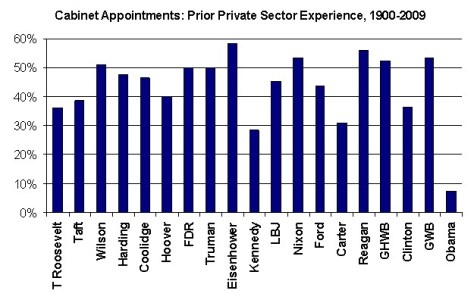
Why are the Democrats so incompetent on economic policy?

Well, it’s because there is almost no one in the Obama socialist regime who has ever run a business or worked in a business. Check out this graphic. (H/T Flopping Aces)

You can read more about the Obama administration’s ignorance of business and economics here in Forbes magazine.

This Reuters article discusses the price of economic ignorance: (H/T Gateway Pundit)

Excerpt:

Hunger is spreading while the number of homeless families is increasing as a result of the recession and other factors, according to a report on Tuesday.

The U.S. Conference of Mayors said cities reported a 26 percent jump in demand for hunger assistance over the past year, the largest average increase since 1991.

Middle-class families as well as the uninsured, elderly, working poor and homeless increasingly looked for help with hunger, which was mainly fueled by unemployment, high housing costs and low wages.

Democrats really don’t know what they are doing. It’s like putting pre-schoolers in charge of Amazon.com. It doesn’t work. Their ivory tower, silver-spoon worldview cannot comprehend real-world, grown-up complexities. So long as the Democrats continue to attack the businesses that employ citizens while redistributing wealth from people who produce to people who vote Democrat, our economic troubles will continue.

Related Cato Institute podcasts