Tag Archives: Finances

Tad Hopp accumulates six figures of college debt, wants taxpayer bailout

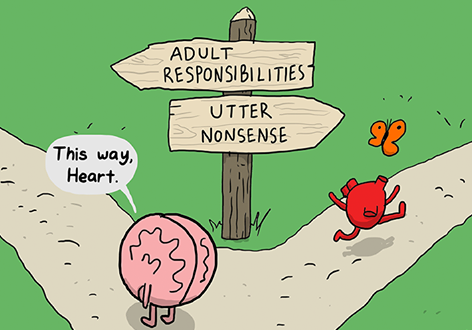
Brain vs Heart, from: theawkwardyeti.com

Here’s an interesting editorial from a “Christian” left blog. (H/T Acton Institute via Lindsay)

The author, Tad Hopp is graduating a PCUSA seminary – an extremely liberal, left-wing denomination.

He writes:

I graduated college in 2007.

[…] I majored in English, not exactly what most people consider a ‘marketable’ or ‘practical’ degree…

[…]I went to a somewhat expensive private school…

[…]I did what many students in their last year of high school do: I went to the school where I felt I was being called…

[…]I do not regret my four years at my undergraduate institution one bit.

[….]When I graduated college, I owed nearly $50,000 in student loan debt and was unemployed for almost six months before I finally found a low-paying office job.

[…]“Can’t find a job? Well, you should have majored in something more ‘practical’, like economics or business or medicine.” Yeah, that would be great…if those were the subjects where my skills and passions lie. They’re not.

[…]I felt called to go to seminary.

[…]I will graduate seminary with close to six figures worth of student loan debt.

Let’s take stock of what he’s said so far:

  • he studied English, a language that he already spoke, which has one of the lowest employment rates
  • he was warned by people who knew something about earning and saving money not to study English
  • he went to a school he couldn’t afford to go to, and he graduated with $50,000 in debt
  • he went to seminary, another subject that doesn’t pay, and added another $50,000 or so of debt
  • he says that he doesn’t have to study subjects that lead to a career because he isn’t “passionate” about them
  • he “followed his heart” by going to the school that he had mystical, emotional, intuitions about = “calling”

My advice to Tad at this point would be for him to take the Bible seriously when it says this:

2 Thessalonians 3:10:

10 For even when we were with you, we used to give you this order: if anyone is not willing to work, then he is not to eat, either.

And 1 Timothy 5:8:

8 But if anyone does not provide for his own, and especially for those of his household, he has denied the faith and is worse than an unbeliever.

Now, for a Bible-believing Christian, these are inerrant and cannot be denied. But we have to go outside the Bible and learn how the world really works in order to figure out how to achieve those stated goals. Why should anyone hire us? What is working really about?

But even before looking at economics, Tad needs to push away all his friends who tell him to “follow his heart” and stick close by his friends who understand economics, who have jobs already, who have savings already, and so on. Don’t look for advice from dreamers, you look to advice from doers – people who can read the times, run the numbers and who have demonstrated the ability to create plans that work to achieve results that please God. When it comes to planning about the future, look at the past accomplishments. Weaving a happy narrative sounds nice, but judge future predictions based on past performance.

I would recommend that Tad read an economist like Thomas Sowell, especially on work, prices, etc., and realize that work means providing value to others. It then follows that he is obligated by the Bible to NOT “follow his heart”, but to instead do something that offers value to his fellow man. Prices are a way of determining what is most valued by your fellow man. And we know what careers have the highest starting salaries and mid-career salaries:

Starting and Mid-Career salaries by profession (click for larger image)

(Source)

Keep in mind that you also have to check to see what the unemployment rate for these fields is, but I think they are all very much in demand, hence the salaries.

I don’t mind if a woman studies English and seminary, but Tad is a man – he has the Biblical obligation to be the primary provider, as we saw in the verses above.

More Tad:

Is the PCUSA doing anything to address this crisis?

[…]What has our government done to address this issue?

[…]I, like so many in my generation, voted for Obama…

[…]It seems to me that we’ve bought into the lie that student loan debt is brought on by the individual person…

[…]You know what I think might stimulate the economy? Automatically cancelling every single outstanding student loan!

[…]If we can spend $640 billion dollars on defense spending, why can’t we find the money to better support public education?

It’s important to understand that an English degree and a seminary degree do not prepare a person to make statements on economics and government. Tad has never studied these things, has no experience in them. He cannot state what the impact of his suggestions would be to all groups, i.e. – he cannot answer “and then what happens?” for every impacted group. Thinking economically is a valuable skill, but as Tad’s personal life shows, it’s not an area he is really knowledgeable about. But he wants to shift money from defense spending (which he knows nothing about) so that he can have a personal bailout. I personally doubt that taxpayers would be better served by paying for his English degree and liberal seminary degree than they would be if a peace-loving democracy could project power abroad to deter aggression from countries like North Korea, Iran, Russia, China and Syria.

Here is the solution to Tad’s problems:

  • we need to put Tad to work in a minimum wage job and confiscate his entire salary, until his loans are paid off.
  • we need to put Tad on a watch list such that he is never allowed to borrow money from anyone ever again.
  • once Tad’s loans are paid off, he should be taxed on his future earnings at the top tax rate for the rest of his life. The money we tax from him can fund education – that’s what he said he wanted.
  • Tad and his household should all be barred from collecting any money for unemployment, welfare or other social programs.

That’s the only bailout Tad should get. It would actually be in his best interest that he encounter real life as quickly as possible, because the longer he waits, the harder it’s going to be for him to recover to independence. He needs to stop his crazy retreat from adult responsibilities, and start working and saving now. I would say that at this point, marriage and parenting is out of the question for him (in another post, he comes out as gay, so that also complicates things). And he can thank the politics of the secular left for marriage and family being less affordable now, thanks to laws like Obamacare, which raised the cost of health care by thousands of dollars. I found it interesting that he actually did work at some point but he mocked the job as a “dead-end job” – as if it was beneath him.

I know some of you will be thinking, “but God called him things and so of course God is going to bail him out with $100,000 for his student loans”. But the thing is, God doesn’t usually work like that. First, I don’t accept that he is a Christian at all. Second, just because you have feelings that your plan will work, that isn’t a calling. The truth is that you certainly can assess the feasibility of things that you feel “called” to do, and if the plan looks crazy, then don’t do it. If you find yourself at odds with wise, practical people when explaining your calling to them, then you’re probably doing it wrong.

Pre-marriage counseling is good, and pre-engagement counseling is even better


Painting: "Courtship", by Edmund Blair Leighton (1888)
Painting: “Courtship”, by Edmund Blair Leighton (1888)

OK, I was chatting with my friend McKenzie who recently got married to an amazing Christian man. She and I are both big believers in asking questions during the courtship. She sent me this article from Verily magazine that has a nice story, and lots of questions.

The article starts like this:

When you know, you know. And with Zach, I knew. Just eleven months into dating, I knew this was the man I wanted to marry. Zach felt the same about me. But instead of putting a ring on it then and there, we decided to seek out a pastor for pre-engagement counseling. You read it right, pre-engagement.

It might sound intense or premature at first, but I am here to tell you that it has been an awesome experience. Sure, the deal isn’t sealed until you say “I do,” but engagement is a huge decision, too. I don’t want to get engaged and then deal with our baggage. When Zach proposes marriage to me, I want my “Yes!” to be with eyes wide open, and pre-engagement counseling has really helped us move in that direction.

What has been so great about pre-marriage preparation? It’s a structured way for us to explore the most important ideas that will be the foundation of our marriage. We have a session once every two weeks for about an hour and a half, during which we’re working through the book Preparing for Marriage by Dennis Rainey with our pastor through homework assignments and discussing together. Of course, pre-marriage counseling can take many forms, but no matter where you might go to get pre-marriage counseling, there are certain things I think any couple should consider before truly committing. Whether you work through them pre-marriage or pre-engagement, like us, is up to you.

She has 4 sections and here they are:

  1. PERSONAL HISTORY
  2. FAMILY
  3. EXPECTATIONS
  4. MONEY MATTERS

The whole essay is very practical, but let me just quote the one that stood out to me:

Few people enjoy talking about money, and Zach certainly did not look forward to this conversation. But money, how we think about it and what we do with it, plays a big part in marital happiness. In our pre-engagement sessions we were posed with great questions when talking about finances. Here are a few of the important questions to cover in a conversation about money:

  • Who will be the primary financial provider in the family?
  • How will you decide on major purchases?
  • Who will pay the bills, balance the checkbook, and keep track of expenses?
  • What is your philosophy of giving (charitable donations to your church or other organizations), and how will you make decisions about giving?
  • What is your conviction about debt and the use of credit cards?

These were just a handful of the financial questions we were asked to think about. We also discussed how we want to handle our finances as a couple and individually (joint or separate bank accounts). It’s a lot to think about, but the goal was to get on the same page.

What I am seeing a lot of these days – I am literally seeing this everywhere – is when older women prefer to date and marry younger men who do not have jobs and who either never did some sort of post-high-school job training or are still students into their mid-20s. And I know why they do that. Younger men who are not serious about providing are very, very easy for older women to manipulate. She can throw out pretty much any crazy plan she wants – and maybe say “God told me” – and he will have no authority from his own life experiences to second guess her. Because he is not responsible or disciplined himself. Young women not only struggle enormously with respecting men, they also prefer men who they do not have to respect, so they can run the relationship based on their own feelings and intuitions.

I have also encountered a very strange attitude among young women where they think that hard work in an area that doesn’t pay is as “promising” as hard work in an area that does. Actually, this isn’t true. Some people work very hard at things that don’t pay, and some people just choose things that do pay and don’t work as hard at them. What matters is not how hard you work, it’s what is in demand. An engineer working a 40 hour week is probably going to make a lot more than a graduate student working 80 hour weeks. Or an assistant professor working 80 hour weeks. The important thing is not to just be busy and organized. It’s much safer to choose a field where you can earn a good salary without killing yourself. Work stress is a stress on the marriage, especially if both spouses have to work because the male provider isn’t making enough.

There is no substitute for earning and saving money. You can’t run a marriage without money – somebody has to pay the bills. Pre-engagement counseling is useful to find out whether one or both people has a proven record of being able to earn, save, and invest. If both people have never earned, saved, or invested, that’s a pretty bad sign. Especially the way things are going with the economy and the national debt. Marriage poses serious financial challenges, and they cannot be wished away. If your plan for prosperity is to discern God’s mysterious will through your feelings and intuitions, then you should make a new plan.

How to go to college without going into debt for the rest of your life

Choosing the right major
Choosing the right major: study one of these, or learn a trade that pays well

First, watch this this 5-minute video that explains why college is so expensive:

This video clearly makes two points:

  1. College costs more because of government subsidies
  2. Only STEM degrees are worth taking out loans for, because there is a demand for STEM-degree holders

Now, in a previous post, I explained more about what’s in the video, and linked to appropriate sources (the New York Times) for support.

But this time, I want to get some advice from a friend of mine, the famous Lindsay. She has a BS and MS in biology, was admitted to a PhD program in biology, but then decided to become a stay-at-home wife, and the best homeschooling mom in the whole world.

She writes:

It is possible to go to college and get a degree that will prepare you for a job and to do it without drowning yourself in debt. I did it. I graduated with a Master’s degree in Biology, with a 4.0 GPA throughout, with no debt, and got a job right out of college. But I’m the exception. You can’t just do what everyone else is doing and expect things to work out well for you. You have to be smart and informed or you’re likely to end up an unhappy statistic, paying down enormous debt on a degree you never use.

She has 5 pieces of advice for you young people.

Here’s my favorite:

5) Remember that the proper amount of student loans is zero and any non-zero amount must be justified by careful study and number-crunching to make sure it is worth it. Your future is at stake. In my experience, the only time student loans are an acceptable investment is when you’re going into a high paying field (think doctor, lawyer, or engineer), have very high graduation and employment potential (good grades and some work experience), and your realistic (not idealistic) future income will be sufficient to pay for your total student loans in less than 10 years while also allowing you to cover all your living expenses. You have to crunch the numbers and make sure the investment, including the interest you will pay, is worth it in better job prospects and pay than you could achieve without the degree. You can’t rely on the system to check this for you. They are all too happy to mortgage your future for a degree you can’t afford and that won’t get you a job.

Straight talk from the Lindsay.

I guess I should say something about me. It’s hard for me to remember the numbers exactly, but I think I finished my Bachelor of Computer Science with $9,000 in the black, and then graduated with a Masters of Computer Science with $16,000 in the black. As Lindsay advises in her point #4, I worked in the summers and took two semesters off (in my BS) to work full time. I went to a very ordinary school in my home town for both degrees, and chose all programming courses as much as I could. I stayed away from anything theoretical, and even niche courses. (At least until graduate school – then I went crazy and audited 5 theoretical courses in addition to my programming courses and thesis). I do recommend working in some work related to your degree, at least in the summer, even if you don’t get paid. However, if you can’t find paid work in the summer related to your degree, that’s a pretty good sign that you’re not in a program that is going to pay for itself.

I mentor a lot of young Christian men and women about their educations and careers. Of all the other young Christians I mentor, everyone is in a STEM program, except for these two girls in California who just started working on. One got a job on Monday night, and the other one (who is shy) is investigating getting a promotion at her current job, as well as adjusting the courses she is taking now. Parents really need to be on top of the education and career situation of their children. And older Christians like me, well we need to be taking an interest in young Christians… making sure they study apologetics, apply themselves in school, study for jobs that pay – either in vocational training or in a STEM college program. Something where they  can find a job that pays. This is especially important for men, because they are tasked with the role of primary provider.

By the way, college is not for everyone. Previously, I blogged about the specialty welder who has struck it rich. There are many advantages to being in a field like that where you get to work as much or as little as you want, instead of working 40 hours a week regardless of money requirements. If you don’t like welding, here’s a list of blue-collar jobs that pay well.