Tag Archives: Feminism

Is it easy for a woman to get pregnant after age 30?

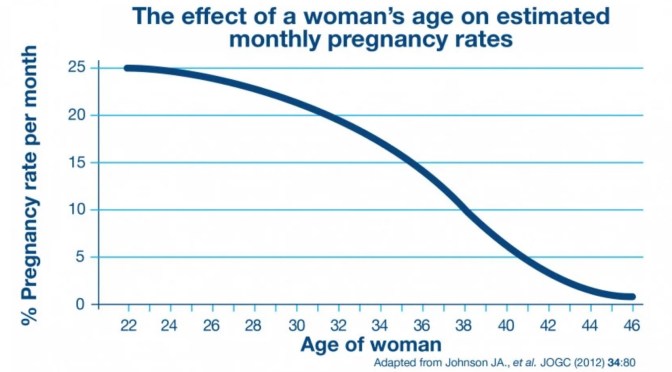
This UK Daily Mail article is a bit old now, but I still it’s important to spread around the knowledge about when a woman’s fertility starts to decline. Somehow, in this age of feminism, there is this idea that women can put off pregnancy into their 40s. The truth is quite different. Let’s take a look at the facts from an unlikely source – the British socialist single-payer health system.

It says:

One of Britain’s top NHS fertility specialists last night issued a stark warning to women: Start trying for a baby before you’re 30 – or risk never having children.

In a strongly worded letter to Education Secretary Nicky Morgan, consultant gynaecologist Professor Geeta Nargund has also demanded that teenagers are taught about the dangers of delaying parenthood, because of the spiralling cost to the taxpayer of IVF for women in their late 30s and 40s.

Professor Nargund cites the agony of a growing number of women left childless as a key reason why fertility lessons must be included in the national curriculum. Her controversial intervention – in which she warns Britain faces a ‘fertility timebomb’ – will fuel the debate over the best time to start a family, amid the rise in women delaying motherhood to pursue careers.

[…]Arguing passionately for fertility lessons, she tells Mrs Morgan: ‘Information is power and the best way to empower people to take control of their fertility is through education.’ Prof Nargund said last night: ‘Ideally, if a woman is ready for a child, she should start trying by the time she is 30. She should consider having a child early because as a woman gets older, her fertility declines sharply.’

If a woman started trying early enough, doctors would still have time to diagnose problems and take action before it was too late, she said.

Her comments were endorsed by Professor Allan Pacey, outgoing chair of the British Fertility Society.

‘You need to be trying by 30 because if there is a problem and you need surgery, hormones or IVF, then you’ve got five years to sort it out,’ he said. ‘If a woman starts trying at 35, doctors have got to sort it out when she is already on a slippery fertility slope’.

Let’s see how accurate women’s beliefs about fertility and age are.

Consider this article from Aeon magazine.

It says:

Many studies show that women are not only woefully ignorant when it comes to fertility, conception and the efficacy of assisted reproductive technologies (ART) – but they overestimate their knowledge about the subject. For instance, a 2011 study in Fertility and Sterility surveyed 3,345 childless women in Canada between the ages of 20 and 50; despite the fact that the women initially assessed their own fertility knowledge as high, the researchers found only half of them answered six of the 16 questions correctly. 72.9 per cent of women thought that: ‘For women over 30, overall health and fitness level is a better indicator of fertility than age.’ (False.) And 90.9 per cent felt that: ‘Prior to menopause, assisted reproductive technologies (such as IVF) can help most women to have a baby using their own eggs.’ (Also false.) Many falsely believed that by not smoking and not being obese they could improve their fertility, rather than the fact that those factors simply negatively affect fertility.

[…]According to a 2011 study in Human Reproduction, which surveyed 410 undergraduate students, most overestimated a women’s chances of spontaneous pregnancy in all age groups, but particularly after receiving IVF beyond age 40. Only 11 per cent of the students knew that genetic motherhood is unlikely to be achieved from the mid-40s onward, unless using oocytes or egg cells frozen in advance. ‘This can be explained by technological “hype” and favourable media coverage of very late pregnancies,’ the authors concluded.

People see graphs of pregnancy chances, but they forget that the rate of miscarriage is also increasing as you age. So, even if you get pregnant, there is a higher risk of miscarriage. Not to mention ectopic pregnancies, and pregnancy complications. It’s also harder to get pregnant your first time after age 30. It’s easier to get pregnant after 30, if it’s not your first time. Also, pregnancies after 30 are much harder on a woman’s body than pregnancies in her 20s.

So, I guess now I’ll issue my advice to women in their 20s on how to avoid infertility:

If you went to college, chances are that you absorbed a lot of feminism. Feminism emphasizes being free of constraints, feeling happy, having fun, career over family, and independence from the needs of men and children. You need to renew your mind in order to undo the cultural denigration of marriage and children. Get yourself a marriage mentor, ask for book recommendations that will educate you about the challenges and rewards of marriage. A good marriage mentor will explain to you why marriage is a better plan than the feminist plan, and will emphasize self-denial, self-sacrifice, self-control and serving others. It’s only by getting specific about marriage and parenting that your heart will change to want to work on marriage rather than work on the things that the feminist culture prefers.

I guess my closing advice would be to be careful about the things you hear about marriage in the culture. It’s very tempting to just believe the words of other people, when they tell you what you want to hear. A lot of people have agendas that sound good, but ultimately, they don’t satisfy. Once your fertility is gone, it’s really gone. IVF and egg-freezing are expensive and unreliable. Again, you should look into this yourself, rather than rely on people who say whatever you want to hear so that you will like them.


Are all sins equally bad? Or are there degrees of severity for different sins?

This question came up recently so I did some digging on theology web sites to find what Bible verses applied to the question.

Here’s what Ligonier said:

It’s clear that we have different degrees of sin when we consider the warnings of Scripture. There are at least twenty-two references in the New Testament to degrees of rewards that are given to the saints in heaven. There are different levels, different rewards, and different roles in heaven. The Bible warns us against adding to the severity of our judgment. Jesus said to Pontius Pilate, “He who delivered me over to you has the greater sin” (John 19:11). Jesus measures and evaluates guilt, and with the greater guilt and greater responsibility comes the greater judgment. It’s a motif that permeates the New Testament.

The idea of gradation of sin and reward is based upon God’s justice. If I commit twice as many sins as another person, justice demands that the punishment fits the crime. If I’ve been twice as virtuous as another person, justice demands that I get more of a reward. God tells us that entrance into heaven will be only on the basis of the merit of Christ, but once we get to heaven, rewards will be dispensed according to works. Those who have been abundant in good works will receive an abundant reward. Those who have been derelict and negligent in good works will have a small reward in heaven. By the same token, those who have been grievous enemies of God will have severe torments in hell. Those who have been less hostile will have a lesser punishment at the hands of God. He is perfectly just, and when He judges, He will take into account all of the extenuating circumstances. Jesus said, “I tell you, on the day of judgment people will give account for every careless word they speak” (Matt. 12:36).

A while back, my friend Dina sent me a sermon where that exact passage (John 19) was brought up by the pastor.

I think the correct position is that any sin is enough to separate you from God, but some sins are more severe than others in God’s objective standard of right and wrong.

OK, that was fine and good, but then I noticed a few days later that Michael Krueger had also blogged about this “all sin are equal” view, too.

Krueger says this:

First, to say all sins are the same is to confuse the effect of sin with the heinousness of sin.  While all sins are equal in their effect (they separate us from God), they are not all equally heinous.

Second, the Bible differentiates between sins. Some sins are more severe in terms of impact (1 Cor 6:18), in terms of culpability (Rom 1:21-32), and in terms of the judgment warranted (2 Pet 2:17;  Mark 9:42; James 3:1).

Even more Bible references, so we’re not on the wrong track.

So then why do some people insist that all sins are equal? It turns out that it is coming from the secular ideal of non-judgmentalism.

Krueger explains:

We should begin by observing that this phrase does not come from Scripture.  People do not use it because it appears in the Bible. Why then do they use it?

One reason, as noted above, is that some Christians use this phrase to uphold the seriousness of sin. It is viewed as a way to remind people not to be dismissive about their sin or regard it is a triviality.

Others use this phrase as way to “flatten out” all sins so that they are not distinguishable from each other.  Or, to put it another way, this phrase is used to portray all human beings as precisely the same.  If all sins are equal, and all people sin, then no one is more holy than anyone else.

In a world fascinated with “equality,” this usage of the phrase is particularly attractive to folks. It allows everyone to be lumped together into a single undifferentiated mass.

Such a move is also useful as a way to prevent particular behaviors from being condemned.  If all sins are equal, and everyone is a sinner, then you are not allowed to highlight any particular sin (or sinner).

Needless to say, this usage of the phrase has featured largely in the recent cultural debates over issues like homosexuality.  Yes, homosexuality is a sin, some Christians reluctantly concede.  But, they argue, all sins are equal in God’s sight and therefore it is no different than anything else.  Therefore, Christians ought to stop talking about homosexuality unless they are also willing to talk about impatience, anger, gluttony, and so on.

Krueger also posted this fascinating follow up post, where he looks at how the phrase is being used by people on Twitter.

Look at these tweets:

  • All sins are equal. People tend to forget that. There is no bigger or smaller sin. Being gay and lying, very equal.

  • all sins are equal in God’s eyes. whatever you’re doing, is no better than what someone else is doing.

  • If you have sex before marriage please don’t come on social media preaching about the wrongs of homosexuality. All sins are equal

  • Need people to realize that all sins are equal… don’t try to look down on me or question my faith just cuz you sin differently than I do.

  • Don’t understand why you’re so quick to judge me, when all sins are equal. So much for family..

  • if you think being gay is a sin, let me ask you something, have you not done anything wrong in your life? all sins are equal. we’re sinners

  • Nope no difference at all. All sins are equal no matter what you’re running for. The bible says do not judge lest ye be judged

  • A huge problem I have with religion is the notion that all sins are equal. Like pre-martial sex and murder are the same amount t of bad.

  • people do bad things because they believe that all sins are equal and ~god~ loves y’all equally so he’s going to forgive you naman ha ha ha

  • It a sin to condemn another sinner and their actions. All sins are equal. So what makes you better than the person you’re condemning?

  • I think so b/c having sex before marriage doesn’t make you less of a women then if you waited until marriage.. all sins are equal soo

  • friendly reminder, all sins are equal in gods eyes so you’re not better than I am in any way. please worry about your own sins before mine.

  • People don’t like when I suggest abortion as an option. This is a free country and all sins are equal so mind your business!!!

  • What I do is no worse than wat you do… all sins are equal no matter what it is… a sin is a sin

  • to god all sins are equal so you have no right to compare your sins to someone else’s bc in the end it doesn’t matter

The first thing that I noticed is that premarital sex and homosexuality are the most popular sins. I would think that divorce and abortion would be up there in the rankings, as well.

Something strange has happened in our society such that more and more people want to be led by their feelings, rather than be bounded by rules or standards. When people get caught breaking moral rules, rather than be accountable, they attack the person judging them. They would rather escape the judgment of their peers than admit fault and try to fix the mistake, and do better next time.

It’s so bad now, that the people who have morals and who make moral judgments are seen as the real bad people. The immoral people are on the offense, and even trying to ban people from being able to disagree with them. We’re seeing that with people who are being attacked for defending natural marriage against divorce and redefinition of marriage. In France, they want to make speech critical of abortion a criminal offense. And in Canada, they’ve now made speech critical of the gay agenda a criminal offense. (It’s already a human rights tribunal offense)

What is even more interesting is when the people who push the “don’t judge me” line try to justify it from the Bible. Very strange, but we seem to have forgotten the value of setting moral boundaries. Now moral boundaries are “evil”. Instead, having compassion for people who break the moral boundaries and harm themselves and others is “good”.

William Lane Craig’s secret weapon is his amazing wife Jan

My favorite painting: "Godspeed" by Edmund Blair Leighton, 1900
My favorite painting: “Godspeed” by Edmund Blair Leighton, 1900

This classic post was mentioned in a previous episode of the Reasonable Faith podcast.

I want to draw your attention to a talk on “Vision in Life” given by Dr. William Lane Craig. Dr. Craig is the ablest defender of the Christian faith operating today. He has done formal academic debates with all of the best known atheists on major university campuses in front of thousands of university students.

It turns out that he owes a lot of his success to his amazing wife Jan.

The MP3 file is here. (32 minutes)

This talk was Dr. Craig’s chapel address to Biola University students.

About 11 minutes into the talk, Bill describes what happened after he finished his Bachelor’s degree at Wheaton:

And so I joined the staff of Campus Crusade for Christ for 2 years, and was assigned to Northern Illinois University. And that was where I met my wife Jan. She was a graduate of the University of North Dakota where she had come to faith in Christ. And she had a similar vision for her life of evangelism and discipleship.

And as we worked at NIU together, she with gals and I with the guys, leading students to Christ and discipling them to walk with the Lord, we fell in love. And we decided that we would be more effective if we joined forces and became a team.

So their reason for getting together was because they thought that they would be more effective in evangelism and discipleship if they worked as a team.

It is at this point in the talk where Bill begins to explain just how Jan molded him into the lean, mean debating machine that travels the world striking terror into the hearts of atheists.

Bill’s first story about Jan occurs early after their marriage while he is working on his first Masters degree at Trinity:

And it was also at that time that I began to see what an invaluable asset the Lord had given me in Jan. I remember I came home from classes one day, and found her at the kitchen table with all the catalogs and schedules and papers spread out in front of her and she said, “look! I’ve figured out how you can get two Masters degrees at the same time that it would normally take to get one! All you have to do is take overloads every semester, go to all full-time summer school and do all these other things, and you can do two MAs in the time it takes to do one!”

And I thought, whoa! Are you sure you really want to make the commitment it takes to do this kind of thing? And she said, “Yeah! Go for it!” And it was then I began to see that God had given me a very special woman who was my supporter – my cheerleader – and who really believed in me. And as long as she believed in me, that gave me the confidence to dream bigger dreams, and to take on challenges that I had never thought of before.

In an article on his web site, he talks about how Jan encouraged him to do his first Ph.D:

As graduation from Trinity neared, Jan and I were sitting one evening at the supper table in our little campus apartment, talking about what to do after graduation. Neither of us had any clear leading or inclination of what we should do next.

So Jan said to me, “Well, if money were no object, what would you really like to do next?”

I replied, “If money were no object, what I’d really like to do is go to England and do a doctorate under John Hick.”

“Who’s he?” she asked.

“Oh, he’s this famous British philosopher who’s written extensively on arguments for the existence of God,” I explained. “If I could study with him, I could develop a cosmological argument for God’s existence.”

But it hardly seemed a realistic idea.

The next evening at supper Jan handed me a slip of paper with John Hick’s address on it. “I went to the library today and found out that he’s at the University of Birmingham in England,” she said. “Why don’t you write him a letter and ask him if you can do a doctoral thesis under him on the cosmological argument?”

What a woman! So I did, and to our amazement and delight Professor Hick wrote back saying he’d be very pleased to supervise my doctoral work on that subject. So it was an open door!

And in the same article, he explains how Jan encouraged him to get his second Ph.D:

As Jan and I neared the completion of my doctoral studies in Birmingham, our future path was again unclear to us. I had sent out a number of applications for teaching positions in philosophy at American universities but had received no bites. We didn’t know what to do.

I remember it like yesterday. We were sitting at the supper table in our little house outside Birmingham, and Jan suddenly said to me, “Well, if money were no object, what would you really like to do next?”

I laughed because I remembered how the Lord had used her question to guide us in the past. I had no trouble answering the question. “If money were no object, what I’d really like to do is go to Germany and study under Wolfhart Pannenberg.”

“Who’s he?”

“Oh, he’s this famous German theologian who’s defended the resurrection of Christ historically,” I explained. “If I could study with him, I could develop a historical apologetic for the resurrection of Jesus.”

Our conversation drifted to other subjects, but Jan later told me that my remark had just lit a fire under her. The next day while I was at the university, she slipped away to the library and began to research grants-in-aid for study at German universities. Most of the leads proved to be defunct or otherwise inapplicable to our situation. But there were two grants she found that were possibilities. You can imagine how surprised I was when she sprung them on me!

Both of these Ph.D experiences are also described in the talk. And the talk concludes as follows:

I am so thankful to be married to a woman who is tremendously resourceful, tremendously talented and energetic, who could have pursued an independent career in any number of areas, but instead, she has chose to wed her aspirations to mine, and to make it her goal to make me the most effective person I can be, for Christ. And she has been like my right arm in ministry over these many years. And it is a tremendous privilege to be a team with a person like that.

And you young men, I would encourage you, if you marry, to find a gal who shares your vision, not some independent vision, but who is interested in aligning herself with you, and pursuing together a common vision and goal that will draw you [together], so that you will avoid the growing separateness that so often creeps into marriages.

And now you know the rest of Bill’s story. The person you marry will have an enormous influence on the impact you will have for Christ and his Kingdom. It is up to you to decide whether that influence is going to be positive or negative, by deciding if you will marry, and if you do marry, by deciding whom you will marry.

You may also be interested in this talk given by William Lane Craig, entitled “Healthy Relationships” (National Faculty Leadership Conf. 2008) (audio here) In that talk, he offers advice to Christians who want to have a marriage that is consistent with their Christian faith.