Tag Archives: Feminism

Why are boys struggling to succeed in school and to find jobs?

Although you might think that there are no reasons for boys underperforming in school and work, a little research shows that this is not the case.

The first reason boys are struggling is because of no-fault divorce. No-fault divorce allows either person in the marriage to end the marriage for any reason or for no reason at all. It was passed because radical feminists and trial lawyers pushed for it. Each special interest group stands to benefit from it in different ways. Feminists oppose the complementary nature of marriage, and trial lawyers just want to drain as much money as they can out of disintegrating families.

70% of divorces are initiated by women, and this is because women tend to emphasize their own subjective feelings of happiness over the objective commitment they make at the wedding. Women today are influenced by feminism to care more about their happiness than they do about loving and serving others, especially husbands and children. This is especially true of the ones who lack trustworthy male influences. The most unstable relationships are lesbian relationships, because there you have two happiness-seekers and no promise-keepers.

In addition, feminism causes women to lose the ability to evaluate men according to traditional male roles, making them vulnerable to predators who do not have the ability to commit to them self-sacrificially. Do you ever wonder why you see single mothers living with atheist men who deliver pizzas and playing video games at age 30? Why is that? Because feminism taught her that men are not better when they are chaste providers and protective mentors. According to feminism, men have no special role as protector, provider and moral/spiritual leader.  Many just pick the best-looking, most entertaining, least demanding, easiest to control man they can find. Someone who doesn’t lead her to behave morally, control her emotions, and put the needs of others above her own desires.

So what happens to boys when marriages can be dissolved so easily?

This article from the Centre for Economic Policy Research explains:

To assess the long-run effect of divorce, we analyse children’s human capital and demographic outcomes. First, we examine college attendance. In Austria, college attendance implies that this person graduated from a higher secondary school. Second, we check the labour market status (employed; unemployed; out-of-labour force) up to the age of 25 years. Third, we examine children’s own family formation behaviour (i.e. fertility and marriage). Finally, we investigate the probability of early mortality (below 25 years of age). Our results show that parental divorce – due to a high level of sexual integration in fathers’ workplaces — has a negative effect on children’s long-term outcomes. Our main findings for human capital outcomes are summarised in Figure 1…

Here’s Figure 1:

Figure 1
Figure 1 (click for larger image)

And Figure 3:  The effect of parental divorce on employment over time.
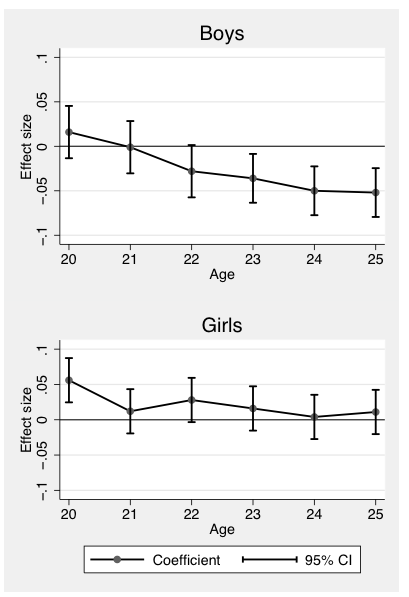
Figure 3
Figure 3

If you want boys to transition into marriage-minded men, you need to fight against no-fault divorce.

The War Against Boys

The other problem affected boys is also rooted in feminism. Feminism is deeply suspicious of male teachers and male administrators in the schools. As a result, schools tend to be dominated by female teachers and female administrators. Many of these women are feminists, and they seek to change the nature of education from something that is fair to boys and girls, to something that punishes boys and gives the advantage to girls. In addition, feminists in the education industry tend to oppose allowing boys to attend all-male schools, where boys perform at much higher levels.

This article in the left-leaning The Atlantic explains how the school system punishes boys and favors girls – from kindergarten to the workplace, where women receive affirmative action preferences.

Excerpt:

American boys across the ability spectrum are struggling in the nation’s schools, with teachers and administrators failing to engage their specific interests and needs. This neglect has ominous implications not only for the boy’s social and intellectual development but for the national economy, as policy analysts are just beginning to calculate.

[…]Women in the United States now earn 62 percent of associate’s degrees, 57 percent of bachelor’s degrees, 60 percent of master’s degrees, and 52 percent of doctorates.

Boys in all ethnic groups and social classes are far less likely than their sisters to feel connected to school, to earn good grades, or to have high academic aspirations. A recent working paper from the National Bureau of Economic Research documents a remarkable trend among high-achieving students: In the 1980s, nearly the same number of top male and female high school students said they planned to pursue a postgraduate degree (13 percent of boys and 15 percent of girls). By the 2000s, 27 percent of girls expressed that ambition, compared with 16 percent of boys. During the same period, the gap between girls and boys earning mostly A’s nearly doubled—from three to five percentage points.

This gap in education engagement has dire economic consequences for boys. A 2011 Brookings Institution report quantifies the economic decline of the median male: For men ages 25 to 64 with no high school diploma, median annual earnings have declined 66 percent since 1969; for men with only a high school diploma, wages declined by 47 percent. Millions of male workers, say the Brookings authors, have been “unhitched from the engine of growth.”  The College Board delivered this disturbing message in a 2011 report about Hispanic and African-American boys and young adults: “Nearly half of young men of color age 15 to 24 who graduate from high school will end up unemployed, incarcerated or dead.” Working-class white boys are faring only slightly better. When economist Andrew Sum and his colleagues at the Center for Labor Market Studies at Northeastern University examined gender disparities in the Boston Public Schools, they found that for the class of 2007, among blacks and Hispanics, there were 186 females for every 100 males attending a four-year college or university. For white students: 153 females to every 100 males.

Note that radical feminists and socialists oppose solving this problem:

In the U.S., a powerful network of women’s groups works ceaselessly to protect and promote what it sees as female interest. But there is no counterpart working for boys—they are on their own.

[…]The reluctance to face up to the boy gap is evident at every level of government. In Washington, President Obama established a White House Council on Women and Girls shortly after taking office in 2009, declaring: “When our daughters don’t have the same education and career opportunities as our sons, that affects…our economy and our future as a nation.” On the other hand, the proposal for a Council for Boys and Men from a bi-partisan group of academics and political leaders has now been languishing in Secretary of Education Arne Duncan’s office for two years.

Similarly, in Maine, the Portland Press Herald ran an alarming story about the educational deficits of boys—reporting that high school girls outnumber boys by almost a 2-1 ratio in top-10 senior rankings, that men earn about 38 percent of the bachelor’s degrees awarded by Maine’s public universities, and that boys both rich and poor had fallen seriously behind their sisters. But the director of Women’s Studies at the University of Southern Maine, Susan Feiner, expressed frustration over the sudden concern for boys. “It is kind of ironic that a couple of years into a disparity between male and female attendance in college it becomes ‘Oh my God, we really need to look at this. The world is going to end.’”

The rest of the Atlantic article explains how to solve this problem. And the proven solutions clearly show that the problem is not with boys, it’s with an education system that discriminates against boys, making it harder for them to learn the skills they need to find work.

So, the tendency of young men to stay home and play video games comes from discrimination against men in the education system, and no-fault divorce laws that allow spouses (mostly women) to divorce easily. It is women who need to do a better job of “womaning up” to attack no-fault divorce and discrimination against boys in school. But pro-male voices among women are few and far between. Women tend to go along with what makes them look good to others in the culture, and what gives them the most autonomy to pursue happiness (unless they are balanced out by strong men who lead them), and that means the most women tend to just ignore the root causes of male decline.  When I see single women overwhelmingly supporting the anti-male Democrat party, it just tells me that they are not serious about marriage. Whether they intend to or not, they are killing marriage with their political support for misandry.

It would be nice if we got some leadership from pastors in the churches on this issue. It would be if nice the pastors could challenge women to think about how their voting and advocacy of certain policies affect boys. Basically, if pastors could get women to think “and then what happens” to boys who experience no-fault divorce and anti-male schools. But most pastors are like women, and they put more emphasis on being liked based on what is valued in the secular culture. It’s easier for them to remain ignorant and bash men than to pick up a book on education or divorce and read it. If we have a crisis of masculinity, it began in the church, from the “men” behind the pulpit. They need to man up and challenge the feminism that is killing marriage.

Young women: one of the best things you can do is marry and raise children

Does government provide incentives for people to get married?
Should women postpone marriage and raising children for other things?

Super-mom Lindsay sent me this article about by a former feminist who was once opposed to children, then had 4 of them in 5 years.

Introduction:

Up until my mid-20’s I was firm in my belief that I never wanted to have kids. A combination of events made me reconsider the issue, and by the time we got married I was open to the idea of having some pre-set, small number of kids and had begun thinking about the precise timetables on which I would have them.

[…]It would have been inconceivable to me to imagine that constantly having my plans derailed by pregnancies and not even having any idea when I’d be done changing diapers would be an improvement over my fully controlled, well-ordered life, but it has been.

[…]Lately I’ve been imagining what I would say to 2003 Jen if I could go back in time and give her a crystal ball to show her what her future would be like. I’ve been trying to imagine how I would talk her down from the balcony ledge after the crystal ball got to the “four kids in five years — and doing NFP!” part, how I could possibly convince her that this life is not only not a recipe for misery, but the true fulfillment of everything she thought she wanted.

I would love to tell you that I’d simply be able to explain that each child is such a joy and a blessing, but that would not have resonated with Old Jen; I might have agreed, but ultimately I would have said that those joys and blessing are just too much hard work. “I just don’t see how that kind of life could be anything but miserable for someone like me,” I would have said.

So how do you convince a woman that “hard work”, i.e. – self-denial, self-control, self-discipline, self-sacrifice – while caring for children could actually lead to a fulfilling life? And most importantly, that it should not be postponed in pursuit of something that appears more fun, more thrilling or more important (according to a feminist measure of fun, thrills and importance).

She makes 5 points in her post.

Here’s one:

3. “It’s not what you do, it’s whom you serve.”

A product of secular society, I’d fallen into the common notion that the way to find true happiness is to focus on yourself more and other people less. It makes perfect sense, after all: doing pleasurable things for me is fun, sacrifice and hard work are not fun; ergo, the secret to happiness must be to live for myself as much as possible. Right?

How shocked I was to discover that I was wrong — dead wrong. Part of fully understanding the concept of vocation was understanding that a vocation is not to be thought of as “what you do” as much as it is “whom you serve.” It was nothing short of revolutionary to hear the concept that God has called every one of us to serve others, that living for yourself is not a valid option; that the key to deep fulfillment, to finding your very purpose in life, is as simple as finding out the specific way in which you’re called to serve. Do that, and you will find peace.

It sounded not only too simple to be true, but too difficult. As a spoiled only child the idea of living to serve sounded terrible. But once I actually took a leap of faith and tried it, I had no doubt that this was truth.

Next,I want to talk about one of the young Christians I mentor, and then about the woman I supported for President in the 2012 election.

I spent Friday night playing with one of the young women I mentor. This is the one who did the BS in computer science, and is now doing the MS in computer science. After playing a few rounds of “Keep Talking and Nobody Explodes”, she mentioned the salary from her internship this summer. She asked me “what am I going to do with so much money? I think I had better stop thinking so much about myself and find some people out there to help”. And I was so pleased. Because this woman, more than any of the other young people I mentor, is my replacement.

J. Warner Wallace likes to talk about training your replacement, and I have several replacements, but none better than her. I remember when she was younger, she was a bit more selfish than now. She still organized events, like bringing Frank Turek, Tim McGrew, etc. to speak on her campus. But she never showed much interest in one-on-one care for others. It was my hope that just like me, she would react to computer science salary with a sense of obligation to others, and so she has. And that’s how I think women ought to be. They should be educated, they should be successful – but they should be open to the needs of others.

Michele Bachmann

The woman I admire the most in the world is former GOP Congresswoman Michele Bachmann, who was my first choice for President in 2012. I had been following her for many years before that, when she was just a state senator. I liked her because of her interest in apologetics, as well as her focus on her family.

Marcus and Michele Bachmann and family

The  radically leftist New York Times did a profile of her.

It says:

Nearly two decades ago, a stay-at-home mother and onetime federal tax lawyer named Michele Bachmann felt a spiritual calling to open her clapboard home here to troubled teenage girls.

“We had our five biological children that God gave to us, and then he called us to take foster children into our home,” Mrs. Bachmann told a Christian audience in 2006. “We thought we were going to take unwed mothers in,” she continued, adding, “We took 23 foster children into our home, and raised them, and launched them off into the world.”

Today Mrs. Bachmann is Representative Bachmann, a Minnesota Republican, first elected to the House in 2006, and now a candidate for her party’s nomination for president. In Washington, she has grabbed the spotlight as a staunch fiscal conservative and brash Tea Party leader. But a look at her life here shows that it was her role as a mother, both to her biological children and to her adolescent foster daughters, that spurred her to seek public office.

[…]Mrs. Bachmann’s political awakening began with her deep disenchantment with the public school system.

[…]By the late 1990s, with her own children enrolled in private Christian schools, Mrs. Bachman was upset by the education her foster children were getting in public school. Teachers gave them “little special attention,” and many were “placed in lower-level classes, as if they were not expected to succeed,” she told a House subcommittee in 2007.

One brought home “an 11th-grade math assignment that involved coloring a poster,” she testified. Another “spent an entire week watching movies.” A third “remarked to me once that she was in ‘stupid people math.’ ”

So Mrs. Bachmann immersed herself in the minutiae of Minnesota’s graduation requirements. She worked with a conservative researcher and began giving talks in church basements.

[…]The Rev. Marcus Birkholz, the pastor at Salem Lutheran Church, which Mrs. Bachmann attended for years, calls her “a lady with energy and a heart” whose uncompromising “support for the unborn” extends beyond fighting abortion. “She sees the whole picture,” Pastor Birkholz said. “It’s not just bringing a child into the world; that child has to be nurtured and educated.”

[…]Mrs. Bachmann, whose biological children now range in age from 17 to 29, worked until her fourth child was born. (Her youngest, Sophia, is headed to college this fall, while the eldest, Lucas, is a medical resident at the University of Connecticut, pursuing a specialty in psychiatry.) Friends remember her planning neighborhood picnics and organizing bicycle parades.

“I had all these balls in the air that I was juggling,” she said in an interview with Minnesota Monthly last year. In choosing to leave work, she said, “I finally realized my dream, which was to be mom of a big, happy family.”

What does it mean? It means that women ought not be horrified by husband needs or children needs. They should not be opposed to responsibilities, expectations and obligations in relationships. Sometimes, the path to greatness means taking a few years off from work to homeschool your kids. After all, isn’t it better for God to have FIVE Christian kids who will surpass you in influence?  Michele didn’t get involved in politics by thinking of herself. She got involved in politics by thinking of her children, and her 23 foster children.

Here’s my advice to young women: 1) Study something hard that pays. 2) Work a few years and get debt free. 3) Marry a good provider in your mid-to-late 20s. 4) Have as many children as your husband can support. 5) Be actively involved in the education of your kids (with apologetics, too). 6) Open your home to kids who don’t have a mom or a dad. 7) Teach your kids the importance of caring for others. 8) Run for President (as a Republican).

Why don’t men talk to women about commitment and marriage any more?

Painting:
Painting: “Courtship”, by Edmund Blair Leighton (1888)

I saw this essay from a young woman named Jordana Narin who is explaining how she feels about not being able to talk seriously to a man she had sex with. She is a radical feminist and has a useless, easy degree in creative writing.

The essay was published in the radically leftist New York Times.

First kiss:

I met [a guy] at summer camp in the Poconos at 14, playing pickup basketball by day and talking in the mess hall late into the night. Back home we lived only 30 minutes apart, but I didn’t see him again until 11th grade, when we ran into each other at a Halloween party in a Lower Manhattan warehouse.

[…]Under the muted flashes of a strobe light, we shared our first kiss.

She spent her first kiss on a guy she barely knew at a party, with no relationship context.

And this is how they talked:

We stayed in touch for the rest of high school, mostly by text message.

[…]Every time his name popped up on my phone, my heart raced.

Still, we were never more than semiaffiliated, two people who spoke and loved to speak and kissed and loved to kiss and connected and were scared of connecting.

Where is this relationship going? This boy has no job and no savings and no proven record of steady work – and therefore he cannot marry anyone.

More:

Two years after our first kiss, we were exchanging “I’ve missed you” messages again. It was a brisk Friday evening in our first semesters of college when I stepped off a train and into his comfortable arms.

He had texted weeks earlier on Halloween (technically our anniversary) to ask if I would visit. We had not talked since summer, and I was trying to forget him. We had graduated from high school into the same inexpressive void we first entered in costume, where an “I’ve missed you” was as emotive as one got.

Long gaps in between text messages – they have nothing to talk about, and there is no goal. Nevertheless, they are away from their parents, and so she had sex with him, losing her virginity to a man she was not married to.

And then:

Naïvely, I had expected to gain clarity, to finally admit my feelings and ask if he felt the same. But I couldn’t confess, couldn’t probe. Periodically I opened my mouth to ask: “What are we doing? Who am I to you?” He stopped me with a smile, a wink or a handhold, gestures that persuaded me to shut my mouth or risk jeopardizing what we already had.

On the Saturday-night train back to Manhattan, I cried. Back in my dorm room, buried under the covers so my roommates wouldn’t hear, I fell asleep with a wet pillow and puffy eyes.

The next morning I awoke to a string of texts from him: “You get back OK?” “Let’s do it again soon :)”

Yes. She had sex with him because of text messages, Facebook comments and because he “missed her”. Not because he had presented his resume and balance sheet to her father, dated her for many months, bought her an engagement ring, courted her for more months, bought her a wedding ring, then walked down the aisle with her.

Why is this happening?

There’s an interview that goes with it on the radically leftist NPR web site, but I saved a copy of the MP3 file here in case it disappears.

Moderate Christian Rod Dreher comments on the interview:

I wouldn’t have understood the full scope of what this young woman is saying in her essay without the interview, which is short. In the segment, Narin says that men and women in her generation don’t have actual romantic relationships anymore. It’s all casual, non-committal sex. “Nobody knows whether their own feelings are real,” she says.

[..]She tells the interviewer that there’s lots of making out and sex, but nobody wants to be emotionally vulnerable to anybody else.

[…]“Everyone in college uses Tinder,” she said, referring to the wildly popular dating and hook-up app. “You can literally swipe right and find someone just to hang out for the night. There’s no commitments required, and I think that makes committing to someone even harder, because it’s so normal, and so expected even, to not want to commit.”

In a different time, my grandparents, my great grandparents, they might have thought they were missing out on casual sex,” she says. “But since my generation has been saddled down with that, we kind of look to the past and say well, wasn’t that nice. I think both are optimal. I’m a huge feminist, and I think women should be able to do whatever they want to do. If a woman wants to have tons of casual sex, she totally should. But I think that there should be the option. And they shouldn’t be gendered, women and men. But there should be the option of being in a relationship.”

Right. Young women like her who have swallowed radical feminism hook, line and sinker don’t want to “miss out” on casual sex right now, but they want to get married “some day” – after they have a lot of fun traveling and doing exciting, fun things.

But what do they think marriage is?

This:

Look at the lyrics:

You got that 9 to 5
But, baby, so do I
So don’t be thinking I’ll be home and baking apple pies
I never learned to cook

After every fight
Just apologize
And maybe then I’ll let you try and rock my body right
Even if I was wrong
You know I’m never wrong

And know we’ll never see your family more than mine

Even when I’m acting crazy
Tell me everything’s alright

This is what women today understand marriage to be. They expect to be pursuing their own careers, not supporting their husbands and raising children. Most feminists view the roles of wife and mother as demeaning. They aren’t interested in supporting or respecting a man who provides for them – they just want him to say yes to whatever they feel like doing – fun and thrills.

The woman singing expects to win every disagreement because, like the song says, she is never wrong. The lyrics also say that sex is conditional on whether the woman feels happy. When it comes to visiting family and holidays, she lets us know that her family is more important than his. And she is allowed to act crazy, which could involve a whole host of selfish, wasteful, narcissistic behaviors, and he is just supposed to celebrate and maybe pay for it. For the rest of his life.

How do men respond to these radical feminists?

Most men are not interested in committing to, or discussing commitment with, radical feminists. Men will have sex with a radical feminist, (not me, but other men), but they will never commit to them. Why not? If a man’s role is just to please the “huge feminist”, then there is no reason to commit to her. Radical feminists believe that relationships are about their plans and their needs. They are not interested in responsibilities, expectations or obligations to men or to children. But men, even secular men, understand that they must not marry a woman who thinks that relationships should impose no obligations on her. Men play dumb with women to keep the sex coming, but there is no way they would commit to such women.

Now there is one exception to this rule, and that’s young, naive men. If a woman is a “huge feminist” then she might be able to get attention from a doormat man without having to give him sex. Typically, these men have no work experience, no savings, are much younger, and are so desperate for attention that they do what Meghan Trainor says in the song: apologize, grovel, condone craziness and selfishness, etc. Although a woman may think she wants a man like that in the short-term, in the long-term, those men prove unattractive and unsatisfactory.

In order to be masculine, a man needs to be a good moral leader and a good spiritual leader. And that means that he needs to call a woman higher, away from her self-centeredness, so she can serve God and serve other people. He cannot just agree with whatever crazy, emotional thing that she thinks up that is fun, thrilling and bound to fail. A good leader has experience as a provider, protector and leader that he brings to bear on decision-making, and proven ability achieving and leading others to greatness. I think women with low self-esteem will be interested in men who are doormats, but that is not the solution to the commitment problem. A doormat man does not have what it takes to provide and lead a family.