Tag Archives: Feelings

Mark D. Linville: does Darwinian evolution make morality rational?

Have you ever heard an atheist tell you that naturalistic evolution is an answer to the moral argument? I have. And I found a good reply to this challenge in the book “Contending With Christianity’s Critics“. The chapter that responds to the challenge is authored by Dr. Mark D. Linville. It is only 13 pages long. I have a link to the PDF at the bottom of this post.

First, a bit about the author:

Blog: The Tavern at the End of the World
Current positions:

  • PhD Research Fellow
  • Tutoring Fellow in Philosophy

Education:

  • PhD in Philosophy with a minor in South Asian Studies and a specialization in Philosophy of Religion, University of Wisconsin-Madison
  • MA in Philosophy, University of Wisconsin-Madison
  • MA in Philosophy of Religion, Trinity Evangelical Divinity School
  • MA in Theology, Cincinnati Christian Seminary
  • BA in Biblical Studies, Florida Christian College

Here is his thesis of the essay:

Darwin’s account of the origins of human morality is at once elegant, ingenious, and, I shall argue, woefully inadequate. In particular, that account, on its standard interpretation, does not explain morality, but, rather, explains it away . We learn from Darwin not how there could be objective moral facts, but how we could have come to believe—perhaps erroneously—that there are.

Further, the naturalist, who does not believe that there is such a personal being as God, is in principle committed to Darwinism, including a Darwinian account of the basic contours of human moral psychology. I’ll use the term evolutionary naturalism to refer to this combination of naturalism and Darwinism. And so the naturalist is saddled with a view that explains morality away. Whatever reason we have for believing in moral facts is also a reason for thinking naturalism is false. I conclude the essay with a brief account of a theistic conception of morality, and argue that the theist is in a better position to affirm the objectivity of morality.

And here’s a sample to get your attention:

But even if we are assured that a “normal” person will be prompted by the social instincts and that those instincts are typically flanked and reinforced by a set of moral emotions, we still do not have a truly normative account of moral obligation. There is nothing in Darwin’s own account to indicate that the ensuing sense of guilt—a guilty feeling—is indicative of actual moral guilt resulting from the violation of an objective moral law. The revenge taken by one’s own conscience amounts to a sort of second-order propensity to feel a certain way given one’s past relation to conflicting first-order propensities (e.g., the father’s impulse to save his child versus his impulse to save himself). Unless we import normative considerations from some other source, it seems that, whether it is a first or second-order inclination,one’s being prompted by it is more readily understood as a descriptive feature of one’s own psychology than material for a normative assessment of one’s behavior or character. And, assuming that there is anything to this observation, an ascent into even higher levels of propensities (“I feel guilty for not having felt guilty for not being remorseful over not obeying my social instincts…”) introduces nothing of normative import. Suppose you encounter a man who neither feels the pull of social, paternal or familial instincts nor is in the least bit concerned over his apparent lack of conscience. What, from a strictly Darwinian perspective, can one say to him that is of any serious moral import? “You are not moved to action by the impulses that move most of us.” Right. So?

The problem afflicts contemporary construals of an evolutionary account of human morality. Consider Michael Shermer’s explanation for the evolution of a moral sense—the “science of good and evil.” He explains,

By a moral sense, I mean a moral feeling or emotion generated by actions. For example, positive emotions such as righteousness and pride are experienced as the psychological feeling of doing “good.” These moral emotions likely evolved out of behaviors that were reinforced as being good either for the individual or for the group.2

Shermer goes on to compare such moral emotions to other emotions and sensations that are universally experienced, such as hunger and the sexual urge. He then addresses the question of moral motivation.

In this evolutionary theory of morality, asking “Why should we be moral?” is like asking “Why should we be hungry?” or “Why should we be horny?” For that matter, we could ask, “Why should we be jealous?” or “Why should we fall in love?” The answer is that it is as much a part of human nature to be moral as it is to be hungry, horny, jealous, and in love.3

Thus, according to Shermer, given an evolutionary account, such a question is simply a non-starter. Moral motivation is a given as it is wired in as one of our basic drives. Of course, one might point out that Shermer’s “moral emotions” often do need encouragement in a way that, say, “horniness,” does not. More importantly, Shermer apparently fails to notice that if asking “Why should I be moral?” is like asking, “Why should I be horny?” then asserting, “You ought to be moral” is like asserting, “You ought to be horny.” As goes the interrogative, so goes the imperative. But if the latter seems out of place, then, on Shermer’s view, so is the former.

One might thus observe that if morality is anything at all, it is irreducibly normative in nature. But the Darwinian account winds up reducing morality to descriptive features of human psychology. Like the libido, either the moral sense is present and active or it is not. If it is, then we might expect one to behave accordingly. If not, why, then, as a famous blues man once put it, “the boogie woogie just ain’t in me.” And so the resulting “morality” is that in name only.

In light of such considerations, it is tempting to conclude with C. S. Lewis that, if the naturalist remembered his philosophy out of school, he would recognize that any claim to the effect that “I ought” is on a par with “I itch,” in that it is nothing more than a descriptive piece of autobiography with no essential reference to any actual obligations.

When it comes to morality, we are not interested in mere descriptions of behavior. We want to know about prescriptions of behavior, and whether why we should care about following those prescriptions. We are interested in what grounds our sense of moral obligation in reality. What underwrites our sense of moral obligation? If it is just rooted in feelings, then why should we obey our moral sense when obeying it goes against out self-interest? Feelings are subjective things, and doing the right thing in a real objective state of affairs requires more than just feelings. There has to be a real objective state of affairs that makes it rational for us to do the right thing, even when the right thing is against our own self-interest. That’s what morality is – objective moral obligations overriding subjective feelings. I wouldn’t trust someone to be moral if it were just based on their feelings.

The PDF is right here for downloading, with the permission of the author.
Can a Christian woman divorce her husband if she is really, really unhappy?

So, the topic for this post is whether it’s OK to get divorced.

I noticed a lot of people getting divorced these days in the church, and trying to justify why they are allowed to divorce and why they should be allowed to pursue remarriage. So I’m first going to quote from an article from Focus on the Family by Amy Tracy.

She writes:

God is very clear, however, that He hates divorce (Malachi 2:16). He also says, “So they are no longer two, but one. Therefore what God has joined together, let man not separate” (Matthew 19:6). According to the New Testament, there are two justifications for divorce: infidelity (Matthew 5:32) and desertion (1 Corinthians 7:15).

Now, I had always taken the rule of Dr. Laura for this. She says that you can get divorced for adultery and abandonment (as above), but she allows allows for physical abuse and drug addiction. But it looks like the Bible is more strict than Dr. Laura, even.

Now with that Biblical standard in mind, take a look at this post about a woman who professes to be a Christian who is divorcing her husband for unhappiness, which I found on Sunshine Mary’s blog.

Look:

So how are we to understand women like Jenny Erickson, and the many other Christian women like her, who claim that despite thousands of years of Christian and Jewish tradition, despite the clear commands in Scripture not to separate from one’s husband, despite the commandments against adultery, nevertheless the Lord God Himself has made a special exemption just for her?  Because He wants her to be happy, so if she needs to be a faithless woman who breaks her vows and becomes an adulteress, then hey it’s all good?

[…]After secretly filing for divorce from her husband, Mrs. Erickson’s pastor caught wind of the situation and attempted to discuss it with her.  When she refused, the pastor went to her husband about the situation.  Mrs. Erickson has since railed against her soon-to-be ex-husband and her now ex-Pastor because they actually had the nerve to call what she was doing a sin – which, according to the Bible, is is.  Let’s read through a few quotes from Mrs. Erickson:

Thankfully, my faith in God is stronger than my fear of men, and I feel like I’m finally getting right with Him again after years of wandering in the wilderness.

[…]Here are a few more things that Mrs. Erickson claims:

It’s odd and strangely freeing to not know exactly where I’m going to be a year from now. I’ve always been the girl with The Plan. The Plan has changed every now and then, because hey, life requires adaptation, but right now there is No Plan other than love my girls like crazy, work hard enough to pay the bills, and rely totally and fully on God.  I’m sure His Plan is better than My Plan anyway.

and

I needed a time-out for my marriage — possibly a permanent one. But every person that tells me I’m going against God’s will by separating from my husband drives me further away from wanting to reconcile with him.

Details aren’t needed. Leif is the father of my amazing children, and I want nothing more than to be his friend again someday, regardless of what happens in our marriage. But things have been very broken between us for a very long time, and it took every ounce of courage I had to take the step that went against everything my religious culture told me but somehow I knew God was telling me was right.

and

To be told that this beautiful, wonderful thing I have learned exists in my soul, this thing that gives me the strength to flip my life over when nothing else has worked, this thing that has made me braver than I thought possible, and made me rely on God more than I ever have in my entire life … to be told that this is a perversion of His plan for me?

These points must confuse a lot of women because I have heard these rationalizations used by many Christian women who are leaving or have left their husbands.  Therefore, allow me to clear up the confusion that seems to be rampant (but it really isn’t confusion, it is willful disobedience), lest any of my sisters in Christ are considering following Mrs. Erickson’s example.

God’s plan for you will never include violating anything written in the Bible.

If you hear a voice whispering in your ear, Here’s the plan; what I want you to do is... and the plan includes going against clear commandments in God’s Word, then it is not God who is speaking to you.  God’s plan for your life, sister, never includes you filing for divorce.  Not ever, not under any circumstances, no matter what your husband has or has not done, no matter what you want, no matter what would make you happy.

So, I think we (men) need to be really careful with spousal candidates (women) who claim to be Christian – we need to make sure that they really are comfortable with being led and with the authority of the Bible to overrule their feelings. In fact, you can check to see if a person takes their faith seriously just by trying to lead them to take the Bible seriously. You just have to read the Bible and think about how to live it out in a marriage, and then talk to your spousal candidate about what you’ve discovered. You want to present to them your plans and your reasons for those plans, and explain what you need them to do in order to make the plan work. This is a great way to see if they know what marriage is really about and how they feel about what’s expected of them if they marry YOU.

Woman who had sex with 18 different men shocked that men don’t want to marry her

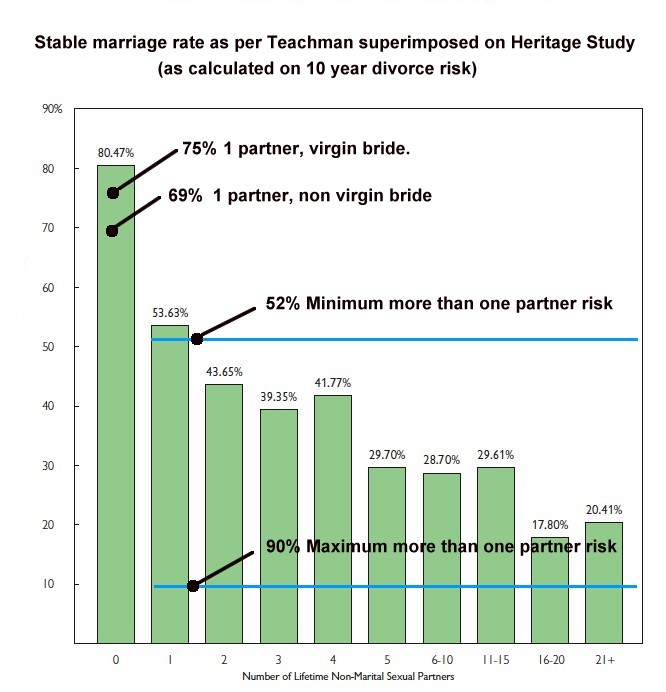
Does being a virgin before marriage affect marital stabilitity?
Does being a virgin before marriage affect marital stability?

Sunshine Mary linked to a post from Reddit by a 32-year old “progressive” woman who is surprised that 15 years of sleeping around with 18 different guys is not attractive to marriage-minded men.

Excerpt:

My parents are first generation immigrants. I have a younger brother and younger sister. In my family I was always the rebellious one; I would often challenge my parents. My family was very strict, when it came to dating and my siblings usually fell in line. However, I would challenge that norm.

My brother and sister were very repressed with their sexualities as a result, while I lost my virginity at 17 to my then boyfriend. While my brother and followed the traditional Indian path. My brother ended up not having any sexual contact with a girl until he got married at 25 (arranged marriage) and now they have a child together. My sister (too never kissed a boy) has recently gotten married too at 24 with an Indian boy she met at our Temple (both parents approved).

I live in LA, a city where both men and woman tend to marry a bit later in life, and yet I still spent the last years of my 20‘s feeling that somehow, I’d messed up. I had followed the wrong trail and thus, my “important-life-moments” timeline was off. Even with my more progressive friends it began slowly at first, when I was 27 … an engagement post on Facebook, an invite to a wedding—it was happening. People I knew were beginning the next stage of life and saying “I do.”

Throughout my whole life I never really dated any Indian guys; I exclusively dated white guys. However now I realize more than ever that the guys I dated never really took me seriously. They never really viewed me as someone they would eventually marry. I was always just some exotic fun. This part was definitely a realization that has hurt me to the core. I didn’t actually do it to spite Indian men or anything like that. I did what a lot of my white female friends did; I thought I was the same as them, but that could be farther from the truth. Most white guys I ran into wanted white wives.

I am now 32, and seems like everyone in my family has lapped me. I too want a family a marriage. However, now my chance of finding someone is gone. At my age getting an arranged marriage or finding another Indian man to marry me is out of the question. Majority of Indian guys usually get married pretty early. Often either to another Indian girl they meet here, or they go back to India for an arranged marriage. My parents have tried signing me up for a matrimony site, but of the guys I’d meet they would be turned off by my history (drink/eat meat/not a virgin).

[…]Most of my relationships have been long term I have only been with 18 guys and I have been sexually active since I was 17 years old.

She has only had steady sexual relationships with 18 guys in 15 years! That’s not a lot. Is it?

Let’s see what Sunshine Mary says first:

However, the more I think about it, the more it seems to me that articles like hers are a good thing simply because they expose the lie.  Feminists have sold young women a bill of goods, that they can live like men, work like men, have sex like men, and then turn back into women when they feel like it.  We laugh at a woman like this sometimes and make fun of her and say, “Didn’t she know that she’d end up like this?”

No, she didn’t know that.  That’s because when you are 17 years old, you don’t know much, especially in this culture of extended adolescence.  And when you have been told from a very young age that, as a girl, it is your destiny to Have It All exactly When You Want It, I’m sure it is very baffling to find yourself in your thirties with no husband and none in sight, with the dawning realization that your job and lonely apartment are not nearly as fulfilling as being a wife and mother would have been.

[…]Personally, I feel no joy in this woman’s pain.  I don’t think a White Knight should ride in to save her because I think she should suffer the natural consequences of her decisions so that other young women may see and learn from her errors, but I take no pleasure in the fact that she will have this lot in life.  However, what most of us don’t seem to understand is that young women make the terrible choices that they are making because they are told from an early age that these are actually good choices.  Some girls are able to resist that message, which saturates every aspect of the media and schools, but most girls aren’t, and they don’t develop the necessary wisdom until it is too late.

Emphasis hers. And now my turn.

Let me tell you what I think awaits a man who marries a woman like that, who spent her 20s hooking up with hot guys who had no interest in marriage and no demonstrated ability to protect, provide and lead on moral/spiritual issues. She will have convinced herself that she is more attractive than she really is because in her mind she deserves a man as attractive as these men. What other criteria is there for a man? It’s all appearances. I therefore do not recommend that any man marry this woman as she is now. What men need in marriage is respect, affection, affirmation and approval. A woman with a background like this will not have the trust and vulnerability that a marriage-minded man wants. The only way to fix this shattered trust is a long period of chastity. She must choose to form relationships with good protector / provider / moral leader / spiritual leader men and to support those men. That is the only way to fix the damage of promiscuity, if it even can be fixed.

A man can sense how trusting and vulnerable a woman is by how much she trusts and encourages him in his plans. If a woman is constantly putting him down, calling him names, and making excuses for why she doesn’t have to care about his needs and feelings, then that’s just her past promiscuity showing itself. Virgins with good relationships with their fathers don’t put men down like that – they choose good men who are doing good things and they build them up. My recommendation for women who realize that they are making bad choices with men and being negative about the men they choose is to look in the mirror and acknowledge that they are the problem. The solution, then, is to find a good man and work hard at being submissive and supportive, but chastely. Stop choosing men with motorcycles. Stop choosing atheists. Stop choosing drunkards. Stop choosing men who are pro-abortion and pro-gay-marriage. Stop choosing men who want bigger government. Just stop it.

That’s the advice I would give this woman. Choose men who can do the work that men do in a marriage. Find out what a man’s plan is. Build the skills he needs for his plan. Marry him.