Tag Archives: Family

Are same-sex unions the same as heterosexual married unions?

Marriage and family
Marriage and family

Note: I am re-posting this post because my friend Papa Giorgio informs me that the post is referenced in a new book on homosexuality and culture, authored by Dr. Michael Brown. Papa Giorgio says it’s a good book so far, so I’m going to get it. In the meantime, here’s the post Dr. Brown linked to.

I’ve written before about the differences between same-sex unions and opposite sex married couples.

Here’s a post from Canon and Culture on the same topic by social scientist Glenn Stanton.

He finds two differences.

First, instability:

[T]he research is strong and numerous enough that a recent and very provocative Atlantic cover story on what straights could learn from gay marriage couldn’t ignore it. Liza Mundy, the article’s author, doesn’t appear to have a conservative bone in her body, yet she is fair and straight-up honest with the research on the nature of committed same-sex relationships.

[…]Mundy explains that studies have found “higher dissolution rates among same-sex couples” in Scandinavia – one of the world’s most gay-friendly cultures — than married heterosexual couples. This study, published in Demography, found that even though same-sex couples enter their legal unions at older ages — a marker related to greater relational stability – male same-sex marriages break up at twice the rate of heterosexual marriages.  And the break-up rate for lesbians? A stunning 77% higher  than the same-sex male unions! When controlling for possible confounding factors, the “risk of divorce for female partnerships actually is more than twice than that for male unions.”

[…]A study of two generations of British couples (one born 1958, the other 1970) in same-sex cohabiting, opposite-sex cohabiting and opposite-sex marriage relationships found the same-sex relationships dramatically more likely to break up than the opposite-sex cohabiting and married relationships.

According to that British study, only 25% of same-sex co-habitating couples are intact after  8 years. The stability number for married couples after 8 years is 82%. That’s a big difference.

But there’s more:

Other studies – conducted by celebrated lesbian scholars – find notable instability in lesbian homes, even those with children. The current National Longitudinal Lesbian Family Study (NLLFS) found “a significant difference” in family dissolution rates when comparing lesbian with mother/father headed families, 56% and 36% respectively. (p. 1201)

Another research study by two celebrated gay-friendly scholars, highlights a major comparative study between hetero and lesbian homes where, in the 5-year period of the study, 6 of the 14 lesbian mother-headed homes had broken up compared to only 5 of the 38 mom/dad headed homes. (p. 11) These scholars creatively explains that this stability imbalance is likely due to the “high standards lesbians bring to their intimate unions…” (p.12)

Ever heard of lesbian bed death?

And Mundy points something else predictable in lesbian relationships. In fact, its consistency has earned it a name in the LGBT community: lesbian bed death. Seriously.  This is the truth that sexual interest and frequency in many long-term lesbian relationships tends to decline considerably and even die over the years.

Usually, in relationships, men tend to be the ones who want more frequent sex. What happens when you have no aggressors and two gatekeepers? Lesbian bed death.

Next up, something common in male homosexual relationships: infidelity.

Stanton writes:

A noted 2010 study on non-monogamy in long-term gay relationships by two gay-affirming scholars — the Couples Study — observes in their report’s first sentence: “…non-monogamous relationships are very common in the gay community…” Their data showed that of the non-monogamous, long-term couples in their study, 42 percent made an arrangement for outside-sexual relationships within the first three months of the relationship’s beginning and by the end of the first year, that number increased to 49 percent. At the seventh anniversary mark, an additional 24 percent of gay couples adopted such agreements. So such agreements are increasingly made as these relationships grow longer.

The Atlantic piece is notes this as well; explaining that after the AIDS crisis, “gay male couples are more monogamous than they used to be, but not nearly to the same degree as other kinds of couples.” One study Mundy cites asked those in various relationships whether they had any agreed-upon rules permitting extra-curricular activities. The differences were astonishing. Only 4% of male/female couples had them compared to 40% of gay men in legally recognized unions and 49% in long-term cohabiting unions.

Another widely respected investigation, found that only a third of gay couples had monogamous agreements and truly honored them with no outside sex. In fact, it found that in the openly nonmonogamous gay relationships, the frequency of extra-dyadic sex from its start ranged from 2 to a whopping 2,500 separate incidents. The median was a remarkable 41.5 extracurricular incidents since the relationship’s beginning. Frequency in the last year was startling was well, ranging from 0 to 350 occurrences of outside sex, with a median of 8 incidences in the last twelve months. Even those who pledged true monogamy, the range was from 1 to 63 “slip-ups” with a median of 5. Five “slip-ups” are not slip-ups. The corresponding numbers for men in heterosexual marriages are microscopic in comparison.

So what does all this mean?

It means that if you are interested in a definition of marriage that involves stability and marital fidelity, then you shouldn’t be in favor of legalizing gay marriage. When you open up the term marriage to include relationships that seem to be very unstable and/or very unfaithful, you change the definition of marriage. Marriage means life-long married love. If we just turn around and call any association of adults “marriage”, then we are losing the distinctiveness of marriage in the process. Think about it. We did the same thing in the previous redefinition of marriage (no-fault divorce) which attacked the permanence of marriage. Marriage has a specific meaning and we should not be redefining it every few years for the benefit of selfish adults.
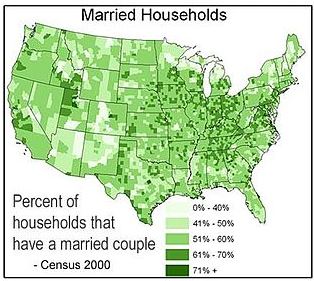
Red families v. blue families: which states have the strongest families?

Map of marriage rate by state

This article from The Daily Signal talks about a recent study.

It says:

According to a study from the Institute for Family Studies, red counties tend to have more married adults, more children born within marriage and higher levels of children living with both biological parents than blue counties.

“The reddest counties have higher rates of family stability, which is surprising because red counties, especially in the South, tend to have higher divorce rates,” said W. Bradford Wilcox, senior fellow with the Institute for Family Studies and author of the study. “But what seems to be happening here is that non-marital childbearing has emerged as a bigger engine of family instability than divorce in America. And this brief indicates that non-marital childbearing is lower in redder counties.”

[…]Wilcox acknowledged in his report some of the most stable families do come from blue states, such as Massachusetts and Minnesota, and that, indeed, the most stable families exist in the most extreme red and blue states.

But Wilcox said the state-level data addresses only part of the equation because it does not explain the “connection between family stability and political culture” at the local level.

“At the local level, red counties typically enjoy somewhat stronger families than do blue counties on at least three measures worth considering: marriage, non-marital childbearing and family stability,” Wilcox wrote in the report.

“The bottom line: The marriage advantage in red America helps explain why children in red counties are somewhat more likely to enjoy stable families than are children in blue counties,” he added.

I’m going to guess that the reason why people in blue states have lower rates of marriage and higher out-of-wedlock birth rates is because of higher tax rates, marriage penalties at the state level, and big government welfare programs that reward single mothers. Smaller government helps economic growth and leaves money in the pockets of responsible people. It’s much easier to take the marriage track when you have more of your own money in your pocket.

I also think that Judeo-Christian values are a huge factor. People who are religious have the habit of unselfishness that is necessary to get married in the first place. Marriage is about self-sacrificially loving another sinner, and that is attractive to religious people. Marriage is not so attractive to people who think that there is no afterlife, that the purpose of life is fun, and selfishness is awesome. If you believe that this life is all there is and there is no objective morality, then there is no rational basis there for serving others when it goes against your self-interest.

Regarding that last point, about how religious people are more suited to unselfishness and cooperation, there is a new study out.

Consider this recent study from the University of Toronto, in Canada.

The abstract says:

A large literature is currently contesting the impact of religion on prosocial behavior. As a window into this discussion, I examine the close social networks of American adults and consider whether religious traditionalists are more likely than other network members to supply several basic forms of social support. Analysis of the Portraits of American Life Survey reveals three main findings. First, a majority of Americans—religious or not—count at least one perceived religious traditionalist among their close network ties. Second, American adults are more likely to receive advice, practical help, and money from ties identified as religious traditionalists than from other types of ties, a pattern that held among both kin and nonkin network ties. Finally, although perceived traditionalist network members appear especially inclined to assist highly religious people, they nevertheless offer social support to Americans across a broad spectrum of religiosity. Beyond its relevance for debates on religion and community life, this study also proposes a novel strategy to assess prosocial behavior. Asking people to recount the deeds of their network members can reduce certain self-reporting biases common to survey research and helps locate prosocial activity in concrete and meaningful social relationships.

So, people who are more religious and traditional already have the character traits to be unselfish. And what is marriage, but the promise to be unselfish, for the sake of your spouse, and eventually, for the sake of your kids?

Does sex before marriage have any effect on your future relationships?

Is it OK to tell women they are wrong?
Do young people understand the long-term impact of premarital sex?

I’ve posted before about how premarital sex affects the stability of marriages by making divorce more likely. But there has been more research published since. Let’s take a look.

Here a good study on relationship tempo and relationship quality.

Abstract:

Rapid sexual involvement may have adverse long-term implications for relationship quality. This study examined the tempo of sexual intimacy and subsequent relationship quality in a sample of married and cohabiting men and women. Data come from the Marital and Relationship Survey, which provides information on nearly 600 low- to moderate-income couples living with minor children. Over one third of respondents became sexually involved within the first month of the relationship. Bivariate results suggested that delaying sexual involvement was associated with higher relationship quality across several dimensions. The multivariate results indicated that the speed of entry into sexual relationships was negatively associated with marital quality, but only among women. The association between relationship tempo and relationship quality was largely driven by cohabitation. Cohabiting may result in poorer quality relationship because rapid sexual involvement early in the romantic relationship is associated with entrance into shared living.

The authors are from Cornell University and University of Wisconsin – Madison. Prestigious schools, and very far to the left.

Here’s another recent study that shows that if a woman has more partners than just her husband as a premarital sex partner, the risk of divorce increases.

Conclusion:

Using nationally representative data from the 1995 National Survey of Family Growth, I estimate the association between intimate premarital relationships (premarital sex and premarital cohabitation) and subsequent marital dissolution. I extend previous research by considering relationship histories pertaining to both premarital sex and premarital cohabitation. I find that premarital sex or premarital cohabitation that is limited to a woman’s husband is not associated with an elevated risk of marital disruption. However, women who have more than one intimate premarital relationship have an increased risk of marital dissolution.

Here’s another study that makes it even more clear.

Findings:

Data from the 1988 US National Survey of Family Growth (NSFG) were utilized to assess the impact of premarital sexual activity on subsequent marital stability. Among white NSFG subjects first married in 1965-85, virgin brides were significantly less to have become separated or divorced (25%) than women who had not been virgins at marriage (35%).

[…]The lower risk of divorce on the part of white women with no premarital sexual experience persisted even after numerous intervening and background variables were controlled.

And I am going to save the best study for last. This marvelous PDF is from August 2014, and is put out by the National Marriage Project at the University of Virginia. It is comprehensive, and links to many papers from decades ago to the state of the art today. It seems like people are really rushing into sex these days, without much thought. They want to have fun, feel accepted, be like their friends, conform to the culture. But sometimes, it’s better to be practical than to be governed by the desire for fun and thrills. If you want to do something, look at the research and find out what the consequences are before you do it. That’s what a sensible person does.

When it comes to discussing the Bible’s rules on sex, evidence is very important. Evidence is what convinces even non-Chrsitian people to take the Bible seriously when it comes to putting sex in its proper place. That’s why we need to know what the Bible says, and we need to augment that with real-world evidence so that it is applied to our own decision-making, and so that we can be persuasive when discussing it with others.