
Tag Archives: Faith

Cold Case Christianity podcast talks about lack of authenticity in the church

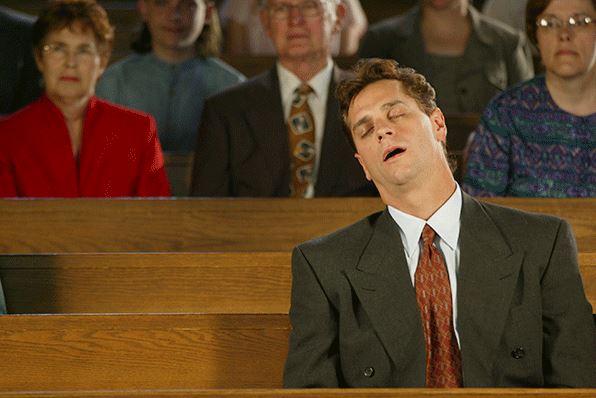
Church sucks, that's why men are bored there
Making church less boring for young people

Here’s an episode of the Cold Case Christianity podcast that I really liked. This is one you definitely do not want to miss. I wanted to summarize the first topic of three that he covers, because it’s something that’s been coming up a lot lately. Topics 2 and 3 are worth listening to, as well.

You can grab the MP3 file here.

Topic #1: Why are young people leaving church?

  • problem: not convinced Christianity is true
  • problem: apparent conflict with science
  • problem: unanswered questions
  • problem: difficulties inside the church
  • problem: the church’s (correct) position on same-sex marriage

Jim’s claim: if people do not think that the Bible is accurate and divinely inspired, then they are going to be tempted to pick and choose what to believe and what not to believe

Jim reads a blog post from a young lady who attends church, and here are her top problems with the church:

  1. you can’t ask questions
  2. you can’t voice your doubts
  3. you can’t explain your struggles
  4. you can’t confess your sins
  5. you can’t confide your fears

And she wants the leadership to be real and open about these things as well.

Wallace says that there here are two main problems that teens run into at college:

  1. intellectual skepticism
  2. selfish desires, especially in sexual areas

It’s aggravated by the hostile university setting (skeptical professors), and a culture of drinking and sex.

The university culture is offering you a worldview that makes your selfish desires more permissible and normal. Unless people have a compelling reason not to reject that, they won’t reject it. It’s the path of least resistance to conform to the expectations of your peers and professors. Our aim should be to provide young people with evidence before they face the skepticism in college.

Another major problem facing young people is the Christian position on homosexuality and gay marriage. Christian teachings on sexuality in general are viewed with suspicion, and these things are not discussed or debated in the church. One way to respond to this is to defend the reliability of Scripture. (Note: I think another way to respond is to give secular reasons for what the Bible teaches, and to help young people link their decisions about sexuality with their larger life plan).

Topic 2 was about objective vs cultural moral standards, and topic 3 was about whether different denominations differ in essentials or in peripheral issues.

My thoughts on topic #1

This week I’ve been spending time with a younger Christian discussing apologetics with her and we have had some different life experiences and she sometimes asks me to explain what happened. So I’ve been telling about some of the problems I had trying to map what the Bible says onto real life. I’m not going to post them here, but there were definitely problems dealing with my parents, my peers in school, my co-workers and church people. I kept trying to do good things, like trying to talk about my faith at work, and sometimes, very unexpected things happened to me. So telling about these struggles does convey the sort of seriousness that I think is lacking in the church environment.

So my point here is this. If you are dealing with young people, it might be a good idea to not gloss over these problems and keep everything at the surface level. Talk to them about what a Christian life should look like and the struggles you had trying to live it out. Talk to them about their plans, and how different decisions are going to affect those plans. Talk to them about their grades. Talk to them about their future profession. Talk to them about apologetics. Talk to them about politics and economics, so they know how to vote for their futures. Basically, they should have the idea that you are interested in whether Christianity is true or not, and that you are interested in them make some sort of plan to serve God and making the decisions they need to get there. You should tell young people your plan and how you are funding it and working on it, in order to prod them to make their own plan.

So if the problem is perceived lack of authenticity, then the solution is to talk to young people like grown ups and give them insight. This is my plan to serve God. This is my plan for my marriage. This is why I think Christianity is true. This is what I want my kids to end up like. This is what I want my wife to do. This is how I intend to fund all this. These are the laws/public policies that help/hurt my plan. These are the problems and struggles I’ve had implementing my plan. Here is an area where my sinfulness is really messing up my plan. When I talk to other Christians, we talk about these issues relevant to my plan.

It’s this kind of frank talk about what you are trying to do (and what role self-control plays in your plans) that helps young people to get serious about their beliefs. Don’t reduce the whole religion to rituals and feelings – it’s a mistake.


New study: scientists discover that inverted retina / blind spot is not a “bad design”

Apologetics and the progress of science

Here’s what atheist Richard Dawkins says about the inverted retina:

Any engineer would naturally assume that the photocells would point towards the light, with their wires leading backwards towards the brain. He would laugh at any suggestion that the photocells might point away from the light, with their wires departing on the side nearest the light. Yet this is exactly what happens in all vertebrate eyes. Each photocell is, in effect, wired in backwards, with its wires sticking out on the side nearest to the light. This means that the light, instead of being granted an unrestricted passage to the photocells, has to pass through a forest of connecting wires, presumably suffering at least some attenuation and distortion (actually probably not much but, still, it is the principle of the thing that would offend any tidy-minded engineer!)

Source: Dawkins, Richard (1986). The Blind Watchmaker. London: Penguin Books; pp. 93-94.

Now let’s look at a new study reported in Science Daily.

They write:

From a practical standpoint, the wiring of the human eye — a product of our evolutionary baggage — doesn’t make a lot of sense. In vertebrates, photoreceptors are located behind the neurons in the back of the eye — resulting in light scattering by the nervous fibers and blurring of our vision. Recently, researchers at the Technion — Israel Institute of Technology have confirmed the biological purpose for this seemingly counterintuitive setup.

“The retina is not just the simple detector and neural image processor, as believed until today,” said Erez Ribak, a professor at the Technion — Israel Institute of Technology. “Its optical structure is optimized for our vision purposes.” Ribak and his co-authors will describe their work during the 2015 American Physical Society March Meeting, on Thursday, March 5 in San Antonio, Texas.

Ribak’s interest in the optical structure of the retina stems from his previous work applying astrophysics and astronomy techniques to improve the ability of scientists and ophthalmologists to view the retina at high detail.

Previous experiments with mice had suggested that Müller glia cells, a type of metabolic cell that crosses the retina, play an essential role in guiding and focusing light scattered throughout the retina. To test this, Ribak and his colleagues ran computer simulations and in-vitro experiments in a mouse model to determine whether colors would be concentrated in these metabolic cells. They then used confocal microscopy to produce three-dimensional views of the retinal tissue, and found that the cells were indeed concentrating light into the photoreceptors.

“For the first time, we’ve explained why the retina is built backwards, with the neurons in front of the photoreceptors, rather than behind them,” Ribak said.

You can read more on some other reasons why the inverted retina is not a bad design in this article by agnostic scientist Michael Denton. But this study is a good reminder of why Christians need to keep up with science and how we need to talk about science.

The importance of having a narrative

All Christians should be familiar with the following basic pieces of evidence which fit the war between science and naturalism narrative:

  1. The origin of the universe
  2. The cosmic fine-tuning
  3. The origin of life (biological information)
  4. The sudden origin of the Cambrian phyla
  5. The habitability/observability correlation

It’s very important to present these five basic evidences to non-Christians in the historical context. And here is the story you must tell: “In the beginning, there was the naturalism, and the naturalism tried to argue from ignorance that God was not Creator and God was not Designer. And then came the science, and now people have to give up their naturalism in order to not be crazy and irrational”. That’s the narrative you use when talking to non-Christians about science.

In the beginning was the naturalism:

  1. In pre-scientific times, atheists maintained that the universe was eternal
  2. In pre-scientific times, atheists maintained that a life-permitting universe was as likely as a life-prohibiting universe
  3. In pre-scientific times, atheists maintained that the cell was a simple blob of jello that could spontaneously emerge in some warm pond
  4. In pre-scientific times, atheists maintained that the sudden origin of the Cambrian phyla would be explained by subsequent fossil discoveries
  5. In pre-scientific times, atheists maintained that there was nothing special about our galaxy, solar system, planet or moon

But then science progressed by doing experiments and making observations.

Here are some examples of discoveries that undermined the primitive atheism:

  1. Scientists discovered redshift and the cosmic microwave background radiation (evidence for a cosmic beginning) and more!
  2. Scientists discovered the fine-tuning of gravity and of the cosmological constant and more!
  3. Scientists discovered protein sequencing and exposed the myth of “junk DNA” and more!
  4. Scientists discovered an even shorter Cambrian explosion period and the absence of precursor fossils and more!
  5. Scientists discovered galactic habitable zones and circumstellar habitable zones and more!

Atheism, as a worldview, is not rooted in an honest assessment about what science tells us about reality. Atheism is rooted in a religion: naturalism. And the troubling thing we learn from looking at the history of science is that this religion of naturalism is insulated from correction from the progress of science. Nothing that science reveals about nature seems to be able to put a dent in the religion of naturalism, at least for most atheists. Their belief in naturalism is so strong that it repels all scientific evidence that falsifies it. Atheists simply don’t let science inform and correct their worldview.

Positive arguments for Christian theism

J. Warner Wallace: I am not a Christian because it works for me

12231469_1518516371799768_1908477683_n

Here’s a must-read post from Cold-Case Christianity author J. Warner Wallace.

Excerpt:

Life on this side of my decision hasn’t always been easy. It’s been nearly seventeen years since I first trusted Jesus as Lord and Savior. I still struggle to submit my prideful will to what God would call me to do. Christianity is not easy. It doesn’t always “work” for me. There are times when I think it would be easier to do it the old way; easier to cut a corner or take a short cut. There are many times when doing the right thing means doing the most difficult thing possible. There are also times when it seems like non-Christians have it easier, or seem to be “winning”. It’s in times like these that I have to remind myself that I’m not a Christian because it serves my own selfish purposes. I’m not a Christian because it “works” for me. I had a life prior to Christianity that seemed to be working just fine, and my life as a Christian hasn’t always been easy.

I’m a Christian because it is true. I’m a Christian because I want to live in a way that reflects the truth. I’m a Christian because my high regard for the truth leaves me no alternative.

I think this is important. There are people who I know who claim to be Christian, but they are clearly believing that God is a mystical force who arranges everything in their lives in order to make them happy. They are not Christians because it’s true, but because of things like comfort and community. But people ought to become Christians because they think it’s true. Truth doesn’t necessarily make you happy, though. Truth can impose intellectual obligations and moral obligations on you. Seeing God as he really is doesn’t help us to “win” at life, as the culture defines winning.

Winning in Christianity doesn’t mean making lots of money, or being famous, or winning human competitions, or being approved of by lots of people. Winning for a Christian might involve things like building relationships with people and leading them to know that God exists and who Jesus is. That has no cash value, and it’s not going to make you famous. Actually, it will probably cost you money and time, and make you unpopular with a lot of people.

The Bible doesn’t promise that people who become Christians will be happier. Actually, it promises that Christians will suffer for doing the right things. Their autonomy will suffer, as they sacrifice their own interests and happiness in order to make God happy, by serving his interests. Christianity isn’t something you add on to your before-God life in order to achieve your before-God goals. When you become a Christian, you get a new set of goals, based on God’s character and his design for you. And although you might be very successful in the world as part of serving God, there is no guarantee of that. Christianity is not life enhancement.