What I am suggesting is that the public packaging of Darwinian theory has become intensely political, and that would-be critics face certain pressures.
But don’t take my word for it. Listen to what evolutionists themselves are saying.
Consider the words of philosopher Jerry Fodor and cognitive scientist Massimo Piattelli-Palmarini in their book What Darwin Got Wrong:
We’ve been told by more than one of our colleagues that, even if Darwin was substantially wrong to claim that natural selection is the mechanism of evolution, nonetheless we shouldn’t say so. Not, anyhow, in public. To do that is, however inadvertently, to align oneself with the Forces of Darkness, whose goal is to bring Science into disrepute.
(Jerry Fodor and Massimo Piattelli-Palmarini, What Darwin God Wrong, p. xx (Farrar, Straus and Giroux, 2010)
Likewise, theoretical biologist Günter Thieβen wrote in Theory in Biosciences:
It is dangerous to raise attention to the fact that there is no satisfying explanation for macroevolution. One easily becomes a target of orthodox evolutionary biology and a false friend of proponents of non-scientific concepts.
(Günter Theißen, “The Proper Place of Hopeful Monsters in Evolutionary Biology,” Theory in Biosciences, Vol. 124: 349-369 (2006).)
Again, philosopher and biologist John Dupré writes in American Scientist:
The enduring debates with creationists have also undoubtedly tended to discourage admission that major conceptual issues about evolution remain unresolved.
Such words are not harbingers of some kind of a mass conspiracy to hide problems with evolution from the public. No such conspiracy exists. But they do show evidence of the hyper-political nature of this debate, where scientists feel political pressure to avoid lending credence to those they call “creationists.”
It’s important to point that what materialists mean by “science” is presuming materialism and then carrying on a charade of investigating the world and discovering that materialism did it. They can’t be open to agent causation, because their religion doesn’t allow it.
Give me that old-time religion
Imagine a materialist CIO who thought that code was written by large numbers of monkeys pounding at keyboards instead of by engineers. He would be firing all the software engineers and replacing them with monkeys in order to generate better code. And he would call this method of generating new code “science”. It’s the scientific way of generating new information, he would say, and using software engineers to generate new code isn’t “science”. It’s what he learned at UC Berkeley and UW Madison! His professors of biology swear that it is true!
It seems to me that there are incentives in place that make it impossible for Darwinists to discuss their materialistic religion honestly. They feel pressured to distort the evidence in the public square, and there are political pressures on them to distort the evidence in order to avoid being censured by their employers and colleagues. When questions about the evidence for Darwinism come up, they have to rally around their religion and chant the creeds that comfort them. There can be no questioning of their faith in the presupposition of materialism.
UPDATE: The video and audio from the Krauss-Craig debate are linked in this post.
I’ve put together some relevant resources to prepare you for tonight’s BIG debate (and to get tweeted by Brian Auten of Apologetics 315, I hope!)
The Big Bang and the Fine-Tuning
First, since Lawrence Krauss is a physicist, I expect that there will be some disagreement about the the kalam cosmological argument and the cosmic fine-tuning argument. To prepare yourself for the cosmological argument, you should print out this peer-reviewed article written by Craig. To prepare yourself for the fine-tuning argument, you should read this paper by Robin Collins.
And then you can watch this 10-part lecture delivered by William Lane Craig at the University of Colorado, Boulder. It is entitled “Beyond the Big Bang”.
If you watch the full lecture, you’ll notice that Craig takes a question from famous atheist Victor Stenger. Stenger is a physicist whom Craig had debated before the lecture on the existence of God at the University of Hawaii. You can watch their entire debate on Youtube, and I’ve linked it below.
Keep in mind that Craig recently debated arch-naturalist Francisco Ayala (link goes to Youtube playlist), so he will be fully prepared to debate philosophy of science, should that come up. I don’t recommend watching the entire debate, because Ayala is difficult to understand.
If you want to see the moral argument played out in a couple of debates, you could watch the William Lane Craig vs. Paul Kurtz debate on Youtube. Yes, that’s the same Paul Kurtz who wrote the “Humanist Manifesto”. Or you could watch the more recent William Lane Craig vs. Louise Anthony debate on Youtube, if you’ve already seen the Kurtz debate.
So, I think that’s where the clash is going to be tonight – on those three arguments.
Extra credit
Brian Auten maintains the William Lane Craig Audio Debate Feed here, in case you get through all of these and would like to see how well Bill Craig performs against other famous challengers, like Marcus Borg, Lewis Wolpert, Arif Ahmed, Bart Ehman, John Shelby Spong, Gerd Ludemann, John Dominic Crossan, Walter Sinnott-Armstrong, etc.
First, let’s re-cap the challenge to evolution from the phenomenon of the Cambrian explosion.
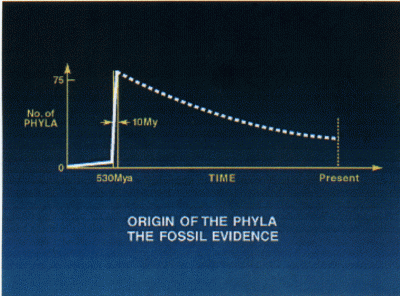
The newly released film “Darwin’s Dilemma” argues that the geologically abrupt appearance of the major groups of animals (the “phyla”) in the Cambrian Explosion posed a serious problem for Charles Darwin’s theory of evolution (as he himself knew), and that subsequent fossil discoveries—far from solving the problem—have made it worse.
Basically, all the major body plans we have today appear in the fossil record in a 2-3 million period about 543 million years ago. There are no precursors in the fossil record showing the gradual evolution of these major body plans.
The Cambrian Explosion: 0 to 60 in a few million years
Darwin expected to discover lots and lots of fossils leading up to the Cambrian explosion period that would show how all these phyla came into existence slowly over time. Unfortunately for the naturalistic evolutionists, the discoveries we’ve been making haven’t shown any hint of precursor fossils leading up the Cambrian explosion.
Since 1859, however, many Precambrian fossils have been found, including microfossils of single-celled bacteria in rocks more than three billion years old. In addition, multicellular Precambrian fossils have been found in the Ediacara Hills of Australia, though there is continuing debate over whether any—or how many—of the Ediacaran fossils were animals, or what relationship—if any—they had to the Cambrian phyla. In 1998, Cambridge University paleobiologist Simon Conway Morris (who is featured in the film “Darwin’s Dilemma”) wrote, “Apart from the few Ediacaran survivors… there seems to be a sharp demarcation between the strange world of Ediacaran life and the relatively familiar Cambrian fossils” (Crucible of Creation, 30).
But wait! Maybe we can’t find the precusor fossils required by Darwinism because they are too small or too soft to have survived for so long?
Since 1859, however, many Precambrian fossils have been found, including microfossils of single-celled bacteria in rocks more than three billion years old. In addition, multicellular Precambrian fossils have been found in the Ediacara Hills of Australia… In 1998, Cambridge University paleobiologist Simon Conway Morris… wrote, “Apart from the few Ediacaran survivors… there seems to be a sharp demarcation between the strange world of Ediacaran life and the relatively familiar Cambrian fossils” (Crucible of Creation, 30).
So there is now no shortage of Precambrian fossils. Not only do we have fossils of bacteria, but we also have many fossils of soft-bodied Multicellular organisms. “In the Ediacaran organisms there is no evidence for any skeletal hard parts,” wrote Conway Morris in 1998. “Ediacaran fossils look as if they were effectively soft-bodied” (Crucible of Creation, 28). The same is true of many of the organisms fossilized in the Cambrian explosion.
But wait! Scientists have discovered lots of exceptionally preserved microbes just before the Cambrian explosion. Don’t microbes count as precursors to the Cambrian explosion phyla?
Richard Callow and Martin Brasier reported in the January 2009 issue of the Journal of the Geological Society, London “a variety of exceptionally preserved microbes” from late Precambrian rocks in England that address “the paradox known as ‘“Darwin’s dilemma’.”
[…]Callow and Brasier didn’t solve Darwin’s dilemma. Instead, they put one more nail in the coffin of Darwin’s attempt to salvage his theory from it. The truth is that “exceptionally preserved microbes” from the late Precambrian actually deepen Darwin’s dilemma, because they suggest that if there had been ancestors to the Cambrian phyla they would have been preserved.
I am willing to believe in evolution. But in order to get me to believe it, I insist on seeing a fossil record that shows the gradual emergence of phyla, one or two at a time, over hundreds of millions of years. That is what Darwinism predicts. We now have a solid record of what came before the Cambrian explosion. So where are the precursors? Where is the record of gradual emergence? Where is my evidence?
A new peer-reviewed paper has been published that concludes that there is no material explanation for the massive amounts of information introduced during the Cambrian explosion, when all of the phyla came into being in the blink of an eye, geologically speaking, with no fossilized precursors.
Excerpt:
Thus, elucidating the materialistic basis of the Cambrian explosion has become more elusive, not less, the more we know about the event itself, and cannot be explained away by coupling extinction of intermediates with long stretches of geologic time, despite the contrary claims of some modern neo-Darwinists.
Once again, the progress of science brings light.
The DI post goes on to cite another passage from the paper:
Beginning some 555 million years ago the Earth’s biota changed in profound and fundamental ways, going from an essentially static system billions of years in existence to the one we find today, a dynamic and awesomely complex system whose origin seems to defy explanation. Part of the intrigue with the Cambrian explosion is that numerous animal phyla with very distinct body plans arrive on the scene in a geological blink of the eye, with little or no warning of what is to come in rocks that predate this interval of time. The abruptness of the transition between the ‘‘Precambrian’’ and the Cambrian was apparent right at the outset of our science with the publication of Murchison’s The Silurian System, a treatise that paradoxically set forth the research agenda for numerous paleontologists — in addition to serving as perennial fodder for creationists. The reasoning is simple — as explained on an intelligent-design t-shirt.
Fact: Forty phyla of complex animals suddenly appear in the fossil record, no forerunners, no transitional forms leading to them; ‘‘a major mystery,’’ a ‘‘challenge.’’ The Theory of Evolution – exploded again (idofcourse.com).
Although we would dispute the numbers, and aside from the last line, there is not much here that we would disagree with. Indeed, many of Darwin’s contemporaries shared these sentiments, and we assume — if Victorian fashion dictated — that they would have worn this same t-shirt with pride.
I linked before to a bunch of easy-to-understand videos that explain the Cambrian explosion. Here’s another peer-reviewed research paper on the Cambrian explosion written by Stephen C. Meyer, on the Cambrian explosion. This is the paper that got evolutionary biologist Richard Sternberg fired by secular leftists. He has two earned Ph.Ds in biology. I would expect that the people who fired him had never seen the inside of a biology lab. That’s the way it goes – science (intelligent design) vs. religion (materialism).