
Tag Archives: Evolution

New study: Gorilla genome calls common ancestry thesis into question

ECM sent me this must-read article from Evolution News.

Excerpt:

A whopping 30% of the gorilla genome — amounting to hundreds of millions of base pairs of gorilla DNA — contradicts the standard supposed evolutionary phylogeny of great apes and humans. That’s the big news revealed last week with the publication of the sequence of the full gorilla genome.

[…]The standard evolutionary phylogeny of primates holds that humans and chimps are more closely related to one-another than to other great apes like gorillas. In practice, all that really means is that when we sequence human, chimp, and gorilla genes, human and chimp genes have a DNA sequence that is more similar to one-another’s genes than to the gorilla’s genes. But huge portions of the gorilla genome contradict that nice, neat tidy phylogeny. That’s because these gorilla genes are more similar to the human or chimp version than the human or chimp versions are to one-another. In fact, it seems that some 30% of the gorilla genome contradicts the standard primate phylogeny in this manner.

[…]The bottom line is that the gorilla genome has confirmed that there is not a consistent story of common ancestry coming from the genomes of the great apes and humans. Hundreds of millions of base pairs in the gorilla genome conflict with the supposed phylogeny of great apes and humans. They might think their explanation salvages common ancestry, but clearly the gorilla genome data badly messes up the supposedly nice, neat, tidy arguments which they use to claim humans are related to the great-apes.

Read the whole thing to see how the Darwinists wiggle and squirm to avoid the implications of the data.

We have to form our beliefs about origins based on scientific evidence, not based on philosophical assumptions. It does not good at all to assume materialism and then determine in advance that some sort of physical process must be responsible for the diversity of life. We have to eschew philosophical assumptions and led the scientific experiments determine our conclusions. Experiments are good, naturalistic religious dogma is bad.
Trial begins for former NASA employee fired for belief in intelligent design

From Fox News.

Excerpt:

NASA’s Jet Propulsion Laboratory has landed robotic explorers on the surface of Mars, sent probes to outer planets and operates a worldwide network of antennas that communicates with interplanetary spacecraft.

Its latest mission is defending itself in a workplace lawsuit filed by a former computer specialist who claims he was demoted — and then let go — for promoting his views on intelligent design.

[…]David Coppedge, who worked as a “team lead” on the Cassini mission exploring Saturn and its many moons, alleges that he was discriminated against because he engaged his co-workers in conversations about intelligent design and handed out DVDs on the idea while at work. Coppedge lost his “team lead” title in 2009 and was let go last year after 15 years on the mission.

Opening statements are expected to begin Monday in Los Angeles Superior Court after two years of legal wrangling in a case that has generated interest among supporters of intelligent design. The Alliance Defense Fund, a Christian civil rights group, and the Discovery Institute, a proponent of intelligent design, are both supporting Coppedge’s case.

“It’s part of a pattern. There is basically a war on anyone who dissents from Darwin and we’ve seen that for several years,” said John West, associate director of the Center for Science and Culture at the Seattle-based Discovery Institute. “This is free speech, freedom of conscience 101.”

[…]Coppedge’s attorney, William Becker, says his client was singled out by his bosses because they perceived his belief in intelligent design to be religious.


If Darwinism was all it was cracked up to be, then why do they have to resort to silencing people who disagree with them, and ruining their careers? This is not an isolated occurrence.

Does intelligent design theory require that the designs be perfect?

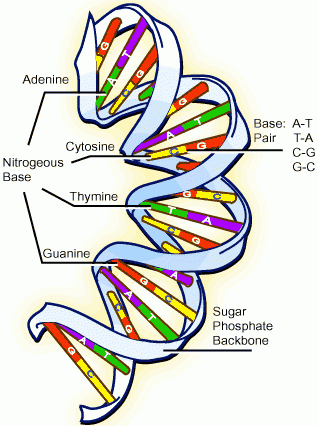
Structure of DNA
Structure of DNA

From Evolution News.

Excerpt:

By the word “intelligent,” ID proponents simply mean to indicate that a structure has features requiring a mind capable of forethought to design the blueprint. Thus, ID proponents test ID by looking for complex and specified information, which is an indicator that some goal-directed process, capable of acting with will, forethought, and intentionality, was involved in designing an object.

We do not test ID by looking for “perfect design” or “undesirable design,” because minds don’t always make things that are “perfect,” and sometimes they make things that are “undesirable” (to other minds, at least). Holding biological systems to some vague standard of “perfect design” where they are refuted by “undesirable design” is the wrong way to test ID. Examples like broken machinery, computer failures, and decaying buildings all show that a structure might be designed by an intelligent agent even if it subsequently breaks or shows flaws. Intelligent design does not necessarily mean “perfect design.” It doesn’t even require optimal design. Rather, “intelligent design” means exactly what it sounds like: design by an intelligent agent.

“Undesirable design” arguments share three general problems, some or all of which can be found in each of Gilmour’s 130 examples. Here are the three main problems:

  1. An object can have imperfections and be undesirable, but still be designed.
  2. Critics’ standards of perfection are often arbitrary.
  3. “Bad design” arguments don’t hold up under their own terms, as the objects often turn out to be well designed when we inspect them more closely.

Problem (1) applies to every single example Gilmour gives. Problems (2) and (3) apply to many, though not all, of his examples. In fact, some of them are legitimate examples of undesirable design. I mean, who likes “easily worn out knees” or hernias — both examples of how our bodies break down? Objectively speaking, those are flaws or imperfections. But as much as you might not like “undesirable design,” they don’t refute ID because ID is a scientific argument that isn’t concerned with the moral value, perfection, or desirable/undesirable quality of a structure. Computers break down but were still intelligently designed. In the same way, the fact that our bodies break down doesn’t mean they weren’t intelligently designed.

If you would like  quick introduction to intelligent design, click here. The best introductory book on the subject is “The Politically Incorrect Guide to Darwinism and Intelligent Design” by Dr. Jonathan Wells, and the best complex book is “Signature in the Cell: DNA and the Evidence for Intelligent Design” by Dr. Stephen C. Meyer.

Related posts