Tag Archives: Evidence

Does archaeological evidence confirm names, dates and places in the Bible?

Sherlock Holmes and John Watson: let's take a look at the facts
Sherlock Holmes and John Watson: let’s take a look at the facts

I spotted this post on Be Thinking by UK apologist Peter S. Williams. (H/T Eric Chabot at Think Apologetics)

So let me pick the ones I liked most for this post.

Here’s a good one:

Jerusalem and The Pool of Bethesda

John 5:1-15 describes a pool in Jerusalem, near the Sheep Gate, called Bethesda, surrounded by five covered colonnades. Until the 19th century, there was no evidence outside of John for the existence of this pool and John’s unusual description “caused bible scholars to doubt the reliability of John’s account, but the pool was duly uncovered in the 1930s – with four colonnades around its edges and one across its middle.”[38] Ian Wilson reports: “Exhaustive excavations by Israeli archaeologist Professor Joachim Jeremias have brought to light precisely such a building, still including two huge, deep-cut cisterns, in the environs of Jerusalem’s Crusader Church of St Anne.”[39]

And this one:

Jerusalem and The Pool of Siloam

In the 400s AD, a church was built above a pool attached to Hezekiah’s water tunnel to commemorate the healing of a blind man reported in John 9:1-7. Until recently, this was considered to be the Pool of Siloam from the time of Christ. However, during sewerage works in June 2004 engineers stumbled upon a 1stcentury ritual pool when they uncovered some ancient steps during pipe maintenance near the mouth of Hezekiah’s tunnel. By the summer of 2005, archaeologists had revealed what was “without doubt the missing pool of Siloam.”[40] Mark D. Roberts reports that: “In the plaster of this pool were found coins that establish the date of the pool to the years before and after Jesus. There is little question that this is in fact the pool of Siloam, to which Jesus sent the blind man in John 9.”[41]

I just read this one because I am working my way through John. In case you haven’t read John, you really should it’s my favorite gospel.

Here’s another one:

Herod the Great

We have a bronze coin minted by Herod the Great. On the obverse side (i.e. the bottom) is a tripod and ceremonial bowl with the inscription ‘Herod king’ and the year the coin was struck, ‘year 3’ (of Herod’s reign), or 37 BC.

In 1996 Israeli Professor of Archaeology Ehud Netzer discovered in Masada a piece of broken pottery with an inscription, called an ostracon. This piece had Herod’s name on it and was part of an amphora used for transportation (probably wine), dated to c. 19 BC. The inscription is in Latin and reads, “Herod the Great King of the Jews (or Judea)”, the first such that mentions the full title of King Herod.

Herodium is a man-made mountain in the Judean wilderness rising over 2,475 feet above sea level. In 23 BC Herod the Great built a palace fortress here on top of a natural hill. Seven stories of living rooms, storage areas, cisterns, a bathhouse, and a courtyard filled with bushes and flowering plants were constructed. The whole complex was surrounded and partly buried by a sloping fill of earth and gravel. Herod’s tomb and sarcophagus were discovered at the base of Herodium by archaeologist Ehud Netzer in 2007.

And one more:

The ‘James, son of Joseph, brother of Jesus’ Ossuary

James, the brother of Jesus, was martyred in AD 62. A mid-1st century AD chalk ossuary discovered in 2002 bears the inscription “James, son of Joseph, brother of Jesus” ( ‘Ya’akov bar Yosef akhui di Yeshua’). Historian Paul L. Maier states thatthere is strong (though not absolutely conclusive) evidence that, yes, the ossuary and its inscription are not only authentic, but that the inscribed names are the New Testament personalities.[68] New Testament scholar Ben Witherington states that:“If, as seems probable, the ossuary found in the vicinity of Jerusalem and dated to about AD 63 is indeed the burial box of James, the brother of Jesus, this inscription is the most important extra-biblical evidence of its kind.”[69] According to Hershel Shanks, editor in chief of the Biblical Archaeological Review: “this box is [more] likely the ossuary of James, the brother of Jesus of Nazareth, than not. In my opinion … it is likely that this inscription does mention the James and Joseph and Jesus of the New Testament.”

And finally one short one:

Tiberius Caesar

The Denarius coin, 14-37 AD, is commonly referred to as the ‘Tribute Penny’ from the Bible. The coin shows a portrait of Tiberius Caesar. Craig L. Blomberg comments: “Jesus’ famous saying about giving to Caesar what was his and to God what his (Mark 12:17 and parallels) makes even more sense when one discovers that most of the Roman coins in use at the time had images of Caesar on them.”[48]

This is a good article to bookmark in case you are ever looking for a quick, searchable reference on archaeology and the Bible. There are many more examples in that post.
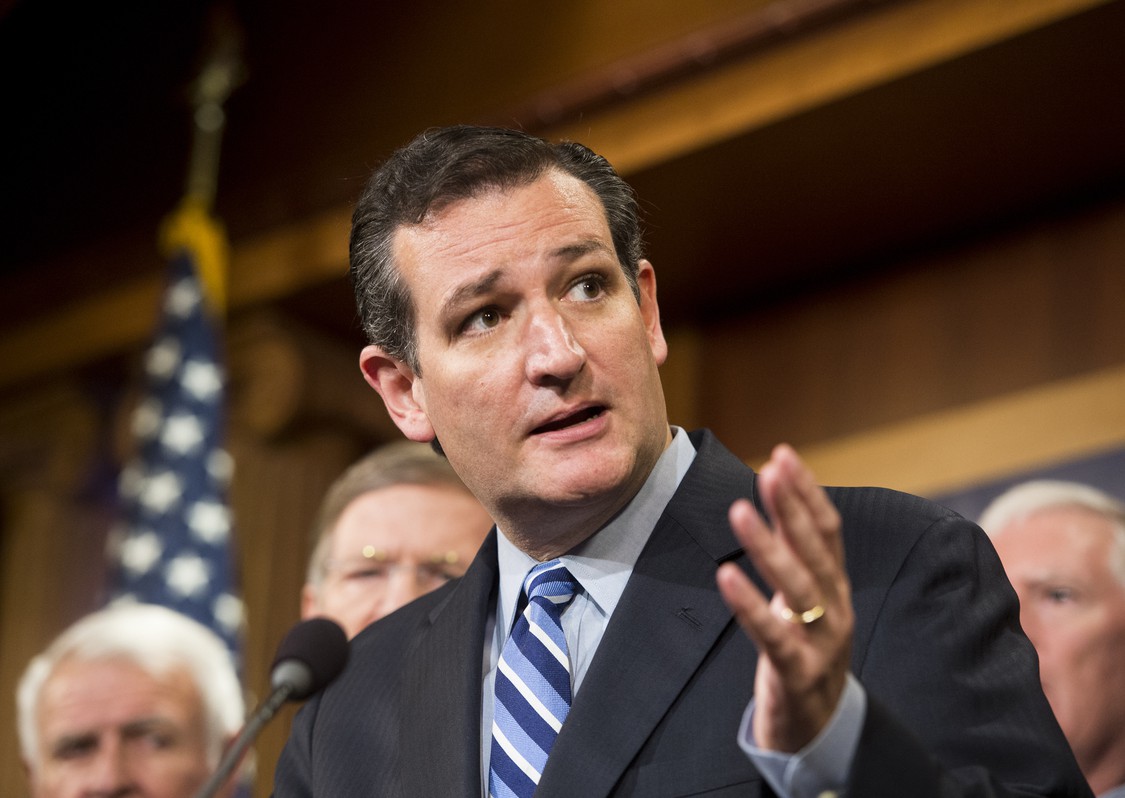
 

Ted Cruz invites climate scientists to Washington, D.C. to discuss climate change

Texas Senator Ted Cruz

This is from the Daily Signal, and what is interesting is how the Democrats respond to the scientific evidence presented by the scientists.

Excerpt:

Republican Sen. Ted Cruz convened a subcommittee hearing Tuesday to dispute the validity of research from climate “alarmists,” whose findings have become central to crafting environmental policy.

Cruz used his opening remarks to detail the 2013 expedition where a ship of 74 people sent into Antarctica to research climate change got stuck in ice, forcing an airlift rescue a week later.

“This expedition was there to document how the ice was vanishing in the Antarctic, but the ship became stuck,” Cruz said before the Senate Commerce Subcommittee on Space, Science and Competitiveness. “It had run into an inconvenient truth, as Al Gore might put it.”

Cruz, who chairs the subcommittee, also noted Secretary of State John Kerry’s 2009 claim that the Arctic would be “ice-free” by the summer of 2013—which was the same year the researchers became trapped in ice.

Republicans on the committee said the hearing was intended to shed light on “opposing viewpoints in the field of climate science,” which Cruz said are “reflexively” brushed aside by policymakers.

He repeatedly pointed to satellite data that found no significant global warming during the past 18 years, a slowdown often referred to as the warming “pause.”

“Global warming alarmists don’t like these data. They are inconvenient to their narrative,” Cruz said. “But facts and evidence matter.”

Judith Curry, former chair of Georgia Institute of Technology’s School of Earth and Atmospheric Sciences, testified that while climate scientists uniformly agree that surface temperatures have increased during the past century, there is “considerable” disagreement about whether humans drive global warming and if warming is dangerous to the planet.

Curry’s research led her to findings that natural causes could be playing a larger role in warming than human activity, challenging what many consider “settled” conclusions in the climate debate.

But instead of leading to reignited deliberation, Curry said the science community quickly branded her a “heretic” for challenging the status quo.

“In their efforts to promote their ‘cause,’ the scientific establishment behind the global warming issue has been drawn into the trap of seriously understating the uncertainties associated with the climate problem,” she said, adding: “This behavior risks destroying science’s reputation for honesty and objectivity. Without this objectivity and honesty, scientists become regarded as merely another lobbyist group.”

Democrats denounced the four witnesses Republicans called to testify as climate change “deniers” in a press conference held prior to the hearing.

Here are the satellite measurements:

Satellite measurements of global temperature
Satellite measurements of global temperature (University of Alabama – Huntsville)

(Source)

I have blogged about the growing ice extents and the 18-year pause in global warming (according to atmospheric measurements, not Al Gore movies) before. I am glad that someone is trying to confront the Democrats with the experimental science.

More people are looking at the records of the presidential candidates on issues like global warming socialism, and as a result, Cruz is climbing in the polls:

Thirty-five percent of Republican primary voters support Trump, up 13 points since October, and his highest level of support in CBS News polling. Ted Cruz (16 percent) has moved into second place, while Ben Carson, who led the October poll, has dropped to third.

Marco Rubio is in fourth place with 9 percent. Jeb Bush is getting the backing of just 3 percent of Republican primary voters nationwide, his lowest percentage to date in CBS News polling. Carly Fiorina’s support has also dropped; she is at just 1 percent now.

Most of the interviews for this poll were conducted before Trump made statements concerning a ban on Muslims entering the United States.

I realize there is a certain segment of the population that is supporting Trump because they vote for people based on sound bites. A candidate who sounds tough excites them more than a candidate who has performed tough actions. It takes work to look into the candidate’s past and see what actions they’ve taken to prove their conservative convictions. Trump supporters seem unwilling to put the work in. Trump is on record as being “very pro-choice” – he even supports partial-birth abortion. And and he also supports the DREAM act and amnesty. Some people might like to think that saying “I’m pro-life” makes you pro-life, but sane people think that pro-life credentials are established by pro-life actions. Trump has no pro-life actions. And border security credentials are established by border security actions. Trump has no border security actions. And of course, Trump considers gay marriage to be “the law of the land”, because 5 judges said so.

Election time is not the time for people to be swayed by words. It’s the time to look for actions.

William Lane Craig debates Peter Atkins: Does God Exist?

Apologetics 315 posted the video of a debate from the Reasonable Faith speaking tour in the UK:

This is a must-see debate. It was extremely fun to watch.

Details:

On Wednesday 26th October 2011 William Lane Craig debated Peter Atkins on the topic: Does God Exist? This debate took place at the University of Manchester  as part of the UK Reasonable Faith Tour with William Lane Craig. The debate was chaired by Christopher Whitehead, Head of Chemistry School at the University. Post-debate discussion was moderated by Peter S Williams, Philosopher in Residence at the Damaris Trust, UK.

Dr. William Lane Craig:

William Lane Craig (born August 23, 1949) is an American analytic philosopher, philosophical theologian, and Christian apologist. He is known for his work on the philosophy of time and the philosophy of religion, specifically the existence of God and the defense of Christian theism. He has authored or edited over 30 books including The Kalam Cosmological Argument (1979), Theism, Atheism and Big Bang Cosmology(co-authored with Quentin Smith, 1993), Time and Eternity: Exploring God’s Relationship to Time (2001), and Einstein, Relativity and Absolute Simultaneity (co-edited with Quentin Smith, 2007).

Craig received a Bachelor of Arts degree in communications from Wheaton College, Illinois, in 1971 and two summa cum laudemaster’s degrees from Trinity Evangelical Divinity School in Deerfield, Illinois, in 1975, in philosophy of religion and ecclesiastical history. He earned a Ph.D. in philosophy under John Hick at the University of Birmingham, England in 1977 and a Th.D. underWolfhart Pannenberg at the University of Munich in 1984.

Dr. Peter Atkins:

Peter William Atkins (born 10 August 1940) is a British chemist and former Professor of Chemistry at the University of Oxford and a Fellow of Lincoln College. He is a prolific writer of popular chemistry textbooks, including Physical ChemistryInorganic Chemistry, and Molecular Quantum Mechanics. Atkins is also the author of a number of science books for the general public, including Atkins’ Molecules and Galileo’s Finger: The Ten Great Ideas of Science.

Atkins studied chemistry at the University of Leicester, obtaining a bachelor’s degree in chemistry, and – in 1964 – a PhD for research into electron spin resonance spectroscopy, and other aspects of theoretical chemistry. Atkins then took a postdoctoral position at the UCLA as aHarkness Fellow of the Commonwealth fund. He returned to Oxford in 1965 as fellow and tutor of Lincoln College, and lecturer in physical chemistry (later, professor of physical chemistry).

You can get the audio of the debate here, along with links to their previous debate from 1998. This debate is accessible and understandable to novice-level Christians.

I am happy when debates like this come out. I have friends who are Christians who doubt the importance of apologetics in evangelism, because they don’t think that apologists can prove anything or win arguments. I have friends who are skeptical of using arguments that assume a 14-billion year old universe, because they think that the Big Bang is compatible with atheism (!). I have friends who think that philosophical arguments have no persuasive force. I have friends who think that nothing can be proven from history, beyond a reasonable doubt. I have co-workers who ask me whether anyone wins these debates. I think that this debate answers all of those questions.

This debate clearly shows why Christians should not shy away from studying science, philosophy and history. We will not discover anything that harms Christian theism by thinking logically and by looking at the evidence. To the contrary, it is the atheist who makes war on the progress of science, and who is forced to resist the clear experimental evidence, and to resort to baseless speculations and blind faith. If you want to see a good debate with an intelligent atheist, I recommend watching the debate between William Lane Craig and Peter Millican instead. But if you want to see a really, really overwhelming defeat for atheism, watch this debate. It is very clear at the end of this debate why Richard Dawkins refused to debate William Lane Craig at Oxford.

SUMMARY OF THE OPENING SPEECHES

I only had time to summarize the first two speeches. Keep in mind that Dr. Craig always shines in his rebuttals, and this debate is no different. So you’ll want to watch those rebuttals. Dr. Atkins literally says in this debate in his first rebuttal “There was nothing here originally. There is nothing here now. But it is an interesting form of nothing which seems to be something.” And the audience laughs nervously. This debate is like that. You will see a clear winner and clear loser in this debate. This fight is decided by knockout.

William Lane Craig opening speech:

1. the origin of the universe
2. the moral argument
3. the resurrection of Jesus

Peter Atkins opening speech:

1. Dr. Craig is stupid, lazy and evil:
– Dr. Craig’s arguments are old: from the 11th century! Old arguments can’t be true
– Dr. Craig is just asserting that “God did it” because he is lazy
– Dr. Craig feels pressured to agree with the theistic majority
– Dr. Craig needs a psychological crutch to comfort him
– Dr. Craig is fearful of death
– Dr. Craig is just wishing for an eternal life of bliss
– Dr. Craig is driven by his heart, and not by his head

2. Origin of the universe:
– Maybe the universe is eternal and has no beginning – we don’t know
– Maybe mommy universes can give birth to daughter universes
– It is naive to think that a cause is needed to cause the creation of the universe from nothing
– Science is just about to show how it is possible that something appears out of nothing without cause
– Some scientists have already begun to speculate about about how something can come into being out of nothing
– Maybe nothing is not really nothing, but it is actually something
– It would be admitting defeat to say that God created the universe out of nothing

3. Fine-Tuning:
– It could be the case that the fundamental constants are not variable
– It could be the case that the fine-tuning of the cosmic constants is a happy accident
– It could be the case that there are billions of billions of unobservable universes that are not fine tuned
– It could be the case that the cosmic constants in these billions and billions of unobservable universes are all random so that some are fine-tuned
– Anyone who infers that an intelligence is the best explanation of a finely-tuned set of life-permitting cosmic constants is lazy

4. Purpose:
– Philosophers and theologians are stupid
– I don’t think that there is purpose in the universe
– I think that the universe is more grand if there is no purpose, so there is no purpose

5. Miracles:
– I don’t think that miracles happen
– The resurrection is a fabrication
– It could be the case that Jesus didn’t exist
– It could be the case that Jesus wasn’t really crucified
– It could be the case that Jesus didn’t  really die after being crucified
– It could be the case that the disciples stole his body
– It could be the case that the women went to the wrong hole in the ground
– the gospels are political propaganda written long after the events they are reporting on

6. Theodicy:
– God has no morally sufficient reason for allowing humans to perform actions that result in suffering
– God has no morally sufficient reason for allowing nature to cause suffering

7. Morality:
–  customs and conventions emerges arbitrarily in different times and places based on an awareness of the consequences of actions, as well as various anecdotes and experiences
–  these customs and conventions are decided based on the goal for survival, in much the same way as politeness and manners emerge for decorum and to avoid offense
– it is childish to presume that there is an umpire God who decides moral values and duties

8. Religious believers are stupid, lazy and evil:
– the notion of God has arisen because people are stupid and want to be comforted
– there are no arguments or evidences for belief in God
– people who believe in God do not think, but instead take refuge in incomprehensible nonsense