Tag Archives: Evidence

William Lane Craig debates Austin Dacey: Does God Exist?

Two tough rams butt heads, and may the best ram win!

Here is the video and summary of a debate between Christian theist William Lane Craig and Austin Dacey at Purdue University in 2004 about the existence of God.

The debaters:

The video: (2 hours)

The video shows the speakers and powerpoint slides of their arguments. Austin Dacey is one of the top atheist debaters, and I would put him second to Peter Millican alone, with Walter Sinnott-Armstrong in third place. This is the debate to show people who are new to apologetics. The debate with Peter Millican is better for advanced students, and that’s no surprise since he teaches at Oxford University and is familiar with all of Dr. Craig’s work. The Craig-Dacey debate is the one that I give to my co-workers.

By the way, you can get the DVDs and CDs for the first Craig-Dacey debate and the second Craig-Dacey debate and the second Craig-Sinnott-Armstrong debate. The Peter Millican debate is not available on DVD, but the link above (Peter Millican) has the video and my summary.

Dr. Dacey’s 5 arguments below are all good arguments that you find in the academic literature. He is also an effective and engaging speaker, This is a great debate to watch!

SUMMARY of the opening speeches:

Dr. Craig’s opening statement:

Dr. Craig will present six reasons why God exists:

  1. (Contingency argument) God is the best explanation of why something exists rather than nothing
  2. (Cosmological argument)  God’s existence is implied by the origin of the universe
  3. (Fine-tuning argument) The fine-tuning of the universe for intelligent life points to a designer of the cosmos
  4. (Moral argument) God is the best explanation for the existence of objective moral values and objective moral duties
  5. (Miracles argument) The historical facts surrounding the life, death and resurrection of Jesus
  6. (Religious experience) God’s existence is directly knowable even apart from arguments

Dr. Dacey’s opening argument:

There are two ways to disprove God’s existence, by showing that the concept of God is self-contradictory, or by showing that certain facts about ourselves and the world are incompatible with what we would expect to be true if God did exist. Dr. Dacey will focus on the second kind of argument.

  1. The hiddenness of God
  2. The success of science in explaining nature without needing a supernatural agency
  3. The dependence of mind on physical processes in the brain
  4. Naturalistic evolution
  5. The existence of gratuitous / pointless evil and suffering

One final point:

One thing that I have to point out is that Dr. Dacey quotes Brian Greene during the debate to counter Dr. Craig’s cosmological argument. Dr. Craig could not respond because he can’t see the context of the quote. However, Dr. Craig had a rematch with Dr. Dacey where was able to read the context of the quote and defuse Dr. Dacey’s objection. This is what he wrote in his August 2005 newsletter after the re-match:

The following week, I was off an another three-day trip, this time to California State University at Fresno. As part of a week of campus outreach the Veritas Forum scheduled a debate on the existence of God between me and Austin Dacey, whom I had debated last spring at Purdue University. In preparation for the rematch I adopted two strategies: (1) Since Dacey had come to the Purdue debate with prepared speeches, I decided to throw him for a loop by offering a different set of arguments for God, so that his canned objections wouldn’t apply. I chose to focus on the cosmological argument, giving four separate arguments for the beginning of the universe, and on the evidence for Jesus’ resurrection. (2) I reviewed our previous debate carefully, preparing critiques of his five atheistic arguments. In the process I found that he had seriously misunderstood or misrepresented a statement by a scientist on the Big Bang; so I brought along the book itself in case Dacey quoted this source again. I figured he might change his arguments just as I was doing; but I wanted to be ready in case he used his old arguments again.

[…]The auditorium was packed that night for the debate, and I later learned that there were overflow rooms, too. To my surprise Dr. Dacey gave the very same case he had presented at Purdue; so he really got clobbered on those arguments. Because he wasn’t prepared for my new arguments, he didn’t even respond to two of my arguments for the beginning of the universe, though he did a credible job responding to the others. I was pleased when he attacked the Big Bang by quoting the same scientist as before, because I then held up the book, specified the page number, and proceeded to quote the context to show what the scientist really meant.

Dr. Craig is always prepared!

J.P. Moreland asks: does truth matter when choosing a religion?

Christian Apologist March Madness Tournament
Please help me in the Christian Apologist March Madness Tournament

Since I’m facing off against J. P. Moreland in the Apologetics March Madness tournament (click here), I thought I’d re-post one of my favorite J. P. Moreland posts. I’m asking for your vote, although right now, he is leading 75-25 and it doesn’t look good. The poll runs to the end of Friday.

This lecture contains Moreland’s famous “Wonmug” illustration. If you don’t know who Wonmug is, you can find out in this lecture.

The MP3 file is here.

Topics:

  • Is it intolerant to think that one religion is true?
  • Is it more important to be loving and accepting of people regardless of worldview?
  • How should Christians approach the question of religious pluralism?
  • How does a person choose a religion anyway?
  • Who is Wonmug, and would you like to be like Wonmug?
  • Is it enough that a belief “works for you”, or do you want to believe the truth?
  • Can all the religions in the world be true?
  • Is it wise to pick and choose what you like from all the different religions?
  • Is it possible to investigate which religion is true? How?
  • Which religions are testable for being true or false?
  • How you can test Christianity historically (very brief)

I’m posting this, because I’ve noticed that there’s an awful lot of cultural Christianity in red states. Basically, if you ask someone if they are a Christian, and they say yes, they don’t usually mean that they think it’s true and that they’ve investigated whether it’s true. They usually just mean that they like it, or it makes them feel good, or that’s how they were raised, etc. My worry about this is that if Christianity isn’t adopted because it’s true, then no one is going to do any work or self-sacrifice for it. And I think that Christianity won’t survive the challenges of the secular culture if parents and pastors don’t understand that Christianity will require work, if it’s going to be presented to people as TRUE in a persuasive way.

Why is truth important? People are willing to invest in projects self-sacrificially if they think that they are involved in something true. So, you might enroll in a chemistry program in college because you expect to come out with true beliefs about chemistry. You’ll do the work and solve the problems because you think that chemistry is real. But if you think that chemistry is just made up nonsense with no use at all, you’re probably not going to work at it and sacrifice for it. You’ll probably just find something else to do with your life that’s easier and more fun. That’s why the truth question is really important.

How the WMAP satellite confirmed nucleosynthesis predictions and falsified atheism

Christianity and the progress of science

Prior to certain scientific discoveries, most people thought that the universe had always been here, and no need to ask who or what may have caused it. But today, that’s all changed. Today, the standard model of the origin of the universe is that all the matter and energy in the universe came into being in an event scientists call “The Big Bang”. At the creation event, space and time themselves began to exist, and there is no material reality that preceded them.

So a couple of quotes to show that.

An initial cosmological singularity… forms a past temporal extremity to the universe. We cannot continue physical reasoning, or even the concept of spacetime, through such an extremity… On this view the big bang represents the creation event; the creation not only of all the matter and energy in the universe, but also of spacetime itself.

Source: P. C. W. Davies, “Spacetime Singularities in Cosmology,” in The Study of Time III, ed. J. T. Fraser (Berlin: Springer Verlag ).

And another quote:

[A]lmost everyone now believes that the universe, and time itself, had a beginning at the big bang.

Source: Stephen Hawking and Roger Penrose, The Nature of Space and Time, The Isaac Newton Institute Series of Lectures (Princeton, N. J.: Princeton University Press, 1996), p. 20.

So, there are several scientific discoveries that led scientists to accept the creation event, and one of the most interesting and famous is the discovery of how elements heavier than hydrogen were formed.

Nucleosynthesis: forming heavier elements by fusion

Here’s the history of how that discovery happened, from the National Aeronautics and Space Administration (NASA) web site:

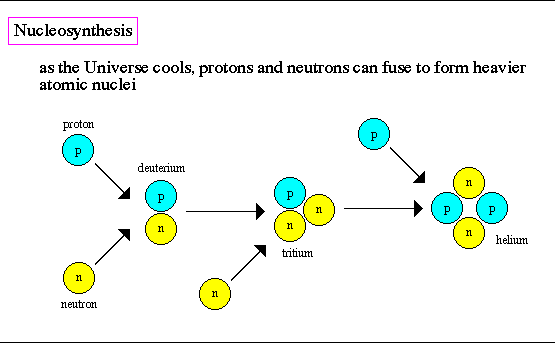
The term nucleosynthesis refers to the formation of heavier elements, atomic nuclei with many protons and neutrons, from the fusion of lighter elements. The Big Bang theory predicts that the early universe was a very hot place. One second after the Big Bang, the temperature of the universe was roughly 10 billion degrees and was filled with a sea of neutrons, protons, electrons, anti-electrons (positrons), photons and neutrinos. As the universe cooled, the neutrons either decayed into protons and electrons or combined with protons to make deuterium (an isotope of hydrogen). During the first three minutes of the universe, most of the deuterium combined to make helium. Trace amounts of lithium were also produced at this time. This process of light element formation in the early universe is called “Big Bang nucleosynthesis” (BBN).

The creation hypothesis predicts that there will be specific amounts of these light elements formed as the universe cools down. Do the predictions match with observations?

Yes they do:

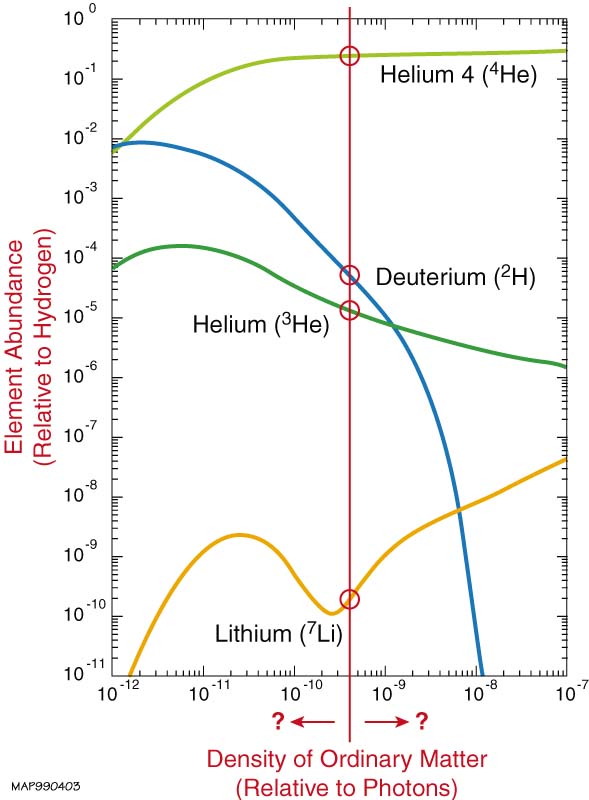
The predicted abundance of deuterium, helium and lithium depends on the density of ordinary matter in the early universe, as shown in the figure at left. These results indicate that the yield of helium is relatively insensitive to the abundance of ordinary matter, above a certain threshold. We generically expect about 24% of the ordinary matter in the universe to be helium produced in the Big Bang. This is in very good agreement with observations and is another major triumph for the Big Bang theory.

Moreover, WMAP satellite measurements of mass density agree with our observations of these light element abundances.

Here are the observations from the WMAP satellite:

Scientific observations match predictions

And here is how those WMAP measurements confirm the Big Bang creation event:

However, the Big Bang model can be tested further. Given a precise measurement of the abundance of ordinary matter, the predicted abundances of the other light elements becomes highly constrained. The WMAP satellite is able to directly measure the ordinary matter density and finds a value of 4.6% (±0.2%), indicated by the vertical red line in the graph. This leads to predicted abundances shown by the circles in the graph, which are in good agreement with observed abundances. This is an important and detailed test of nucleosynthesis and is further evidence in support of the Big Bang theory. 

“An important and detailed test”.

For completeness, we should learn how elements heavier than these light elements are formed:

Elements heavier than lithium are all synthesized in stars. During the late stages of stellar evolution, massive stars burn helium to carbon, oxygen, silicon, sulfur, and iron. Elements heavier than iron are produced in two ways: in the outer envelopes of super-giant stars and in the explosion of a supernovae. All carbon-based life on Earth is literally composed of stardust.

That’s a wonderful thing to tell a young lady when you are on a date: “your body is made of stardust”. In fact, as I have argued before, this star formation, which creates the elements necessary for intelligent life, can only be built if the fundamental constants and quantities in the universe are finely-tuned.

Now, you would think that atheists would be happy to find observations that confirm the origin of the universe out of nothing, but they are not. Actually, they are in denial.

Here’s a statement from the Secular Humanist Manifesto, which explains what atheists believe about the universe:

Religious humanists regard the universe as self-existing and not created.

For a couple of examples of how atheistic scientists respond to the evidence for a cosmic beginning, you can check out this post, where we get responses from cosmologist Lawrence Krauss, and physical chemist Peter Atkins.

You cannot have the creation of the universe be true AND a self-existing, eternal universe ALSO be true. Someone has to be wrong. Either the science is wrong, or the atheist manifesto is wrong. I know where I stand.

Positive arguments for Christian theism