Tag Archives: Evidence

How the discovery of the cosmic microwave background radiation falsified atheism

Prior to certain scientific discoveries, most people thought that the universe had always been here, and no need to ask who or what may have caused it. But today, that’s all changed. Today, the standard model of the origin of the universe is that all the matter and energy in the universe came into being in an event scientists call “The Big Bang”. At the creation event, space and time themselves began to exist, and there is no material reality that preceded them.

So a couple of quotes to show that.

An initial cosmological singularity… forms a past temporal extremity to the universe. We cannot continue physical reasoning, or even the concept of spacetime, through such an extremity… On this view the big bang represents the creation event; the creation not only of all the matter and energy in the universe, but also of spacetime itself.

Source: P. C. W. Davies, “Spacetime Singularities in Cosmology,” in The Study of Time III, ed. J. T. Fraser (Berlin: Springer Verlag ).

And another quote:

[A]lmost everyone now believes that the universe, and time itself, had a beginning at the big bang.

Source: Stephen Hawking and Roger Penrose, The Nature of Space and Time, The Isaac Newton Institute Series of Lectures (Princeton, N. J.: Princeton University Press, 1996), p. 20.

So, there are several scientific discoveries that led scientists to accept the creation event, and one of the most interesting and famous is the discovery of the cosmic microwave background radiation.

Here’s the history of how that discovery happened, from the American Physical Society web site:

Bell Labs radio astronomers Arno Penzias and Robert Wilson were using a large horn antenna in 1964 and 1965 to map signals from the Milky Way, when they serendipitously discovered the CMB. As written in the citation, “This unexpected discovery, offering strong evidence that the universe began with the Big Bang, ushered in experimental cosmology.” Penzias and Wilson shared the Nobel Prize in Physics in 1978 in honor of their findings.

The CMB is “noise” leftover from the creation of the Universe. The microwave radiation is only 3 degrees above Absolute Zero or -270 degrees C,1 and is uniformly perceptible from all directions. Its presence demonstrates that that our universe began in an extremely hot and violent explosion, called the Big Bang, 13.7 billion years ago.

In 1960, Bell Labs built a 20-foot horn-shaped antenna in Holmdel, NJ to be used with an early satellite system called Echo. The intention was to collect and amplify radio signals to send them across long distances, but within a few years, another satellite was launched and Echo became obsolete.2

With the antenna no longer tied to commercial applications, it was now free for research. Penzias and Wilson jumped at the chance to use it to analyze radio signals from the spaces between galaxies.3 But when they began to employ it, they encountered a persistent “noise” of microwaves that came from every direction. If they were to conduct experiments with the antenna, they would have to find a way to remove the static.

Penzias and Wilson tested everything they could think of to rule out the source of the radiation racket. They knew it wasn’t radiation from the Milky Way or extraterrestrial radio sources. They pointed the antenna towards New York City to rule out “urban interference”, and did analysis to dismiss possible military testing from their list.4

Then they found droppings of pigeons nesting in the antenna. They cleaned out the mess and tried removing the birds and discouraging them from roosting, but they kept flying back. “To get rid of them, we finally found the most humane thing was to get a shot gun…and at very close range [we] just killed them instantly. It’s not something I’m happy about, but that seemed like the only way out of our dilemma,” said Penzias.5 “And so the pigeons left with a smaller bang, but the noise remained, coming from every direction.”6

At the same time, the two astronomers learned that Princeton University physicist Robert Dicke had predicted that if the Big Bang had occurred, there would be low level radiation found throughout the universe. Dicke was about to design an experiment to test this hypothesis when he was contacted by Penzias. Upon hearing of Penzias’ and Wilson’s discovery, Dicke turned to his laboratory colleagues and said “well boys, we’ve been scooped.”7

Although both groups published their results in Astrophysical Journal Letters, only Penzias and Wilson received the Nobel Prize for the discovery of the CMB.

The horn antenna was designated a National Historic Landmark in 1990. Its significance in fostering a new appreciation for the field of cosmology and a better understanding of our origins can be summed up by the following: “Scientists have labeled the discovery [of the CMB] the greatest scientific discovery of the 20th century.”8

It’s the greatest scientific discovery of the 20th century.

In the New York Times, Arno Penzias commented on his discovery – the greatest discovery of the 20th century – so:

The best data we have [concerning the Big Bang] are exactly what I would have predicted, had I nothing to go on but the five books of Moses, the Psalms, the bible as a whole.

Just one problem with the greatest scientific discovery of the 20th century: atheists don’t accept it. Why not?

Here’s a statement from the Secular Humanist Manifesto, which explains what atheists believe about the universe:

Religious humanists regard the universe as self-existing and not created.

For a couple of examples of how atheistic scientists respond to the evidence for a cosmic beginning, you can check out this post, where we get responses from cosmologist Lawrence Krauss, and physical chemist Peter Atkins.

You cannot have the creation of the universe be true AND a self-existing, eternal universe ALSO be true. Someone has to be wrong. Either the science is wrong, or the atheist manifesto is wrong. I know where I stand.

Positive arguments for Christian theism

The worst mistake you can make when defending the Christian worldview

So, this is just an advice post for doing apologetics.

Here are three situations I’ve run into while doing apologetics in the last month.

First situation. I was talking with a lady who is an atheist. I had a copy of “God’s Crime Scene” in my hand, and she asked me about it. I told her that it was a book written by the guy who solved the homicide case that I asked her to watch on Dateline. She remembered – it was the two-hour special on the woman who was killed with a garrotte. She pointed at the book and said “what’s in it?” I said, it has 8 pieces of evidence that fit better with a theistic worldview than with an atheistic one, and some of them scientific. Her reply to me was – literally – “which denomination do you want me to join?”

Second situation. I was talking with a friend of mine who teaches in a Catholic school. She was telling that she got the opportunity to talk to her students about God, and found out that some of them were not even theists, and many of them had questions. So she asked them for questions and got a list. The list included many hard cases, like “what about the Bible and slavery” and “why do Christians oppose gay marriage?” and so on.

Third situation. Talking to a grad student about God’s existence. I’m laying out my scientific arguments for her, holding up the peer-reviewed papers for each discovery. I get to the Doug Axe paper on protein folding probabilities, and she holds up her hand. One question: “Am I going to Hell?”

So think about those three situations. In each case, the opponent is trying to reject Christianity by jumping way, way ahead to the very end of the process. When you do Christian apologetics, you do not take the bait and jump to the end of the process dealing with nitty gritty details until you have made your case for the core of the Christian worldview using your strongest evidence. Let me explain.

So, your strongest evidence as a Christian are the scientific arguments, along with the moral argument. Those would include (for starters) the following:

  1. kalam cosmological argument
  2. cosmic fine-tuning
  3. galactic and stellar habitability
  4. origin of life / DNA
  5. molecular machines / irreducible complexity
  6. the moral argument

The problem I am seeing today is that atheists are rejecting discussions about evidence because they think that all we are interested in is getting them to become Christians. Well, yes. I want you to become a Christian. But I know perfectly well what that entails – it entails a change of life priorities. Both of the women I spoke to are living with their boyfriends, and the kids in the Catholic school just want to have fun. None of them wants to believe in a God who will require self-denial, self-control, and self-sacrifice. Nobody wants God to be in that leader position in their lives. Christianity is 100% reversed from today’s me-first, fun-seeking, thrill-seeking, fear-of-missing-out travel spirit of the age.

So, how to answer all these late-game questions? The answer is simple. You don’t answer any late-game questions until the person you are talking with accounts for the widely-accepted data in your list. These are things that have got to be accepted before any discussion about minor issues like one angel vs two angels at the empty tomb can occur. When we discuss all the basic issues where the evidence is the strongest, then we can go on to discuss issues where the evidence is debatable, then finally, in the last bits before the end, we can discuss these other kinds of questions.

How to explain why this process must be followed to the person who asks specific questions about minor issues? Simple. You explain that your goal is not to get them to become a Christian right now. That you want to let them believe anything thing they want. That’s right. They can believe anything they want to believe. As long as what they believe is consistent with the evidence. And what I am going to do is give them the evidence, and then they can believe whatever they want – so long as it’s consistent with the evidence.

So, for example, I’m going to tell them 3 pieces of evidence for a cosmic beginning of the universe: the expanding universe (redshift), the cosmic microwave background radiation, and the light element abundances. That’s mainstream science that shows that the universe came into being out of nothing, a finite time in the past. And I will charge them not to believe in any religion that assumes that the universe has always been here. For example, Mormonism is ruled out, they believe in eternally existing matter. See how that works? Hey, Ms. Atheist. You can believe anything you want. As long as what you believe is consistent with the evidence. 

I think this approach of not letting them rush you to the end at the beginning is important for two reasons. First, we can get our foot in the door to talk about things that are interesting to everyone, in a non-stressed environment. Everyone can talk about evidence comfortably. Second, we show that we hold our beliefs because we are simply letting evidence set boundaries for us on what we are allowed to believe. We can’t believe not-Christianity, because not-Christianity is not consistent with the evidence. And you start with the most well-supported evidence, and eliminate worldviews that are falsified by the most well-supported evidence. Atheism actually gets falsified pretty quickly, because of the scientific evidence.

So, that’s my advice. Had a friend of mine named William try this out about a week ago. It went down like this:

William to me:

This guy I know messaged me and bragged for a while about how easy he can dismantle Christianity. He said: “present the gospel to me as you understand it. I’ll simply ask questions to demonstrate it is not worth your belief.”

WK to William:

First of all, he isn’t allowed to just sit there and poke holes in your case, he has to present a positive case for atheism. Second, don’t discuss Christianity with him at all until you first discuss the evidence for theism – start with the good scientific evidence.

And William wrote this to his friend:

The way I’m wired is that I process all competing theories and go with the best one. By doing a comparative analysis of worldviews I find that Christian theology easily explains the most about the world I find myself living in.

I’m pretty sure that a God of some sort exists because of the scientific evidence for the origin of the universe and the fine tuning in physics. From there I find it quite intuitive that if a God went through the trouble of creating and tuning a universe for life that this God likely has some sort of interest in it and has revealed Himself to humanity in some way.

From there I can look at the major world religions and compare them to see which one explains the past and the present the best. Christianity easily comes out on top.

And then a few days later, I got this from William:

I finally got the agnostic to tell me what he thinks about origin and fine tuning. When I started pointing out that his views were unscientific, he blew a gasket, called me dishonest and told me he didn’t want to discuss anything further.

And that’s where you want to be. Cut off all discussions where the challenger tries to jump to the end and get you to debate the very last steps of your case. Present the strongest evidence for your core claims, and get him to account for this evidence within his own worldview. Lead the discussion with public, testable evidence. All warfare depends on picking the terrain, weapons and tactics that allow you to match your strength against your opponent’s weakness.

Are feminists right to think that gender-neutral marriage makes women happier?

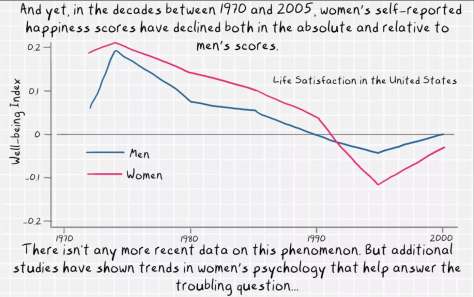
Male And Female Happiness After Feminism And Socialism
Male and female happiness throughout America’s adoption of radical feminism

I was reading this article by a feminist fiction writer on Vox, where she explains that although feminists have gotten what they wanted (careers, contraceptives, promiscuity, abortion, no-fault-divorce, daycare, etc. it hasn’t made them happier. So, what does this feminist fiction writer think would make feminists happier?

She gives two reasons why women women are still unhappy after feminism has been adopted by our society:

  • men don’t do enough housework
  • women are not as successful as men because they are discriminated against, the so-called “glass ceiling”

I think those complaints are pretty popular among feminists. Let’s take a look at some studies to see if her opinions are supported by peer-reviewed studies.

First study:

COUPLES who share housework duties run a higher risk of divorce than couples where the woman does most of the chores, a study has found.

The divorce rate among couples who shared housework equally was around 50 per cent higher than among those where the woman did most of the work.

“The more a man does in the home, the higher the divorce rate,” Thomas Hansen, co-author of the study entitled Equality in the Home, said.

Second study:

Researchers at the University of Illinois examined data on nearly 1,500 men and 1,800 women, aged between 52 and 60. Their well-being was evaluated through surveys.

The researchers first found that men’s well-being decreased once they had exited the workforce to become home-makers.

Meanwhile, the inverse was not so for women: Women’s psychological well-being was not affected by leaving their jobs to become stay-at-home mothers.

Third study:

A study called “Egalitarianism, Housework and Sexual Frequency in Marriage,” which appeared in The American Sociological Review last year, surprised many, precisely because it went against the logical assumption that as marriages improve by becoming more equal, the sex in these marriages will improve, too. Instead, it found that when men did certain kinds of chores around the house, couples had less sex. Specifically, if men did all of what the researchers characterized as feminine chores like folding laundry, cooking or vacuuming — the kinds of things many women say they want their husbands to do — then couples had sex 1.5 fewer times per month than those with husbands who did what were considered masculine chores, like taking out the trash or fixing the car. It wasn’t just the frequency that was affected, either — at least for the wives. The more traditional the division of labor, meaning the greater the husband’s share of masculine chores compared with feminine ones, the greater his wife’s reported sexual satisfaction.

Regarding the pay gap, that is entirely caused by women’s own choices. E.g. – the choice to study creative writing instead of petroleum engineering, the choice to work 35 hour weeks instead of 70 hour weeks, etc.

Fourth study:  (summarized by AEI economist)

When the [Bureau of Labor Statistics] reports that women working full-time in 2018 earned 81.4% of what men earned working full-time, that is very much different from saying that women earned 81.4% of what men earned for doing exactly the same work while working the exact same number of hours in the same occupation, with exactly the same educational background and exactly the same years of continuous, uninterrupted work experience, and with exactly the same marital and family (e.g., number of children) status. As shown above, once we start controlling individually for the many relevant factors that affect earnings, e.g., hours worked, age, marital status, and having children, most of the raw earnings differential disappears.

Fifth study:

This study leads to the unambiguous conclusion that the differences in the compensation of men and women are the result of a multitude of factors and that the raw wage gap should not be used as the basis to justify corrective action. Indeed, there may be nothing to correct. The differences in raw wages may be almost entirely the result of the individual choices being made by both male and female workers.

I think that women are entitled to make their own decisions, but they aren’t allowed to force the rest of us to subsidize their failures and celebrate their destructive outcomes.

I could go on, but I think enough has been said to show that research is very much at odds with feminist rhetoric. They feel they know what will make them happy and we gave them everything they asked for. They eliminated shaming of promiscuity with sex education. They get preferential treatment in the schools in a female-dominated education system.They are hired because of affirmative action quotas. They get expensive daycare, government schools, welfare and other programs. Taxes are raised to equalize outcomes for divorced women who choose men for feelings, and then nuke their own marriage enterprise. We have been on a long experiment of giving feminists everything they felt they wanted, at the expense of men’s rights and children’s rights, and it hasn’t even produced the results that feminists felt it would.

The social costs of feelings-based decision-making

Let’s look at two examples of policies that feminists asked for in the past, which didn’t work out the way they wanted.

I can understand why feminists would introduce sex education. They felt that “if everyone is having sex, then I won’t be the only one chasing attention from hot no-commitment bad boys by giving them recreational sex before marriage”.  They wanted to eliminate the standards of chastity and marriage-focused dating and normalize fun-focused drunken promiscuity. And they got that. But since they didn’t consult any research and evidence about how that would affect their future marriage stability and marriage happiness, they are even more unhappy than before.

How about no-fault divorce? No-fault divorce was brought in by a coalition of feminists, Marxists and trial lawyers. The Marxists want to destroy the family in order to increase dependence on the state. The trial lawyers wanted to make money. And the feminists thought that the standard approach to courting and marriage was just too much work. They didn’t want to be chaste. They didn’t want to be sober. They didn’t want to evaluate a man for traditional husband and father roles. The no-fault divorce laws gave them an escape from the messes caused by their own feelings-driven choices. But divorce just makes makes men and women much poorer, and passes the costs of supporting single mothers onto taxpayers.

And the costs of the failures of feminism are passed onto taxpayers.

Consider this study:

This paper examines the growth of government during this century as a result of giving women the right to vote. Using cross-sectional time-series data for 1870–1940, we examine state government expenditures and revenue as well as voting by U.S. House and Senate state delegations and the passage of a wide range of different state laws. Suffrage coincided with immediate increases in state government expenditures and revenue and more liberal voting patterns for federal representatives, and these effects continued growing over time as more women took advantage of the franchise. Contrary to many recent suggestions, the gender gap is not something that has arisen since the 1970s, and it helps explain why American government started growing when it did.

We are already $28 trillion in debt, partly because of feminism’s replacement of husbands and families with higher taxes and big government. Every time we transfer money from tax-paying men to feminists to fix their mistakes, it leaves less money in the hands of the men who actually want to get married. The declining value of marriage after feminism for men explains why marriage is being delayed, and why marriage rates are plunging.