I listened to this debate and thought that Dawkins did well against Lennox. It is a very short debate. This is not a rigorous academic debate, as neither participant argued in a formal manner. Dawkins came across as firm, but gracious, and he does a lot better than Hitchens did in his recent debate against Craig.
This debate is recommended for beginners to get a bird’s eye view of some of the issues before moving on to professional academic debates featuring analytical philosophers such as William Lane Craig, Walter Sinott-Armstrong, etc. They don’t really go into complicated details.
I give these videos my highest recommendation. If you have not seen them, you must see them.
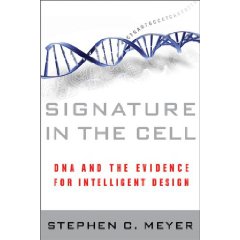
Stephen C. Meyer’s new book
The new book by Stephen C. Meyer is called “Signature in the Cell: DNA and the Evidence for Intelligent Design”. It is being published by Harper-Collins.
Signature in the Cell
Here is the blurb:
Meyer tells the story of the successive attempts to solve this mystery of DNA and argues that fundamental objections now exist to the adequacy of all purely naturalistic or materialistic theories. The book then proposes a radical alternative based upon developments in molecular biology and the information sciences: it proposes the design hypothesis as the best explanation for the origin of the information necessary to produce the first life.
SIGNATURE IN THE CELL will not merely provide a critique of evolutionary theories. It also shows that, based on our uniform and repeated experience-the basis of all scientific reasoning about the past-there is a strong positive case for intelligent design. From our experience we know that intelligence alone produces large amounts of information. Thus, the book shows that the argument for intelligent design from DNA is not based on ignorance or a desire to “give up on science,” but instead upon just the opposite: our growing scientific knowledge of the inner workings of the cell and our experience-based knowledge of the cause-and-effect structure of the world. For just this reason the argument for design can be formulated as a rigorous and positive scientific argument-specifically one called “an inference to the best explanation.” The book shows, ironically, that the argument for intelligent design from DNA is based on the same method of scientific reasoning that Darwin himself used.
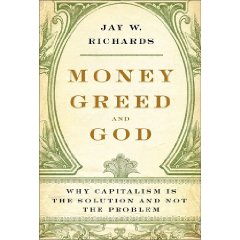
To understand what capitalism is, you can watch this lecture entitled “Money, Greed and God: Why Capitalism is the Solution and Not the Problem” by Jay W. Richards, delivered at the Heritage Foundation think tank, and televised by C-SPAN2. The book has the same title, and is published by Harper-Collins.
Money, Greed and God
Here is the blurb:
Does capitalism promote greed? Can a person follow Jesus’s call to love others and also support capitalism? Was our recent economic crisis caused by flaws inherent to our free market system? Jay Richards presents a new approach to capitalism, revealing how it’s fully consistent with Jesus’s teachings and the Christian tradition, while also showing why this system is our best bet for renewed economic vigor.
The church is bombarded with two competing messages about money and capitalism:
wealth is bad and causes much of the world’s suffering
wealth is good and God wants you to prosper and be rich
Richards exposes these myths, and other common misconceptions about capitalism, and reveals the surprising ways that capitalism is, in fact, the best system to respond to the biblical mandates of alleviating poverty and protecting the environment. Money, Greed, and God equips readers to take practical steps in their own lives to conduct business, worship God, and serve others without falling into the “prosperity gospel” trap.
Well, if it does, doesn’t that mean that evolution wasn’t proved before?
But I digress. Whenever you have questions about evolution and culture, there is only one blog that you really need to read, and that’s Denyse O’Leary’s Post-Darwinist. She has written no less than THREE stories on the Ida fossil, so let’s take a look at see what she’s found.
First, on May 19th, she noted that the lemur-like fossil contradicted the current best naturalistic theory of human origins.
[The] fossil doesn’t “explain” human evolution; it complicates the picture. The theory that was gaining ground was that humans were descended from tarsier-like creatures, but this fossil, touted as a primate ancestor, is a lemur-like creature.
This recent Messil Pit find bolsters the case of the lemur supporters against the previously dominant tarsier supporters.
That only creates more confusion about origins, it seems to me, rather than resolving anything.
Where you have opposing histories, evidence that strengthens one history must weaken the other.
It does not necessarily add up to a gain in information.
What if the tarsier advocates find a fossil that bolsters their case in, say, 2012?
And who’s to say that won’t happen – as it has happened already?
Everything gets so complicated, once you look past the “missing link” sound-bites. But many people looking for validation for their atheist lifestyle will never bother – so long as the cultural authorities can offer them some Piltdown Man or Archaeoraptor or Haeckel’s embryos or Peppered Moths, etc., to justify their atheistic faith.
Denyse also points to a round-up of links from Access Research Network, as well as a New Scientist story that is skeptical of Ida’s status as *the* missing link.
… in the research paper detailing the discovery, the scientists had painted a rather different picture. Ida, they said, “could represent a stem group from which later anthropoid primates (including humans) evolved but we are not advocating this here”.
And more:
Robert Foley, professor of human evolution at Cambridge University, believes many people misunderstand the huge timescales involved in assessing fossils.
“This animal lived around 47m years ago but human-like creatures only appeared in the last 2m years,” he said. “That’s a gap of around 45m years with many other species lying between us and that era. Any one of them could be called a missing link. Really, the term is meaningless.”
Now I know what my many atheist readers are saying: “we’re only skeptical of your beliefs! Not our beliefs!”. Well, I’m sorry, true believers, to throw cold water on you.

 WINTERY KNIGHT