Tag Archives: Evidence

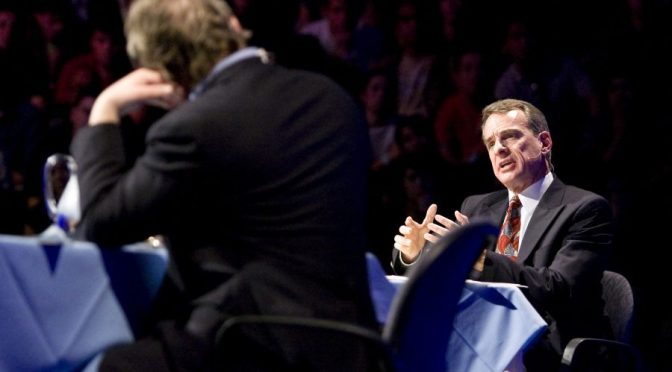
Michael Behe and Keith Fox debate theistic evolution vs intelligent design

Michael Behe and Keith Fox debate evolution and intelligent design. (See below for link to video)

Details:

Michael Behe is professor of biochemistry at Lehigh University, Pennsylvania and the founder of the modern Intelligent Design movement. His book “Darwin’s Black Box” ignited the controversy 14 years ago when it claimed that certain molecular machines and biological processes are “irreducibly complex” and cannot be explained by Darwinian evolution.

Keith Fox is Professor of biochemistry at the University of Southampton and chairman of Christians in Science. As a theistic evolutionist he believes that Evolution is the best explanation going for the complexity we see and that ID is a blind scientific alley and theologically unappealing to boot.

They debate whether micromachines in the cell such as the “bacterial flagellum” could have evolved by a Darwinian process of evolution. When inference to design is and isn’t acceptable in science. Whether random mutation can mathematically stack up to complex life, and whether God is reduced to a divine “tinkerer” by ID.

Here’s the debate:

Summary

Note: the following debate summary is rated “S” for Snarky. Reader discretion is advised.

Michael Behe:

  • ID is not Biblical creationism
  • ID is not religion
  • ID is a scientific research program
  • People refuse to discuss ID because of personal philosophical assumptions
  • ID is like the Big Bang – it is based on evidence, but it has broad religious implications

Keith Fox:

  • ID is not Biblical creationism, but it isn’t science

Michael Behe:

  • ID is compatible with common descent
  • ID is only opposed to unplanned, unguided evolution (Darwinism)
  • ID is not necessarily opposed to long periods of time

Behe’s first book – the bacterial flagellum

Keith Fox:

  • Here are a couple of papers that show how parts of the flagellum evolved
  • They are possible pathways

Michael Behe

  • No, those are studies that show that there are similarities between bacterial flagella in multiple organisms
  • Similarities of proteins between different organisms do not necessarily imply a developmental pathway
  • The problem of having the instructions to BUILD the flagellum still remains

Keith Fox:

  • Maybe parts of the flagellum had other functions before they were used in the flagellum
  • Maybe you can use the parts of the flagellum for other purposes
  • Maybe, one can imagine, it’s possible that!

Michael Behe:

  • No, parts have to be modified and re-purposed in order to be used for other functions

Keith Fox:

  • But maybe the proteins can be used in other systems for other things
  • I re-purpose parts from of designed things to other purposes in my house when I do maintenance

Michael Behe

  • Uh, yeah – but aren’t you an intelligent designer? What does your home maintenance have to do with Darwinian evolution?

Is ID another God-of-the-gaps argument?

Michael Behe:

  • Well consider the Big Bang… there was a build-up of scientific evidence for that theory
  • Just because a theory has religious implications, doesn’t mean that it isn’t true
  • You really have to look at the specific evidence for a theory, and not decide in advance

Keith Fox: (I’m paraphrasing/inventing/mocking from now on)

  • But the Big Bang is based on discoveries, and intelligent design is based on gaps in our scientific knowledge
  • What if I did have evidence of a step by step pathway (which I don’t right now)? Then I would win the argument – what would you do then?

Michael Behe:

  • Well, if tomorrow you do manage to find expiremental evidence of a pathway, which you don’t have today, then I would be wrong
  • ID is falsifiable by experimental evidence
  • But what about your your view? Is that falsifiable by experimental evidence?
  • What if someone goes into a lab (someone like Scott Minnich?) and performs gene knockout experiments, and publishes the results
  • You knock out a gene from the bacterial flagellum, you wait for a large number of generations, and it never develops the missing gene
  • You repeat this with every one of the 50 genes in the bacterial flagellum and it never recovers for any of the 50 genes
  • There is no pathway to build up even one of the 50 genes – according to actual experiments
  • What do Darwinists do with experimental evidence that falsifies Darwinism?

Keith Fox:

  • No, I would not accept that experimental evidence could falsify Darwinism
  • Just because known published experimental evidence that we have today falsifies Darwinism, it doesn’t mean Darwinism is false because it’s not falsifiable
  • We don’t know how Darwinism even works – it happened so long ago, and it’s not repeatable or testable, so how could lab ,experiments falsify it?
  • Darwinism is science and intelligent design is faith, though

Which side has the experimental evidence?

Michael Behe:

  • Consider the largest longest-running lab experiment of evolution, Richard Lenski’s experiments on e. coli
  • Lenski has presided over 50,000 generations, (millions of years of evolution)
  • The bacterium did evolve and they did get better but not by evolving features, but by disabling features

Keith Fox:

  • But those are just LAB EXPERIMENTS! What do lab experiments prove?
  • What if? What if? What if? You don’t know, it happened so long ago, and you weren’t there! You weren’t there!
  • (clutches Flying Spaghetti Monster idol tighter and sobs pitifully)

Michael Behe:

  • See, the thing is that I have actual experiements, and here’s some more evidence that just got published last week
  • So I’ve got evidence and then some more evidence and them some other evidence – experimental evidence
  • And all the evidence shows that adaptation is done losing traits not by gaining traits
  • And the published observations are what we see in nature as well

Keith Fox:

  • But doesn’t Darwinism explain some things that we observe?

Michael Behe:

  • Well, I am not saying that micro-evolution doesn’t explain some things – it explains bacterial resistance, and other micro-evolution
  • it just doesn’t explain macro-evolution, and that’s what the experiments show

Keith Fox:

  • But ID is a science stopper! It stops science! You can’t produce experimental evidence to falsify Darwinism – that would stop science!

Michael Behe:

  • Well, you have to understand that the Big Bang postulated a non-material cause to the entire physical universe and yet the experimental evidence was allowed to stand because it was testable and verifiable evidence, even if the theory does have religious implications
  • All explanations in science are design to settle a question and it stops rival explanations that are not as good at explaining the observations
  • Finding the best explanation stops further study because it is better than rival explanations

Keith Fox:

  • Well you have to come up with a materialist explanation because that’s the only kind that a functional atheist like me will allow

Michael Behe:

  • Well, what if the best explanation for an observed effect in nature is non-material, as with the Big Bang?

Keith Fox:

  • But I have to have a material explanation because I am a functional atheist! (i.e. – a theistic evolutionist = functional atheist)

Michael Behe:

  • Well what about the cosmic fine-tuning argument? Do you accept that?
  • That’s an inference to design based on the latest scientific discoveries

Keith Fox:

  • Well I do accept that argument, but I don’t accept design in biology
  • When you apply it to biology, somehow it’s bad and you can’t do that or you losing research money and get fired
  • Anyway, your argument is based on a gap in our current knowledge

Michael Behe:

  • No, back in Darwin’s time we had a gap in our knowledge – we didn’t know what the cell was – we thought it was jello
  • Now, we know what the cell is really like, it’s irreducibly complex, and you can’t build up those molecular machines in a step-wise manner
  • The inference to design is based on the progress of science revealing the increasing levels of complexity
  • In experiments, Darwinian mechanisms cannot build anything useful, instead genes are disabled or dropped
  • You guys don’t have the evidence to prove your view that naturalistic mechanisms can do the creating
  • You keep issuing promissory notes

Keith Fox:

  • Well, you’re just seeing design subjectively, because you are a non-scientist
  • I’m being objective when I tell you that we will discover a materialist explanation later on – really really soon now, maybe even tomorrow, yeah
  • You won’t accept my speculations and you insist on these published experiments
  • You’re subjective and I’m objective
  • Just give me more research money so I can hide the decline better

Michael Behe:

  • Uh, you’re the one who is subjective – I cited evidence, and you are the one who is speculating
  • You have arguments from credulity, and I’ve got the lab experiments
  • You refuse to be skeptical, I am the one who is being skeptical

Keith Fox:

  • Maybe, maybe, maybe! Maybe tomorrow! Maybe in a parallel universe! Maybe aliens from Planet 9 from Outer Space!
  • Who knows! I certainly don’t know! And that somehow means you don’t know either! See?

Michael Behe:

  • Well, to prove me wrong, go into the lab, and run experiments and evolve some new genes (using Darwinian mechanisms) that have new useful functionality

Are there limits to what evolution can do?

Michael Behe:

  • You need multiple changes in the genome to get a new helpful feature (let’s say two specific mutations)
  • One specific change is possible
  • the odds are against getting multiple beneficial changes are really really small – you need two SPECIFIC changes to occur in order

Keith Fox:

  • Well, lots of things are really unlikely – any permutation of dice rolls is as unlikely as any other

Michael Behe:

  • Well, we are talking about TWO SPECIFIC mutations that are needed to get a beneficial function – lots of other mutations are possible, but we are looking for a specific outcome that requires two SPECIFIC mutations out of the whole genome
  • You aren’t going to get useful outcomes unless you direct the mutations

Keith Fox:

  • But then why does God allow evil!!!!1!1!!one!!!

Bible study: the importance of truth in religion

Here’s an interesting passage of the Bible. What do you all think the practical value of this passage is?

1 In the second year of his reign, Nebuchadnezzar had dreams; his mind was troubled and he could not sleep.

2 So the king summoned the magicians, enchanters, sorcerers and astrologers to tell him what he had dreamed. When they came in and stood before the king,

3 he said to them, “I have had a dream that troubles me and I want to know what it means.”

4 Then the astrologers answered the king, “May the king live forever! Tell your servants the dream, and we will interpret it.”

5 The king replied to the astrologers, “This is what I have firmly decided: If you do not tell me what my dream was and interpret it, I will have you cut into pieces and your houses turned into piles of rubble.

6 But if you tell me the dream and explain it, you will receive from me gifts and rewards and great honor. So tell me the dream and interpret it for me.”

7 Once more they replied, “Let the king tell his servants the dream, and we will interpret it.”

8 Then the king answered, “I am certain that you are trying to gain time, because you realize that this is what I have firmly decided:

9 If you do not tell me the dream, there is only one penalty for you. You have conspired to tell me misleading and wicked things, hoping the situation will change. So then, tell me the dream, and I will know that you can interpret it for me.”

10 The astrologers answered the king, “There is no one on earth who can do what the king asks! No king, however great and mighty, has ever asked such a thing of any magician or enchanter or astrologer.

11 What the king asks is too difficult. No one can reveal it to the king except the gods, and they do not live among humans.”

12 This made the king so angry and furious that he ordered the execution of all the wise men of Babylon.

13 So the decree was issued to put the wise men to death, and men were sent to look for Daniel and his friends to put them to death.

14 When Arioch, the commander of the king’s guard, had gone out to put to death the wise men of Babylon, Daniel spoke to him with wisdom and tact.

15 He asked the king’s officer, “Why did the king issue such a harsh decree?” Arioch then explained the matter to Daniel.

16 At this, Daniel went in to the king and asked for time, so that he might interpret the dream for him.

17 Then Daniel returned to his house and explained the matter to his friends Hananiah, Mishael and Azariah.

18 He urged them to plead for mercy from the God of heaven concerning this mystery, so that he and his friends might not be executed with the rest of the wise men of Babylon.

19 During the night the mystery was revealed to Daniel in a vision. Then Daniel praised the God of heaven

20 and said:

“Praise be to the name of God for ever and ever;
wisdom and power are his.

21 He changes times and seasons;
he deposes kings and raises up others.
He gives wisdom to the wise
and knowledge to the discerning.

22 He reveals deep and hidden things;
he knows what lies in darkness,
and light dwells with him.

23 I thank and praise you, God of my ancestors:
You have given me wisdom and power,
you have made known to me what we asked of you,
you have made known to us the dream of the king.”

24Then Daniel went to Arioch, whom the king had appointed to execute the wise men of Babylon, and said to him, “Do not execute the wise men of Babylon. Take me to the king, and I will interpret his dream for him.”

25 Arioch took Daniel to the king at once and said, “I have found a man among the exiles from Judah who can tell the king what his dream means.”

26 The king asked Daniel (also called Belteshazzar), “Are you able to tell me what I saw in my dream and interpret it?”

27 Daniel replied, “No wise man, enchanter, magician or diviner can explain to the king the mystery he has asked about,

28 but there is a God in heaven who reveals mysteries. He has shown King Nebuchadnezzar what will happen in days to come. Your dream and the visions that passed through your mind as you were lying in bed are these:

29 “As Your Majesty was lying there, your mind turned to things to come, and the revealer of mysteries showed you what is going to happen.

30 As for me, this mystery has been revealed to me, not because I have greater wisdom than anyone else alive, but so that Your Majesty may know the interpretation and that you may understand what went through your mind.

This passage is interesting to me because it shows the kind of attitude that God answers. The King in this passage was tired of hearing man-made stories from his servants – stories that were undoubtedly influenced by the servants desire to survive the King’s wrath. The servants would only have told the King things that were vague and happy, so that they could never be proved wrong or found to be judgmental or offensive. But the King was tired of that. He wanted someone with authority to tell him the truth about the way the world was.

In the rest of the chapter, Daniel interprets the dream, and concludes by saying this: “The great God has shown the king what will take place in the future. The dream is true and its interpretation is trustworthy.”. The King replies: “Surely your God is the God of gods and the Lord of kings and a revealer of mysteries, for you were able to reveal this mystery.”

I think it is is going to be difficult for Christians living today to be able to tell people their dreams like that. But what we can do is talk about God’s miracles as revealed by science and history. We can study astrophysics, biochemistry and history and we can explain what God did in creating and fine-tuning the universe for life, in sequencing amino acids into functioning proteins, in creating brand new body plans in the Cambrian explosion, in raising Jesus from the dead as a matter of historical record, and so on. We have to show how great God is to people who do not even think he exists, and without assuming that they believe in the Bible. And we have to do it by focusing on what is true. 

Early last week, I got a message from a friend who was interested in a girl that he met on an online dating service. She claimed to be a Christian. My friend explained why he was so interested in some of the evidences I outlined above. She was not impressed. She said “I prefer to show people Christianity is true by not judging them, by being compassionate, by introducing them to a fun and affirming community”. There was no emphasis on truth in her approach. In fact, any religious group could do those things and “establish” their religion as true, by appealing to feelings. But this is clearly not what the God of the Bible intends for people who seek him. He is a God of truth, and truth is established by logical reasoning and supporting evidence.

There are still people out there like the King who are looking for someone who can speak to them with authority. All it takes from us is a little studying, and we can be like Daniel, too. But we have to know what God has done from science and history, and speak with authority about how we can know that God has acted supernaturally. Authority to speak comes from having knowledge about what we are talking about, and knowledge comes from studying and debating with people we disagree with. Nebuchadnezzar  was not a believer in the God of Israel, but he was still interested in truth. That won’t always be the case, but it is the case for some people.

How the WMAP satellite confirmed nucleosynthesis predictions and falsified atheism

Prior to certain scientific discoveries, most people thought that the universe had always been here, and no need to ask who or what may have caused it. But today, that’s all changed. Today, the standard model of the origin of the universe is that all the matter and energy in the universe came into being in an event scientists call “The Big Bang”. At the creation event, space and time themselves began to exist, and there is no material reality that preceded them.

So a couple of quotes to show that.

An initial cosmological singularity… forms a past temporal extremity to the universe. We cannot continue physical reasoning, or even the concept of spacetime, through such an extremity… On this view the big bang represents the creation event; the creation not only of all the matter and energy in the universe, but also of spacetime itself.

Source: P. C. W. Davies, “Spacetime Singularities in Cosmology,” in The Study of Time III, ed. J. T. Fraser (Berlin: Springer Verlag ).

And another quote:

[A]lmost everyone now believes that the universe, and time itself, had a beginning at the big bang.

Source: Stephen Hawking and Roger Penrose, The Nature of Space and Time, The Isaac Newton Institute Series of Lectures (Princeton, N. J.: Princeton University Press, 1996), p. 20.

So, there are several scientific discoveries that led scientists to accept the creation event, and one of the most interesting and famous is the discovery of how elements heavier than hydrogen were formed.

Nucleosynthesis: forming heavier elements by fusion

Here’s the history of how that discovery happened, from the National Aeronautics and Space Administration (NASA) web site:

The term nucleosynthesis refers to the formation of heavier elements, atomic nuclei with many protons and neutrons, from the fusion of lighter elements. The Big Bang theory predicts that the early universe was a very hot place. One second after the Big Bang, the temperature of the universe was roughly 10 billion degrees and was filled with a sea of neutrons, protons, electrons, anti-electrons (positrons), photons and neutrinos. As the universe cooled, the neutrons either decayed into protons and electrons or combined with protons to make deuterium (an isotope of hydrogen). During the first three minutes of the universe, most of the deuterium combined to make helium. Trace amounts of lithium were also produced at this time. This process of light element formation in the early universe is called “Big Bang nucleosynthesis” (BBN).

The creation hypothesis predicts that there will be specific amounts of these light elements formed as the universe cools down. Do the predictions match with observations?

Yes they do:

The predicted abundance of deuterium, helium and lithium depends on the density of ordinary matter in the early universe, as shown in the figure at left. These results indicate that the yield of helium is relatively insensitive to the abundance of ordinary matter, above a certain threshold. We generically expect about 24% of the ordinary matter in the universe to be helium produced in the Big Bang. This is in very good agreement with observations and is another major triumph for the Big Bang theory.

Moreover, WMAP satellite measurements of mass density agree with our observations of these light element abundances.

Here are the observations from the WMAP satellite:

Scientific observations match predictions

And here is how those WMAP measurements confirm the Big Bang creation event:

However, the Big Bang model can be tested further. Given a precise measurement of the abundance of ordinary matter, the predicted abundances of the other light elements becomes highly constrained. The WMAP satellite is able to directly measure the ordinary matter density and finds a value of 4.6% (±0.2%), indicated by the vertical red line in the graph. This leads to predicted abundances shown by the circles in the graph, which are in good agreement with observed abundances. This is an important and detailed test of nucleosynthesis and is further evidence in support of the Big Bang theory.

“An important and detailed test”.

For completeness, we should learn how elements heavier than these light elements are formed:

Elements heavier than lithium are all synthesized in stars. During the late stages of stellar evolution, massive stars burn helium to carbon, oxygen, silicon, sulfur, and iron. Elements heavier than iron are produced in two ways: in the outer envelopes of super-giant stars and in the explosion of a supernovae. All carbon-based life on Earth is literally composed of stardust.

That’s a wonderful thing to tell a young lady when you are on a date: “your body is made of stardust”. In fact, as I have argued before, this star formation, which creates the elements necessary for intelligent life, can only be built if the fundamental constants and quantities in the universe are finely-tuned.

Now, you would think that atheists would be happy to find observations that confirm the origin of the universe out of nothing, but they are not. Actually, they are in denial.

Here’s a statement from the Secular Humanist Manifesto, which explains what atheists believe about the universe:

Religious humanists regard the universe as self-existing and not created.

For a couple of examples of how atheistic scientists respond to the evidence for a cosmic beginning, you can check out this post, where we get responses from cosmologist Lawrence Krauss, and physical chemist Peter Atkins.

You cannot have the creation of the universe be true AND a self-existing, eternal universe ALSO be true. Someone has to be wrong. Either the science is wrong, or the atheist manifesto is wrong. I know where I stand.

Positive arguments for Christian theism