
Tag Archives: Evangelism

William Lane Craig lectures on the evidence for the resurrection of Jesus

Sherlock Holmes and John Watson: let's take a look at the facts
Sherlock Holmes and John Watson: let’s take a look at the facts

Here is Dr. William Lane Craig giving a long-form argument for the historical event of the resurrection of Jesus, and taking questions from the audience.

The speaker introduction goes for 6 minutes, then Dr. Craig speaks for 35 minutes, then it’s a period of questions and answers with the audience. The total length is 93 minutes, so quite a long period of Q&A. The questions in the Q&A period are quite good.

Introduction:

  • Many people who are willing to accept God’s existence are not willing to accept the God of Christianity
  • Christians need to be ready to show that Jesus rose from the dead as a historical event
  • Private faith is fine for individuals, but when dealing with the public you have to have evidence
  • When making the case, you cannot assume that your audience accepts the Bible as inerrant
  • You must use the New Testament like any other ancient historical document
  • Most historians, Christian and not, accept the basic minimal facts supporting the resurrection of Jesus

Fact #1: the burial of Jesus following his crucifixion

  • Fact #1 is supported by the early creed found in Paul’s first letter to the Corinthians (1 Cor 15)
  • Fact #1 is supported by the early Passion narrative which was a source for Mark’s gospel
  • Fact #1 passes the criterion of enemy attestation, since it praises one of the Sanhedrin
  • Fact #1 is not opposed by any competing burial narratives

Fact #2: on the Sunday following his crucifixion, Jesus’ tomb was found empty by some women

  • Fact #2 is supported by the early Passion narrative which was a source for Mark’s gospel
  • Fact #2 is implied by the early creed found in Paul’s first letter to the Corinthians (1 Cor 15)
  • Fact #2 is simple and lacks legendary embellishment, which argues for an early dating
  • Fact #2 passes the criterion of embarrassment, because it has female, not male, witnesses
  • Fact #2 passes the criterion of enemy attestation, since it is reported by the Jewish leaders

Fact #3: Jesus appeared to various people in various circumstances after his death

  • Fact #3 is supported by the early creed found in Paul’s first letter to the Corinthians (1 Cor 15)
  • Fact #3 is supported by multiple, independent reports of the events from all four gospels
  • Fact #3 explains other historical facts, like the conversion of Jesus’ skeptical brother James

Fact #4: the earliest Christians proclaimed their belief in the resurrection of Jesus

  • Fact #4 explains why the earliest Christians continued to identify Jesus as the Messiah
  • Fact #4 explains why the earliest Christians were suddenly so unconcerned about being killed

Dr. Craig then asks which hypothesis explains all four of these facts. He surveys a number of naturalistic hypotheses, such as the hallucination theory or various conspiracy theories. All of these theories deny one or more of the minimal facts that have been established and accepted by the broad spectrum of historians. In order to reject the resurrection hypothesis, a skeptic would have to deny one of the four facts or propose an explanation that explains those facts better than the resurrection hypothesis.

I listened to the Q&A period while doing housekeeping and I heard lots of good questions. Dr. Craig gives very long answers to the questions. One person asked why we should trust the claim that the Jewish leaders really did say that the disciples stole the body. Another one asked why we should take the resurrection as proof that Jesus was divine. Another asks about the earthquake in Matthewand whether it is intended to be historical or apocalyptic imagery. Dr. Craig is also asked about the Jewish scholar Geza Vermes, and how many of the minimal facts he accepts. Another questioner asked about the ascension.

If you are looking for a good book to read on this topic, the best introductory book on the resurrection is “The Case for the Resurrection of Jesus” and the best comprehensive book is “The Resurrection of Jesus“.

Should Christians be motivated by the fear of missing out (FOMO)?

Bible study that hits the spot

My best friend Dina and I recently spent some time talking over some articles that we found on the culture. We specifically talked about what is motivating young people, so I wanted to write something about that.

FOMO: Fear Of Missing Out

Here’s a leftist New York Times article explaining where FOMO comes from:

It’s known as FOMO, or “fear of missing out,” and refers to the blend of anxiety, inadequacy and irritation that can flare up while skimming social media like Facebook, Twitter, Foursquare and Instagram. Billions of Twitter messages, status updates and photographs provide thrilling glimpses of the daily lives and activities of friends, “frenemies,” co-workers and peers.

[…]When we scroll through pictures and status updates, the worry that tugs at the corners of our minds is set off by the fear of regret, according to Dan Ariely, author of “Predictably Irrational” and a professor of psychology and behavioral economics at Duke University. He says we become afraid that we’ve made the wrong decision about how to spend our time.

[…]A friend who works in advertising told me that she felt fine about her life — until she opened Facebook. “Then I’m thinking, ‘I am 28, with three roommates, and oh, it looks like you have a precious baby and a mortgage,’ ” she said. “And then I wanna die.”

It’s like they want to run a race to do fun and exotic things with their peers, and not finish last.

Anyway, I want to begin this post with examples of FOMO behavior I have personally encountered.

FOMO Travel

Dina and I read and discussed this article by Alain de Botton in The European – notice the emphasis on travel and having fun, sophisticated experiences:

We’re continually being bombarded with suggestions about what we might do (go jet skiing, study in Colorado, visit the Maldives or see the Pyramids). We’re always hearing of the amazing things friends have done or are going to do: ‘there was this great bar we all went to …’; ‘she’s getting married in a little country church, then we’re having a picnic…’; ‘the sun was glinting on Sydney Harbour…’ There are endless hints of the allure of life in other places: an article about family-friendly restaurants in Brooklyn, a crime novel set in Trieste, the departure board at the airport with its list of places only a plane trip away: Moscow, Bangkok, Addis Ababa… The modern world makes sure we know at all times just how much we’re missing. It is a culture in which intense and painful doses of FOMO (Fear Of Missing Out) are almost inevitable.

What’s interesting is this – how does FOMO travel affect young, unmarried Christians?

Travel through missions work seems to be the FOMO activity of choice for at least a few young, unmarried Christians. One of my best friends who is married to another of my best friends told me about her missions trip to a European country. I asked her why she did it, since it meant lost savings, lost earnings, lost work experience, etc. (She gave up a year of earnings, and she had a great job in engineering). Her answer was that she did it for the adventure. I have a hard time hearing Jesus say that he was going to do something because he was bored and wanted an adventure. Especially when it’s $30,000 in costs, $60,000 of lost income, and lost work experience – per year. This was before the time of the Internet, though, when missionary work actually made sense. I just don’t think it’s worth spending that kind of money for the impact you make. The people I know who went on missionary trips just wanted to feel spiritual, look spiritual, and have a fun “life experience” vacation. One missionary told me that she was desperate to get away from her boring mid-Western roots.

If you really want to share Christ effectively with people in other countries, then you can start a blog and pay the tiny costs for it out of your earnings from your day job – that’s what I do. I get more people from Europe reading my blog than I could contact in a year of missionary work. I Skype with the people who are interested in Christianity from these countries (Scotland, Northern Ireland, England, Canada, etc.), as well. Meanwhile, I keep working my not-exciting job, so my savings increase, and my resume remains gap-less. This is good stewardship of finances, and self-denial prepares your character for the hard work of marriage and parenting. The Bible says that those who do not work should not eat. And Paul says that he built tents so that no one could accuse him of taking on missionary work for financial gain.

You can tell whether a person is sincere in their missionary intentions by looking at how responsible they’ve been in their decision-making. If a person has gone into debt paying for fun, thrilling activities like skydiving, ziplining, surfing, etc., then it’s FOMO travel. We must look past the spiritual smokescreen, and tell young people to grow up.

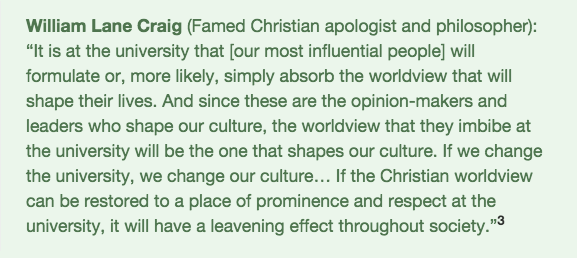
After all, if defending God’s honor was the missionary’s main goal, then the real battlefield would be the university.

Bill Craig puts it best:

If serving God is your goal, look to the university

There is already a perfectly fine university right next door – no need to fly to Europe to find one! Remember, the university that took your faith away, or maybe the faith of someone you cared about? Yeah, it’s still sitting there in your home town! And it’s still ruining the lives of thousands of young people, by peer-pressuring them into secular, liberal views – and behaviors. It seems to me that it’s better stewardship to stay here and work, then give money to groups like Reasonable Faith. And you can start a blog, teach in church and invite scholars to the local university, too. That costs almost nothing, and it produces better results.

What about Jesus?

Sometimes, it’s a good idea to look beyond the words of the Bible and reflect on the overall message of it at a higher level. When I look in the Bible, I see that Jesus went through a lot of suffering in obedience to God in order to secure the salvation of people who did not even like him. And it’s from this sacrifice on our behalf that his claim on our obedience comes. There are things that I don’t like to do that I do anyway because they work to serve God. Jesus life’s ambition was not to do things that were easy, or that made him happy. Experienced Christians do things that are not fun, because these things are right and because they solve the real problem.

The worst mistake you can make when defending the Christian worldview

I have a key that will unlock a puzzling mystery

So, this is just an advice post for doing apologetics.

Here are three situations I’ve run into while doing apologetics in the last month.

First situation. I was talking with a lady who is an atheist. I had a copy of “God’s Crime Scene” in my hand, and she asked me about it. I told her that it was a book written by the guy who solved the homicide case that I asked her to watch on Dateline. She remembered – it was the two-hour special on the woman who was killed with a garrotte. She pointed at the book and said “what’s in it?” I said, it has 8 pieces of evidence that fit better with a theistic worldview than with an atheistic one, and some of them scientific. Her reply to me was – literally – “which denomination do you want me to join?”

Second situation. I was talking with a friend of mine who teaches in a Catholic school. She was telling that she got the opportunity to talk to her students about God, and found out that some of them were not even theists, and many of them had questions. So she asked them for questions and got a list. The list included many hard cases, like “what about the Bible and slavery” and “why do Christians oppose gay marriage?” and so on.

Third situation. Talking to a grad student about God’s existence. I’m laying out my scientific arguments for her, holding up the peer-reviewed papers for each discovery. I get to the Doug Axe paper on protein folding probabilities, and she holds up her hand. One question: “Am I going to Hell?”

So think about those three situations. In each case, the opponent is trying to reject Christianity by jumping way, way ahead to the very end of the process. When you do Christian apologetics, you do not take the bait and jump to the end of the process dealing with nitty gritty details until you have made your case for the core of the Christian worldview using your strongest evidence. Let me explain.

So, your strongest evidence as a Christian are the scientific arguments, along with the moral argument. Those would include (for starters) the following:

  1. kalam cosmological argument
  2. cosmic fine-tuning
  3. galactic and stellar habitability
  4. origin of life / DNA
  5. molecular machines / irreducible complexity
  6. the moral argument

The problem I am seeing today is that atheists are rejecting discussions about evidence because they think that all we are interested in is getting them to become Christians. Well, yes. I want you to become a Christian. But I know perfectly well what that entails – it entails a change of life priorities. Both of the women I spoke to are living with their boyfriends, and the kids in the Catholic school just want to have fun. None of them wants to believe in a God who will require self-denial, self-control, and self-sacrifice. Nobody wants God to be in that leader position in their lives. Christianity is 100% reversed from today’s me-first, fun-seeking, thrill-seeking, fear-of-missing-out travel spirit of the age.

So, how to answer all these late-game questions? The answer is simple. You don’t answer any late-game questions until the person you are talking with accounts for the widely-accepted data in your list. These are things that have got to be accepted before any discussion about minor issues like one angel vs two angels at the empty tomb can occur. When we discuss all the basic issues where the evidence is the strongest, then we can go on to discuss issues where the evidence is debatable, then finally, in the last bits before the end, we can discuss these other kinds of questions.

How to explain why this process must be followed to the person who asks specific questions about minor issues? Simple. You explain that your goal is not to get them to become a Christian right now. That you want to let them believe anything thing they want. That’s right. They can believe anything they want to believe. As long as what they believe is consistent with the evidence. And what I am going to do is give them the evidence, and then they can believe whatever they want – so long as it’s consistent with the evidence.

So, for example, I’m going to tell them 3 pieces of evidence for a cosmic beginning of the universe: the expanding universe (redshift), the cosmic microwave background radiation, and the light element abundances. That’s mainstream science that shows that the universe came into being out of nothing, a finite time in the past. And I will charge them not to believe in any religion that assumes that the universe has always been here. For example, Mormonism is ruled out, they believe in eternally existing matter. See how that works? Hey, Ms. Atheist. You can believe anything you want. As long as what you believe is consistent with the evidence. 

I think this approach of not letting them rush you to the end at the beginning is important for two reasons. First, we can get our foot in the door to talk about things that are interesting to everyone, in a non-stressed environment. Everyone can talk about evidence comfortably. Second, we show that we hold our beliefs because we are simply letting evidence set boundaries for us on what we are allowed to believe. We can’t believe not-Christianity, because not-Christianity is not consistent with the evidence. And you start with the most well-supported evidence, and eliminate worldviews that are falsified by the most well-supported evidence. Atheism actually gets falsified pretty quickly, because of the scientific evidence.

So, that’s my advice. Had a friend of mine named William try this out about a week ago. It went down like this:

William to me:

This guy I know messaged me and bragged for a while about how easy he can dismantle Christianity. He said: “present the gospel to me as you understand it. I’ll simply ask questions to demonstrate it is not worth your belief.”

WK to William:

First of all, he isn’t allowed to just sit there and poke holes in your case, he has to present a positive case for atheism. Second, don’t discuss Christianity with him at all until you first discuss the evidence for theism – start with the good scientific evidence.

And William wrote this to his friend:

The way I’m wired is that I process all competing theories and go with the best one. By doing a comparative analysis of worldviews I find that Christian theology easily explains the most about the world I find myself living in.

I’m pretty sure that a God of some sort exists because of the scientific evidence for the origin of the universe and the fine tuning in physics. From there I find it quite intuitive that if a God went through the trouble of creating and tuning a universe for life that this God likely has some sort of interest in it and has revealed Himself to humanity in some way.

From there I can look at the major world religions and compare them to see which one explains the past and the present the best. Christianity easily comes out on top.

And then a few days later, I got this from William:

I finally got the agnostic to tell me what he thinks about origin and fine tuning. When I started pointing out that his views were unscientific, he blew a gasket, called me dishonest and told me he didn’t want to discuss anything further.

And that’s where you want to be. Cut off all discussions where the challenger tries to jump to the end and get you to debate the very last steps of your case. Present the strongest evidence for your core claims, and get him to account for this evidence within his own worldview. Lead the discussion with public, testable evidence. All warfare depends on picking the terrain, weapons and tactics that allow you to match your strength against your opponent’s weakness.