
Tag Archives: European Union

How well is the Tspiras-Syriza “austerity is over” plan working out for Greece?

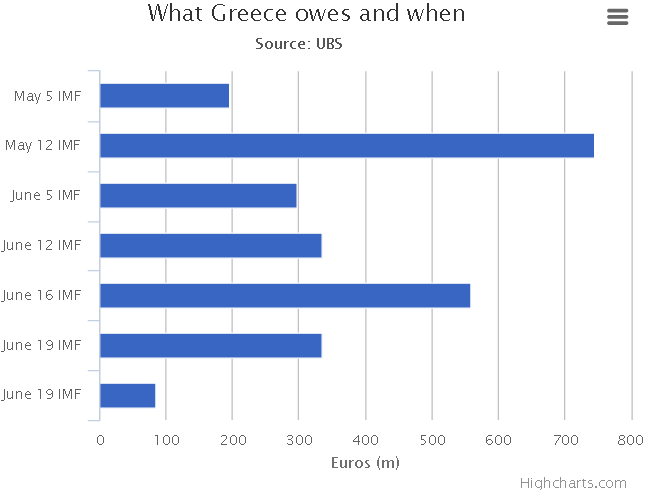
Greece debt repayment schedule

First, let’s recall what the socialist leader Tsipras said after he was elected to save nearly bankrupt Greece.

Look how the radically leftist UK Guardian gushed when Tsipras took office:

In a dramatic start to his tenure in office, Greece’s new prime minister, Alexis Tsipras, has begun unpicking the deeply unpopular austerity policies underpinning the debt-stricken country’s bailout programme.

[…]“We won’t get into a mutually destructive clash, but we will not continue a policy of subjection,” said Tsipras, who at 40 is Greece’s youngest postwar leader.

[…]Earlier, the energy minister, Panagiotis Lafazanis, called a halt to the privatisation programme that the EU and IMF have demanded in exchange for the €240bn in aid keeping Greece afloat. Plans to sell off the country’s dominant power corporation, PPC, were to be frozen with immediate effect. “We will immediately stop any privatisation of PPC,” said the politician, who heads Syriza’s militant Left Platform. A proposed scheme to privatise the port of Pireaus, the country’s largest docks, were also put on hold.

Yes, only nasty conservatives like me think that private industry is cheaper, more efficient and less corrupt than big government for handling big projects.

More:

After that, ministers announced more measures: the scrapping of fees for prescriptions and hospital visits, the restoration of collective work agreements, the rehiring of workers laid off in the public sector, the granting of citizenship to migrant children born and raised in Greece. On his first day in office – barely 48 hours after storming to power – Tsipras got to work. The biting austerity his Syriza party had fought so long to annul now belonged to the past, and this was the beginning not of a new chapter but a book for the country long on the frontline of the euro crisis.

“A new era has begun, a government of national salvation has arrived,” he declared as cameras rolled and the cabinet session began. “We will continue with our plan. We don’t have the right to disappoint our voters.”

If Athens’s troika of creditors at the EU, ECB and IMF were in any doubt that Syriza meant business it was crushingly dispelled on Wednesday . With lightning speed, Europe’s first hard-left government moved to dismantle the punishing policies Athens has been forced to enact in return for emergency aid.

Measures that had pushed Greeks on to the streets – and pushed the country into its worst slump on record – were consigned to the dustbin of history, just as the leftists had promised.

Yes, everything is going to be sunshine and roses, because a 40-year-old know-nothing with no experience says it will be. Economics? That dismal science belongs in the dustbin of history. We can unilaterally reverse the policies our creditors demanded, and then they will of course keep lending us money anyway.

Another leftist UK Guardian article has more happy rhetoric and socialist policies:

Dismantling the EU-IMF mandated measures that had plunged Greece into poverty and despair would, declared Panos Skourletis, the labour minister, be his single greatest priority.

“The reinstatement of the minimum wage to €751 (£560) [a month] will be among the government’s first bills,” Skourletis announced on Antenna TV.

Under international stewardship, Athens had been forced to pare back the minimum wage to under €500, ostensibly to increase competitiveness and make the labour market more attractive. Skourletis, formerly Syriza’s hard-nosed spokesman, said plans were similarly under way to bring back collective work agreements – a major demand of unions – and to annul the enforced mobilisation of workers protesting against cuts.

Everything is awesome! Well, those two articles were from January 2015. Let’s see what’s happening now.
Everything is awesome! Lets have fun!

This is from UK Telegraph:

Greece’s “war cabinet” has resolved to defy the European creditor powers after a nine-hour meeting on Sunday, ensuring a crescendo of brinkmanship as the increasingly bitter fight comes to a head this month.

Premier Alexis Tsipras and the leading figures of his Syriza movement agreed to defend their “red lines” on pensions and collective bargaining and prepare for battle whatever the consequences, deeming the olive-branch policy of recent weeks to have reached a dead end.

“We have agreed on a tougher strategy to stop making compromises. We were unified and we have a spring our step once again,” said one participant.

The Syriza government knows that this an extremely high-risk strategy. The Greek treasury is already empty and emergency funds seized from local authorities and state entities will soon run out.

Greece’s mayors warned over the weekend that they would not release any more funds to the central government. The Greek finance ministry must pay the International Monetary Fund €750m (£544m) on Tuesday, the first of an escalating set of deadlines running into August.

“We have enough money to pay the IMF this week but not enough to get through to the end of the month. We all know that,” said one minister, speaking to The Telegraph immediately after the emotional conclave.

If there’s one thing that makes me feel better about all the crap that is happening in this world, it’s the wonderful truth that eventually, bad economics meets with reality. You can imagine anything you want today that makes you feel good, and imagine that it will all be paid for somehow in the future. I really like it when people who don’t have any money make these elaborate future plans and then bet their futures on it. Because when reality comes, we all find out that there is justice in the world after all. There is no path to prosperity that involves doing whatever you want and being happy all the time – that is a myth that children have about life. Anyway, pass me the popcorn and let’s see how the Peter Pan plans of these inexperienced children work out. We won’t have to wait long. Mmm, this popcorn tastes schadenfreudelicious.

After destroying religion and marriage, Europe tries to convince people to make babies

Fertility rates in European countries
Fertility rates in European countries (click for larger image)

This is from the radically leftist New York Times, of all places.

They write:

Recently, Sex and Society, a nonprofit group that provides much of Denmark’s sex education, adjusted its curriculum. The group no longer has a sole emphasis on how to prevent getting pregnant but now also talks about pregnancy in a more positive light.

It is all part of a not-so-subtle push in Europe to encourage people to have more babies. Denmark, like a number of European countries, is growing increasingly anxious about low birthrates. Those concerns have only been intensified by the region’s financial and economic crisis, with high unemployment rates among the young viewed as discouraging potential parents.

The Italian health minister described Italy as a “dying country” in February. Germany has spent heavily on family subsidies but has little to show for it. Greece’s depression hasfurther stalled its birthrate. And in Denmark, the birthrate has been below the so-called replacement rate needed to keep a population from declining — just over two children per woman — since the early 1970s.

“For many, many years, we only talked about safe sex, how to prevent getting pregnant,” said Marianne Lomholt, the national director of Sex and Society. “Suddenly we just thought, maybe we should actually also tell them about how to get pregnant.”

The demographic shift is more pressing in Europe than almost any other major region, save Japan. There are an estimated 28 Europeans 65 or older for every 100 residents ages 20 to 64, almost twice the world average, according to the United Nations, and compared with 24.7 for the United States. By the end of the century, the United Nations expects the European figure to double.

Such trends will transform societies, potentially reducing economic growth and increasing stress on public pension systems and requiring more elder care. Japan already faces existential questions in a country whereadult diaper sales are beginning to eclipse those of baby diapers.

But there is not a consensus about the impact of demographics. Some see a natural maturing of developed societies. Others see disaster ahead, because with fewer workers and more retirees, the active work force faces an increased burden to sustain social programs.

Productivity gains over time, though, can make up for such population stresses. Declining birthrates can also lead to labor shortages, and Germany has faced a gap in skilled labor. But that is hardly an issue now for much of Europe, which is mired in high unemployment.

OK, so it’s a crisis. But how did it happen?

Nicholas Eberstadt explains what’s happening to marriage and parenting, in this Wall Street Journal article.

Why is it happening?

All around the world today, pre-existing family patterns are being upended by a revolutionary new force: the seemingly unstoppable quest for convenience by adults demanding ever-greater autonomy. We can think of this as another triumph of consumer sovereignty, which has at last brought rational choice and elective affinities into a bastion heretofore governed by traditions and duties—many of them onerous. Thanks to this revolution, it is perhaps easier than ever before to free oneself from the burdens that would otherwise be imposed by spouses, children, relatives or significant others with whom one shares a hearth.

People are rejecting responsibilities, expectations, and obligations because they are selfish.

When he talks about Europe, he offers an explanation for this:

Now consider Europe, where the revolution in the family has gained still more ground. European demographers even have an elegant name for the phenomenon: They call it the Second Demographic Transition (the First being the shift from high birth rates and death rates to low ones that began in Europe in the early industrial era and by now encompasses almost every society). In the schema of the Second Demographic Transition, long, stable marriages are out, and divorce or separation are in, along with serial cohabitation and increasingly contingent liaisons. Not surprisingly, this new environment of perennially conditional, no-fault unions was also seen as ushering in an era of more or less permanent sub-replacement fertility.

According to Eurostat, the European Union’s statistical agency, the probability of marriage before age 50 has been plummeting for European women and men, while the chance of divorce for those who do marry has been soaring. In Belgium—the birth-land of the scholars who initially detected this Second Transition—the likelihood of a first marriage for a woman of reproductive age is now down to 40%, and the likelihood of divorce is over 50%. This means that in Belgium the odds of getting married and staying married are under one in five. A number of other European countries have similar or even lower odds.

Europe has also seen a surge in “child-free” adults—voluntary childlessness. The proportion of childless 40-something women is one in five for Sweden and Switzerland, and one in four for Italy. In Berlin and in the German city-state of Hamburg, it’s nearly one in three, and rising swiftly. Europe’s most rapidly growing family type is the one-person household: the home not only child-free, but partner- and relative-free as well. In Western Europe, nearly one home in three (32%) is already a one-person unit, while in autonomy-prizing Denmark the number exceeds 45%. The rise of the one-person home coincides with population aging. But it is not primarily driven by the graying of European society, at least thus far: Over twice as many Danes under 65 are living alone as those over 65.

“Perenially conditional, no-fault unions”. That means that either party can leave at any time, for any reason.

Basically, people became skeptical of objective morality and the afterlife, and they have decided to follow their hearts and go more the most happiness they can have in this life. And they’ve noticed that relationships with other people – with all the nasty expectations, obligations and responsibilities – get in the way of this self-centeredness. To get married and have children is to embrace responsibility. It means that you are accepting the obligation to learn the needs of other people and care for those needs. Something has gone wrong in European society where these social obligations declined, just as religion declined. And the same thing is being taught to the next generation in our most prestigious universities.

This is a bird’s-eye view. I’ll have a closer look at the problem in my next post.

UK Supreme Court rules against Christian B&B couple’s conscience rights

Dina sent me this article from the UK Telegraph about a recent Supreme Court decision from the UK.

Excerpt:

The devoutly Christian owners of a Cornish hotel who refused to allow two gay men to take a double room have lost their final appeal to the Supreme Court. It ruled that Peter and Hazelmary Bull had discriminated against the couple, even though they had long operated a rule that unmarried guests had to sleep apart. One of the judges, Lady Hale, said such a case would have been unthinkable less than two decades ago, and it is a measure of how both the law and societal norms have changed that the Bulls should have found themselves in such a predicament.

It is also a pity this matter was not settled amicably when the Bulls made an offer of redress; but campaigners were intent on making an example of them. The aggrieved men, Martyn Hall and Steven Preddy, who were in a civil partnership, were supported by the Equalities and Human Rights Commission (EHRC). The Bulls were perplexed as to why the EHRC should act against them, since their right to exercise their religious beliefs was being set against that of the men not to be discriminated against on the grounds of their sexual orientation.

Dina also sent me this article from the pro-gay Spiked Online.

Excerpt:

[A]s the systematic unequal treatment of gays has ended, so another problem has grown. One pernicious social force has been replaced by another: the willingness of the state to outlaw minority or eccentric views and behaviours. State-backed oppression has yielded to state-backed intolerance.

The Bulls have been hauled before the courts and told they can no longer practise what they preach. To deny a couple the right to make a living in a manner consistent with their Christian values is draconian. The Bulls’ fate is similar to that of Lillian Ladele, an Islington marriage registrar, and Gary McFarlane, a Relate counsellor, who were both sacked after declining to provide their professional services to lesbians and gays. Equality laws did for them all.

The problem here is not, as it appears, merely a slap in the face to Christians. It is a slap in the face to the right of all individuals to act free of state control absent a compelling reason for intervention. As John Stuart Mill put it in On Liberty (1859): ‘The only purpose for which power can be rightfully exercised over any member of a civilised community, against his will, is to prevent harm to others.’

As if to satisfy Mill’s harm principle, the Supreme Court went in search of Preddy and Hall’s ‘harm’. What they found was that when the Bulls’ house rules were explained to Preddy and Hall, they found it ‘upsetting’ and ‘very hurtful’. Even in the touchy-feely twenty-first century, where self-esteem is seen as so important and so fragile, this is pretty lame.

The Supreme Court judge, Lady Hale, may have been aware that this ‘affront to their dignity’, as she put it, was not the sort of harm, in the Mill sense, that should justify the state’s coercive power. She bolstered her argument by linking Preddy and Hall’s hurt feelings to a bigger historical picture. ‘We should not underestimate’, she said, ‘the continuing legacy of those centuries of discrimination, persecution even, which is still going on in many parts of the world’.

Fascism happens when the normal desire for compassion is taken out of the family context and becomes the policy of a powerful feminist welfare state. And that’s when it becomes a threat to the right of individuals to make moral judgments and to exercise religious liberty.

The EHRC, you’ll remember, was a project of the Labour Party of the UK, which is the socialist party in the UK. There is also a communist party called the Liberal Democrats. The striking thing is that many church-attending Christians not only vote for the Labour Party, but they also vote for the Liberal Democrats, which are even more liberal. A lot of this is because British Christians are so far to the left on economic issues that they sort of go along with the assault on their own religious liberty out of ignorance. They vote for bigger and bigger government, and then they are surprised when they actually get it.

The same thing happened in Canada with the Liberal Party and their introduction of Human Rights Commissions and Human Rights Tribunals, which criminalize offending people with free speech. The very Christians that voted for expanding government to reduce poverty were the ones who were then persecuted by the same big government they voted to create. This goes to show why we need to have better economics knowledge among Christians, because many of us are voting for left-wing parties because we think that private, voluntary charity can be replaced with government-controlled redistribution of wealth. Not only does that not work to reduce poverty, but in the end, we lose our liberties, too.

In the UK, you’ll find a lot of Christians who think that rent control is a good thing, that price controls are a good thing, that raising minimum wage is a good thing, that tariffs on imported goods are a good thing – positions which are generally viewed as incorrect by academic economists across the ideological spectrum. That’s why churches need to teach the Christian worldview, including economics. The UK church should be training Christians to undo this ignorant, patriotic confidence that UK Christians have in their welfare state. We all have a lot of work to do to educate ourselves on how the Bible applies to the real world (e.g. – economics), or else we will end up undermining our own liberties.

Additionally, I find it very frustrating that so many churches are so focused on providing emotional comfort and a sense of community to the people in the pews that they neglect to talk about these religious liberty issues. Pastors don’t want to alert ordinary Christians about how dangerous it’s becoming to take unpopular stands on issues like gay rights in public – it’s scary and divisive and drives people away from church. You’re not going to hear them trying to apply the Bible to moral issues or economic issues, etc. from the pulpit, because that spoils the “experience” and “the show” – the comfort and entertainment that people expect from church. We need to do better at helping Christians to be aware of threats to our liberties. They need to be trained to connect their faith to specific laws and policies in the real world.