
Tag Archives: Entitlements

Real unemployment rate for youth is 22.9%

I found an article  from the Wall Street Journal via Lonely Conservative in Captain Capitalism’s latest round-up .

Excerpt:

When the recession began in December, 2007, 59.2% of the under-25 population was in the labor force, meaning they were either working or looking for work. Today, that figure has fallen to 54.5%. That may not sound like a big drop, but it makes a huge difference. If the so-called participation rate had remained unchanged, there would be 1.8 million more young people in the labor force today than there actually are. Counting those people as unemployed, rather than out of the labor force, would push the unemployment rate up to 22.9%. That’s only a hair better than the 23.9% youth unemployment rate in the euro zone, and has shown only very modest improvement during the recovery.

The decline in the participation rate among the young can’t all be attributed to the recession. Labor force participation among young people peaked at just under 70% in 1989, and has trended downward ever since, primarily due to rising rates of college attendance.

The decline accelerated during the recession, as many young people sought refuge in college or other forms of education or training. In a normal cycle, that might have worked out well, leaving a generation of highly educated workers ready to re-enter the job market when the economy recovered. Instead, they have been graduating into a labor market that remains deeply challenged, especially for those without much work experience. To make matters worse, many graduates are carrying hefty debt burdens, and those who can find work are often being forced to low-skill jobs.

But are these young people victims? Or are they doing this to themselves?

Young UK socialists rejoice over Maggie Thatcher's death
Young UK socialists rejoice over Maggie Thatcher’s death

I was looking over the Captain’s blog and I found a post where he argues that young people are not victims.

He writes:

However, before we all jump on the baby boomer generation (and don’t worry, history will be INCREDIBLY harsh on them) we have to look at our own generational selves in the mirror.  Specifically, whether we deserve all these programs or not.

Of course, the question is moot and academic.  I don’t think there will be any money to be paid out in the first place, but let’s just say there was.  Do our generations really deserve all the unicorns, puppies, hope, and change the government says we’re entitled to?  I say no and here is the reason why.

Gen X and Gen Y are doing the EXACT same thing as their baby boomer predecessors did.  They are spending more money than they make.  They expect other people to take care of themselves.  They are entitled WAY more than the baby boomers ever were.  And (most importantly) THEY VOTED IN DROVES FOR BARACK OBAMA and thus THE MORTGAGING OF THEIR OWN FUTURES.

Much as I loathe the baby boomers, the successive generations, mine included, are worse.  Despite BLATANT and OBVIOUS financial problems our generations faced, we lacked the adult maturity (let alone simple 2nd grade mathematics) to turn this country around.  And while the baby boomers have been voting more and more conservative, it is the younger generations through galactic stupidity, ignorance and selfishness that merely nailed a couple more nails in the US-coffin and thus our own futures.

Like I said, I doubt there will even be any money for Gen Y, Gen X and any future generations to make good on all those socialist entitlement goodies we promised ourselves.  But before we start blaming previous generation’s for our current problems, we should start blaming ourselves for making our future problems worse.

We should be careful about pitying young people who are struggling to find work, and who won’t get a dime from social programs like Social Security and Medicare. They are voting to punish employers with taxes and regulations. Most of them don’t know or care about what they are doing – they don’t connect their vote to their unemployed status. They think that education means jobs, and that they can vote in order to feel good and be liked, and still find work. They think that if they pay into these entitlement programs, then the money will be there. They trust Obama and they vote for him. They are not victims.
Should we believe what Obama says in his State of the Union speech?

Barack Obama Budget Deficits

What should we expect from the State of the Union speech tonight? We should expect Obama to argue against spending cuts, and for more spending.

Excerpt:

President Obama will use his State of the Union speech Tuesday to turn public opinion against automatic spending cuts and argue that some of the money to replace the cuts should instead come from higher taxes.

He will use the prime-time TV address to argue the economy would be damaged if $85 billion in automatic spending cuts were to go ahead on schedule on March 1, and will seek to set up Republicans to take the blame if they do.

The State of the Union address is also expected to highlight Obama’s second-term shift on the deficit.

From 2010 to 2012, the president consistently argued for new spending to spur on the economy, but also called for accompanying spending cuts and tax hikes to rein in the deficit.

But in his radio address on Saturday, Obama emphasized that the White House and Congress already have “cut our deficit by more than $2.5 trillion” through spending cuts and higher tax rates imposed on households with annual incomes above $450,000.

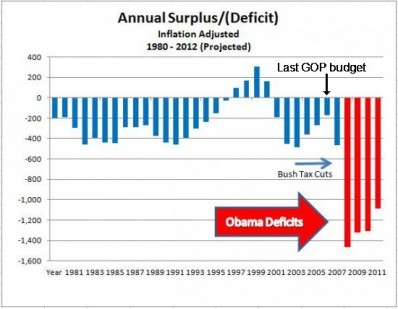
Look at the graph above. Does that look like we have cut our deficit? It used to be $160 billion in 2006/2007 under George W. Bush. Obama ran trillion dollar deficits for FOUR years. How is that cutting the deficit? What is Obama talking about? Bush added $4 trillion to the debt in 8 years, Obama’s added nearly $6 trillion to the debt in 4 years.

More:

A Congressional Budget Office report issued last week found the budget deficit will drop below $1 trillion this year to $845 billion, before falling further by 2015 to $430 billion.

In a more ominous sign, the same CBO report found an aging population and soaring healthcare costs would lead to an explosion in entitlement spending in later years, with budget deficits approaching $1 trillion again by 2023.

Obama thinks that not reforming entitlements is fiscally responsible. Should we believe that he knows what he is doing when it comes to the economy?

The Heritage Foundation says we shouldn’t believe Obama, because he lied the last time he gave a State of the Union speech.

Excerpt: (links removed)

Take a look at some of the promises Obama made back in 2009 during his first State of the Union.

“I pledged to cut the deficit in half by the end of my first term in office.”

During his first State of the Union, newly inaugurated President Obama vowed to cut the deficit in half by the end of his first term. Instead, Obama has averaged deficits nearly three timesthat of his predecessor.

For those who were concerned with President George W. Bush’s $4 trillion national debt, this pledge may have seemed like the “hope and change” the American people voted for in 2008. However, the reality of America’s additional debt over the past four years under the Obama Administration is staggering—almost $6 trillion in four years, on track to triple the amount Bush accumulated over his eight years as President. Now that Obama is heading into his second term, we’ve seen quite a change from the Barack Obama who thought $4 trillion in debt was“irresponsible” and “unpatriotic.”

“Over the next two years, this [stimulus] plan will save or create 3.5 million jobs.”

The President promised great things from the stimulus plan, but as Heritage’s J.D. Foster has said, we have to look at his record. He may have promised 3.5 million new jobs, but he’s 7.7 million jobs in the hole instead.

“…we must have quality, affordable health care for every American. It’s a commitment that’s paid for in part by efficiencies in our system that are long overdue.”

President Obama’s promise that Obamacare would provide health insurance for every American has been proven false. According to the Congressional Budget Office, 30 million Americans are projected to remain uninsured even after Obamacare is fully implemented.

The idea that Obamacare would improve the “efficiencies” of the health care system is laughable. Obama’s plan for “efficiencies” in the system was just slashing Medicare provider reimbursement rates to the tune of $716 billion to help pay for Obamacare. The mammoth law is going to take 127 million hours of paperwork per year for Americans to comply with it. And Members of Congress are already walking back their support for the law—they are grumbling about several parts of it and even repealed one part in the fiscal cliff deal.

What the Republicans should do is just walk out of there. Why sit there and listen to high-minded rhetoric that never amounts to anything? Well, except to make Obama feel good about himself.

Overpopulation? Latest research suggests that we face a decline in population

From the left-wing Slate, of all places.

Excerpt:

A report issued last month by the Pew Research Center found that immigrant births fell from 102 per 1,000 women in 2007 to 87.8 per 1,000 in 2012. That helped bring the overall U.S. birthrate to a mere 64 per 1,000 women—not enough to sustain our current population.

Moreover, the poor, highly fertile countries that once churned out immigrants by the boatload are now experiencing birthrate declines of their own. From 1960 to 2009, Mexico’s fertility rate tumbled from 7.3 live births per woman to 2.4, India’s dropped from six to 2.5, and Brazil’s fell from 6.15 to 1.9. Even in sub-Saharan Africa, where the average birthrate remains a relatively blistering 4.66, fertility is projected to fall below replacement level by the 2070s. This change in developing countries will affect not only the U.S. population, of course, but eventually the world’s.

Why is this happening? Scientists who study population dynamics point to a phenomenon called “demographic transition.”

“For hundreds of thousands of years,” explains Warren Sanderson, a professor of economics at Stony Brook University, “in order for humanity to survive things like epidemics and wars and famine, birthrates had to be very high.” Eventually, thanks to technology, death rates started to fall in Europe and in North America, and the population size soared. In time, though, birthrates fell as well, and the population leveled out. The same pattern has repeated in countries around the world. Demographic transition, Sanderson says, “is a shift between two very different long-run states: from high death rates and high birthrates to low death rates and low birthrates.” Not only is the pattern well-documented, it’s well under way: Already, more than half the world’s population is reproducing at below the replacement rate.

If the Germany of today is the rest of the world tomorrow, then the future is going to look a lot different than we thought. Instead of skyrocketing toward uncountable Malthusian multitudes, researchers at Austria’s International Institute for Applied Systems Analysis foresee the global population maxing out at 9 billion some time around 2070. On the bright side, the long-dreaded resource shortage may turn out not to be a problem at all. On the not-so-bright side, the demographic shift toward more retirees and fewer workers could throw the rest of the world into the kind of interminable economic stagnation that Japan is experiencing right now.

It kind of undercuts the need for the leftist fixation on abortion, environmentalism, etc. doesn’t it?

Ari also sent me this article from Foreign Policy magazine that argues that the declining rate of population is actually good news for conservatives.

Excerpt:

Declining birthrates also change national temperament. In the United States, for example, the percentage of women born in the late 1930s who remained childless was near 10 percent. By comparison, nearly 20 percent of women born in the late 1950s are reaching the end of their reproductive lives without having had children. The greatly expanded childless segment of contemporary society, whose members are drawn disproportionately from the feminist and countercultural movements of the 1960s and 70s, will leave no genetic legacy. Nor will their emotional or psychological influence on the next generation compare with that of their parents.

Meanwhile, single-child families are prone to extinction. A single child replaces one of his or her parents, but not both. Nor do single-child families contribute much to future population. The 17.4 percent of baby boomer women who had only one child account for a mere 7.8 percent of children born in the next generation. By contrast, nearly a quarter of the children of baby boomers descend from the mere 11 percent of baby boomer women who had four or more children. These circumstances are leading to the emergence of a new society whose members will disproportionately be descended from parents who rejected the social tendencies that once made childlessness and small families the norm. These values include an adherence to traditional, patriarchal religion, and a strong identification with one’s own folk or nation.

This dynamic helps explain, for example, the gradual drift of American culture away from secular individualism and toward religious fundamentalism. Among states that voted for President George W. Bush in 2004, fertility rates are 12 percent higher than in states that voted for Sen. John Kerry. It may also help to explain the increasing popular resistance among rank-and-file Europeans to such crown jewels of secular liberalism as the European Union. It turns out that Europeans who are most likely to identify themselves as “world citizens” are also those least likely to have children.

Does this mean that today’s enlightened but slow-breeding societies face extinction? Probably not, but only because they face a dramatic, demographically driven transformation of their cultures. As has happened many times before in history, it is a transformation that occurs as secular and libertarian elements in society fail to reproduce, and as people adhering to more traditional, patriarchal values inherit society by default.

At least as long ago as ancient Greek and Roman times, many sophisticated members of society concluded that investing in children brought no advantage. Rather, children came to be seen as a costly impediment to self-fulfillment and worldly achievement. But, though these attitudes led to the extinction of many individual families, they did not lead to the extinction of society as a whole. Instead, through a process of cultural evolution, a set of values and norms that can roughly be described as patriarchy reemerged.

I think that if conservative men and women can get together and raise effective, influential children outside of the public school system, then we have some hope for the future. The welfare that is used to support single motherhood by choice is going to come to an end because of the debt crisis. When that happens, families headed by high-achieving men will be raising a higher proportion of the leaders of the next generation. Men and women who pool their resources and have more children will have more of an influence on the next generation.