Tag Archives: Entitlement

English professor decries the radicalization of the liberal arts on campus

From Pajamas Media, a post by a Canadian English professor at the University of Ottawa.

Excerpt:

When I finally landed a tenure-track position at a Canadian university, I was ecstatic and full of hope — exhilarated by the opportunity to teach students about literature and ideas and to have conversations with colleagues equally in love with literature and ideas. I didn’t realize that my experience as a university teacher of English would have much less to do with these passions than with the distortion of the university’s core mission in the name of pedagogical and political orthodoxy.

To begin with, the student writing that came across my desk left me aghast. I had taught before, but I was unprepared for the level of illiteracy, the stunted vocabularies, near-complete absence of historical knowledge, and above all the extraordinary apathy of many English majors. The most basic of expression rules — the difference between it’s and its, the incorrectness of “would of” for “would have,” the role of the apostrophe or semi-colon, the fact that “a lot” was two words — were beyond the grasp of the majority, no matter how often I reviewed grammar or devised mnemonic devices. And the sheer sloppiness and muddled thinking in the essays, where the titles of poems and authors’ names were frequently misspelled and dates were wildly inaccurate, suggested a fundamental indifference to the subject matter.

Not only was my students’ writing appalling, but I soon encountered their resentment at being told about it. “Who are you to tell me I can’t write?” was the attitude — once expressed in those very words. More than one student insisted that her other teachers had always rewarded her with high marks for her “creativity.” Most believed themselves more than competent. After sitting with one young woman explaining the cause of her failing grade, I was befuddled when her only response was a sullen: “This doesn’t exactly make me feel good.” When I responded that my job was not to make her feel good, she stood haughtily, picked up her paper with an air of injury, and left my office without another word. In her mind, I later realized, I had been unforgivably cruel.

I was up against it: the attitude of entitlement rampant amongst university students and nurtured by the utopian ideology that permeates modern pedagogy, in which the imposition of rules and identification of errors are thought to limit student creativity and the fostering of a hollow self-esteem takes precedence over the building of skills on which genuine self-respect might be established. In the Humanities subjects in particular — and in English especially, the discipline I know best — such a philosophy has led to a perilous watering down of course content, with self-validation seen as more important than the mastery of specific knowledge.

With this philosophy has come a steady grade inflation. The majority of students in English courses today can expect a B grade or higher merely for warming a seat and handing in assignments on time. The result, as I soon discovered, was a generation of students so accustomed to being praised for their work that when I told them it was inadequate, they simply could not or would not believe me. They seemed very nearly unteachable: lacking not only the essential skills but also the personal gumption to respond adequately to criticism.

I wonder what will happen when these students find out that the jobs they feel they are entitled to have have been shipped off to some country where young people don’t have all of this attitude, and where business owners pay a corporate tax rate less than half of what American businesses pay. My guess is that they will blame the very capitalists who warned them not to do what they did.

Paul Ryan’s Path to Prosperity plan balances the budget without raising taxes

Americans for Tax Reform explains what’s in it.

Excerpt:

The main details are:

Revenue neutrality.  The budget calls for the House Ways and Means Committee to produce a tax reform package with a tax revenue target of between 18 and 19 percent of GDP.  This is in line with historical revenue figures.  By contrast, big government budgets like “Gang of Six,” “Simpson-Bowles,” and the Obama budget call for a long-range revenue target of over 20 percent of GDP.  The Ryan budget is a no tax hikes budget.

Six personal rates down to two.  The Ryan budget replaces the current six-rate personal income tax structure (10, 15, 25, 28, 33, and 35 percent) with a two-rate system of 10 and 25 percent.  This will result in a lower tax rate on the majority of small business profits, from 33 or 35 percent down to 25 percent.

Repeals Obamacare tax hikes.  The Ryan budget eliminates the entire Obamacare law.  This includes repealing the 20 new or higher taxes which have taken or are about to take effect from that law.

Eliminate the AMT.  The Ryan budget eliminates the AMT, instead favoring a simpler system with lower rates and a broad tax base.

Lower rates on businesses.  As said above, the Ryan budget lowers the tax rate on the majority of small business profits to 25 percent.  It also lowers the federal income tax rate on larger corporate employers from 35 percent (the highest in the developed world) to 25 percent (closer to the developed nation average).  While this makes American companies more competitive, it would still leave us with a higher corporate income tax rate than the developed nation average, Canada, and the United Kingdom.  In order to make us truly internationally-competitive, the federal rate must fall to 20 percent or less.

No more picking winners and losers in the tax code.  In order to target revenues at 18-19 percent of GDP with tax rates no higher than 25 percent, the Ways and Means Committee will have to curtail or eliminate most tax exclusions, adjustments, deductions, and credits.  That means that all consumed income will be taxed once and only once.  No longer will the tax code favor one type of economic behavior over another.

Moves tax code from “worldwide taxation” to “territoriality.”  The Ways and Means Committee is directed to shift our tax code from one which seeks to tax income earned all over the world to one which only seeks to tax income earned in America.  This is known as “territoriality,” and it’s already been adopted by and large by our trading competitors.  By retaining a worldwide tax regime, we’re exposing our own countries to double taxation–once when they pay the foreign nation’s income tax, and again when they try to bring the money home.

This is what the budget does: (Debt as % of GDP)

Paul Ryan's 2013: The Path to Prosperity

Doug Ross has three nice charts explaining the details.

Is Barack Obama going to do anything about the debt?

According to CBS News, Obama has exploded our national debt, so there is no reason to trust anything he says about reducing the debt.

Excerpt:

The National Debt has now increased more during President Obama’s three years and two months in office than it did during 8 years of the George W. Bush presidency.

The Debt rose $4.899 trillion during the two terms of the Bush presidency. It has now gone up $4.939 trillion since President Obama took office.

The latest posting from the Bureau of Public Debt at the Treasury Department shows the National Debt now stands at $15.566 trillion. It was $10.626 trillion on President Bush’s last day in office, which coincided with President Obama’s first day.

The National Debt also now exceeds 100% of the nation’s Gross Domestic Product, the total value of goods and services.

Mr. Obama has been quick to blame his predecessor for the soaring Debt, saying Mr. Bush paid for two wars and a Medicare prescription drug program with borrowed funds.

The federal budget sent to Congress last month by Mr. Obama, projects the National Debt will continue to rise as far as the eye can see. The budget shows the Debt hitting $16.3 trillion in 2012, $17.5 trillion in 2013 and $25.9 trillion in 2022.

[…]His latest budget projects a $1.3 trillion deficit this year declining to $901 billion in 2012, and then annual deficits in the range of $500 billion to $700 billion in the 10 years to come.

If Mr. Obama wins re-election, and his budget projections prove accurate, the National Debt will top $20 trillion in 2016, the final year of his second term. That would mean the Debt increased by 87 percent, or $9.34 trillion, during his two terms.

Some of Bush’s debt total can be explained by considering that Nancy Pelosi and Harry Reid raised the debt by $5 trillion dollars over 4 years when they took control of the House and Senate in January of 2007. But they’re Democrats, and that’s what Democrats do.

Related posts

In California, students protest the results of their own liberal voting

Victor Davis Hanson writes about it National Review.

Excerpt:

Here in California, students just marched on Sacramento in outrage that state-subsidized tuition at the UC and CSU campuses keeps climbing. It is true that per-unit tuition costs are rising, despite even greater exploitation of poorly paid part-time teachers and graduate-student TAs. But the protests are sort of surreal. The California legislature is overwhelmingly Democratic. The governor is a Democrat. The faculties and administrative classes are largely Democratic. Who then, in the students’ minds, have established these supposedly unfair budget priorities?

Sales, income, and gas taxes are still among the highest in the nation (and are proposed to rise even higher) — prompting one of the largest out-of-state exoduses of upper-income brackets in the nation. The state budget is pretty much entirely committed to K–12 education (whose state-by-state comparative test scores in math and science hover between 45th and 49th in the nation), prisons, social services, and public-employee salaries and pensions. Whom, then, can the students be angry at?

Are students angry at public-union salaries and pensions that are among the highest in the nation? Do they think the many highly compensated retired Highway patrol officers have shorted students at UC Davis? Are they mad at the 50,000 illegal aliens in the California prison system that might have siphoned off scholarship funds from CSU Monterey Bay? Or is the rub the influx of hundreds of thousands of children of illegal aliens who require all sorts of language remediation and extra instruction in the public schools, and so might in theory divert library funds from UC Santa Cruz?

Perhaps the students don’t want billions to be committed to high-speed rail that might rob Berkeley of needed funding, or environmental efforts to introduce salmon into the San Joaquin River, in which the $70 million spent so far in studies and surveys might have come from nearby CSU Fresno? Are they mad at state social services, whose medical expenses have skyrocketed to address the health-care needs of millions of illegal aliens, and thus in theory could curb the choice of classes at CSU Stanislaus? Are they angry that some $10–15 billion a year probably leaves the state as remittances to Mexico?

If one cannot blame the wealthy for “not paying their fair share” (the top 1 percent of Californians now pay about 37 percent of all income-tax revenue — and their numbers have decreased by one-third in recent years, as the state has come to rely on the income tax for half its revenue), or Republican majorities in government, who, then, is left to blame?

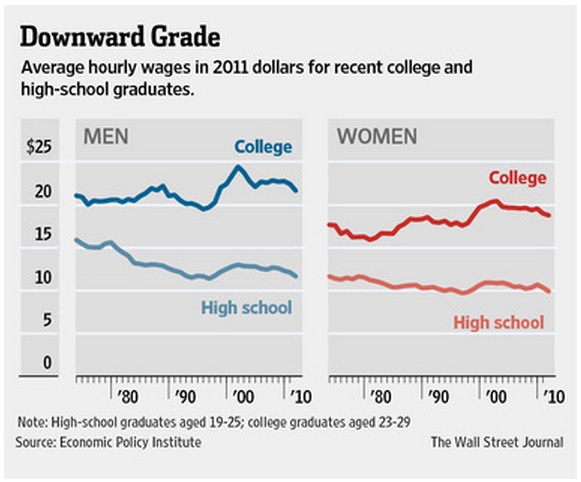
Not only are their tuition costs going UP but their likely salary is going DOWN.

Students majoring in booze and hook-up sex
How's that hopey-changey stuff workin' for ya?

I got that image from a post at the American Enterprise Institute.

Excerpt:

  • Only 35 percent of students starting a four-year degree program will graduate within four years, and less than 60 percent will graduate within six years.
  • The U.S. college dropout rate is about 40 percent, the highest college dropout rate in the industrialized world.
  • Over the past 25 years, the total number of students in college has increased by about 50 percent. But the number of students graduating with degrees in STEM subjects has remained more or less constant.
  • In 2009, the United States graduated 37,994 students with bachelor’s degrees in computer and information science. That’s not bad, but we graduated more students with computer-science degrees 25 years ago!
  • Few disciplines have changed as much in recent years as microbiology, but in 2009 we graduated just 2,480 students with bachelor’s degrees in microbiology—about the same number as 25 years ago. Who will solve the problem of antibiotic resistance?
  • If students aren’t studying science, technology, engineering, and math, what are they studying?
  • In 2009, the United States graduated 89,140 students in the visual and performing arts, more than in computer science, math, and chemical engineering combined and more than double the number of visual-and-performing-arts graduates in 1985.
  • Moreover, more than half of all humanities graduates end up in jobs that don’t require college degrees, and those graduates don’t get a big income boost from having gone to college.

I think this is interesting. What exactly are these students paying for?

If there is one thing I learned from my love of Shakespeare, it’s that it is tragic to be the cause of your own downfall because of your own tragic flaw. Right now, there are a bunch of young people who have been totally brainwashed by the unionized public school teachers and professors to have views on economics that are completely opposite to what works in the real world. They keep voting for bigger and bigger government, which creates more and more debt in order to provide their parents with bigger and bigger benefits. They have lots of self-esteem, but very few marketable skills. Eventually, the bill for all the government spending on “helping the poor”, (e.g. – food stamps for millionaires and bailouts for bankrupt green energy firms), comes due, and it’s the students who will be paying the bill. I wonder if they will look as favorably on socialism and global warming alarmism then?

UPDATE: I noticed that in Quebec, the most liberal province in Canada, students are doing the same thing.