Tag Archives: Entitlement

Neil Cavuto explains basic economics to college student who wants free tuition

She has $280,000 in student loan debt for "Chinese medicine"
She has $280,000 in student loan debt for “Chinese medicine”

The video, which goes about 10 minutes. This is a must watch.

The description of the video explains the contents:

Keely Mullen, an organizer for the Million Student March movement, joined Fox Business Network anchor Neil Cavuto on the air Thursday to discuss the movement’s demands for free public college, student debt cancelation and a $15-an-hour minimum wage for student workers. In the awkward 9-minute interview, Cavuto repeatedly cited facts and figures that seemed to fluster the student.

When asked who would pick up the tab for the demands she listed, Mullen said, “The 1 percent of people who are hoarding the wealth and causing a catastrophe students are facing.”

“If the 1 percent just had their taxes raised a few years ago back to almost 40 percent then to pay for the healthcare law, they had them raised another few percentage points, then they had their deductions limited to raise another couple points — depending on the state or locality — they’re pushing over about 50 percent in taxes,” Cavuto told Mullen. “How much more do you think they should pay?”

Cavuto’s question, asked within the first two minutes of the interview, became the centerpiece of the entire discussion, as Mullen was unable to provide a clear answer.Mullen did say the rate should be raised to “enough until we have a system where not one in two families are threatened with poverty.” And when asked if she and her friends and family would pay more in taxes for her demands, she said “we already are.” However, according to Forbes, 45 percent of households pay no federal income taxes.

Cavuto asked Mullen where the money would come from should “these 1 percent hoarders” leave the country, and Mullen insisted there would always be wealthy people in the U.S. However, later in the interview, Cavuto told his guest that countries around the world, using Greece as an example, have run out of money because the top earners are fleeing.

When Cavuto asked her if she think the 1 percent could actually fund all her demands, Mullen said, “Absolutely.” However, Cavuot claimed taxing the 1 percent at 100 percent wouldn’t even fund Medicare for three years — let alone all of her demands for free services.

“They’ve done studies on this, Keeley, I don’t want to get boring here, but even if you were to take the 1 percent and take all of their money — tax it 100 percent — do you know that couldn’t keep Medicare, just Medicare, in this country going for three years?” Cavuto asked. “Did you know that?”

“Yeah, I don’t believe that,” Mullen said in response. “Yeah, I’m sorry, that just sounds completely ludicrous to me.”

Toward the end of the interview, Cavuto told Mullen taxing the 1 percent on 100 percent of their income would only yield “about one trillion” toward any entitlement program.

I took a look and found out that her father owns a million-dollar home. Also, she is studying two non-STEM subjects – political science and sociology. Both of these have some value, but they are also not the STEM areas that are in demand by employers.

By the way, Cavuto is not joking about how much money you can get by taking everything the 1% make.

The radically leftist New York Times explains how much you can get from “the rich” with a reasonably high tax rate:

To get the most accurate picture possible, throw in all the scraps of income, from the most obvious (like wages, interest and dividends) to the least (like employer contributions to health plans, overseas earnings and growth in retirement accounts). According to that measure — used by the Tax Policy Center, a joint project of the Urban Institute and the Brookings Institution — the top 1 percent includes about 1.13 million households earning an average income of $2.1 million.

Raising their total tax burden to, say, 40 percent would generate about $157 billion in revenue the first year. Increasing it to 45 percent brings in a whopping $276 billion.

The Wall Street Journal has computed the costs of Bernie Sanders’ spending plan, and it came out to $18 trillion. Getting rid of all the current outstanding student loan balances would cost $1.2 trillion alone. I’ve already talked about the consequences of raising the minimum wage for young, minority workers – they won’t be able to find the entry level jobs they need to get their careers started, so they can move up.

The real question that needs to be asked is the one that Cavuto asked – do you expect the wealthy to continue producing at the same level when you take half or all of what they make. On the student’s view, the rich would work just as hard even if you took all their money and gave it to students taking underwater basket weaving, medieval pottery and puppetry. This is the question that people on the left never ask – what are the consequences of these policies for ALL of the parties who will be affected. That’s a simple question, but apparently not something that leftist professors teach their students to ask. College is generally little narcissists learning from big narcissists, at least in non-STEM programs. It certainly is not the place to learn basic economics and basic civics.
Why is it so hard for young people to find a job?

Young people have a sense of entitlement

Bloomberg News discusses the “Professionalism in the Workplace” survey of human resources specialists from York College of Pennsylvania.

Forty-nine percent of [those surveyed] stated that less than half of new employees “exhibit professionalism in their first year.” More than half (53 percent) have noticed “a sense of entitlement” rising among younger workers; almost 45 percent have seen a “worsening of the work ethic,” including “too casual of an attitude toward work” and “not understanding what hard work is.”

Younger workers believe they can multitask and remain productive, the human-resources people told the York researchers. Thirty-eight percent of respondents blamed multitasking for the lack of “focus” among younger workers. The authors of the study explained that the younger generation “believes that it is possible to multi-task effectively” and that using social media, for example, is an efficient way to communicate. In interviews, the applicants check their phones for texts and calls, dress inappropriately and overrate their talents.

“The sad fact is some of these persons probably do not understand what is wrong with this,” the authors note.

Older workers have always complained about younger workers, of course, but there’s a difference: This time they attribute the youthful flaws not to ignorance or waywardness, but to a “sense of entitlement.”

We might forgive 18-year-olds fresh out of high school for lacking employability skills (the manufacturing sector hires many workers lacking undergraduate degrees). But when he or she reaches 23 and has four years of college, employers expect a white-collar worker to recognize basic norms of dress and deportment.

What happened in college, then? The survey by York College’s Center for Professional Excellence assigns colleges part of the blame, observing that letting students miss deadlines without penalty and assigning good grades for middling work only make them form the wrong expectations.

Meanwhile, the UK Daily Mail had the results from a 2013 survey:

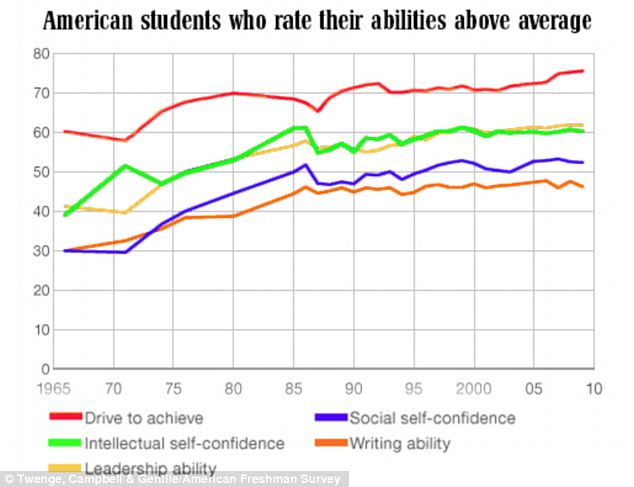
Young people’s unprecedented level of self-infatuation was revealed in a new analysis of the American Freshman Survey, which has been asking students to rate themselves compared to their peers since 1966.

Roughly 9 million young people have taken the survey over the last 47 years.

Psychologist Jean Twenge and her colleagues compiled the data and found that over the last four decades there’s been a dramatic rise in the number of students who describe themselves as being ‘above average’ in the areas of academic ability, drive to achieve, mathematical ability, and self-confidence.

But in appraising the traits that are considered less invidualistic – co-operativeness, understanding others, and spirituality – the numbers either stayed at slightly decreased over the same period.

Researchers also found a disconnect between the student’s opinions of themselves and actual ability.

While students are much more likely to call themselves gifted in writing abilities, objective test scores actually show that their writing abilities are far less than those of their 1960s counterparts.

Also on the decline is the amount of time spent studying, with little more than a third of students saying they study for six or more hours a week compared to almost half of all students claiming the same in the late 1980s.

Though they may work less, the number that said they had a drive to succeed rose sharply.

[…]Twenge is the author of a separate study showing a 30 per cent increase towards narcissism in students since 1979.

‘Our culture used to encourage modesty and humility and not bragging about yourself,’ Twenge told BBC News. ‘It was considered a bad thing to be seen as conceited or full of yourself.’

Just because someone has high self-esteem doesn’t mean they’re a narcissist. Positive self-assessments can not only be harmless but completely true.

However, one in four recent students responded to a questionnaire called the Narcissistic Personality Inventory with results pointing towards narcissistic self-assessments.

Narcissism is defined as excessive self-love or vanity; self-admiration, or being self-centered.

Twenge said that’s a trait that is often negative and destructive, and blames its boom on several trends – including parenting styles, celebrity culture, social media, and easy credit – for allowing people to seem more successful than they really are.

I think what I am seeing is that not only do they work less, but they work at things they “like”, rather than at things that will allow them to provide value to others. So, you’re not going to find a lot of computer programmers or petroleum engineers among young Americans, but you will find a lot of people gravitating to jobs that are easy that make them feel good about themselves, and look good to other people, too.

Obviously, there are policy reasons for youth unemployment being so high, but I think this attitude that young people have is definitely part of it.

Tad Hopp accumulates six figures of college debt, wants taxpayer bailout

From: theawkwardyeti.com

Here’s an interesting editorial from a “Christian” left blog. (H/T Acton Institute via Lindsay)

The author, Tad Hopp is graduating a PCUSA seminary – an extremely liberal, left-wing denomination.

He writes:

I graduated college in 2007.

[…] I majored in English, not exactly what most people consider a ‘marketable’ or ‘practical’ degree…

[…]I went to a somewhat expensive private school…

[…]I did what many students in their last year of high school do: I went to the school where I felt I was being called…

[…]I do not regret my four years at my undergraduate institution one bit.

[….]When I graduated college, I owed nearly $50,000 in student loan debt and was unemployed for almost six months before I finally found a low-paying office job.

[…]“Can’t find a job? Well, you should have majored in something more ‘practical’, like economics or business or medicine.” Yeah, that would be great…if those were the subjects where my skills and passions lie. They’re not.

[…]I felt called to go to seminary.

[…]I will graduate seminary with close to six figures worth of student loan debt.

Let’s take stock of what he’s said so far:

  • he studied English, a language that he already spoke, which has one of the lowest employment rates
  • he was warned by people who knew something about earning and saving money not to study English
  • he went to a school he couldn’t afford to go to, and he graduated with $50,000 in debt
  • he went to seminary, another subject that doesn’t pay, and added another $50,000 or so of debt
  • he says that he doesn’t have to study subjects that lead to a career because he isn’t “passionate” about them
  • he “followed his heart” by going to the school that he had mystical, emotional, intuitions about = “calling”

My advice to Tad at this point would be for him to take the Bible seriously when it says this:

2 Thessalonians 3:10:

10 For even when we were with you, we used to give you this order: if anyone is not willing to work, then he is not to eat, either.

And 1 Timothy 5:8:

8 But if anyone does not provide for his own, and especially for those of his household, he has denied the faith and is worse than an unbeliever.

Now, for a Bible-believing Christian, these are inerrant and cannot be denied. But we have to go outside the Bible and learn how the world really works in order to figure out how to achieve those stated goals. Why should anyone hire us? What is working really about?

But even before looking at economics, Tad needs to push away all his friends who tell him to “follow his heart” and stick close by his friends who understand economics, who have jobs already, who have savings already, and so on. Don’t look for advice from dreamers, you look to advice from doers – people who can read the times, run the numbers and who have demonstrated the ability to create plans that work to achieve results that please God. When it comes to planning about the future, look at the past accomplishments. Weaving a happy narrative sounds nice, but judge future predictions based on past performance.

I would recommend that Tad read an economist like Thomas Sowell, especially on work, prices, etc., and realize that work means providing value to others. It then follows that he is obligated by the Bible to NOT “follow his heart”, but to instead do something that offers value to his fellow man. Prices are a way of determining what is most valued by your fellow man. And we know what careers have the highest value:

Petroleum Engineering – Starting Salary: $103,000 / Mid-Career Salary: $160,000
Actuarial Mathematics – Starting Salary: $58,700 / Mid-Career Salary: $120,000
Nuclear Engineering – Starting Salary: $67,600 / Mid-Career Salary: $117,000
Chemical Engineering – Starting Salary: $68,200 / Mid-Career Salary: $115,000
Aerospace Engineering – Starting Salary: $62,800 / Mid-Career Salary: $109,000
Electrical Engineering – Starting Salary: $64,300 / Mid-Career Salary: $106,000
Computer Engineering – Starting Salary: $65,300 / Mid-Career Salary: $106,000
Computer Science – Starting Salary: $59,800 / Mid-Career Salary: $102,000
Physics – Starting Salary: $53,100 / Mid-Career Salary: $101,000
Mechanical Engineering – Starting Salary: $60,900 / Mid-Career Salary: $99,700

English and seminary are dead last on the list – he literally could not have chosen worse than he did. I don’t mind if a woman studies these things, but Tad is a man – he has the Biblical obligation to be the primary provider, as we saw in the verse above.

More Tad:

Is the PCUSA doing anything to address this crisis?

[…]What has our government done to address this issue?

[…]I, like so many in my generation, voted for Obama…

[…]It seems to me that we’ve bought into the lie that student loan debt is brought on by the individual person…

[…]You know what I think might stimulate the economy? Automatically cancelling every single outstanding student loan!

[…]If we can spend $640 billion dollars on defense spending, why can’t we find the money to better support public education?

It’s important to understand that an English degree and a seminary degree do not prepare a person to make statements on economics and government. Tad has never studied these things, has no experience in them. He cannot state what the impact of his suggestions would be to all groups, i.e. – he cannot answer “and then what happens?” for every impacted group. Thinking economically is a valuable skill, but as Tad’s personal life shows, it’s not an area he is really knowledgeable about. But he wants to shift money from defense spending (which he knows nothing about) so that he can have a personal bailout. I personally doubt that taxpayers would be better served by paying for his English degree and liberal seminary degree than they would be if a peace-loving democracy could project power abroad to deter aggression from countries like North Korea, Iran, Russia, China and Syria.

Here is the solution to Tad’s problems:

  • we need to put Tad to work in a minimum wage job and confiscate his entire salary, until his loans are paid off.
  • we need to put Tad on a watch list such that he is never allowed to borrow money from anyone ever again.
  • once Tad’s loans are paid off, he should be taxed on his future earnings at the top tax rate for the rest of his life. The money we tax from him can fund education – that’s what he said he wanted.
  • Tad and his household should all be barred from collecting any money for unemployment, welfare or other social programs.

That’s the only bailout Tad should get. It would actually be in his best interest that he encounter real life as quickly as possible, because the longer he waits, the harder it’s going to be for him to recover to independence. He needs to stop his crazy retreat from adult responsibilities, and start working and saving now. I would say that at this point, marriage and parenting is out of the question for him (in another post, he comes out as gay, so that also complicates things). And he can thank the politics of the secular left for marriage and family being less affordable now, thanks to laws like Obamacare, which raised the cost of health care by thousands of dollars. I found it interesting that he actually did work at some point but he mocked the job as a “dead-end job” – as if it was beneath him.

I know some of you will be thinking, “but God called him things and so of course God is going to bail him out with $100,000 for his student loans”. But the thing is, God doesn’t usually work like that. First, I don’t accept that he is a Christian at all. Second, just because you have feelings that your plan will work, that isn’t a calling. The truth is that you certainly can assess the feasibility of things that you feel “called” to do, and if the plan looks crazy, then don’t do it. If you find yourself at odds with wise, practical people when explaining your calling to them, then you’re probably doing it wrong.