
Tag Archives: Engineering

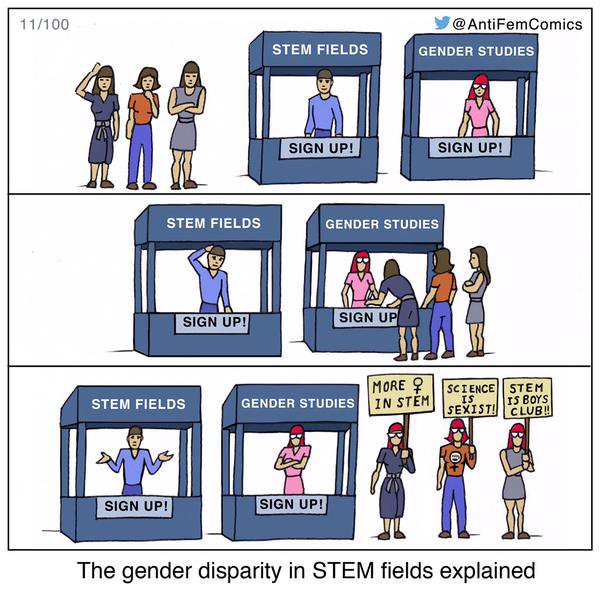
Is Google right to say that sex differences don’t exist?

Radical feminists complain a lot about sexism, but damage is self-inflicted

Google recently fired a software engineer who asked them to do a better job of promoting diversity by actually appealing to women’s different needs and desires. He suggested more collaborative coding (“pair programming”) and more part-time work options. Google responded to his suggestions by ejecting him forcibly from their left-wing politically correct echo chamber. Google executives claim that their company is rooted in science. Well, is there a science of sex differences? Who is right?

This article from The Globe and Mail, which is the more leftist of Canada’s two national newspapers, is written by a PhD in the field of sexual neuroscience from York University.

She says:

Despite how it’s been portrayed, the memo was fair and factually accurate. Scientific studies have confirmed sex differences in the brain that lead to differences in our interests and behaviour.

As mentioned in the memo, gendered interests are predicted by exposure to prenatal testosterone – higher levels are associated with a preference for mechanically interesting things and occupations in adulthood. Lower levels are associated with a preference for people-oriented activities and occupations. This is why STEM (science, technology, engineering and mathematics) fields tend to be dominated by men.

We see evidence for this in girls with a genetic condition called congenital adrenal hyperplasia, who are exposed to unusually high levels of testosterone in the womb. When they are born, these girls prefer male-typical, wheeled toys, such as trucks, even if their parents offer more positive feedback when they play with female-typical toys, such as dolls. Similarly, men who are interested in female-typical activities were likely exposed to lower levels of testosterone.

As well, new research from the field of genetics shows that testosterone alters the programming of neural stem cells, leading to sex differences in the brain even before it’s finished developing in utero. This further suggests that our interests are influenced strongly by biology, as opposed to being learned or socially constructed.

Her article is filled with linked to peer-reviewed papers, although I removed the links when quoting her article.

She even links to peer-reviewed papers to refute the Google science-deniers:

Many people, including a former Google employee, have attempted to refute the memo’s points, alleging that they contradict the latest research.

I’d love to know what “research done […] for decades” he’s referring to, because thousands of studies would suggest otherwise. A single study, published in 2015, did claim that male and female brains existed along a “mosaic” and that it isn’t possible to differentiate them by sex, but this has been refuted by four – yes, four – academicstudies since.

This includes a study that analyzed the exact same brain data from the original study and found that the sex of a given brain could be correctly identified with 69-per-cent to 77-per-cent accuracy.

[…]Contrary to what detractors would have you believe, women are, on average, higher in neuroticism and agreeableness, and lower in stress tolerance.

I think the key point in this debate is one that the author makes herself: women ought to be able to find ways to study and work on things that are interesting to them. Of course some jobs pay more than others because they are more productive, and of course we should make women aware of the consequences of studying nonsense subjects that don’t pay. We don’t want women running up student loans they’ll never pay back, then defaulting on them and passing the costs off to taxpayers. But we shouldn’t try to push women into STEM jobs by watering down the requirements of those jobs – that just treats the people who can do the jobs very unfairly.

In my own case, I prefer women who do have STEM degrees and STEM work experience, but that’s because I think that STEM education and work experience grinds out some of the characteristics of women that make them bad partners for goal-directed men like myself. I have every reason for wanting more women in STEM, but I want them to do it honestly. I want them to be treated fairly, and not get a whole bunch of advantages in education and the workplace just because they are women.


Biomimetics again: scientists reverse engineer the design of snake scales

Christianity and the progress of science

Today, I have an example of biomimetics.

But first, here’s what that is:

Biomimetic refers to human-made processes, substances, devices, or systems that imitate nature. The art and science of designing and building biomimetic apparatus is called biomimetics, and is of special interest to researchers in nanotechnology, robotics, artificial intelligence (AI), the medical industry, and the military.

This is from Science Daily. (H/T Fuz Rana)

It says:

A snake moves without legs by the scales on its belly gripping the ground. It generates friction at the points needed to move forwards only and prevents its scales from being worn off by too much friction. Researchers of KIT have found a way to transfer this feature to components of movable systems. In this way, durability of hip prostheses, computer hard disks or smartphones might be enhanced.

“Friction and wear are two of the biggest challenges in systems of several individual components,” Christian Greiner of the Institute for Applied Materials says. A solution is found in nature: Snakes, such as the ball python, or lizards, such as the sandfish skink, use friction to move forwards, but can reduce it to a minimum thanks to their scales. Together with Michael Schäfer, Greiner developed a process to transfer the scale structure of reptiles to components of electromechanical systems: With a fiber laser, they milled scales into a steel bolt of 8 mm in diameter.

With the help of two different structures, the materials researchers tested whether the distance of the scales influences friction behavior. In the first structure, the scales overlap and are located very closely to each other, such as the scales on the belly of a ball python. The second structure consists of scales arranged in vertical rows at a larger distance, such as the skin of a sandfish skink. “The distance between the rows in our experiment was the smallest possible distance we could produce with the laser. The structure, hence, does not entirely correspond to that of the sandfish skink,” Greiner says. In the future, however, the researchers plan to produce structures that are closer to the original in nature.

[…]To find out whether scales reduce friction, Greiner and Schäfer fixed the structured surface of the bolts to a rotating plate. The experiments were carried out without and with a lubricant (1 ml of mineral oil). For the experiments with oil as lubricant, the scientists used steel disks. Under dry sliding conditions, sapphire disks were applied. The disk diameter was 50 mm.

Experiments under lubricated conditions revealed that both narrow and wide arrangements of the scales increase friction compared to the unstructured bolt: By the wide scales, friction is increased by a factor of 1.6. The narrow scales increase friction by a factor of 3. In the non-lubricated state, the wide scale structure reduced friction by more than 40 percent, while friction was reduced by 22 percent in case of a narrow scale structure.

The finding that the narrow scale structure increases friction under both lubricated and non-lubricated conditions had not been expected by the researchers: “We assumed that the narrow structure is more effective, as it is closer to nature,” Greiner says.

See the related posts for more examples of humans learning from the engineering designs in nature.

Related posts

Target acquisition and interception in dragonflies

Apologetics and the progress of science

Here is a fascinating post about some of the capabilities of dragonflies from Evolution News.

Selective attention

First, dragonflies have “selective attention” – the ability to focus on a single prey and ignore other distractions:

Dragonflies are among the best flyers in the insect world. Their twin pairs of paper-thin wings allow them to hover and move in all directions, even in mating. When the time comes to dart after prey at high speed, they rarely miss.

What’s their secret? One is “selective attention” — a trait previously known only in primates, according to new research from the University of Adelaide, Australia. Selective attention is the ability to focus on one object and exclude others. Just as a tennis player must focus on the ball and ignore the cheers of the crowd, a dragonfly must pick out one target from a swarm of insects and avoid being distracted by all the others.

Here’s a snip from the research paper:

Our data make a compelling case that CSTMD1 reflects competitive selection of one target. We emphasize “competitive,” because the attended target is not always the same between trials or even within a trial, as seen in strikingly perfect switches from one to the other…. Competition is further suggested by rare examples where the activity observed under Pair stimulation initially lags both T1and T2 responses… suggesting initial conflict in the underlying neural network before resolution of competition by a “winning” target.

We previously showed that CSTMD1 still responds robustly to a target even when it is embedded within a high-contrast natural scene containing numerous potential distracters. Taken together with recent evidence that the behavioral state of insects strongly modulates responses of neurons involved in visuomotor control, our new data thus suggest a hitherto unexpected sophistication in higher-order control of insect visual processing, akin to selective attention in primates.Perhaps the most remarkable feature of our data is that once the response “locks” onto a target (or following a switch), the second target exerts no influence on the neuron’s response: the distracter is ignored completely.

In order to succeed at the task of catching its prey, the dragonfly has to tune out all other distractions.

Target selection

In addition, dragonflies have the ability to intercept a target in mid-air – similar missile defense systems on AEGIS cruisers and destroyers.

The Evolution News article explains:

Another paper on dragonflies shows that these marvels of the insect world are equipped with navigational equipment that can do vector calculus. In the Proceedings of the National Academy of Sciences, Gonzalez-Bellido and a team at the Howard Hughes Medical Institute discerned “Eight pairs of descending visual neurons in the dragonfly [that] give wing motor centers accurate population vector of prey direction.

Intercepting a moving object requires prediction of its future location. This complex task has been solved by dragonflies, who intercept their prey in midair with a 95% success rate. In this study, we show that a group of 16 neurons, called target-selective descending neurons (TSDNs), code a population vector that reflects the direction of the target with high accuracy and reliability across 360°. The TSDN spatial (receptive field) and temporal (latency) properties matched the area of the retina where the prey is focused and the reaction time, respectively, during predatory flights. The directional tuning curves and morphological traits (3D tracings) for each TSDN type were consistent among animals, but spike rates were not. Our results emphasize that a successful neural circuit for target tracking and interception can be achieved with few neurons and that in dragonflies this information is relayed from the brain to the wing motor centers in population vector form.

What did I make of this? Well, evidence like this always causes me to think aboutthe reality of God, and the disturbing thought that we do not live in an accidental universe where I can do whatever I want and be accountable to no one. It’s easier to believe that – it requires less work and it frees us to be our own boss and make our happiness the first priority. As individuals, it’s very tempting for us to think that we are number one, and to resent our obligations to anyone else. The problem is that the scientific data doesn’t support that worldview. The facts are what they are and it is up to us, now, to try to find out who the designer is and what he wants from us.