Senior Senate Democrats are growing frustrated by what they see as President Obama’s passivity on the economy, and are beginning to discuss a large infrastructure package funded by tax increases.
Some Democrats, such as Iowa Sen. Tom Harkin, who serves as chairman of the Health, Education, Labor and Pensions Committee, think such a package could lower the unemployment rate by as much as two percentage points.
[…]“I am concerned about the Obama administration’s approach on this,” Harkin said. “It always has been about jobs. I think the administration kind of got snookered talking about the deficit and the debt after the last election.
“The last election was about jobs and the economy, and now we’re in a position where we really do need some economic pump-priming by the federal government,” he said.
Sen. Jay Rockefeller (D-W.Va.), chairman of the Senate Commerce Committee, endorsed Harkin’s argument for more infrastructure spending, and said it is gaining support in the broader caucus.
“There’s very broad support,” Rockefeller said. “There’s no other way to get at this problem.”
Rockefeller said a spending package was discussed at several meetings Wednesday and that there’s a recognition Democrats need to be tougher in negotiations with Republicans.
“We have to be much more aggressive about all this, because as soon as they say ‘We’re not going to do that,’ as they’ve been saying for so long about so many things, you just kind of say ‘oh.’ We’ve got to stop saying ‘oh,’ ” he said, referring to the hard line Republicans have taken for Medicare cuts and against tax increases.
Even centrists like Senate Budget Committee Chairman Kent Conrad (D-N.D.) say a major infrastructure package funded by tax revenue-generating measures is what’s needed to strengthen the economy.
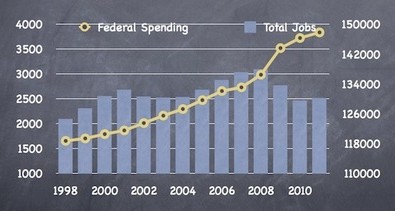
Here’s how well the stimulus spending has been working so far to create jobs:
A very large proportion of recent university graduates have soured on President Barack Obama, and many will vote GOP or stay at home in the 2012 election, according to two new surveys of younger voters.
“These rock-solid Obama constituents are free-agents,” said Kellyanne Conway, president of The Polling Company, based in Washington, D.C. She recently completed a large survey of college grads, and “they’re shopping around, considering their options, [and] a fair number will stay at home and sit it out,” she said.
The scope of this disengagement from Obama is suggested by an informal survey of 500 post-grads by Joe Maddalone, founder of Maddalone Global Strategies. Of his sample, 93 percent are aged between 22 and 28, 67 percent are male and 83 percent voted for Obama in 2008. But only 27 percent are committed to voting for Obama again, and 80 percent said they would consider voting for a Republican, said New York-based Maddalone.
That’s a drop of almost 60 points in support for Obama among this influential class of younger post-grad voters, who Maddalone recruited at conferences held at New York University and Thomson-Reuters’ New York headquarters.
The bad news for Obama was underlined May 19 with a report by a job-firm Adecco that roughly 60 percent of recent college-grads have not been able to find a full-time job in their preferred area. One-in-five graduates have taken jobs far from their training, one-in-six are dependent on their parents, and one-in-four say they’re in debt, according to the firm’s data.
Let’s see. These graduates voted for Obama during college, and now they’ve just finished going through many years of indoctrination from teachers who are typically isolated from real life, i.e. – isolated from private sector employment, military service, entrepreneurship, stay-at-home motherhood, and so forth. They parroted all of the secular left-wing views of their indoctrinators, got their diplomas in social work or English or peace studies, and now they are out on their own for the first time, looking for jobs from the people they have been taught to hate and despise. Imagine their surprise to find out that the world is nothing like they were led to believe, their non-quantitative degrees are useless, and that they are now $60,000 in debt, and they will never collect a dime from entitlement programs from Social Security.
Barack Obama and the Democratic congressional supermajorities of 2009-10 raised federal spending from 21 to 25 percent of gross domestic product. Their stimulus package stopped layoffs of public employees for a while, even as private sector payrolls plummeted.
And the Obama Democrats piled further burdens on would-be employers in the private sector. Obamacare and the Dodd-Frank financial regulation bill are scheduled to be followed by thousands of regulations that will impose impossible-to-estimate costs on the economy.
[…]It’s hard to avoid the conclusion that the threat of tax increases and increased regulatory burdens have produced something in the nature of a hiring strike.
And then there is the political posturing. On April 13 Obama delivered a ballyhooed speech at George Washington University. The man who conservatives as well as liberal pundits told us was a combination of Edmund Burke and Reinhold Niebuhr was widely expected to present a serious plan to address the budget deficits and entitlement spending.
Instead the man who can call on talented career professionals at the Office of Management and Budget to produce detailed blueprints gave us something in the nature of a few numbers scrawled on a paper napkin.
The man depicted as pragmatic and free of ideological cant indulged in cheap political rhetoric, accusing Republicans, including House Budget Committee Chairman Paul Ryan who was in the audience, of pushing old ladies in wheelchairs down the hill and starving autistic children.
The signal was clear. Obama had already ignored his own deficit reduction commission in preparing his annual budget, which was later rejected 97-0 in the Senate. Now he was signaling that the time for governing was over and that he was entering campaign mode 19 months before the November 2012 election. People took notice, especially those people who decide whether to hire or not. Goldman Sachs’s Current Activity Indicator stood at 4.2 percent in March. In April — in the middle of which came Obama’s GW speech — it was 1.6 percent. For May it is 1 percent.
“That is a major drop in no time at all,” wrote Business Insider’s Joe Weisenthal.
After April 13 Obama Democrats went into campaign mode. They staged a poll-driven Senate vote to increase taxes on oil companies.
They began a Mediscare campaign against Ryan’s budget resolution that all but four House Republicans had voted for. That seemed to pay off with a special election victory in New York’s 26th Congressional District.
The message to job creators was clear. Hire at your own risk. Higher taxes, more burdensome regulation and crony capitalism may be here for some time to come.
Corporations do not hire workers or expand their businesses when there is uncertainty and looming tax increases.
Marriage plays a big role in the well-being of the U.S. economy, such that sound and stable marriages keep the economy healthy while divorce helps the economy regress, a new report suggests.
The findings released by the Family Research Council’s Marriage and Religion Research Institute show how intact married-couple families outperform other family types, including remarried families, divorced families, single-parent families, and cohabiting families, in all of the following economic segments: employment, income, net value, net worth, poverty, receipt of welfare and child economic well-being.
Basically the stats show that the more intact the family remains, the less the difficulties and the inefficiencies the family encounters.
Married-couple families generate the most income with “the median household income twice that of divorced households and four times that of separated households,” reads the report.
Divorced families on the other hand experience a sharp decrease in income after the separation. Divorced women are affected the most as they are 2.83 times more prone to live in poverty than women who remain married.
MARRI Director Pat Fagan, Ph.D, said couples that remain stably married can provide a sound environment where children can be securely fostered while divorce triggers society’s reliance on government welfare programs – programs that currently cost tax payers around $112 billion per year.
The economic well-being of the United States is strongly related to marriage, which is a choice about how we channel our sexuality. The implications of sexual choices are apparent when comparing family structures across basic economic measures such as employment, income, net worth, poverty, receipt of welfare, and child economic well-being. In all of these the stable, intact married family outperforms other sexual partnering structures; hence the economy rises with the former and encounters more difficulties and inefficiencies as it diverges from it.
Family Structures and Economic Outcomes:
Employment and Income. Married-couple families generate the most income, on average. Young married men are more likely to be in the labor force, employed, and working a full-time job than their nonmarried counterparts. Cohabiting men have less stable employment histories than single and married men. Married families generally earn higher incomes than stepfamilies, cohabiting families, divorced families, separated families, and single-parent families. According to one study, married couples had a median household income twice that of divorced households and four times the household income of separated households.
Net Worth. Intact, married families have the greatest net worth. A family’s net worth is the value of all its assets minus any liabilities it holds. Married households’ net worth is attributable to more than simply having two adults in the household: a longer-term economic outlook, thrift, and greater head-of-household earning ability (the marriage premium) all contribute to greater household net worth.
Poverty and Welfare. Poverty rates are significantly higher among cohabiting families and single-parent families than among married families. Over one third of single mothers live in poverty. Nearly 60 percent of non-teenage single mothers rely on food stamps or cash welfare payments.
Child Economic Mobility and Well-Being. Children in married, two-parent families enjoy more economic well-being than children in any other family structure. Children in cohabiting families enjoy less economic well-being than children in married families, but more than children in single-parent families. The children of married parents also enjoy relatively strong upward mobility. By contrast, divorce is correlated with downward mobility. A non-intact family background increases by over 50 percent a boy’s odds of ending up in the lowest socioeconomic level.
Having a high net worth is necessary if you want to have an impact. With money, you can buy people apologetics books, sponsor debates, get more degrees, and contribute to Michele Bachmann, and send your children to the best universities so they can have an influence. Therefore, we need to be extra careful who we marry, extra diligent about preparing for our roles in marriage, and extra persistent in staying married. We need the money for important things.
The FRC is my second favorite think tank, right behind the Heritage Foundation.


 WINTERY KNIGHT