Tag Archives: Employment

Michigan governor Rick Snyder signs right-to-work bill into law

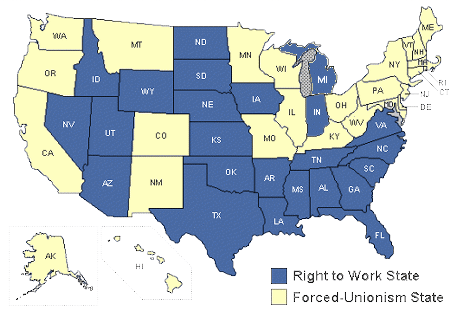
Map of right-to-work states: Michigan is #24

It’s official – Michigan has enacted a new right-to-work law that will create more jobs and free workers from having to violate their consciences by forcibly supporting pro-abortion, pro-gay marriage policies via their mandatory union dues.

Here’s an interesting article by Byron York in the Washington Examiner, discussing the political significance of this development.

Excerpt:

Republicans say the move would not only give current workers the freedom to choose whether to join a union and pay dues but would, more importantly, bring many, many new jobs to Michigan. Rep. Gov. Rick Snyder, who supports the bill, points out that Indiana enacted (after a long and bitter fight) the same kind of law earlier this year. “We’ve carefully watched what’s gone on in Indiana since they passed similar legislation back in February,” Snyder told Fox News’ Greta van Susteren last week, “and they’ve seen a significant increase in the number of companies talking about [bringing] thousands of jobs to their state.”

Of course, the move is not just economic. It’s political, too. Democrats depend on millions — actually, billions — of dollars in support from the forced dues of union members. If that money supply were to dry up, or even just decrease, the Democratic Party would be in serious trouble.

De-funding the unions is the first step to education reform. And Michigan students need education reform very badly. Even 40% of the union workers – who are much more sensible and patriotic than the union bosses – agree with the new law:

Regardless of news reports, the people of Michigan are behind this. A recent poll showed that 51 percent of Michigan voters support right-to-work. Only 41 percent are opposed. In fact, 40 percent of union households supported it. In November, Michigan voters rejected a ballot proposal that would have amended the state constitution to prevent the legislature from passing a right-to-work law and elevated union contracts above state law. The New York Times called it “a test case on enshrining the rights of unions,” and unions spent more than $23 million campaigning for the initiative. It lost by 15 points.

[…][M]aking union dues voluntary makes union organizers less aggressive—they get less financial benefit from organizing new firms, because they cannot force workers to pay them. Union organizing attempts drop 40 percent to 50 percent after states pass a right-to-work law. That in turn attracts business investment. Employers want to know unions will leave them alone if they treat their workers well. As a result, right-to-work states have lower unemployment rates—and more manufacturing jobs.

CNS News reports that only 7% of Detroit public school 8th graders can read at proficiency level.

Excerpt:

In the public schools in Detroit, Mich., according to the U.S. Department of Education, only 7 percent of the eighth graders are grade-level proficient or better in reading.

Some public school teachers in the City of Detroit and around the state of Michigan are reportedly taking a vacation or a sick day today to protest right-to-work legislation likely to be approved by the state legislature. Under current law, Michigan public school teachers must pay dues to the teachers’ union. If the right-to-work law is enacted, Michigan public-school teachers will be free to join the union and pay dues to it if they wish, but they will also be free not to join the union and not to pay it dues.

Detroit public-school eighth graders do even worse in math than they do in reading, according to the Department of Education. While only 7 percent scored highly enough on the department’s National Assessment of Educational Progress test in 2011 to be rated “proficient” or better in reading, only 4 percent scored highly enough to be rated “proficient” or better in math.

Statewide in Michigan, only 32 percent of public-school eighth graders scored grade-level proficient or better in reading, and only 31 percent scored grade-level proficient or better in math.

According to this report, over 26,000 students missed school because of the “sick day” protest by the teachers.

Here’s a video of what happens at the protests:

The actual unemployment rate of right-to-work states is 6.7%. Compare that with the 8.7% unemployment rate of forced-unionism states. Jobs are the number one priority right now, and right-to-work means more jobs.

Related posts

Michigan approves right-to-work law for private sector unions

Map of right-to-work states: Michigan is #24

Dad sent me this article from Fox News, which reports on how Michigan became the 24th right-to-work state.

Excerpt:

Republicans rushed right-to-work legislation through the Michigan Legislature Thursday, drawing raucous protests from hundreds of union supporters, some of whom were pepper-sprayed by police when they tried to storm the Senate chamber.

With six-vote margins in both chambers, the House and Senate approved measures prohibiting private unions from requiring that nonunion employees pay fees. The Senate was debating a similar bill, with Democrats denouncing it as an attack on worker rights and the GOP sponsor insisting it would boost the economy and jobs. Separate legislation dealing with public-sector unions was expected to come later.

Because of rules requiring a five-day delay between votes in the two chambers on the same legislation, final enactment appears unlikely until next week. Republican Gov. Rick Snyder, who previously had said repeatedly that right-to-work was “not on my agenda,” told reporters Thursday he would sign the measures.

[…]In an interview with The Associated Press, Snyder said he had kept the issue at arm’s length while pursuing other programs to bolster the state economy. But he said circumstances had pushed the matter to the forefront.

“It is a divisive issue,” he acknowledged. “But it was already being divisive over the past few weeks, so let’s get this resolved. Let’s reach a conclusion that’s in the best interests of all.”

Also influencing his decision, he said, were reports that some 90 companies had decided to locate in Indiana since that state adopted right-to-work legislation. “That’s thousands of jobs, and we want to have that kind of success in Michigan,” he said.

Do right-to-work states create more jobs than forced-union-dues states, like the Republican governor says?

The radically left-wing Washington Post takes a look at it:

The Facts

We searched the Labor Department’s Bureau of Labor Statistics Web site to find data on each state’s non-farm, seasonally adjusted employment during the past 10 years. Just as Romney said, right-to-work states have better employment numbers on the whole.

Romney’s camp relied on numbers from the BLS household survey. The data, which his team compiled in July, show that right-to-work states experienced a net gain of 3.6 million jobs during the past decade, while “union states” saw a net loss of 900,000 jobs over the same time span.

The updated BLS numbers are right here.

Unions are a Democrat constituency, and that means that unions support abortion and gay marriage. It is wrong that unions are able to force socially conservative workers to pay dues that are used to elect pro-abortion and anti-marriage leftists. Right-to-work laws protect workers from being forced to support causes that violate their consciences. They can pay the dues if they want to, but they don’t have to. You shouldn’t have to support abortion and gay marriage just so you can work.

Now ask yourself another question. Why would Democrats want to prevent job creation? Could it be that they want more people to be dependent on government for their daily bread, so that they can control them and coerce them into voting for bigger government?

Democrats are the party of dependence, debt and unemployment. They hate jobs, they hate business. That’s why we have seen an explosion of debt, unemployment, taxes and regulations over the last four years, with more to come in the next four. You can’t argue with these numbers, and no amount of spirited teleprompter-reading will change what actually works. And what actually doesn’t work.

Related posts

Will raising taxes on the rich help the economy and create more jobs?

The presidents of my two favorite think tanks, Arthur Brooks (AEI) and Edwin Feulner (Heritage) explain in this USA Today editorial.

Excerpt: (links removed)

First, there is no evidence that tax increases will actually solve our troubles. On the contrary, years of data from around the world show that when nations try to solve a fiscal crisis primarily by raising tax revenues, they tend to fail. In contrast, fiscal approaches based on entitlement reform and spending cuts tend to succeed.

American Enterprise Institute economists Kevin Hassett, Andrew Biggs and Matthew Jensen examined the experiences of 21 Organization for Economic Cooperation and Development (OECD) countries between 1970 and 2007. They found that countries with successful fiscal reforms, on average, closed 85% of their budget gaps with spending cuts. The countries with failed reforms, on average, relied at least 50% on tax increases. President Obama’s strategy falls firmly in the latter camp. After discounting the accounting tricks that create fictitious spending cuts, the president’s plan would impose about $3 in tax hikes for every $1 in spending cuts.

That is, his approach would probably land America in the “failed attempt” column. Five years down the line, we would be in the same fiscal mess we are in today, just with higher taxes and a bigger government.

Second, tax hikes aimed at small segments of the population wouldn’t raise much in revenues. Consider the “Buffett Rule” that the president spent many months promoting. According to the Joint Committee on Taxation, it would raise about $47 billion over a decade. The federal government currently spends about $4 billion more per day than it takes in. The Buffett Rule, then, would raise about enough next year to cover 28 hours of government overspending. Heritage Foundation economist Curtis Dubay finds that closing the deficit solely by raising the two highest tax brackets would require hiking them to 159% and 166%, respectively.

Third, as economists and business executives have noted repeatedly, raising taxes on families earning over $250,000 per year is effectively a massive tax hike on small businesses. Most small businesses today organize as S-corporations or other pass-through entities; their income is taxed as personal income. A study by Ernst and Young shows that Obama’s proposed tax hike would force these small businesses to eliminate about 710,000 jobs. Moreover, these households already bear a great deal of tax liability. According to the most recent Internal Revenue Service data, those earning $250,000 and above — roughly 2% of all taxpayers — earn 22% of income, but pay 45% of all federal income taxes.

Simply put, increasing tax rates on the wealthy is not a serious approach to solving America’s fiscal woes. The problem is purely one of excessive spending, not inadequate taxing.

Revenues haven’t changed substantially over the last decade, but government spending is way, way up. That’s what’s causing us to go into debt – massive government spending on turtle tunnels and Solyndra. We can do better than socialism.