Tag Archives: Emotions

Fertility and pregnancy: how long can a woman wait before having a baby?

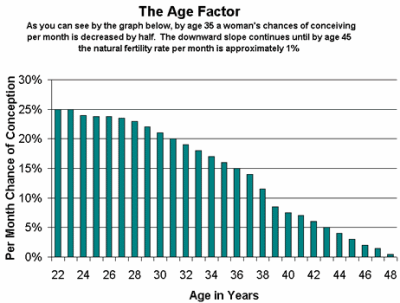
Woman's fertility by age
Woman’s fertility by age

This is from Aeon magazine. The author writes for several ultra-leftist publications, including the New York Times, the Los Angeles Times, Salon and Slate.

She writes:

Many studies show that women are not only woefully ignorant when it comes to fertility, conception and the efficacy of assisted reproductive technologies (ART) – but they overestimate their knowledge about the subject. For instance, a 2011 study in Fertility and Sterility surveyed 3,345 childless women in Canada between the ages of 20 and 50; despite the fact that the women initially assessed their own fertility knowledge as high, the researchers found only half of them answered six of the 16 questions correctly. 72.9 per cent of women thought that: ‘For women over 30, overall health and fitness level is a better indicator of fertility than age.’ (False.) And 90.9 per cent felt that: ‘Prior to menopause, assisted reproductive technologies (such as IVF) can help most women to have a baby using their own eggs.’ (Also false.) Many falsely believed that by not smoking and not being obese they could improve their fertility, rather than the fact that those factors simply negatively affect fertility.

Fertility fog infects cultures and nations worldwide, even those that place more of a premium on reproduction than we do in the West. A global study published for World Fertility Awareness Month in 2006 surveyed 17,500 people (most of childbearing age) from 10 countries in Europe, Africa, the Middle East and South America, revealing very poor knowledge about fertility and the biology of reproduction. Take Israel, a country that puts such a premium on children that they offer free IVF to citizens up to age 45 for their first two children. According to a 2011 study in Human Reproduction, which surveyed 410 undergraduate students, most overestimated a women’s chances of spontaneous pregnancy in all age groups, but particularly after receiving IVF beyond age 40. Only 11 per cent of the students knew that genetic motherhood is unlikely to be achieved from the mid-40s onward, unless using oocytes or egg cells frozen in advance. ‘This can be explained by technological “hype” and favourable media coverage of very late pregnancies,’ the authors concluded.

[…]For a woman over 42, there’s only a 3.9 per cent chance that a live birth will result from an IVF cycle using her own, fresh eggs, according to the American Society of Reproductive Medicine (ASRM). A woman over 44 has just a 1.8 per cent chance of a live birth under the same scenario, according to the US National Center for Chronic Disease Prevention and Health Promotion. Women using fresh donor eggs have about a 56.6 per cent chance of success per round for all ages.

Indeed, according to research from the Fertility Authority in New York, 51 per cent of women aged between 35 and 40 wait a year or more before consulting a specialist, in hopes of conceiving naturally first. ‘It’s ironic, considering that the wait of two years will coincide with diminished fertility,’ the group says.

[…]‘No one talks about fertility,’ said [reproductive endocrinologist Janelle Luk, medical director of Neway Fertility in New York City], who does not believe women are really open to hearing about it. ‘I don’t think women know that there’s a limit: the message is equal, equal, equal. Women say: “We want to go to college, we want to work on our careers, we want to be equal to men.” But our biological clock is not.’

[…]Another way women might even out the fertility playing field is by focussing on the so-called male biological clock. But is there one? Although there have been recent news stories about how advanced age in men (over 40 or 50) increases time to conception and the incidence of autism and schizophrenia, the absolute risk is negligible. ‘When you look at the numbers, you have to separate what the absolute risk and the increased risk is,’ said Natan Bar-Chama, director of male reproductive medicine and surgery at Mount Sinai Medical Center in New York. ‘The absolute risk is still really very small.’

I think if I ever have a daughter, I will be sure to urge her to be skeptical of her emotions and intuitions, to learn how to assess probabilities, to disregard exceptional cases when making plans, to resist the feminism in the culture, to get wisdom from older married women with children instead of young unmarried childless women, to accept that she is not so special that laws and rules don’t apply to her, and to accept that the universe is not malleable according to her needs and desires. I hope my wife will see the value of reining our daughter in before the catastrophes like infertility happen.

Where does the organized opposition to educating young women about fertility facts come from?

‘We feel that women should be able to talk to their ob/gyn about fertility,’ said Sandra Carson, ACOG’s vice president for education. ‘We certainly want to remind women gently that, as they get older, fertility is compromised, but we don’t want to do it in such a way that they feel that it might interfere with their career plans or make them nervous about losing their fertility.’ In other words, there are no guidelines for talking to a woman about her fertility unless she herself brings it up.

All this talk of ‘gentle’ reminders and ‘appropriate’ counselling has a history – a political one. Back in 2001, the ASRM devoted a six-figure sum to a fertility awareness campaign, whose goal was to show the effects of age, obesity, smoking and sexually transmitted diseases on fertility. Surprisingly, the US National Organization for Women (NOW) came out against it. ‘Certainly women are well aware of the so-called biological clock. And I don’t think that we need any more pressure to have kids,’ said Kim Gandy, then president of NOW. In a 2002 op-ed in USA Today, she wrote that NOW ‘commended’ doctors for ‘attempting’ to educate women about their health, but thought they were going about it the wrong way by making women feel ‘anxious about their bodies and guilty about their choices’.

We don’t want women to feel bad, so it’s best to let them follow their hearts. That view is not helpful to women! If we want to help women, we must tell them the truth, and take the consequences.

All this talk about fertility could be accompanied by a discussion of the hard fact that a woman’s attractiveness will decline as she ages. This is a troubling lesson that countless women have had to learn the hard way. When you are young, you stand a much better chance of finding a successful male with good values and who is willing to commit to marriage and parenting. Many women will testify that, as you get older, this convenience deteriorates quickly. The good men will be claimed by the responsible women who don’t waste their youthful years seeking thrills.  Men who are contemplating marriage value a woman’s appearance, fertility, vulnerability and submissiveness to his leadership. Women need to be careful not to embark on a course that will reduce their ability in any of these areas that are important to men, e.g. – careerism, premarital promiscuity, etc.

Related posts

J. Warner Wallace explains and defends the doctrine of Hell in five podcasts

I have a key that will unlock a puzzling mystery

Straight talk on the doctrine of Hell from cold case homicide detective J. Warner Wallace.

Number 1:

In the wake of Rob Bell’s new book, “Love Wins,” many people are beginning to question the nature and existence of Hell and how exactly God decides who must go there. For many, the idea that our temporal, finite sin on earth should deserve an eternal punishment of infinite torment in hell is ridiculously inequitable. Why would God torture infinitely those who have only sinned finitely? Jim addresses this objection and answers listener email.

The MP3 file is here.

Number 2:

A loving God would never create a place like Hell, would He? Any God that would send people to a place of punishment and torment is unloving by definition, right? In this podcast, Jim responds to these foundational objections to the existence of Hell. In addition, Jim comments on the Harris / Craig debate and answers listener email related to hearing God’s voice.

The MP3 file is here.

Number 3:

In this podcast, Jim answers the objection that God would send people like Gandhi to Hell (simply because they are not Christians) alongside people like Hitler (who have committed unspeakable atrocities). How can a reasonable and just God be the source of such inequitable punishment? Also Jim answers listener email related to the power of prayer, the importance of evidential apologetics and the grounding for objective morality.

The MP3 file is here.

Number 4:

Isn’t it unfair for God to penalize people who are otherwise good, just because they haven’t heard about Jesus? A good God would not send good people to Hell. Jim responds to this objection and answers listener email related to the Craig/Harris debate, pre-existing mythologies that are similar to Jesus, and the difficult, exclusive nature of “election”.

The MP3 file is here.

Number 5:

If God is all-loving, why doesn’t he “reform” people rather than simply “punish” them in Hell? Skeptics sometimes argue that a God who simply punishes his children in Hell is a sadistic and vengeful God, unworthy of our worship. Jim responds to this objection and answers listener email related to the nature of “election”, the evidence for “annihilationism”, and a political quote related to same sex marriage.

The MP3 file is here.

Good listening to help you defend a doctrine that is very unpopular with people who think God should be their cosmic butler.

Serial sexual relationships, multi-partner fertility, single motherhood and fatherlessness

A man leading a woman upward

Here’s an article from the policy journal National Affairs (editor is Yuval Levin) that has some statistics about single motherhood by choice. When you are reading the article, keep in mind that most people who lean left are so influenced by feminism that they seem to think that women trip and fall accidentally, and end up pregnant from random men. I don’t think that we should minimize the fact that most women freely choose the men who treat them badly.

Excerpt:

Pew Foundation and Centers for Disease Control and Prevention surveys indicate that, on a range of measures, a very large share of fathers who do not live with their children have virtually no meaningful relationship with their non-custodial children. More than one-half report that they had not shared a meal with their non-custodial children in the last four weeks, while nearly two-thirds had not read to their children and a full three-quarters had not done homework with them. Moreover, these are self-reported figures, so the share of fathers with no relationship to their non-custodial children is most likely even higher.

When fathers form new romantic partnerships, their involvement with children from previous relationships declines. Jo Jones and William Mosher report that, while 39% of fathers in new romantic relationships had shared a meal with their non-custodial 5- to 18-year-old children at least once in the past month, 62% of those not in a new romantic relationship had. While 55% of fathers in a new romantic relationship had spoken with their 5- to 18-year-old non-custodial children, 77% of those not in a new romantic relationship had.

In addition, men with less education are more likely to exhibit absent-father behavior. Whereas 70% of fathers with at least some college had talked to their non-custodial 5- to 18-year-old children at least once in the past month, 59% of those with no more than a high-school degree had done so. While 74% of fathers with at least some college had played with their non-custodial child under 5 years old at least once in the past month, only 53% of those fathers with no more than a high-school degree had.

Multi-partner fertility is not only associated with father abandonment, it also adversely impacts child-maltreatment rates. Women attempting to balance work, the demands of new relationships, and the challenges of raising children are faced with a set of chronic stressors that often lead to child abuse and neglect. The shift from welfare to work increased these stresses. Partially as a result, between 1993 and 2005, the rate of overall abuse, physical abuse, sexual abuse, and serious abuse, respectively, rose by 22%, 14%, 49%, and 34% for children living with single mothers. By contrast, for children living in two-parent households, child-abuse rates fell on each of the four measures (by 42%, 24%, 62%, and 37%, respectively). By 2005, the child-abuse rate was 2.9 per 1,000 for children living with married biological parents but 10.2 for those living with a single parent and no partner, according to the U.S. Department of Health and Human Services. This disparity cannot be explained solely by socioeconomic status since the abuse rate for children in families of all kinds in the lowest socioeconomic group was still lower than that for children living in single-parent households.

Multi-partner fertility also increases child-abuse rates in a second way: the presence of non-biological fathers in the house. Child abuse in households with single mothers triples when they live with a man other than the child’s father. Child-maltreatment rates are actually lower in black than white households when the mother lives alone. But unfortunately, many men bring their job and other frustrations into the home, creating abusive situations. As a result, when a partner is present, the black rates on all three measures of child maltreatment — emotional, physical, and endangerment — are almost double the white rates. In addition, rates of intimate violence are over 12 times higher for single mothers than for married mothers.

Edin and Nelson ignore the subject of abusive behavior in men. Instead, despite the fathers’ caring attitudes, we are told, the mothers kick them out because they don’t earn sufficient income. And on the impact of multi-partner fertility on children, Doing the Best I Can offers one benign sentence: “Kids are amazingly resilient, but the rate of family change among children of unwed fathers has become so rapid, and now leads to such complicated family structures, that kids might have a hard time adjusting.”

Academic studies paint a much grimmer picture. After surveying the evidence, Sara McLanahan and Christopher Jencks concluded earlier this year,

[A] father’s absence increases antisocial behavior [among children], such as aggression, rule breaking, delinquency, and illegal drug use. These antisocial behaviors affect high school completion independent of a child’s verbal and math scores. Thus it appears that a father’s absence lowers children’s educational attainment…by disrupting their social and emotional adjustment and reducing their ability or willingness to exercise self-control.

The effects of growing up without both parents when it comes to aggression, rule breaking, and delinquency are also larger for boys than for girls. Marianne Bertrand and Jessica Pan found in 2011 that the behavior of boys is far more dependent upon good parenting practices — spending time with a child, emotional closeness, and avoiding harsh discipline — than that of girls. Such parenting habits are far more common in two-parent families, which helps to explain why boys with absent fathers are more likely to be suspended and have other behavioral problems than boys who have both parents at home.

The evidence also indicates that the outcomes are most negative when a man other than the biological father is present. Cassandra Dorius and Karen Guzzo found that “adolescents with a half-sibling with a different father are about 65 percent more likely to have used marijuana, uppers, inhalants, cocaine, crack, hallucinogens, sedatives, or other drugs by the time of their 15th birthday than those who have only full siblings.” Cynthia Harper and Sara McLanahan reported in 2004 that, among fatherless boys, those who lived with stepfathers were at an even greater risk of incarceration than those who lived with a single mother.

I think in today’s society, there seems to be a lot of fear and trembling to speak about moral standards. And it seems to be especially true that men are not allowed to tell women about their moral obligations. I know that at least when I speak to young women, they are often very rebellious. The attitude I encounter most often is that they feel that they should be able to trust their feelings and act in the way that their feelings dictate. Any destructiveness that results – which I warned them about – is dismissed as “unexpected”.

I can clearly remember the first time this happened to me, when I was in high school. I was friends with a girl named Tara who would come over and speak to me before morning announcements. She would tell me about her stock car driving boyfriend. One day, she told me that she was moving in with him. I warned her against it, and listed off a bunch of statistics about how this would cause problems. She stopped coming to talk to me, and so did her best female friend. Well, a few years later I ran into her again at one of our local universities where I was an undergraduate. She filled me in on what had happened. He had cheated on her with her best friend in their house. He got her pregnant. She had an abortion. She knew better now, but back in high school I was easily dismissed, and all of her friends sided with her.

Whenever I try to produce evidence to say that something is likely to cause harm, the response is usually “well I know a person who broke the rules and nothing happened”. I produce statistics about some likely consequence of following your heart, and it’s dismissed because some Hollywood celebrity managed to escape the probabilities. “Don’t judge me!” they say. Happiness comes first, and the best way to decide how to be happy in the long-term is apparently to do what makes a person feel happy right now. But statistics are there to tell a story of how the world normally works – dismissing it all with individual cases is bad logic. There are consequences to following your feelings and dismissing moral obligations.