Tag Archives: Education

In California, students protest the results of their own liberal voting

Victor Davis Hanson writes about it National Review.

Excerpt:

Here in California, students just marched on Sacramento in outrage that state-subsidized tuition at the UC and CSU campuses keeps climbing. It is true that per-unit tuition costs are rising, despite even greater exploitation of poorly paid part-time teachers and graduate-student TAs. But the protests are sort of surreal. The California legislature is overwhelmingly Democratic. The governor is a Democrat. The faculties and administrative classes are largely Democratic. Who then, in the students’ minds, have established these supposedly unfair budget priorities?

Sales, income, and gas taxes are still among the highest in the nation (and are proposed to rise even higher) — prompting one of the largest out-of-state exoduses of upper-income brackets in the nation. The state budget is pretty much entirely committed to K–12 education (whose state-by-state comparative test scores in math and science hover between 45th and 49th in the nation), prisons, social services, and public-employee salaries and pensions. Whom, then, can the students be angry at?

Are students angry at public-union salaries and pensions that are among the highest in the nation? Do they think the many highly compensated retired Highway patrol officers have shorted students at UC Davis? Are they mad at the 50,000 illegal aliens in the California prison system that might have siphoned off scholarship funds from CSU Monterey Bay? Or is the rub the influx of hundreds of thousands of children of illegal aliens who require all sorts of language remediation and extra instruction in the public schools, and so might in theory divert library funds from UC Santa Cruz?

Perhaps the students don’t want billions to be committed to high-speed rail that might rob Berkeley of needed funding, or environmental efforts to introduce salmon into the San Joaquin River, in which the $70 million spent so far in studies and surveys might have come from nearby CSU Fresno? Are they mad at state social services, whose medical expenses have skyrocketed to address the health-care needs of millions of illegal aliens, and thus in theory could curb the choice of classes at CSU Stanislaus? Are they angry that some $10–15 billion a year probably leaves the state as remittances to Mexico?

If one cannot blame the wealthy for “not paying their fair share” (the top 1 percent of Californians now pay about 37 percent of all income-tax revenue — and their numbers have decreased by one-third in recent years, as the state has come to rely on the income tax for half its revenue), or Republican majorities in government, who, then, is left to blame?

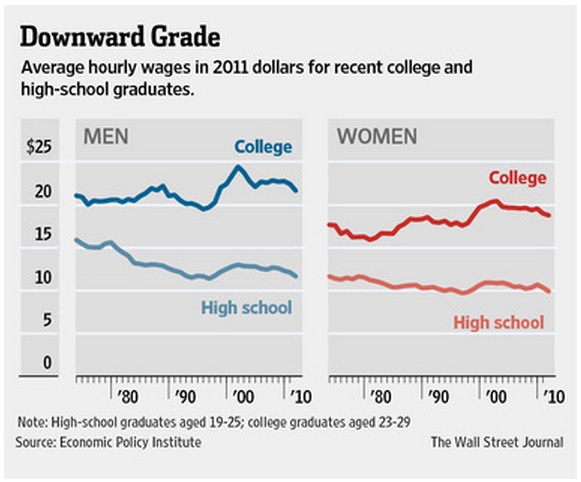
Not only are their tuition costs going UP but their likely salary is going DOWN.
Students majoring in booze and hook-up sex
How's that hopey-changey stuff workin' for ya?

I got that image from a post at the American Enterprise Institute.

Excerpt:

  • Only 35 percent of students starting a four-year degree program will graduate within four years, and less than 60 percent will graduate within six years.
  • The U.S. college dropout rate is about 40 percent, the highest college dropout rate in the industrialized world.
  • Over the past 25 years, the total number of students in college has increased by about 50 percent. But the number of students graduating with degrees in STEM subjects has remained more or less constant.
  • In 2009, the United States graduated 37,994 students with bachelor’s degrees in computer and information science. That’s not bad, but we graduated more students with computer-science degrees 25 years ago!
  • Few disciplines have changed as much in recent years as microbiology, but in 2009 we graduated just 2,480 students with bachelor’s degrees in microbiology—about the same number as 25 years ago. Who will solve the problem of antibiotic resistance?
  • If students aren’t studying science, technology, engineering, and math, what are they studying?
  • In 2009, the United States graduated 89,140 students in the visual and performing arts, more than in computer science, math, and chemical engineering combined and more than double the number of visual-and-performing-arts graduates in 1985.
  • Moreover, more than half of all humanities graduates end up in jobs that don’t require college degrees, and those graduates don’t get a big income boost from having gone to college.

I think this is interesting. What exactly are these students paying for?

If there is one thing I learned from my love of Shakespeare, it’s that it is tragic to be the cause of your own downfall because of your own tragic flaw. Right now, there are a bunch of young people who have been totally brainwashed by the unionized public school teachers and professors to have views on economics that are completely opposite to what works in the real world. They keep voting for bigger and bigger government, which creates more and more debt in order to provide their parents with bigger and bigger benefits. They have lots of self-esteem, but very few marketable skills. Eventually, the bill for all the government spending on “helping the poor”, (e.g. – food stamps for millionaires and bailouts for bankrupt green energy firms), comes due, and it’s the students who will be paying the bill. I wonder if they will look as favorably on socialism and global warming alarmism then?

UPDATE: I noticed that in Quebec, the most liberal province in Canada, students are doing the same thing.

Rick Santorum’s economic plan is good for Ohio and Ohioans

From the Wall Street Journal, a column by Rick Santorum.

Excerpt:

[I]n my first 100 days as president, I’ll submit to Congress and work to pass a comprehensive pro-growth and pro-family Economic Freedom Agenda. Here are 10 of its main initiatives:

  • Unleash America’s energy. I’ll approve the Keystone Pipeline for jobs and energy security, and sign an order on day one unleashing America’s domestic energy production, allowing states to choose where they want to explore for oil and natural gas and to set their own regulations for hydrofracking.
  • Stop job-killing regulation. All Obama administration regulations that have an economic burden over $100 million will be repealed, including the Environmental Protection Agency rule on CO2 emissions that’s already shut down six power plants. I’ll review all regulations, making sure they use sound science and cost benefit analysis.
  • A pro-growth, pro-family tax policy. I’ll submit to Congress comprehensive tax policies to strengthen opportunity in our country, with only two income tax rates of 10% and 28%. To help families, I’ll triple the personal deduction for children and eliminate the marriage tax penalty.
  • Restore America’s competitiveness. The corporate tax rate should be halved, to a flat rate of 17.5%. Corporations should be allowed to expense all business equipment and investment. Taxes on corporate earnings repatriated from overseas should be eliminated to bring home manufacturing. I’ll take the lead on tort reform to lower costs to consumers.
  • Rein in spending. I’ll propose spending cuts of $5 trillion over five years, including cuts for the remainder of fiscal year 2013. I’ll propose budgets that spend less money each year than prior years, and I’ll reduce the nondefense-related federal work force by at least 10%, without replacing them with private contractors.
  • Repeal and replace ObamaCare. I’ll submit legislation to repeal ObamaCare, and on day one issue an executive order ending related regulatory obligations on the states. I’ll work with Congress to replace ObamaCare with competitive insurance choices to improve quality and limit the costs of health care, while protecting those with uninsurable health conditions. In contrast, Gov. Romney signed into law RomneyCare, which provided the model for ObamaCare. Its best-known feature is its overreaching individual health-care mandate. But it shares over a dozen other similarities with ObamaCare and has given Massachusetts the highest health-care premiums in the nation, and longer waits for health care.
  • Balance the budget. I’ll submit to Congress a budget that will balance within four years and call on Congress to pass a balanced-budget amendment to the Constitution which limits federal spending to 18% of GDP.
  • Negotiate and submit free trade agreements. Because many Americans work for companies which export, I’ll initiate negotiations in the first 100 days and submit to Congress five free trade agreements during my first year in office to increase exports.
  • Reform entitlements. I’ll cut means-tested entitlement programs by 10% across the board, freeze them for four years, and block grant them to states—as I did as the author of welfare reform in 1996. I’ll reform Medicare and Social Security so they are fiscally sustainable for seniors and young people.
  • Revive housing. I’ll submit plans to Congress to phase out within several years Fannie Mae and Freddie Mac’s federal housing role, reform and make transparent the Federal Reserve, and allow families whose mortgages are “underwater” to deduct losses from the sale of their home in order to get a fresh start in difficult economic times.

According to the Wall Street Journal, Santorum’s a “supply-sider for the working man“.

Rick Santorum

What does Rick Santorum’s economic plan do?

From the Wall Street Journal, a column by Rick Santorum.

Excerpt:

[I]n my first 100 days as president, I’ll submit to Congress and work to pass a comprehensive pro-growth and pro-family Economic Freedom Agenda. Here are 10 of its main initiatives:

  • Unleash America’s energy. I’ll approve the Keystone Pipeline for jobs and energy security, and sign an order on day one unleashing America’s domestic energy production, allowing states to choose where they want to explore for oil and natural gas and to set their own regulations for hydrofracking.
  • Stop job-killing regulation. All Obama administration regulations that have an economic burden over $100 million will be repealed, including the Environmental Protection Agency rule on CO2 emissions that’s already shut down six power plants. I’ll review all regulations, making sure they use sound science and cost benefit analysis.
  • A pro-growth, pro-family tax policy. I’ll submit to Congress comprehensive tax policies to strengthen opportunity in our country, with only two income tax rates of 10% and 28%. To help families, I’ll triple the personal deduction for children and eliminate the marriage tax penalty.
  • Restore America’s competitiveness. The corporate tax rate should be halved, to a flat rate of 17.5%. Corporations should be allowed to expense all business equipment and investment. Taxes on corporate earnings repatriated from overseas should be eliminated to bring home manufacturing. I’ll take the lead on tort reform to lower costs to consumers.
  • Rein in spending. I’ll propose spending cuts of $5 trillion over five years, including cuts for the remainder of fiscal year 2013. I’ll propose budgets that spend less money each year than prior years, and I’ll reduce the nondefense-related federal work force by at least 10%, without replacing them with private contractors.
  • Repeal and replace ObamaCare. I’ll submit legislation to repeal ObamaCare, and on day one issue an executive order ending related regulatory obligations on the states. I’ll work with Congress to replace ObamaCare with competitive insurance choices to improve quality and limit the costs of health care, while protecting those with uninsurable health conditions. In contrast, Gov. Romney signed into law RomneyCare, which provided the model for ObamaCare. Its best-known feature is its overreaching individual health-care mandate. But it shares over a dozen other similarities with ObamaCare and has given Massachusetts the highest health-care premiums in the nation, and longer waits for health care.
  • Balance the budget. I’ll submit to Congress a budget that will balance within four years and call on Congress to pass a balanced-budget amendment to the Constitution which limits federal spending to 18% of GDP.
  • Negotiate and submit free trade agreements. Because many Americans work for companies which export, I’ll initiate negotiations in the first 100 days and submit to Congress five free trade agreements during my first year in office to increase exports.
  • Reform entitlements. I’ll cut means-tested entitlement programs by 10% across the board, freeze them for four years, and block grant them to states—as I did as the author of welfare reform in 1996. I’ll reform Medicare and Social Security so they are fiscally sustainable for seniors and young people.
  • Revive housing. I’ll submit plans to Congress to phase out within several years Fannie Mae and Freddie Mac’s federal housing role, reform and make transparent the Federal Reserve, and allow families whose mortgages are “underwater” to deduct losses from the sale of their home in order to get a fresh start in difficult economic times.

According to the Wall Street Journal, Santorum’s a “supply-sider for the working man“.

Rick Santorum