
Tag Archives: Economics

Is there evidence of systemic racism in the United States?

ANNOUNCEMENT: I’m going to be on the Free Thinking Ministries podcast today at 2 PM Pacific, 5 PM Eastern, with host Tim Stratton. Join us, and we will discuss Black Lives Matter, Christianity and more. And I’ll explain my plan to achieve the American Dream as a person of color and legal immigrant to America. Live stream link here.

Systemic racism is the idea that people can’t lift themselves out of poverty by making good decisions, because powerful groups in society that hold the poor down, regardless of their decisions. Do you think that America is a place where no matter what choices you make, you’ll never be able to be more properous? That’s what the leaders of Black Lives Matter think.

Here’s what Nikole Hannah-Jones, creator of the 1619 Project, says in the New York Times (a former newspaper):

To summarize, none of the actions we are told black people must take if they want to “lift themselves” out of poverty and gain financial stability — not marrying, not getting educated, not saving more, not owning a home — can mitigate 400 years of racialized plundering.

Got that? It doesn’t matter what individual choices a non-white person takes in America, they’re going to be poor. The “systemic racism” of the powerful whites will always keep them down. Single motherhood doesn’t make people poor, and marriage doesn’t make people wealthier. Dropping out of high school doesn’t make you poor, and getting a Masters degree in computer science won’t make you wealthier.

But let’s take a look at the data from the 2018 Census, and see the evidence.
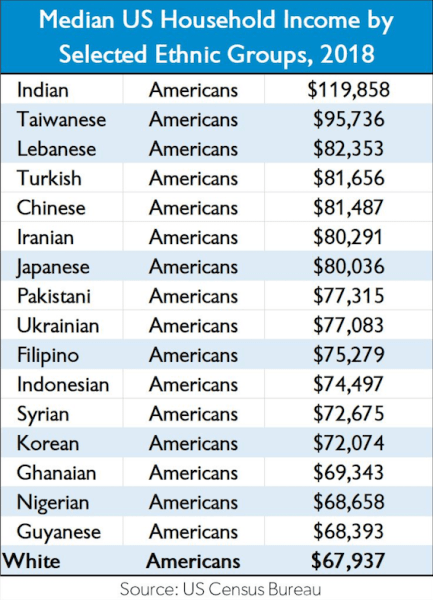
White people are doing a bad job of keeping non-whites down

White people are doing a bad job of keeping non-whites down

Well, it looks like at least SOME people of color are able to do well in America despite all the “systemic racism” that keeps non-whites down. And do you know what those non-white groups at the top have in common? They’ve made good decisions, they’ve worked hard, they haven’t blamed other people when they fail, and they’ve saved their money instead of spending it on shiny junk.

Let’s look at some decisions that the non-whites who are prosperous have made, that those further down have not.
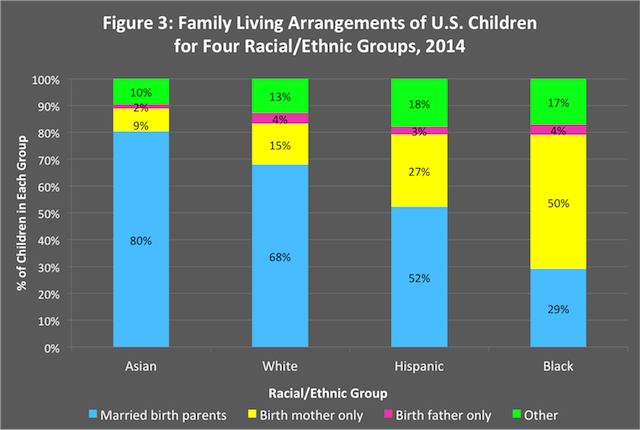
Asians marry before they have children, so the kids have two parents

Asians marry before they have children, so the kids have two parents

Education and marriage

This article is written by the far-left radical Nicholas Kristof, writing in the radically-leftist New York Times (a former newspaper).

Excerpt:

A new scholarly book, “The Asian American Achievement Paradox,” by Jennifer Lee and Min Zhou, notes that Asian-American immigrants in recent decades have started with one advantage: They are highly educated, more so even than the average American. These immigrants are disproportionately doctors, research scientists and other highly educated professionals.

It’s not surprising that the children of Asian-American doctors would flourish in the United States. But Lee and Zhou note that kids of working-class Asian-Americans often also thrive, showing remarkable upward mobility.

[…]There’s also evidence that Americans believe that A’s go to smart kids, while Asians are more likely to think that they go to hard workers… Asian-American kids are allowed no excuse for getting B’s — or even an A-. The joke is that an A- is an “Asian F.”

One reason Asians students do so well is because their parents are usually married:

Strong two-parent families are a factor, too. Divorce rates are much lower for many Asian-American communities than for Americans as a whole, and there’s evidence that two-parent households are less likely to sink into poverty and also have better outcomes for boys in particular.

American blacks have a 73% out-of-wedlock birth rate. A huge difference compared to Asians.

So, when Nikole Hannah-Jones tells you that education and marriage don’t matter, she’s just wrong.

Compound interest

Education and marriage are important, but so is saving your money. The wealthiest people in America are typically the ones who are experts at saving money early, and investing it. They know about the law of compound interest. If you invest money early and leave it alone, then it will grow into a fortune by the time you are read to stop working.

This graph explains compound interest:

Don't trust people with non-STEM degrees to tell you how to get rich

Investing $24,000 from age 21 to 41 vs investing $24000 from age 47 to 67

What does Nikole Hannah-Jones say when she looks at that graph? She doesn’t think that saving money makes a difference to having more or less wealth. She thinks skin color determines whether saving money makes you wealthy or not. The graph clearly shows what we should be recommending to young people of color. They need to stop spending money and start saving it, and the earlier the better. It doesn’t matter what your skin color is, saving money early JUST WORKS.

Similarly, when she says that home ownership doesn’t make you more wealthy, this is just terrible advice. It’s always better to pay down your own mortgage (at least when interest rates are low like they are now) than to pay someone else rent. You have to live somewhere, and paying for your own home is better because it costs about the same as rent, and then you get to keep the home when you’re done paying for it.

Communism

Nikole Hannah-Jones does have a “solution” to disparities in wealth. Her solution is communism. She wants to transfer money from those who earn, to those who don’t. But we already have tried that in the 21st century and it resulted in the deaths of over 100 million people. That’s not my opinion, that’s all documented in a book published by Harvard University Press.

You don’t even have to read the book to know the truth – just look at countries that score low on the Index of Economic Freedom, and compare their GDP per capita to countries that score high on the Index of Economic Freedom. The more communist a nation goes, the less wealth there is for the citizens. That’s why people in Venezuela are eating zoo animals and selling their bodies in prostitution in order to get food to eat and water to drink. Nikole Hannah-Jones wants to reduce economic freedom, but we know by looking at other countries that this reduces per-capita GDP over time.

There’s a lot more than could be said here, but the point is that we need to be telling American blacks to make decisions that match the decisions of other successful non-white communities in America. We need to start teaching young people basic economics so they don’t fall prey to charlatans.

Podcast: Was Jesus a socialist? Does Christianity teach socialism?

Let's take a deep dive into the Bible
Let’s take a deep dive into the Bible

I noticed that Christianity Today, which has turned hard left in recent years, is now openly endorsing socialism. So, I thought it might be a good idea to listen to this new episode of the Think Biblically podcast, which deals with the issue of Christianity and socialism. The hosts actually brought an economist on to define socialism, then they analyze the teachings of Jesus.

Here’s the description: (H/T Nathan)

It has not been uncommon for advocates of virtually every economic system to invoke Jesus in support of their views, though some of the most ardent advocates for both capitalism and socialism did not have any particular religious views themselves (Rand, Marx). Over the years, some of the more recent advocates of socialist type economic arrangements have appealed to Jesus and the gospels in support of such systems. Economist Lawrence Reed helps us sort out the application of the teaching of Jesus to economics and its relevance for economic life today. Join us for this provocative conversation as he tackles the question of Jesus and socialism.

Show notes, including a full transcript, are available at: biola.edu/thinkbiblically

Topics:

  • who plans the economy in socialism?
  • who should own the means of production in socialism?
  • how should wealth be distributed in socialism?
  • what tools does socialism use to provide people with health care, employment, security, etc.
  • which countries have adopted socialism? North Korea? Cuba? Venezuela? How about the Scandinavian countries?
  • what in the New Testament has caused people to think that Jesus was a socialist?
  • did Jesus ever advocate for concentrating power in the government in order to meet the material needs of people?
  • did Jesus ever advocate for voluntary charity in order to meet the material needs of people?
  • in our experience, is government seen to be more compassionate or less compassionate than individual people?
  • does voluntary charity have any advantages over forced redistribution by a powerful central government?
  • what about the example of common possessions among the earliest Christians?
  • what is the Bible’s view of wealth? is it always bad to be wealthy, or does it matter how you obtained it and how you use it?
  • what does the parable of the talents tell us about socialism vs capitalism?
  • what does the parable of the good Samaritan tell us about socialism vs capitalism?
  • what does the parable of the three different shifts of workers tell us about socialism vs capitalism?
  • what about socialist policies and higher tax rates in countries like Canada and Scandinavian countries?

I have to be honest. I think that some of the economics reasoning about the parables was a stretch, because those parables are talking mainly about other topics, not economics. But it’s true that the parables aren’t friendly to socialism even if they are interpreted as being about economics.

Are feminists right to think that gender-neutral marriage makes women happier?

Male And Female Happiness After Feminism And Socialism
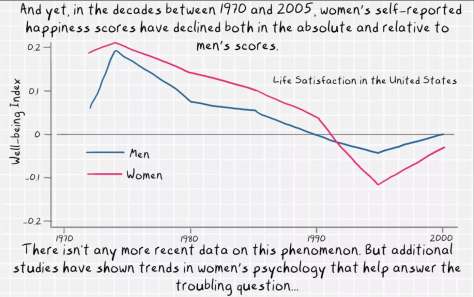
Male and female happiness throughout America’s adoption of radical feminism

I was reading this article by a feminist fiction writer on Vox, where she explains that although feminists have gotten what they wanted (careers, contraceptives, promiscuity, abortion, no-fault-divorce, daycare, etc. it hasn’t made them happier. So, what does this feminist fiction writer think would make feminists happier?

She gives two reasons why women women are still unhappy after feminism has been adopted by our society:

  • men don’t do enough housework
  • women are not as successful as men because they are discriminated against, the so-called “glass ceiling”

I think those complaints are pretty popular among feminists. Let’s take a look at some studies to see if her opinions are supported by peer-reviewed studies.

First study:

COUPLES who share housework duties run a higher risk of divorce than couples where the woman does most of the chores, a study has found.

The divorce rate among couples who shared housework equally was around 50 per cent higher than among those where the woman did most of the work.

“The more a man does in the home, the higher the divorce rate,” Thomas Hansen, co-author of the study entitled Equality in the Home, said.

Second study:

Researchers at the University of Illinois examined data on nearly 1,500 men and 1,800 women, aged between 52 and 60. Their well-being was evaluated through surveys.

The researchers first found that men’s well-being decreased once they had exited the workforce to become home-makers.

Meanwhile, the inverse was not so for women: Women’s psychological well-being was not affected by leaving their jobs to become stay-at-home mothers.

Third study:

A study called “Egalitarianism, Housework and Sexual Frequency in Marriage,” which appeared in The American Sociological Review last year, surprised many, precisely because it went against the logical assumption that as marriages improve by becoming more equal, the sex in these marriages will improve, too. Instead, it found that when men did certain kinds of chores around the house, couples had less sex. Specifically, if men did all of what the researchers characterized as feminine chores like folding laundry, cooking or vacuuming — the kinds of things many women say they want their husbands to do — then couples had sex 1.5 fewer times per month than those with husbands who did what were considered masculine chores, like taking out the trash or fixing the car. It wasn’t just the frequency that was affected, either — at least for the wives. The more traditional the division of labor, meaning the greater the husband’s share of masculine chores compared with feminine ones, the greater his wife’s reported sexual satisfaction.

Regarding the pay gap, that is entirely caused by women’s own choices. E.g. – the choice to study creative writing instead of petroleum engineering, the choice to work 35 hour weeks instead of 70 hour weeks, etc.

Fourth study:  (summarized by AEI economist)

When the [Bureau of Labor Statistics] reports that women working full-time in 2018 earned 81.4% of what men earned working full-time, that is very much different from saying that women earned 81.4% of what men earned for doing exactly the same work while working the exact same number of hours in the same occupation, with exactly the same educational background and exactly the same years of continuous, uninterrupted work experience, and with exactly the same marital and family (e.g., number of children) status. As shown above, once we start controlling individually for the many relevant factors that affect earnings, e.g., hours worked, age, marital status, and having children, most of the raw earnings differential disappears.

Fifth study:

This study leads to the unambiguous conclusion that the differences in the compensation of men and women are the result of a multitude of factors and that the raw wage gap should not be used as the basis to justify corrective action. Indeed, there may be nothing to correct. The differences in raw wages may be almost entirely the result of the individual choices being made by both male and female workers.

I think that women are entitled to make their own decisions, but they aren’t allowed to force the rest of us to subsidize their failures and celebrate their destructive outcomes.

I could go on, but I think enough has been said to show that research is very much at odds with feminist rhetoric. They feel they know what will make them happy and we gave them everything they asked for. They eliminated shaming of promiscuity with sex education. They get preferential treatment in the schools in a female-dominated education system.They are hired because of affirmative action quotas. They get expensive daycare, government schools, welfare and other programs. Taxes are raised to equalize outcomes for divorced women who choose men for feelings, and then nuke their own marriage enterprise. We have been on a long experiment of giving feminists everything they felt they wanted, at the expense of men’s rights and children’s rights, and it hasn’t even produced the results that feminists felt it would.

The social costs of feelings-based decision-making

Let’s look at two examples of policies that feminists asked for in the past, which didn’t work out the way they wanted.

I can understand why feminists would introduce sex education. They felt that “if everyone is having sex, then I won’t be the only one chasing attention from hot no-commitment bad boys by giving them recreational sex before marriage”.  They wanted to eliminate the standards of chastity and marriage-focused dating and normalize fun-focused drunken promiscuity. And they got that. But since they didn’t consult any research and evidence about how that would affect their future marriage stability and marriage happiness, they are even more unhappy than before.

How about no-fault divorce? No-fault divorce was brought in by a coalition of feminists, Marxists and trial lawyers. The Marxists want to destroy the family in order to increase dependence on the state. The trial lawyers wanted to make money. And the feminists thought that the standard approach to courting and marriage was just too much work. They didn’t want to be chaste. They didn’t want to be sober. They didn’t want to evaluate a man for traditional husband and father roles. The no-fault divorce laws gave them an escape from the messes caused by their own feelings-driven choices. But divorce just makes makes men and women much poorer, and passes the costs of supporting single mothers onto taxpayers.

And the costs of the failures of feminism are passed onto taxpayers.

Consider this study:

This paper examines the growth of government during this century as a result of giving women the right to vote. Using cross-sectional time-series data for 1870–1940, we examine state government expenditures and revenue as well as voting by U.S. House and Senate state delegations and the passage of a wide range of different state laws. Suffrage coincided with immediate increases in state government expenditures and revenue and more liberal voting patterns for federal representatives, and these effects continued growing over time as more women took advantage of the franchise. Contrary to many recent suggestions, the gender gap is not something that has arisen since the 1970s, and it helps explain why American government started growing when it did.

We are already $22 trillion in debt, partly because of feminism’s replacement of husbands and families with higher taxes and big government. Every time we transfer money from tax-paying men to feminists to fix their mistakes, it leaves less money in the hands of the men who actually want to get married. The declining value of marriage after feminism for men explains why marriage is being delayed, and why marriage rates are plunging.

The Christian view of marriage

In other places, I have written about the evidence for a Christian worldview:

If Christianity is true, then we have inherited a design for marriage and family which includes male and female roles.

Here is what Jesus says about marriage and divorce in Matthew 19:4:

“Haven’t you read,” he replied, “that at the beginning the Creator ‘made them male and female,’ and said, ‘For this reason a man will leave his father and mother and be united to his wife, and the two will become one flesh’? So they are no longer two, but one flesh. Therefore what God has joined together, let no one separate.”

Jesus does not approve of no-fault divorce.

And here’s what Jesus said about premarital sex (“fornication”) in Mark 7:20-23:

20 He went on: “What comes out of a person is what defiles them. 21 For it is from within, out of a person’s heart, that evil thoughts come—sexual immorality, theft, murder, 22 adultery, greed, malice, deceit, lewdness, envy, slander, arrogance and folly. 23 All these evils come from inside and defile a person.

Jesus does not approve of premarital sex.

Christians should not show even a hint of sexual immorality, (premarital sex and no-fault divorce), nor should they partner with those who approve of sexual immorality and no-fault divorce, according to Ephesians 5:

But among you there must not be even a hint of sexual immorality, or of any kind of impurity, or of greed, because these are improper for God’s holy people. Nor should there be obscenity, foolish talk or coarse joking, which are out of place, but rather thanksgiving. For of this you can be sure: No immoral, impure or greedy person—such a person is an idolater—has any inheritance in the kingdom of Christ and of God.[a] Let no one deceive you with empty words, for because of such things God’s wrath comes on those who are disobedient. Therefore do not be partners with them.

Christians should not partner with feminists.

And this is one of the most famous passages on male and female roles in the Bible, also from Ephesians 5:

22 Wives, submit yourselves to your own husbands as you do to the Lord. 23 For the husband is the head of the wife as Christ is the head of the church, his body, of which he is the Savior. 24 Now as the church submits to Christ, so also wives should submit to their husbands in everything.

25 Husbands, love your wives, just as Christ loved the church and gave himself up for her 26 to make her holy, cleansing[b] her by the washing with water through the word, 27 and to present her to himself as a radiant church, without stain or wrinkle or any other blemish, but holy and blameless. 28 In this same way, husbands ought to love their wives as their own bodies. He who loves his wife loves himself. 29 After all, no one ever hated their own body, but they feed and care for their body, just as Christ does the church— 30 for we are members of his body. 31 “For this reason a man will leave his father and mother and be united to his wife, and the two will become one flesh.” 32 This is a profound mystery—but I am talking about Christ and the church. 33 However, each one of you also must love his wife as he loves himself, and the wife must respect her husband.

Christians do not approve of egalitarian marriage which erases sex differences in husband and wife roles.

Most women in the church, and most of their “conservative” pastors, don’t believe that Jesus is an authority about chastity, marriage and male headship. They agree with feminists about premarital sex and no-fault divorce and egalitarian marriage. But the feminist design for women isn’t working out for women – that’s undeniable. Should we really be surprised that feminist’s feelings were not better for women than the Creator’s own design?