Tag Archives: Earth

Can naturalism account for the origin of the 20 amino acids in living systems?

Do the Miller-Urey experiments simulate the early Earth?

The origin of life

There are two problems related to the origin of the first living cell, on naturalism:

  1. The problem of getting the building blocks needed to create life – i.e. the amino acids
  2. The problem of creating the functional sequences of amino acids and proteins that can support the minimal operations of a simple living cell

Normally, I concede the first problem and grant the naturalist all the building blocks he needs. This is because step 2 is impossible. There is no way, on naturalism, to form the sequences of amino acids that will fold up into proteins, and then to form the sequences of proteins that can be used to form everything else in the cell, including the DNA itself. But that’s a topic for a separate post.

Today, let’s take a look at the problems with step 1.

The problem of getting the building blocks of life

Now you may have heard that some scientists managed to spark some gasses to generate most of the 20 amino acids found in living systems. These experiments are called the “Miller-Urey” experiments.

The IDEA center has a nice summary of origin-of-life research that explains a few of the main problems with step 1.

Miler and Urey used the wrong gasses:

Miller’s experiment requires a reducing methane and ammonia atmosphere,11, 12 however geochemical evidence says the atmosphere was hydrogen, water, and carbon dioxide (non-reducing).15, 16 The only amino acid produced in a such an atmosphere is glycine (and only when the hydrogen content is unreasonably high), and could not form the necessary building blocks of life.11

Miller and Urey didn’t account for UV of molecular instability:

Not only would UV radiation destroy any molecules that were made, but their own short lifespans would also greatly limit their numbers. For example, at 100ºC (boiling point of water), the half lives of the nucleic acids Adenine and Guanine are 1 year, uracil is 12 years, and cytozine is 19 days20 (nucleic acids and other important proteins such as chlorophyll and hemoglobin have never been synthesized in origin-of-life type experiments19).

Miller and Urey didn’t account for molecular oxygen:

We all have know ozone in the upper atmosphere protects life from harmful UV radiation. However, ozone is composed of oxygen which is the very gas that Stanley Miller-type experiments avoided, for it prevents the synthesis of organic molecules like the ones obtained from the experiments! Pre-biotic synthesis is in a “damned if you do, damned if you don’t” scenario. The chemistry does not work if there is oxygen because the atmosphere would be non-reducing, but if there is no UV-light-blocking oxygen (i.e. ozone – O3) in the atmosphere, the amino acids would be quickly destroyed by extremely high amounts of UV light (which would have been 100 times stronger than today on the early earth).20, 21, 22 This radiation could destroy methane within a few tens of years,23 and atmospheric ammonia within 30,000 years.15

And there were three other problems too:

At best the processes would likely create a dilute “thin soup,”24 destroyed by meteorite impacts every 10 million years.20, 25 This severely limits the time available to create pre-biotic chemicals and allow for the OOL.

Chemically speaking, life uses only “left-handed” (“L”) amino acids and “right-handed” (“R)” genetic molecules. This is called “chirality,” and any account of the origin of life must somehow explain the origin of chirality. Nearly all chemical reactions produce “racemic” mixtures–mixtures with products that are 50% L and 50% R.

Two more problems are not mentioned in the article. A non-peptide bond anywhere in the chain will ruin the chain. You need around 200 amino acids to make a protein. If any of the bonds is not a peptide bond, the chain will not work in a living system. Additionally, the article does not mention the need for the experimenter to intervene in order to prevent interfering cross-reactions that would prevent the amino acids from forming.

Usually when you hear the origin of life debated, they sort of skirt about the problem of where the amino acids come from, but there is no reason not to make that an issue. The naturalist has to explain how the first living cell could come about naturalistically.

Positive arguments for Christian theism


Four ways the Earth is fine-tuned for life, and one more

Circumstellar Habitable Zone

This is a post from J. Warner Wallace, over at Cold Case Christianity.

Let’s see his four ways first, then I’ll add one that I know.

He writes:

  1. The Earth’s Relationship to the Sun Is Favorable to Life
  2. The Earth’s Atmospheric Conditions Are Favorable to Life
  3. The Earth’s Terrestrial Nature Is Favorable to Life
  4. The Earth’s Relationship to the Moon Is Favorable to Life

I’ve blogged about the moon and plate tectonics before, so we won’t pick #3 and #4 to look at. And I blogged about the stellar habitable zone before, so we won’t pick #1, either.

Let’s look at #2:

The Earth’s Atmospheric Conditions Are Favorable to Life:
The surface gravity of Earth is critical to its ability to retain an atmosphere friendly to life. If Earth’s gravity were stronger, our atmosphere would contain too much methane and ammonia. If our planet’s gravity were weaker, Earth wouldn’t be able to retain enough water. As it is, Earth’s atmosphere has a finely calibrated ratio of oxygen to nitrogen—just enough carbon dioxide and adequate water vapor levels to promote advanced life, allow photosynthesis (without an excessive greenhouse effect), and to allow for sufficient rainfall.

Ok, that’s very good.

Now here is one from me… well, it’s from Science Daily, but I found it. Actually, ECM found it. But he told me.

Excerpt:

They suggest that the size and location of an asteroid belt, shaped by the evolution of the Sun’s protoplanetary disk and by the gravitational influence of a nearby giant Jupiter-like planet, may determine whether complex life will evolve on an Earth-like planet.

This might sound surprising because asteroids are considered a nuisance due to their potential to impact Earth and trigger mass extinctions. But an emerging view proposes that asteroid collisions with planets may provide a boost to the birth and evolution of complex life.

Asteroids may have delivered water and organic compounds to the early Earth. According to the theory of punctuated equilibrium, occasional asteroid impacts might accelerate the rate of biological evolution by disrupting a planet’s environment to the point where species must try new adaptation strategies.

The astronomers based their conclusion on an analysis of theoretical models and archival observations of extrasolar Jupiter-sized planets and debris disks around young stars. “Our study shows that only a tiny fraction of planetary systems observed to date seem to have giant planets in the right location to produce an asteroid belt of the appropriate size, offering the potential for life on a nearby rocky planet,” said Martin, the study’s lead author. “Our study suggests that our solar system may be rather special.”

So, that’s 5 ways that the Earth and our solar system are fine-tuned to be habitable for complex, embodied minds. Somebody is looking out for you, so be thankful and recognize.

Actually, I was thinking about this today (Wednesday). At lunch, I was thinking about this girl I know who is very disrespectful of me, of what I’ve achieved, and she won’t take my advice in the areas where I am experienced – education, career, saving, investing. I was fretting about it as I was about to start eating my lunch and suddenly it struck me that I don’t give God enough credit for the many blessings I get from him. I don’t mean things that “go my way”, I mean big things like habitability, and so on. So I said a longer grace than normal today at lunch. I wonder if he sent me that rebellious girl so that I would know how he feels when I don’t recognize and respect him, and just complain about the things he doesn’t do for me.

Anyway, I hope this habitability post will give you something to be thankful for. Our God is an awesome God.

How tidal effects improve the habitability of a planet

Circumstellar Habitable Zone

Science Daily reports on a new factor that affects planetary habitability: tides. Specifically, tides can affect the surface temperature of a planet, which has to be within a certain range in order to support liquid water – a requirement for life of any conceivable kind.

Excerpt:

Tides can render the so-called “habitable zone” around low-mass stars uninhabitable. This is the main result of a recently published study by a team of astronomers led by René Heller of the Astrophysical Institute Potsdam.

[…]Until now, the two main drivers thought to determine a planet’s temperature were the distance to the central star and the composition of the planet’s atmosphere. By studying the tides caused by low-mass stars on their potential earth-like companions, Heller and his colleagues have concluded that tidal effects modify the traditional concept of the habitable zone.

Heller deduced this from three different effects. Firstly, tides can cause the axis of a planet`s rotation to become perpendicular to its orbit in just a few million years. In comparison, Earth’s axis of rotation is inclined by 23.5 degrees — an effect which causes our seasons. Owing to this effect, there would be no seasonal variation on such Earth-like planets in the habitable zone of low-mass stars. These planets would have huge temperature differences between their poles, which would be in perpetual deep freeze, and their hot equators which in the long run would evaporate any atmosphere. This temperature difference would cause extreme winds and storms.

The second effect of these tides would be to heat up the exoplanet, similar to the tidal heating of Io, a moon of Jupiter that shows global vulcanism.

Finally, tides can cause the rotational period of the planet (the planet’s “day”) to synchronize with the orbital period (the planet’s “year”). This situation is identical to the Earth-moon setup: the moon only shows Earth one face, the other side being known as “the dark side of the moon.” As a result one half of the exoplanet receives extreme radiation from the star while the other half freezes in eternal darkness.

The habitable zone around low-mass stars is therefore not very comfortable — it may even be uninhabitable.

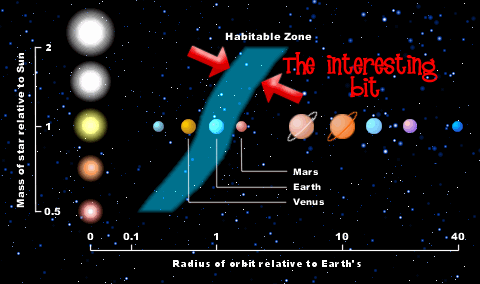
Here is my previous post on the factors needed for a habitable planet. Now we just have one more. I actually find this article sort of odd, because my understanding of stars was that only high-mass stars could support life at all. This is because if the mass of the planet was too low, the habitable zone wouldbe very close to the star. Being too close to the star causes tidal locking, which means that the planet doesn’t spin on its axis at all, and the same side faces the star. This is a life killer.

This astrophysicist who teaches at the University of Wisconsin explains it better than me.

Excerpt:

Higher-mass stars tend to be larger and luminous than their lower-mass counterparts. Therefore, their habitable zones are situated further out. In addition, however, their HZs are much broader. As an illustration,

  • a 0.2 solar-mass star’s HZ extends from 0.1 to 0.2 AU
  • a 1.0 solar-mass star’s HZ extends from 1 to 2 AU
  • a 40 solar-mass star’s HZ extends from 350 to 600 AU

On these grounds, it would seem that high-mass starts are the best candidates for finding planets within a habitable zone. However, these stars emit most of their radiation in the far ultraviolet (FUV), which can be highly damaging to life, and also contributes to photodissociation and the loss of water. Furthermore, the lifetimes of these stars is so short (around 10 million years) that there is not enough time for life to begin.

Very low mass stars have the longest lifetimes of all, but their HZs are very close in and very narrow. Therefore, the chances of a planet being formed within the HZ are small. Additionally, even if a planet did form within the HZ, it would become tidally locked, so that the same hemisphere always faced the star. Even though liquid water might exist on such a planet, the climactic conditions would probably be too severe to permit life.

In between the high- and low-mass stars lie those like our own Sun, which make up about 15% percent of the stars in the galaxy. These have reasonably-broad HZs, do not suffer from FUV irradiation, and have lifetimes of the order of 10 billion years. Therefore, they are the best candidates for harbouring planets where life might be able to begin.

This guy is just someone I found through a web search. He has a support-the-unions-sticker on his web page, so he’s a liberal crackpot. But he makes my point, anyway, so that’s good enough for me.

Maybe the new discovery is talking about this now, but I already knew about the tides and habitability, because I watched The Privileged Planet DVD. Actually that whole video is online, and the clip that talks about the habitable zone and water is linked in this blog post I wrote before.