Tag Archives: Drugs

Read Theodore Dalrymple’s “Life at the Bottom” online for free

I want to recommend that you read a book that is available online for free.

The author  is a psychiatrist in a British hospital that deals with a lot of criminals and victims of crime. So he gets to see the worldview of the “underclass” up close, and to understand how the policies of the compassionate secular left are really working at the street level. The theme of the book is that the left advances policies in order to feel good about themselves, even though the policies actually hurt the poor and vulnerable far more than they help them. And the solution of the elites is more of the same.

The whole book is available ONLINE for free! From City Journal!

Table of Contents

The Knife Went In 5
Goodbye, Cruel World 15
Reader, She Married Him–Alas 26
Tough Love 36
It Hurts, Therefore I Am 48
Festivity, and Menace 58
We Don’t Want No Education 68
Uncouth Chic 78
The Heart of a Heartless World 89
There’s No Damned Merit in It 102
Choosing to Fail 114
Free to Choose 124
What Is Poverty? 134
Do Sties Make Pigs? 144
Lost in the Ghetto 155
And Dying Thus Around Us Every Day 167
The Rush from Judgment 181
What Causes Crime? 195
How Criminologists Foster Crime 208
Policemen in Wonderland 221
Zero Intolerance 233
Seeing Is Not Believing 244

Lots more essays are here, all from City Journal.

My favorite passage

The only bad thing about reading it online is that you miss one of the best quotes from the introduction. But I’ll type it out for you.

The disastrous pattern of human relationships that exists in the underclass is also becoming common higher up the social scale. With increasing frequency I am consulted by nurses, who for the most part come from and were themselves traditionally members of (at least after Florence Nightingale) the respectable lower middle class, who have illegitimate children by men who first abuse and then abandon them. This abuse and later abandonment is usually all too predictable from the man’s previous history and character; but the nurses who have been treated in this way say they refrained from making a judgment about him because it is wrong to make judgments. But if they do not make a judgment about the man with whom they are going to live and by whom they are going to have a child, about what are they ever going to make a judgment?

“It just didn’t work out,” they say, the “it” in question being the relationship that they conceive of having an existence independent of the two people who form it, and that exerts an influence on their on their lives rather like an astral projection. Life is fate.

This is something I run into myself. I think that young people today prefer moral relativists as mates, because they are afraid of being judged and rejected by people who are too serious about religion and morality. The problem is that if you choose someone who doesn’t take religion and morality seriously, then you can’t rely on them to behave morally and exercise spiritual leadership when raising children. And being sexually involved with someone who doesn’t take morality seriously causes a lot of damage.

An excerpt

Here’s one of my favorite passages from “Tough Love”, in which he describes how easily he can detect whether a particular man has violent tendencies on sight, whereas female victims of domestic violence – and even the hospital nurses – will not recognize the same signs.

All the more surprising is it to me, therefore, that the nurses perceive things differently. They do not see a man’s violence in his face, his gestures, his deportment, and his bodily adornments, even though they have the same experience of the patients as I. They hear the same stories, they see the same signs, but they do not make the same judgments. What’s more, they seem never to learn; for experience—like chance, in the famous dictum of Louis Pasteur—favors only the mind prepared. And when I guess at a glance that a man is an inveterate wife beater (I use the term “wife” loosely), they are appalled at the harshness of my judgment, even when it proves right once more.

This is not a matter of merely theoretical interest to the nurses, for many of them in their private lives have themselves been the compliant victims of violent men. For example, the lover of one of the senior nurses, an attractive and lively young woman, recently held her at gunpoint and threatened her with death, after having repeatedly blacked her eye during the previous months. I met him once when he came looking for her in the hospital: he was just the kind of ferocious young egotist to whom I would give a wide berth in the broadest daylight.

Why are the nurses so reluctant to come to the most inescapable of conclusions? Their training tells them, quite rightly, that it is their duty to care for everyone without regard for personal merit or deserts; but for them, there is no difference between suspending judgment for certain restricted purposes and making no judgment at all in any circumstances whatsoever. It is as if they were more afraid of passing an adverse verdict on someone than of getting a punch in the face—a likely enough consequence, incidentally, of their failure of discernment. Since it is scarcely possible to recognize a wife beater without inwardly condemning him, it is safer not to recognize him as one in the first place.

This failure of recognition is almost universal among my violently abused women patients, but its function for them is somewhat different from what it is for the nurses. The nurses need to retain a certain positive regard for their patients in order to do their job. But for the abused women, the failure to perceive in advance the violence of their chosen men serves to absolve them of all responsibility for whatever happens thereafter, allowing them to think of themselves as victims alone rather than the victims and accomplices they are. Moreover, it licenses them to obey their impulses and whims, allowing them to suppose that sexual attractiveness is the measure of all things and that prudence in the selection of a male companion is neither possible nor desirable.

Often, their imprudence would be laughable, were it not tragic: many times in my ward I’ve watched liaisons form between an abused female patient and an abusing male patient within half an hour of their striking up an acquaintance. By now, I can often predict the formation of such a liaison—and predict that it will as certainly end in violence as that the sun will rise tomorrow.

At first, of course, my female patients deny that the violence of their men was foreseeable. But when I ask them whether they think I would have recognized it in advance, the great majority—nine out of ten—reply, yes, of course. And when asked how they think I would have done so, they enumerate precisely the factors that would have led me to that conclusion. So their blindness is willful.

Go read the rest!

Book reviews
FARC terrorist leader Alfonso Cano killed by Colombian armed forces

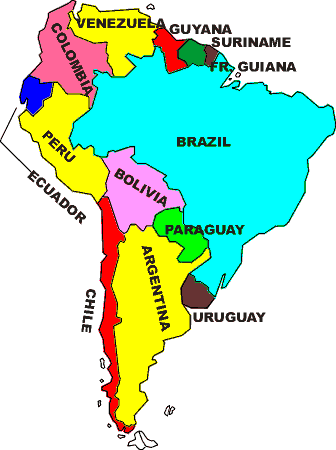
Map of South America

From the Heritage Foundation.

Excerpt:

The armed forces of Colombia have scored a major battlefield victory. They finally hunted down, confronted, and killed the leader of the narco-terrorist Revolutionary Armed Forces of Colombia (FARC), Guillermo Leon Saenz, widely known by his alias Alfonso Cano.

A guerrilla for decades, Cano assumed the top leadership of the FARC following the natural death of founder Manuel Marulanda (2008) and the elimination of senior figures Raul Reyes (2008) and Jorge Briceno (aka Mono Jojoy, 2010).

Seen by some as a modern-day version of the “good revolutionary,” Cano—a life-long advocate of armed violence and terrorism—fell in combat with the Colombian armed forces as they rappelled their way into his secret jungle hideout. Cano was also indicted in a U.S. court for drug trafficking along with dozens of other FARC leaders and had a $5 million price on his head.

FARC is a Marxist terrorist group.

The Economist reports that the Colombian economy is also doing well.

Excerpt:

WHEN the figures are finally tallied, Colombia may prove to have weathered the world recession better than any other of the larger Latin American countries. After a slight contraction at the end of 2008, the economy has been growing modestly this year. This resilience stems from continued foreign investment, an increase in government spending on public works and easier money: since December the central bank has cut interest rates by six percentage points, to 4%, a steeper drop than anywhere in the region outside Chile.

[…]President Álvaro Uribe’s security policies have helped to restore confidence. Investment soared, from 15% of GDP in 2002 to 26% last year, says Mr Zuluaga. Private business has retooled. After many delays, the government has issued licences to expand several ports; this month it hopes to award a contract for the first of four big road schemes, costing a total of $7.5 billion over four years. It hopes for investment of up to $50 billion in mining and oil over the next decade.

And liberal MSNBC has more on the booming Colombian economy.

Excerpt:

…Colombia’s revival is benefiting U.S. economic and political rivals as much as or more than the U.S. itself.

The long delay in signing the treaty allowed Latin America’s fourth-largest economy to strengthen ties with China. It also damaged U.S. credibility in the region, says Eric Farnsworth, vice-president of the Council of the Americas in Washington. “The delay in passing this called into question the United States’ reliability as a partner,” Farnsworth says. “There’s a strategic component to this. It’s not just about economics and trade.”

[…]As talks between the U.S. and Colombia dragged on, Colombia and China forged plans for a rail link between the Pacific and Caribbean that could draw freight away from the Panama Canal. Colombian President Juan Manuel Santos aims for a trade deal with South Korea. To tighten his connections to high-growth Asia, he’s also seeking membership in the Asia-Pacific Economic Cooperation group. “While Washington was debating whether the accord with Colombia was opportune, we advanced in our foreign policy strategy,” says Trade Minister Sergio Diaz-Granados.

Santos has cooperated more with his South American neighbors, organizing a meeting of finance ministers to discuss ways to protect their currencies and economies from the debt crisis in the U.S. and Europe. He supports a stock trading platform with Colombia, Chile, and Peru and wants to bring Mexico and Panama on board. Exports to Brazil have surged tenfold. While the U.S. remains Colombia’s biggest export market, with $16.8 billion in 2010 sales, up 30 percent from a year earlier, sales to China more than doubled last year, to $1.2 billion. Sales to the European Union are also rising, to $5.4 billion this year through August, more than in all of 2010. An EU trade accord could come next year.

The government has reduced cocaine cultivation 37 percent and halved the number of insurgents to about 8,000. Improved security has spurred enough growth to win an investment-grade credit rating from Standard & Poor’s as well as investment from billionaires. Colombia’s victories over the guerrillas opened up swathes of countryside to exploration for oil, gold, and coal. Mexican billionaire Carlos Slim’s push into crude has helped fuel foreign investment that the government says may reach a record $12 billion this year. The economy grew 5.2 percent in the second quarter.

The U.S. faces more competition from Colombia’s neighbors and Canada. In 2010, U.S. agricultural exports to Colombia fell more than 50 percent from 2008, to $827 million, as Argentina’s more than doubled, to $1 billion, according to a report by Senator Richard Lugar’s staff. Diaz-Granados attributes the U.S. setback to the delay in the free-trade agreement.

An August accord reduces or ends Colombian tariffs on Canadian wheat, paper, and machinery. Bank of Nova Scotia, Canada’s third-largest lender, agreed in October to buy 51 percent of Banco Colpatria Red Multibanca Colpatria for about $1 billion—Scotiabank’s largest international takeover. “This is not the Colombia of old,” says Brian J. Porter, group head of international banking for Scotiabank. “The more we looked at Colombia, the more excited we got about the economic potential.”

We really should have signed that trade deal 3 years ago – it would have helped out economy a lot.  But unions got Obama elected, and the unions decided that the trade deal needed to be held up for 3 years. And that’s one of the reasons why we’ve had over 9% unemployment. Our economic policy is being set by unions, not by economists. But in Colombia, economic policy is set by economists, not unions.

Ron Paul on the issues: Ron Paul’s positions on abortion and gay marriage

Ron Paul on gay marriage

Let’s look in this article from the Advocate to find out Ron Paul’s views on same-sex marriage.

Excerpt:

Paul was asked whether his libertarian views on such controversial issues — mainly his belief that personal liberties should not be encroached upon by the federal government — could help him attract socially conservative voters. Paul said he believes that states should have the right to legalize gay marriage, marijuana, and prostitution if they choose to do so.

“If you do not protect liberty across the board, it’s a First Amendment–type issue,” he said. “We don’t have a First Amendment so we can talk about the weather. We have the First Amendment so we can say very controversial things. So, for people to say that, ‘Yes, we have our religious beliefs protected, but people who want to follow something else, or a controversial religion — you can’t do this’ … if you have the inconsistency, then you’re really not defending liberty. But there are strict rules on freedom of choice of this sort, because you can’t hurt other people, you can’t defame other people, but yes, you have a right to do things that are very controversial. If not, you’re going to end up with a government that can tell you what to eat or drink or whatever.”

Gay conservative group GOProud released a statement in support of Paul and the other politicians seeking the party’s nomination.

“[We] thank Congressman Ron Paul for rightly making the case that marriage and family laws should be decided at the state level, not by the politicians in Washington,” the organization said Friday.

That’s Ron Paul’s view of marriage.

Ron Paul on abortion

Here’s what Ron Paul wrote about abortion.

Excerpt:

As the Senate prepares to vote on the confirmation of Supreme Court nominee Samuel Alito this week, our nation once again finds itself bitterly divided over the issue of abortion. It’s a sad spectacle, especially considering that our founders never intended for social policy to be decided at the federal level, and certainly not by federal courts. It’s equally sad to consider that huge numbers of Americans believe their freedoms hinge on any one individual, Supreme Court justice or not.

Roe v. Wade was wrongly decided, but not because the Supreme Court presumed to legalize abortion rather than ban it. Roe was wrongly decided because abortion simply is not a constitutional issue. There is not a word in the text of that document, nor in any of its amendments, that conceivably addresses abortion. There is no serious argument based on the text of the Constitution itself that a federal “right to abortion” exists. The federalization of abortion law is based not on constitutional principles, but rather on a social and political construct created out of thin air by the Roe court.

Under the 9th and 10th amendments, all authority over matters not specifically addressed in the Constitution remains with state legislatures. Therefore the federal government has no authority whatsoever to involve itself in the abortion issue. So while Roe v. Wade is invalid, a federal law banning abortion across all 50 states would be equally invalid.

What states would legalize abortion if Ron Paul allowed states to decide whether abortion should be legal?

Here’s the map:

Which states would Ron Paul allow to legalize abortion?

That’s Ron Paul’s view of abortion.

You can read more about Ron Paul’s troubling views on social issues on Caffeinated Thoughts.

But there’s more. Here’s Ron Paul’s view of the Middle East. He is indifferent to Iran having nuclear weapons. Especially troubling, given the recent terrorist attack on American soil, which implicated the elite Iranian Quds Force.

UPDATE: A commenter adds:

It’s more accurate to say that these are Paul’s views on how states should go about answering these issues. His personal views on these issues are quite clear, that he ascribes to the natural view of marriage and abhors abortion. However he advocates relegating these issues to individual states because of his overriding commitment to a limited federal government and because he believes the constitution does not enumerate such decisions to the federal government for it to answer such questions for all states in the union.

This is true. But if the man becomes President, a lot of unborn babies will still be killed in states that he allows to legalize abortion, and a lot of children will still grow up without a mother or a father, in states that he allows to redefine marriage.  So despite his personal views, the net effect of electing him will be that abortion is permitted in some states, and same-sex marriage, too. So clearly, Ron Paul is not as pro-life or as pro-marriage as other candidates like Michele Bachmann or Rick Santorum.