
Tag Archives: Douglas Groothuis

Philosopher Doug Groothuis explains the logic of the pro-life position

At Christian Post, an article by Douglas Groothuis. (H/T Mary)

Here’s the most useful bit:

When we separate personhood from humanity, we make personhood an achievement based on the possession of certain qualities. But what are these person-constituting qualities? Some say a basic level of consciousness; others assert viability outside the womb; still others say a sense of self-interest (which probably does not obtain until after birth). All of these criteria would take away humanity from those in comas or other physically compromised situations.4 Humans can lose levels of consciousness through injuries, and even infants are not viable without intense and sustained human support. Moreover, who are we to say just what qualities make for membership in the moral community of persons?5 The stakes are very high in this question. If we are wrong in our identification of what qualities are sufficient for personhood and we allow a person to be killed, we have allowed the wrongful killing of nothing less than a person. Therefore, I argue that personhood should be viewed as a substance or essence that is given at conception. The fetus is not a lifeless mechanism that only becomes what it is after several parts are put together—as is the case with a watch or an automobile. Rather, the fetus is a living human organism, whose future unfolds from within itself according to internal principles. For example, the fertilized ovum contains a complete genetic code that is distinct from that of the mother or father. But this is not a mere inert blueprint (which is separable from the building it describes); this is a living blueprint that becomes what its human nature demands.

Yet even if one is not sure when personhood becomes a reality, one should err on the side of being conservative simply because so much is at stake. That is, if one aborts a fetus who is already a person, one commits a deep moral wrong by wrongfully killing an innocent human life. Just as we do not shoot target practice when we are told there may be children playing behind the targets, we should not abortion fetuses if they may be persons with the right not to be killed. As I have argued, it cannot be disputed that abortion kills a living, human being.

Many argue that outside considerations experienced by the mother should overrule the moral value of the human embryo. If a woman does not want a pregnancy, she may abort. But these quality of life considerations always involve issues of lesser moral weight than that of the conservation and protection of a unique human life (which considers the sanctity or innate and intrinsic value of a human life).6 An unwanted pregnancy is difficult, but the answer is not to kill a human being in order to end that pregnancy.

I think that the real question in the abortion debate right now is whether a living organism with a human nature and a human genetic code that is distinct from its mother and father deserves the right to life, or whether it needs to develop some other capability in order to be worthy of protection from violence.

Consider something from philosopher Francis J. Beckwith.

Excerpt:

Some argue that personhood does not arrive until brain waves are detected (40 to 43 days).11Others, such as Mary Anne Warren,12 define a person as a being who can engage in cognitive acts such as sophisticated communication, consciousness, solving complex problems, self-motivated activity and having a self-concept. This would put the arrival of personhood at some time after birth. Still others, such as L. W. Sumner, 13 hold a more moderate position and argue that human personhood does not arrive until the fetus is sentient, the ability to feel and sense as a conscious being. This, according to Sumner, occurs possibly as early as the middle weeks of the second trimester of pregnancy and definitely by the end of that trimester.

Although these criteria differ from each other in important ways, they all have one thing in common: each maintains that if and only if an entity functions in a certain way are we warranted in calling that entity a person. Defenders of these criteria argue that once a human being, whether born or unborn, acquires a certain function or functions–whether it is brain waves, rationality, sentience, etc.– it is then and only then that a person actually exists. Those who defend these personhood criteria typically make a distinction between “being a human” and “being a person.” They argue that although fetuses are members of the species homo sapiens, and in that sense are human, they are not truly persons until they fulfill a particular set of personhood criteria.

Although functional definitions of personhood may tell us some conditions that are sufficient to say that a being is a person, they are not adequate in revealing to us all the conditions that are sufficient for a particular being to be called a person. For example, when a human being is asleep, unconscious, and temporarily comatose, she is not functioning as a person as defined by some personhood criteria. Nevertheless, most people would reject the notion that a human being is not a person while in any of these states. In other words, while personhood criteria, such as the ones presented by Warren can tell us that a being is a person, these criteria are not adequate to declare a being a non-person: The exercise of rational thought tells us that a being is a person; when that person is sleeping, and thus is not exercising rational thought, that lack of exercise of the thought function does not make her a non-person at that time. Consequently, it seems more consistent with our moral intuitions to say that personhood is not something that arises when certain functions are in place, but rather is something that grounds these functions, whether or not they are ever actualized in the life of a human being. Thus, defining personhood strictly in terms of function is inadequate.

If you are pro-life because of your feelings, or because someone told you to be, you ought to know that being pro-life is quite rational and supported by medical evidence. People who are pro-abortion are pro-abortion because they want recreational sex without the complications of having to care for the consequences (babies!) of their own actions. Well, guess what. We ought to care about not hurting other people. If grown-up’ selfish pursuit of happy feelings conflicts with another person’s right to life, then maybe we need to take a step back from being happy and start trying to be good instead.
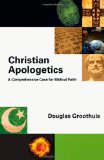
Lee Strobel interviews Douglas Groothuis on his new apologetics book

Christian Apologetics

Mary sent me this article from the BibleGateway site.

Excerpt:

Q. What’s the strongest argument in the arsenal of atheists these days? And why does it fall short?

A. That’s a big question. Different atheists will use different arguments, but they often confront Christians with two things: (1) Darwinism has refuted the idea of Designer and so defeats Christianity (and every other form of theism). They claim that undirected, purely material causes and entities can explain all of biology. (2) The existence of the amount of evil in the world destroys the idea that there is a God who is all-good and all-powerful. No such God would allow this to happen. This is called the problem of evil.

I address (1) in chapters 13 and 14 of Christian Apologetics. To put it into a nutshell: Darwinism is terribly overrated scientifically. Darwinists usually presupposes a materialistic worldview—this is their philosophy, not something derived from science itself—and then interpret everything in biology according to those categories. In other words, “What my net don’t catch, ain’t fish.”

But once we admit intelligent design as a legitimate category of explanation, we find that Darwinism loses its persuasive power as a comprehensive explanation of the biosphere. In fact, Darwinism cannot explain the existence of molecular machines (such as the bacterial flagellum) or the information in DNA code. Nor can it even present a compelling case that all life evolved from a common ancestor.

In addition, my book builds what I hope is a strong cumulative case for Christian theism before addressing the vexing problem of evil in the final chapter. First I consider “dead ends” to explain the fact of evil in the world. Every worldview—and not just Christianity—needs to give an account of the meaning of evil and how to deal with it.

So every worldview has to answer “the problem of evil.” I argue that atheism has no intellectual resources to bring to bear on the problem. It cannot explain the very existence of evil, since it lacks a transcendent and personal standard for good and evil, nor can it give any hope for how to wrestle with evil. This is because all the atheist can say is (to put it politely): “Stuff happens.”

However, Christianity, while challenged by the fact of evil, is not overwhelmed by it. Apart from the problem of evil, we can stand on the foundation of natural theology. There are compelling arguments for, among other things, a First Cause who designed the universe and who is the source of moral law and meaning. Moreover, we find historically reliable documents that speak of Jesus Christ as God incarnate—one who vindicated himself through his matchless life, death, and resurrection. Thus, we do not stand before the problem of evil intellectually naked. Rather, we are girded in strong rational armor.

The Christian answer to the problem of evil is that while God is sovereign, some of God’s creatures (angelic and humans) brought evil into the world through their rebellion. God did not create evil. However, as an all-wise God, God uses evil for greater goods that would not be achievable otherwise. Further, God proves his love and goodness by experiencing the worst possible evil through the crucifixion of Jesus, Christ, God, the Son. Christ’s resurrection three days later stamps history and eternity with the verdict that good (that is, God) wins out over evil in the end.

Q. You offer a compelling case for the resurrection of Jesus. What’s the strongest counter-argument to him rising from the dead? And why does that alternative fail?

A. None of the counter-arguments are as rationally strong as the claim that Jesus left an empty tomb and rose from the dead in space-time actuality. The naturalistic accounts all fail to explain key elements of what we know from history.

However, in recent years, the hallucination theory has generated the most attention, as Gary Habermas has pointed out. This theory affirms that Jesus did not objectively rise from the dead; instead, his followers subjectively hallucinated a resurrection and subsequently built their movement on this delusion. While this counter-argument may be “the best of the bad,” it is still very bad indeed.

First, hallucinations are not group phenomena, but rather individual experiences. But we have well-attested records that many people in their right minds observed the risen Jesus at the same time, as well as other individual appearances (as to Paul).

Second, if many people were deluded about Jesus and began a movement in his name, the Roman government could have put a stop to the young Jesus movement by producing his corpse publicly. They had both the means and the motive to do so. But we have no record of anything like that.

Third, Jesus’ followers did not expect him to rise from the dead. This was not part of their theology and they did not understand Jesus when he made reference to this fact before his resurrection. N.T Wright strongly argues for this. But hallucinations usually involve some form of wish fulfillment: people strongly desire something, and then hallucinate about it. This does not fit the objective historical evidence about Jesus’ followers at all.

I think if you follow apologetics at all, you can see that Doug knows his stuff. But look how precisely he gets the material out – so concisely. I think Doug’s apologetics book and Mike Licona’s resurrection book are the books of the year. But for intermediate to advanced apologists only! Doug and Michael are two of my absolute favorite Christian apologists.

Dealing with objections to Christian apologetics

I found this post on the Possible Worlds blog. (H/T Apologetics 315)

He deals with the following five objections:

  1. You can never argue anyone into the kingdom.
  2. Doesn’t the Bible say to stay away from philosophy?
  3. We should do apologetics from the Word of God only.
  4. Apologetics removes the faith component.
  5. Only the select few can get involved in apologetics, therefore I have no reason to do it.

The fifth one, “not everyone has to do apologetics”, is the one I hear the most often from people:

That is simply not true! As Christians we have an obligation to engage in apologetics! 1 Peter 3:15 says, “But sanctify the Lord God in your hearts: and be ready always to give an answer to every man that asketh you a reason of the hope that is in you with meekness and fear.”

Peter’s message, in context, is that even in the face of persecution, we may suffer for our good lifestyle in Christ. If this is the case, give every man an answer for why you are doing that. I’m willing to bet Peter’s apologetic went along the lines of his sermon in Acts 2. In this sermon, Peter appealed to fulfilled Old Testament prophecy as well as eyewitness testimony of the Resurrection. Sounds like apologetics to me!

But what about those whose intellectual talents are somewhat lacking? Did Peter really expect them to be able to give a reason? Yes. Inasmuch as one is able, he must present an apologetic for Christ. Suppose one cannot follow complex philosophical arguments. What can he do? He may argue from personal experience or a changed life. He may point someone who is interested in the direction of apologetic resources. In essence, any Christian should learn as much as he is able to learn. Almost every Christian I know is capable of presenting the common-sense cosmological argument (“whatever begins to exist had a cause, the universe began to exist, therefore the universe had a cause”).

Not only is apologetics defensible and important in bringing certain types of people to Christ, it is also commanded of every believer. The Bible never commands the level of skill of an apologist, just that the believer holds and expresses a reason for his hope. The more I study the stronger in faith I become. There are always questions I will be unable to answer, but God has answered so many more in such wonderful ways I just have to trust him!

I hear that objection most from people who think that the Christian life consists of being happy and having the feeling that God does really appreciate you caring about him and trying to serve him effectively. I don’t think that is the right way to have a relationship with another person. You have to get to know them and incorporate their character and goals into your decision making. You accommodate them. You serve them.

I found some more reasons why people don’t do apologetics:

  1. Christians don’t seem to care that Christianity is routinely ridiculed
  2. Christians think that faith means belief in the absence of evidence and argument
  3. Christians are not aware of the tremendous intellectual resources available
  4. Christians are more concerned about being “nice” and “tolerant”
  5. Christians don’t want to take the time to study issues thoroughly

The post has my comments on those reasons.

The fact of the matter is that God’s existence and character are under attack, and what works is reason and evidence. Not feelings, not stories, and not being nice. Anyone can be nice. Christianity needs to be presented as TRUE, (by nice people).

My thoughts on this question are here. This is one of my favorite posts.

I’ve noticed that Christian women are often complaining about how to make men take an interest in them. I think the two best things to do to fix that is to get really good at fiscal conservatism and really good at apologetics. Men want women who are marriage-friendly (fiscally conservative) and who put their own happiness second to defend others (apologetics). That’s what fiscal conservatism and apologetics tells a man about your character. If a woman advocates for redistributing wealth to the poor through government, then she is opposed to traditional male rols (provider/protector) and has no idea how marriage is supposed to work in practice. If a woman makes excuses about why she does not have to know how to defend God’s existence and character, then she doesn’t have the ability to care about the needs and goals of others in relationships. Just because a woman says she wants marriage and to be a mother, it doesn’t mean she actually wants that. She may just want people (big and small) to make her happy but without having to care about what they want.