Tag Archives: Designer

Brian Auten interviews philosopher Robin Collins on the fine-tuning argument

Here’s a must-listen interview from Apologetics 315.

Details:

Today’s interview is with Robin Collins, professor of philosophy at Messiah College. His training is in physics and in philosophy and he is a leading advocate for using the fine-tuning of the universe as a design argument for theism. He talks about his background and training, the fine-tuning argument, the different types of fine-tuning with examples and illustrations (laws, constants and initial conditions), two different ways of presenting the fine-tuning argument, answering common objections to the argument, the uniqueness of life, variations of the multiverse hypothesis, the failure of multiverse theory to explain away fine-tuning, objections to Victor Stenger, upcoming books, simplifying the fine-tuning argument for practical use, common mistakes when presenting the argument, the most common objection (who designed God?), and more.

Get the MP3 file from Apologetics 315.

Dr. Collins is extremely cautious and circumspect in his assessment of the fine-tuning argument. He takes the objections to the argument, like the multiverse, seriously and that comes across in the interview. He is familiar with criticisms of the argument and he has engaged with skeptics like Victor Stenger in his published work. I highly recommend it. It is a little more suited to intermediate-level Christians, but not so advanced that it’s impossible for non-math beginners to follow the broad thrust of what’s being said.

About Robin Collins:

Robin Collins (PhD, University of Notre Dame, 1993), is professor of philosophy at Messiah College, Grantham, PA specializing in the area of science and religion. He has written over twenty-five articles and book chapters on a wide range of topics, such as the fine-tuning of the cosmos as evidence for the existence of God, evolution and original sin, the Doctrine of Atonement, Asian religions and Christianity, and Bohm’s theory of quantum mechanics. Some of his most recent articles/book chapters are “Philosophy of Science and Religion” in The Oxford Handbook of Science and Religion, “Divine Action and Evolution” in The Oxford Handbook of Philosophical Theology (2009) “The Multiverse Hypothesis: A Theistic Perspective,” in Universe or Multiverse? (Cambridge University Press), and “God and the Laws of Nature,” in Theism or Naturalism: New Philosophical Perspectives (Oxford University Press, forthcoming). He recently received a grant from the John Templeton Foundation to finish a book that presents the case for design based on physics and cosmology, tentatively entitled The Well-Tempered Universe: God, Cosmic Fine-tuning, and the Laws of Nature.

You can read Robin Collins’ testimony here.

The fine-tuning argument

Here’s a short article where Collins gives TWO examples of the fine-tuning. He is very modest in his argument, merely asserting that the fine-tuning is more compatible with theism than it is with atheism.

Excerpt:

Science is commonly thought to have undercut belief in God. As Nobel Prize winning physicist Steven Weinberg famously remarked, “the more we find out about the universe, the more meaningless it all seems.” Yet, the discoveries of modern physics and cosmology in the last 50 years have shown that the structure of the universe is set in an extraordinarily precise way for the existence of life; if its structure were slightly different, even by an extraordinarily small degree, life would not be possible. In many people’s minds, the most straightforward explanation of this remarkable fine-tuning is some sort of divine purpose behind our universe.

This fine-tuning falls into three categories: the fine-tuning of the laws of nature, the fine-tuning of the constants of physics, and the fine-tuning of the initial conditions of the universe. “Fine-tuning of the laws of nature” refers to the fact that if the universe did not have precisely the right combination of laws, complex intelligent life would be impossible. If there were no universal attractive force (law of gravity), for example, matter would be dispersed throughout the universe and the energy sources (such as stars) needed for life would not exist. Without the strong nuclear force that binds protons and neutrons together in the nucleus, there would not be any atoms with an atomic number greater than hydrogen, and hence no complex molecules needed for life. And without the Pauli-exclusion principle, all electrons would fall to the lowest orbital of an atom, undercutting the kind of complex chemistry that life requires.

Some fundamental physical numbers governing the structure of the universe—called the constants of physics—also must fall into an exceedingly narrow range for life to exist. For example, many have estimated that the cosmological constant—a fundamental number that governs the expansion rate of empty space—must be precisely set to one part in 10120 in order for life to occur; if it were too large, the universe would have expanded too rapidly for galaxies and stars to form, and if it were too small, the universe would have collapsed back on itself. As Stephen Hawking wrote in his book A Brief History of Time, “The remarkable fact is that the values of these numbers [i.e. the constants of physics] seem to have been very finely adjusted to make possible the development of life.” Finally, the initial distribution of mass energy at the time of the big bang must have an enormously special configuration for life to occur, which Cambridge University mathematical physicist Roger Penrose has calculated to be on the order of one part in 1010123. This is an unimaginably small number.

I know what you’re thinking: How do we know that non-Christian scientists acknowledge the fine-tuning of gravity in the way that Collins describes?

Well, the New Scientist actually talks about the fine-tuning of the force of gravity. And they’re not Christians.

Excerpt:

The feebleness of gravity is something we should be grateful for. If it were a tiny bit stronger, none of us would be here to scoff at its puny nature.

The moment of the universe‘s birth created both matter and an expanding space-time in which this matter could exist. While gravity pulled the matter together, the expansion of space drew particles of matter apart – and the further apart they drifted, the weaker their mutual attraction became.

It turns out that the struggle between these two was balanced on a knife-edge. If the expansion of space had overwhelmed the pull of gravity in the newborn universe, stars, galaxies and humans would never have been able to form. If, on the other hand, gravity had been much stronger, stars and galaxies might have formed, but they would have quickly collapsed in on themselves and each other. What’s more, the gravitational distortion of space-time would have folded up the universe in a big crunch. Our cosmic history could have been over by now.

Only the middle ground, where the expansion and the gravitational strength balance to within 1 part in 1015at 1 second after the big bang, allows life to form.

Here’s a very long paper by Collins on the fine-tuning argument, where he answers several objections to the argument, including the multiverse/many-universe hypothesis.

If you want a longer response to the multiverse argument, but you don’t want to shell out big bucks for Collins’ chapter in the “Blackwell Companion to Natural Theology“, then you can just get James Sinclair’s essay in “Contending With Christianity’s Critics“.
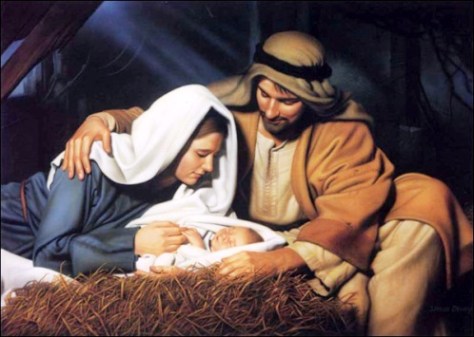
Why do people celebrate Christmas?

It’s the time of year when we explain what Christianity is about.

God exists

Basically, we know from a variety of scientific arguments that the universe was created and fine-tuned for life by an intelligent agent that existed causally prior to the beginning of the universe, because this agent brought the universe into being. Our purpose as humans is to enter into a two-way loving relationship with this Creator/Designer of the universe. This is the only way that we can ultimately be happy and fulfilled.

We avoid God

Now, when you look at human experience, none of us is interested in finding out about the character of this Creator/Designer, because we are afraid that if we find out too much about him then we will have our freedom to do as we please constrained by the demands of a relationship with an all-powerful, all-good being. Just knowing that such a person exists and has a character distinct from our own is enough to cause us to flee from him so that we can stay autonomous from the obligations of the moral law that he expects us to follow.

Christians believe that this universal desire to avoid an all-powerful, all-good God who will judge us is a result of bad behaviors inherited by us from the very first rebellion against God by our ancestors. Ever since that rebellion, the capability for relating to God has been lost, because we no longer have the ability to stop our rebellion against God. Christians call the first rebellion of our ancestors “The Fall of Man”.

What does this rebellion look like for us today? Well, we want to do whatever we want, in order to be happy, and to ignore God’s demands. We want to have happy feelings, including security, community and being morally good, all without a relationship with God. We want to acquire and rearrange matter for our selfish ends without acknowledging and honoring the Creator/Designer of that matter. And, of course, we would like other people to affirm, voluntarily or involuntarily, that our rebellion against God is really the height of moral goodness.

Additionally, some people imagine that God, if he exists at all, must desire our happiness. And of course when their needs are not met by this invented God, then they become even more bitter at God, and eventually decide that God could not really exist since their selfish needs are not being met by him. It never seems to occur to us humans that some pain and suffering may be permitted by God in order to turn our attention away from pleasure and security in this life, and back towards a relationship with him.

This is the mess we find ourselves in. This propensity for turning away from God and trying to pursue selfish happiness and security apart from a relationship with God is what the Bible calls “sin”. Every single one of us deserves severe punishment for refusing to pursue a genuine two-way love relationship with the God who is there. That is the mess we are in before Jesus appears to address this problem.

Jesus saves the day

I cannot say much about how Jesus solves the problem of rebellion against God, because that is really the story of Easter, and today we are dealing with the story of Christmas. But I can say that the solution to the problem requires that God step into history to communicate with his creatures and to perform actions in order to be reconciled with them. That is the message of Christmas: God is stepping into history to do something to end our rebellion. Easter is the story of what he does.

This is talked about in the Bible in John 1, for example.

John 1:1-5:

1In the beginning was the Word, and the Word was with God, and the Word was God.

2He was with God in the beginning.

3Through him all things were made; without him nothing was made that has been made.

4In him was life, and that life was the light of men.

5The light shines in the darkness, but the darkness has not understood it.

You can substitute the word “Word” there for Logos, which really means logic or reason or wisdom. This is a person with a divine nature, identified with the eternal being of God, who exists causally prior to the creation of the universe, who is going to take on an additional human nature, including a human body. (Christians believe that there is one divine “what” being and three divine “who” persons). Software engineers, you can think of Jesus having two natures as multiple inheritance in C++.

And it continues in John 1:10-14:

10He was in the world, and though the world was made through him, the world did not recognize him.

11He came to that which was his own, but his own did not receive him.

12Yet to all who received him, to those who believed in his name, he gave the right to become children of God—

13children born not of natural descent, nor of human decision or a husband’s will, but born of God.

14The Word became flesh and made his dwelling among us. We have seen his glory, the glory of the One and Only, who came from the Father, full of grace and truth.

Here the word grace doesn’t mean like a graceful ballet dancer. It means an instance of mercy received from a superior. A person (a “who”) identified with the divine being (a “what”) has decided to make us a top-down offer of mercy.

The same message of God stepping into history is found in the Christmas carols that people sing at Christmas.

Christmas carols

Here’s the best one, “O, Holy Night“, and it says:

O holy night! The stars are brightly shining.
It is the night of the dear Savior’s birth.
Long lay the world in sin and error pining,
Till He appeared and the soul felt its worth.

When we were in rebellion, we had lost our most valuable capacity – the capacity of being in a direct relationship with God. And if the newborn baby Jesus can accomplish his mission (and he did), then we are going to regain that capacity for a direct relationship with God.

Now look at “Hark! The Herald Angels Sing“, which one of my favorites:

Hark! The herald angels sing,
“Glory to the newborn King!
Peace on earth and mercy mild,
God and sinners reconciled.”

Basically, as I often say, there are only two kinds of people in the world. There are people who are willing to respond to the offer of a relationship with God, with all the little sacrifices and compromises that a relationship entails, and then there are people who are not willing to respond. For the people who are willing to respond, the appearance of Jesus is the best thing that could possibly happen, because now we are finally going to have a chance to deal directly with God, face-to-face, to find out what he is like, and change ourselves to be more like him, with his help.

And that is why people celebrate Christmas. It’s the anniversary of the birth of Jesus. It is the story of God stepping into history to be reconciled with his rebellious creatures. It’s the story of the divine Logos subjecting himself to the life of a creature in order to rescue us from our sinful, self-destructive rebellion. This love for undeserving creatures is above and beyond the call of duty. We didn’t love him, but instead he loved us first, and he loved us enough to come down here and suffer with us so that we could be reconciled with God.

MERRY CHRISTMAS!

How biological convergence falsifies Darwinian evolution

Cornelius Hunter, a software engineer / biologist with a Ph.D in bioinformatics from UIUC explains the latest discovery of biological convergence on his blog. (H/T Tweet from J. Warner Wallace)

Excerpt:

The theory of evolution states that the species arose spontaneously, one from another via a pattern of common descent. This means the species should form an evolutionary tree, where species that share a recent common ancestor, such as two frog species, are highly similar, and species that share a distant common ancestor, such as humans and squids, are very different. But the species do not form such an evolutionary tree pattern. In fact this expectation has been violated so many times it is difficult to keep track. These violations are not rare or occasional anomalies, they are the rule. Entire volumes have been written on them. Many examples are the repeated designs found in what, according to evolution, must be very distant species. Such evolutionary convergence is biology’s version of lightning striking twice. To explain this evolutionists must say that random mutations just happened to hit upon the same detailed, intricate design at different times, in different parts of the world, in different ecological niches, and so forth. The idea that the most complex designs we know of would spontaneously arise by themselves is, itself, not scientifically motivated and a real stretch of the imagination. But for the same intricate designs to arise independently by chance is even more of a stretch. That is why evolutionist’s claim this week that they have found evidence for convergent evolution was so intriguing.

[…]Though evolutionists sometimes deny biological convergence, it is a scientific fact. And a paper from this week added yet another example:

In mammals, hearing is dependent on three canonical processing stages: (i) an eardrum collecting sound, (ii) a middle ear impedance converter, and (iii) a cochlear frequency analyzer. Here, we show that some insects, such as rainforest katydids, possess equivalent biophysical mechanisms for auditory processing. Although katydid ears are among the smallest in all organisms, these ears perform the crucial stage of air-to-liquid impedance conversion and signal amplification, with the use of a distinct tympanal lever system. Further along the chain of hearing, spectral sound analysis is achieved through dispersive wave propagation across a fluid substrate, as in the mammalian cochlea. Thus, two phylogenetically remote organisms, katydids and mammals, have evolved a series of convergent solutions to common biophysical problems, despite their reliance on very different morphological substrates.

It is another curious example of biological convergence, so rather than attempt to deny the undeniable, evolutionists now claim it as another confirmation of evolution.

I’m a software engineer, and we re-use components all the time for different programs that have no “common ancestor”. E.g. – I can develop my String function library and use it in my web application and my Eclipse IDE plug-in, and those two Java programs have no common ancestry, but they do have a common designer. So you find the same bits in two different programs because I am the developer of both programs.

Previously, I blogged about another example of convergence reported by Science Daily. One of the predictions of intelligent design theory is that examples of convergence, which is really just re-use of common code by the designer, will be everywhere in nature. And that predictions just keeps getting confirmed as science marches forward, and the primitive religion of naturalism retreats.