
Tag Archives: Depression

James Dobson lists ten potential sources of depression for wives

I’ve been reading this interesting book by James Dobson, entitled “What Wives Wish Their Husbands Knew About Women“. In the book he asks the reader to rank the 10 common sources of depression for wives in order:

  • low self-esteem
  • fatigue and time pressure
  • loneliness, isolation, and boredom
  • absence of romantic love in marriage
  • financial difficulties
  • sexual problems in marriage
  • menstrual and physiological problems
  • problems with the children
  • aging
  • in-law problems

He has surveyed a whole bunch of Christian and the order above is the order that they gave him from most severe to least severe.

There is room in the book for ranking these and my ranking was like his, pretty much, except that I had two things reversed. I had the financial difficulties and in-law problems reversed, because I have this idea that women are really bad with money and that they care more about relationships. I also had aging and sexual problems reversed because I don’t think that sex is very important to women, and they are sort of unaware of how much of a problem it is for men. However, I think they are terribly concerned about aging.

Note: Commenter Maureen points out to me that women are better than men with money these days. I can’t go against this evidence showing that she is right.

So I thought I would post this to see if anyone else has any thoughts about this list. Does it seem right to you?

I noticed in this article that more and more women are suffering from depression, so it’s important to know why they do that.

Excerpt:

One in four women aged between 45 and 64 now experience some form of mental disorder – an increase of 20 per cent in the last 15 years.

This decline in mental health is greater than any other age or gender group, according to the research.

The study also found that women in general suffer more mental problems – or talk about it more -with 21.5 per cent complaining of stress or depression compared to 13.6 per cent of men.

Mental health charity Mind said women in their 40s and 50s were becoming increasingly affected by trying to manage the responsibilities of family, home and work.

The figures emerged as the independent psychiatric Capio Nightingale Hospital reported a 20 per cent rise in enquiries relating to depression since the start of the year, many related to financial pressures.

The NHS Information Centre report, entitled the Adult Psychiatric Morbidity Survey 2007, was carried out by the National Centre for Social Research and the University of Leicester and questioned 7,461 adults.

It followed on from two similar NHS studies carried out in England in 1993 and 2000.

The report concluded that the number of 45 to 64 year old women with a common mental disorder rose from 20.5 per cent in 1993 to 25.2 per cent in 2007.

The survey also found that the number of women aged between 16 and 74 who reported thinking suicidal thoughts in the previous year rose from 4.2 per cent in 2000 to 5.5 per cent in 2007.

Dr Peter Byrne, director of public education at the Royal College of Psychiatrists, said the role of woman had changed significantly in the last 15 years.

“This particular age group was probably reared by their stay-at-home mothers and they are almost certainly now working mothers, who face the financial pressure of being part of a two income family,” he said.

It’s also important to pick a woman who can be made happy by things that the man can do. I think the wise man has to be careful to choose a woman whose interests are not based on her emotions but on a plan with outward-facing goals. Someone who likes to work at projects and get things done, rather than be dominated by her feelings. Someone who tries to control her feelings when she sees that they are not rooted in reality.

I think it’s a better situation for a man where he is in a relationship with a woman where he can do things in the world and that will drive her emotions. The situation to avoid is where a woman’s emotions are not rooted in anything in the real world and she in’t impressed by what a man does that accomplishes tasks to achieve specific goals that she is passionate about. You want to avoid a woman who is concerns about Betty Friedan’s “the problem that has no name” and one who is impressed with the apologetics course that you are teaching at the church.

You don’t want a woman who says “I’m depressed and since I don’t care about anything except my feelings and victimhood, nothing you can do for me impresses me”. You want a woman who says “I’m depressed but if you do things in the real world that help to achieve goals that I care about, then I’ll feel better”. This is something that has to be tested for in the courtship. At the very least, women ought to know how to identify when they are being tricked by their emotions. They have to be able to talk it out and see that there is nothing specific that is bothering them, and then realize that their feelings are playing tricks on them.
Would the Republican “cut, cap and balance” plan solve the debt crisis?

Let’s take a look at the Republican “Cut, Cap and Balance” plan, as reported by CBS News.

Excerpt:

The House next week will take a vote to raise the debt ceiling and pass a balanced budget amendment, House Republican leaders said today.

The plan is unlikely to go anywhere, since a balanced budget amendment would likely fail in the Democrat-led Senate, but GOP leaders nevertheless called it a serious plan to raise the debt ceiling. They said President Obama and Democrats have failed to come up with an equally serious plan.

“We asked the president to lead,” House Speaker John Boehner said in a press conference today. “We asked him to put forward a plan — not a speech, a real plan — and he hasn’t. We will.”

The “cut, cap and balance” proposal would make raising the debt ceiling contingent on Congress sending a balanced budget amendment to the states. It would also cap government spending at 18 percent of Gross Domestic Product over the next 10 years.

The plan would raise the debt ceiling by $2.4 trillion, since that is the increase requested by the president. However, the plan would actually make even more in spending cuts — as much as $111 billion in 2012 alone.

[…]Boehner said the House would vote on the “cut, cap and balance” plan and then decide how to proceed from there.”I don’t want to preclude any chance of coming to an agreement, but [Democrats have] been unwilling to put a real plan on the table,” Boehner said. “Without serious spending cuts or real reform to entitlement programs, this problem is not going to be solved.”

That’s what the Republicans would do if they were in control. The balanced budget amendment would cap spending at 18% of GDP, so that we would never have a debt crisis ever again. That’s the right solution, except that the Democrats cannot give up the idea of buying votes with the money they steal from job creators. They just can control their addiction to spending.

Now, let’s take a look at who caused the debt crisis, with this House Budget Committee article by fiscal hawk Paul Ryan. (H/T Washington Post)

Excerpt:

While President Obama has recently professed a newfound — and vague — desire to cut government spending, it’s useful to recall what the President has actually done since taking office in 2009. The President signed into law a massive spending spree that plunged us deeper into debt, and failed to deliver on its promise to create jobs.

  • 24% Increase in Base Spending. Non-defense discretionary spending grew by 24% for the first two years of the Obama Administration, adding $734 billion in spending over the next 10 years.
  • Record Government Spending. The Federal government will spend $3.6 trillion this year, 24% of gross domestic product (GDP) and the highest burden on the economy since World War II. Spending has historically averaged a little over 20% of GDP.
  • President’s Budget Makes Matter Worse. According to CBO, the President’s budget never spends less than 23% of GDP and by the end of the decade rises to 24% of GDP. His budget’s failure to address the drivers of our debt threatens the health and retirement security of America’s seniors, and the economic security of all Americans. The President’s budget seeks to spend $46 trillion in government spending over the next decade, and has subsequently fought against House Republican efforts to restrain his spending appetite down to $43.5 trillion.

During the four years when Nancy Pelosi was the Speaker of the House, and Harry Reid was in control of the Senate, the Democrats packed 5.34 trillion dollars onto the national debt.

CBO finds that Obama understated budget deficits by 2.3 TRILLION

From the Hill. (H/T Michelle Malkin)

Excerpt:

The Congressional Budget Office on Friday released its analysis of President Obama’s 2012 budget proposal and found it does less to rein in deficits and the debt than the administration had estimated.

CBO estimates Obama’s plan would produce 10 years of deficits totaling $9.5 trillion. By 2021, it would increase the debt held by the public to 87 percent of gross domestic product.

The administration, using different methods, estimated budget deficits would total $7.2 trillion over the next 10 years under the 2012 budget. It forecast that total debt in 2021 would be 77 percent of GDP.

The White House also said total deficits over the next decade would be $1.1 trillion more without the recommendations included in Obama’s budget.

Marc Goldwein, policy director for the Committee for a Responsible Federal Budget, said that CBO has found the effects to be almost nil.

He explained that the difference between the CBO’s $9.5 trillion estimate and OMB’s $7.2 trillion estimate comes from two sources: rosy economic growth assumptions by OMB and offsets for the Medicare doc fix as well as transportation spending OMB did not specify in the budget and which CBO will not factor in.

The most important aspect of CBO’s analysis is that, while OMB claimed the president’s budget “stabilized” the debt at 77 percent of GDP over the 10-year window, CBO estimates the debt will grow throughout the period and end up at 87 percent, he said.

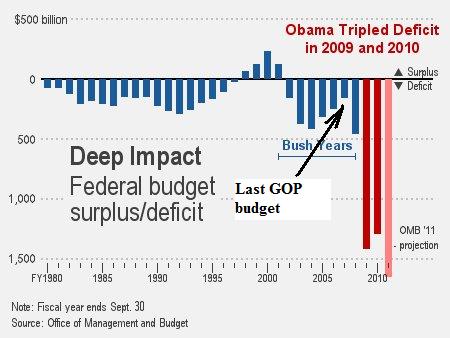
Here’s Michelle Bachmann explaining that since the Democrats took control of the budget in 2007, over 5 trillion dollars has been added to the debt.

The chart Michele is talking about:

Barack Obama Budget Deficit

The last Republican budget was in 2006. The recession started in 2007, along with the spending.

Meanwhile, the Obama will attend his fourth party event of the month. It’s party time! Just like in college!