Tag Archives: Democrat Party

Unemployment rate in socialist Spain now above 20%

Map of Europe
Map of Europe

Here’s the story from Yahoo News.

Excerpt:

Spain announced Friday its jobless rate surged to a 13-year record above 20 percent at the end of 2010, the highest level in the industrialized world, as the economy struggled for air.

It was more bad news for an economy fighting to regain the trust of financial markets and avoid being trapped in a debt quagmire that has engulfed Greece and Ireland and now menaces Portugal.

Another 121,900 people joined Spain’s unemployment queues in the final quarter of the year, pushing the total to 4.697 million people, said the national statistics institute INE.

The resulting unemployment rate was 20.33 percent for the end of the year — easily exceeding Prime Minister Jose Luis Rodriguez Zapatero’s target of 19.4 percent.

Spain appears to be stuck in a rut of staggeringly high levels of unemployment.

After posting a jobless rate of 18.83 percent in 2009 and now 20.33 percent in 2010, the government is forecasting 19.3 percent for 2011 and 17.5 percent in 2012.

The Spanish economy, the European Union’s fifth biggest, slumped into recession during the second half of 2008 as the global financial meltdown compounded the collapse of a labour-intensive construction boom

It emerged with tepid growth of just 0.1 percent in the first quarter of 2010 and 0.2 percent in the second but then stalled with zero growth in the third.

Zapatero has said the fourth quarter will show positive growth which would pick up steam in 2011 but he warned that job creation would be “far from what we need and desire. It will be slow and progressive.”

Remember that Spain elected Jose Luis Rodriguez Zapatero in April 2004, who is a member of the Spanish Socialist Workers’ Party, which is very similar in policy to Barack Obama and the Democrats.  Let’s see what has happened in Spain. (H/T Spain Economy Watch)

Unemployment:
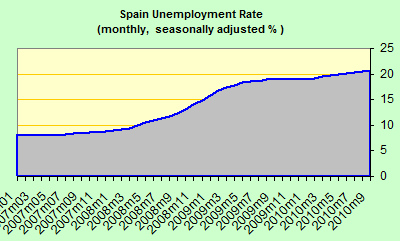
Spain Unemployment Rate

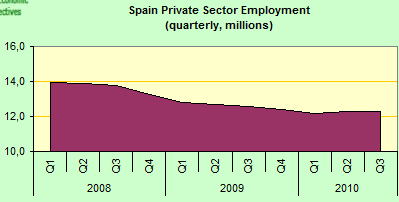
Private sector employment:

Spain Employment Rate - Private Sector
Spain Employment - Private Sector

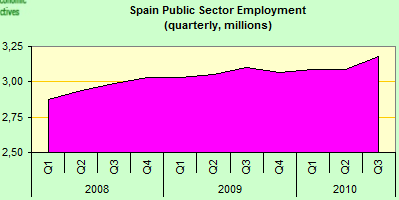
Public sector employment:

Spain Employment - Public Sector

So what do we learn from this?

Well, the public sector doesn’t really sell any products or services, so they don’t really have any customers to please, nor do they have any revenue. They exist by confiscating the wealth of other people (in the private sector) who do have products and services to sell, and do have customers to please. The governments job is to HELP the people in the private sector and not to raise their taxes, or control them, or get in their way except to make sure that they compete fairly and honestly with other people in the private sector. When government oversteps their bounds by raising taxes too high and spending too much, they stop acting like a REFEREE and start acting more like a PARASITE.

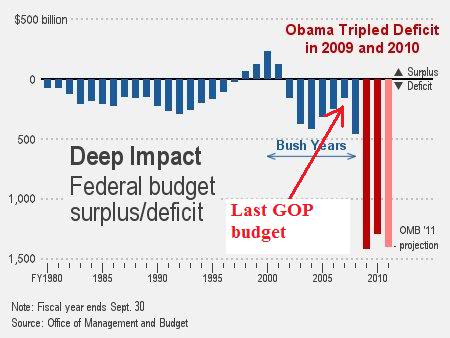
You’ll note that Obama is also spending trillions of dollars on government boondoggles – and where is our unemployment rate now?
What issue could propel the Republicans to victory in 2012?

The issue is school choice. Are the Republicans aware of this issue?

You bet they are.

Excerpt:

The D.C. Opportunity Scholarship Program, as it is known, was launched in 2004 as the first federally funded program providing K-12 education grants. Though supporters say it gives poor students an alternative to the city’s underperforming public school system, teachers unions and other opponents say it draws sorely needed money away from the public system.

Lawmakers opposed to the program succeeded in eliminating it after Sen. Dick Durbin, D-Ill. — who could not be reached for comment Tuesday — attached an amendment to a 2009 spending bill. President Obama stepped in and agreed to allow students currently enrolled to graduate. But the program is no longer accepting new applicants.

Lindsey Burke, a Heritage Foundation analyst also on Boehner’s guest list, said she hopes the proposed legislation finds an audience on the Hill.

“We know that demand is very high for the program,” she said. She said there were four applicants for every available scholarship when the program was accepting students and that graduation rates were far better than in the public system.

Under the program, low-income parents in the District of Columbia were eligible for grants worth up to $7,500 annually to send their kids to private school. According to statistics provided by the Children and Youth Investment Trust Corporation, the average household participating in the program earned just over $25,000 a year. There are still more than 1,000 students enrolled in the Opportunity Scholarship Program.

Washington, D.C., has one of the most troubled public school systems in the country; its students consistently lag behind national averages on standardized testing. According to the scholarship program data, 93 percent of enrolled students would have otherwise attended an underperforming school in the District.

How much does it cost to provide a POOR education to one of these children?

Excerpt:

The most common per-pupil figure used for D.C. Public Schools is an estimated $13,000. That figure is used by all of Washington’s major daily newspapers – The Washington Times, The Washington Post and the Washington Examiner. Local radio and TV stations quote that number as well. But the actual dollar amount is $24,600 – which is “roughly $10,000 more than the average for area private schools,” as Andrew Coulson of the Cato Institute pointed out in his April 4 blog, “The Real Cost of Public Schools.”

Mr. Coulson did not use “new math” to come up with $24,600. He used simple arithmetic. Total funding for D.C. Public Schools this fiscal year (including federal dollars) was $1.216 billion. He divided that by the official enrollment figure of 49,422 and the sum became $24,606.

Also, Mr. Coulson averaged the published tuition costs for private schools in the region and came up with four figures: average tuition paid ($11,627); median tuition paid ($10,043); estimated average per-pupil spending ($14,534); and estimated median per-pupil spending ($12,534). Using simple math, we learned that average per-pupil spending at D.C. area private schools is $10,000 less than at D.C. Public Schools.

And more from the Washington Examiner.

Excerpt:

In a presentation at the Heritage Foundation, Dr. Patrick Wolf, a University of Arkansas researcher who has studied school choice programs, including OPS, for the Department of Education, said that the data shows that public charter schools and voucher programs educate a higher percentage of disadvantaged and minority children on average than traditional public schools.

About 90 percent of OPS recipients are African American and 9 percent are Hispanic, Wolf says, with 17 percent diagnosed with disabilities. Their families’ average income of $17,356 is well below the federal poverty line. But they still managed to do slightly better than their peers in the District’s public schools.

You can get better performance for much less money, even with more disadvantaged children – it just takes vouchers.

The money for the vouchers would naturally come from closing down the schools that cannot satisfy parents, who will use the voucher to go elsewhere to buy their children’s education. Instead of a monopoly where customers are forced to pay for a product they don’t want just because of where they live (because they are POOR and cannot afford to live elsewhere), parents will have a choice of where to send their children, and schools will have to compete to please parents by providing a good product to buy – a quality education. It will turn the public school system from a monopoly into a free market, where the customer (parents) will be king, and the children will benefit. Only underperforming teachers and their allies in the Democrat party stand to lose.

If Republicans take steps to enact robust school choice using voucher programs NOW, then propose a national voucher program in the 2012 election, then they will win the 2012. This is the winning issue. We need to put the children first and put the underperforming adults last.

Must-see videos on education policy

Related posts

Social Security running deficits now, will be bankrupt by 2037

Last Republican budget was in 2006

This is from CBS News. (H/T Robert Stacy McCain)

Excerpt:

Social Security’s finances are getting worse as the economy struggles to recover and millions of baby boomers stand at the brink of retirement.

New congressional projections show Social Security running deficits every year until its trust funds are eventually drained in about 2037.

This year alone, Social Security is projected to collect $45 billion less in payroll taxes than it pays out in retirement, disability and survivor benefits, the nonpartisan Congressional Budget Office said Wednesday. That figure swells to $130 billion when a new one-year cut in payroll taxes is included, though Congress has promised to repay any lost revenue from the tax cut.

The massive retirement program has been feeling the effects of a struggling economy for several years. The program first went into deficit last year, but the CBO said at the time that Social Security would post surpluses for a few more years before permanently slipping into deficits in 2016.

The outlook, however, has grown bleaker as the nation struggles to recover from the worst economic crisis since Social Security was enacted during the Great Depression. In the short term, Social Security is suffering from a weak economy that has payroll taxes lagging and applications for benefits rising. In the long term, Social Security will be strained by the growing number of baby boomers retiring and applying for benefits.

The deficits add a sense of urgency to efforts to improve Social Security’s finances. For much of the past 30 years, Social Security has run big surpluses, which the government has borrowed to spend on other programs. Now that Social Security is running deficits, the federal government will have to find money elsewhere to help pay for retirement, disability and survivor benefits.

You may remember that George W. Bush tried to reform Social Security during his Presidency, but left-wing media and the Democrats cowed him into submission. Shut up, they explained. Just like they shut him up on his plan to regulate Fannie Mae and Freddie Mac back in 2003.

Here’s why nothing is going to be done to fix the problem. (H/T Hyscience)

It’s not going to be fixed until we vote out every last Democrat and replace them with grown-ups from the grown-up party.