Tag Archives: Democrat Party

What happened to the economy after Democrats won the House and Senate in 2007?

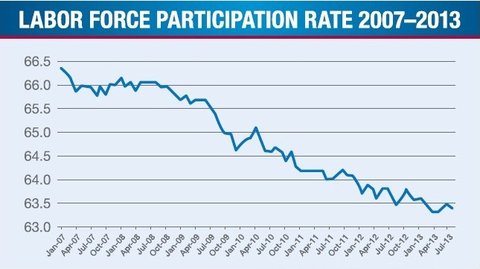
Labor Force Participation Rate from 2007 (Pelosi/Reid) to 2013

Three data points explain what happens when government gets bigger, and job creators get smaller.

First from Investors Business Daily, Obama’s failure to reduce health insurance premiums with his big government takeover of health care.

Excerpt:

The average employer-provided family health insurance premiums have climbed $2,976 since 2009, according to an annual Kaiser Family Foundation survey released this week. They’re up $3,671 compared with the year before President Obama took office. That’s despite Obama’s repeated promises that the health care reform law he championed would cut premiums by $2,500 in his first term.

And while annual premium increases have moderated over the past two years, that’s due to trends in the insurance market largely unrelated to ObamaCare, and trends the law could actually reverse.

The Kaiser survey found that the average family premium this year is $16,351, up 4% over last year, and up 22% since 2009. After adjusting for inflation, premiums climbed an average 3.2% a year in Obama’s first term, higher than the 2.7% average during President Bush’s last four years in office.

During his first campaign for president, Obama repeatedly claimed that his health reform plan would, as he said at a Virginia rally in 2008 “lower premiums by up to $2,500 for a typical family per year.”

Now, let’s take a look the second failure, as reported by the Weekly Standard.

Excerpt:

President Obama likes to talk about income inequality, but what matters far more is the actual income of the typical American.  And how has the typical American household income fared on Obama’s watch?  Well, the economic “recovery” has now spanned an Olympiad, and during that time the typical American household income has not only dropped—it has dropped more than twice as much as it did during the recession.

New estimates derived from the Census Bureau’s Current Population Survey by Sentier Research indicate that the real (inflation-adjusted) median annual household income in America has fallen by 4.4 percent during the “recovery,” after having fallen by 1.8 during the recession.  During the recession, the median American household income fell by $1,002 (from $55,480 to $54,478). During the recovery—that is, from the officially defined end of the recession (in June 2009) to the most recent month for which figures are available (June 2013)—the median American household income has fallen by $2,380 (from $54,478 to $52,098).  So the typical American household is making almost $2,400 less per year (in constant 2013 dollars) than it was four years ago, when the Obama “recovery” began.

Importantly, these income tallies include government payouts such as unemployment compensation and cash welfare. So Obama’s method of funneling ever-more money and power to Washington, and then selectively divvying some of it back out, clearly isn’t working for the typical American family.

And finally, the third example, from the Daily Caller.

Excerpt:

 In 35 states, welfare benefits pay more than a minimum wage job, according to a new study by the libertarian Cato Institute, and in 13 states welfare pays more than $15 per hour.

“One of the single best ways to climb out of poverty is taking a job, but as long as welfare provides a better standard of living than an entry-level job, recipients will continue to choose it over work,” said Michael Tanner, senior policy analyst and co-author of the study.

The study is an updated version of one Tanner put out in 1995 that estimated the full value of welfare benefits packages across the states. The 1995 study found that such tax-free welfare benefits greatly exceeded the poverty level and “their dollar value was greater than the amount of take-home income a worker would receive from an entry-level job.”

Despite efforts to curb welfare spending, many welfare programs and benefits have continued to outpace the income that many workers can receive for working an entry-level job, which disincentivizes work, according to the study.

“The current welfare system provides such a high level of benefits that it acts as a disincentive for work,” reads the study. “Welfare currently pays more than a minimum-wage job in 35 states, even after accounting for the Earned Income Tax Credit, and in 13 states it pays more than $15 per hour.”

According to the study, the federal government funds 126 separate programs designed to support low-income earners. Seventy-two of these programs provide cash or in-kind benefits to recipients. This is on top of additional welfare programs operated by state and local governments.

Welfare recipients in Hawaii get the most benefits, according to Tanner, at $29.13 per hour — or $60,590 pre-tax income annually. However, the state’s minimum wage is only $7.25 per hour, according to the Labor Department. Hawaiians on welfare also earn 167 percent of the median salary in the state, which is only $36,275.

What if a fireman showed up in front of your house on your birthday and claimed that he wanted to put out the candles on your birthday cake because they were a fire hazard? What if he read out a long, passionate, prepared speech about how much he wanted to put out fires? What if he then dumped a bucket of gasoline on your cake? What if your house caught fire and he claimed that you should let him keep throwing gas on the fire to put it out? What if you found out that this person was a lawyer and a community organizer, and knew nothing at all about putting fires out? Obama was not prepared to run the economy, and, as expected, he spent a ton of money without getting the results he said he was going to get. He gave speeches about jobs and poverty and everything he’s done has been to increase unemployment and increase poverty – and now we are $17 trillion dollars in debt. Speeches about achieving objective X during a campaign don’t necessarily translate into achieving objective X. You actually have to know what you are doing in order to achieve objectives, preferably because you’ve done it before in real life.

New study from the Federal Reserve finds that QE stimulus doesn’t grow the economy

Investors Business Daily reports on our incompetent government’s policies.

Excerpt:

For four years now, we’ve heard policymakers and pundits alike defend the Federal Reserve’s quantitative easing based on the idea that, without it, the nation’s economy would have imploded.

Now, a new study from the Fed itself suggests that’s not the case.

The study, by San Francisco Federal Reserve economist Vasco Curdia and New York Fed economist Andrea Ferrero, suggests that quantitative easing (QE) has done little to boost the economy’s trajectory.

“Asset purchase programs like QE2 appear to have, at best, moderate effects on economic growth and inflation,” the economists wrote in a special research note that was released last week.

In their study, Curdia and Ferrero looked specifically at the impact of the Fed’s QE2 program, which totaled $600 billion.

Assuming the $600 billion program lasts for five years — with the Fed buying bonds the first year, holding them for two, then selling them off for the remaining two — the spending turns out largely to have been a waste.

That level of QE stimulus, even when coupled with the Fed’s promise to hold interest rates at zero, likely boosted GDP by a mere 0.13 percentage point, the study found. It added just 0.03 percentage point to inflation.

Bottom line: $600 billion in QE2 spending boosted GDP by less than $200 billion.

[…]And even that minor amount of growth was due in large part to the Fed’s explicit vow to hold official interest rates at close to 0% until the unemployment rate reaches 6.5% or lower, Curdia and Ferrero said.

Take away that promise, and QE2 added just 0.04 percentage point to GDP and 0.02 percentage point to inflation.

What caused it?

With $17 trillion in total U.S. debt — an amount that’s now growing at a rate of $1 trillion a year — the authors argue that the Fed is essentially trapped into printing money through QE.

If QE — which now pushes $85 billion a month into U.S. Treasury and agency debt — stops, interest rates will soar, dragging the economy down.

Fed Chairman Ben Bernanke has been sanguine about this, suggesting this enormous pile of debt can all be sold off with little disruption.

We’re not so sure. Once the Fed begins selling off its massive $3.6 trillion in assets acquired under the QE program (see chart), it will send interest rates surging and tank the economy.

Even more troubling is what it says about current politics.

The White House and a Democrat-led Senate have boosted spending dramatically — outlays as a share of GDP rose initially by 25% under President Obama

The Fed, by buying up much of the newly issued federal debt, has become the No. 1 enabler of a spendthrift government that’s pushing us to the brink of fiscal disaster.

At $85 billion a month, QE2 spending is roughly equal to the amount of federal debt we add each month.

We elected a Keynesian who thought that government could create economic growth (jobs!) by borrowing money and printing money. The countries of the world largely cheered our decision to elect him. He failed to grow the economy and he failed to create jobs. Eventually, the money he’s been spending to keep a sinking ship afloat is going to run out.

Mainstream media silent as Muslim Brotherhood targets Christians in Egypt

Investors Business Daily reports.

Excerpt:

Christians in Egypt are again the target of Islamist Muslim Brotherhood supporters using the new violence as a cover for ongoing persecution. If Christians were burning mosques, the world would be outraged.

Amid the raging violence in Egypt, a less-publicized war is being waged against Egypt’s long-persecuted Coptic Christians, this time using the excuse that they were somehow involved in the military’s ouster of the Muslim Brotherhood’s Mohammed Morsi from power.

Coptic Christians comprise up to 10% of Egypt’s 84 million people.

Ishaq Ibrahim from the Egyptian Initiative for Personal Rights group has documented as many as 39 incidents of violence against churches, monasteries, Coptic schools and shops in different parts of the country within the past few days. They include Thursday’s torching of the Prince Tadros Church in the province of Fayoum, where three similar attacks occurred on other churches the day before.

Islamists firebombed the Mar Gergiss Church in Sohag, a city with a large community of Coptic Christians, burning it to the ground. Islamists previously raised an al-Qaida flag over the church.

Another two places of worship, the Churches of Abraham and the Virgin Mary, were attacked in El-Menia province, leaving them partially damaged by fire. St. Theresa Church in Assiut in Upper Egypt was also burned.

[…]In a terrorist attack one minute after midnight on Jan. 1, 2011, 21 Christians attending a New Year’s mass were killed, and 97 people, mostly Christians, were injured as worshipers were leaving a New Year’s mass at the Saints Church in Alexandria.

On April 7, two Copts were killed and 84 injured by a mob using guns, wielding machetes, throwing stones and possibly hurling Molotov cocktails at mourners exiting St. Mark’s Coptic Orthodox Cathedral in Cairo. The worshippers were mourning the deaths of four Copts in an April 4 attack in Khossus in which a nursery and church were burned.

An investigation into the October 2011 attack on Coptic Christians in Cairo’s Maspero district, leaving 30 dead and more than 500 wounded, was shut down by the Morsi regime. In the Egypt of the Muslim Brotherhood, Christian lives mean little.

As the administration quibbles over the definition of a “coup” regarding Egypt’s military aid, we are reminded the U.S. and NATO went to war over the “ethnic cleansing” of Muslims in Bosnia. What will be our response to the ethnic cleansing of 10% of Egypt’s population?

One of the troubling things that I’ve noticed with younger evangelicals and libertarians is that they don’t understand that wars start when bad people believe that they can behave aggressively and no one will stop them. Being nice doesn’t work on bad people, it just makes them act that more more aggressively.

Here’s an article from Townhall by famous economist Thomas Sowell, in which he explains how tyrants respond to weak foreign policy.

Excerpt:

On the international scene, trying to assuage aggressors’ feelings and look at the world from their point of view has had an even more catastrophic track record. A typical sample of this kind of thinking can be found in a speech to the British Parliament by Prime Minister Neville Chamberlain in 1938: “It has always seemed to me that in dealing with foreign countries we do not give ourselves a chance of success unless we try to understand their mentality, which is not always the same as our own, and it really is astonishing to contemplate how the identically same facts are regarded from two different angles.”

Like our former ambassador from the Carter era, Chamberlain sought to “remove the causes of strife or war.” He wanted “a general settlement of the grievances of the world without war.” In other words, the British prime minister approached Hitler with the attitude of someone negotiating a labor contract, where each side gives a little and everything gets worked out in the end. What Chamberlain did not understand was that all his concessions simply led to new demands from Hitler — and contempt for him by Hitler.

What Winston Churchill understood at the time, and Chamberlain did not, was that Hitler was driven by what Churchill called “currents of hatred so intense as to sear the souls of those who swim upon them.” That was also what drove the men who drove the planes into the World Trade Center.

Pacifists of the 20th century had a lot of blood on their hands for weakening the Western democracies in the face of rising belligerence and military might in aggressor nations like Nazi Germany and imperial Japan. In Britain during the 1930s, Labor Party members of Parliament voted repeatedly against military spending, while Hitler built up the most powerful military machine in Europe. Students at leading British universities signed pledges to refuse to fight in the event of war.

All of this encouraged the Nazis and the Japanese toward war against countries that they knew had greater military potential than their own. Military potential only counts when there is the will to develop it and use it, and the fortitude to continue with a bloody war when it comes. This is what they did not believe the West had. And it was Western pacifists who led them to that belief.

Then as now, pacifism was a “statement” about one’s ideals that paid little attention to actual consequences. At a Labor Party rally where Britain was being urged to disarm “as an example to others,” economist Roy Harrod asked one of the pacifists: “You think our example will cause Hitler and Mussolini to disarm?”

The reply was: “Oh, Roy, have you lost all your idealism?” In other words, the issue was about making a “statement” — that is, posturing on the edge of a volcano, with World War II threatening to erupt at any time. When disarmament advocate George Bernard Shaw was asked what Britons should do if the Nazis crossed the channel into Britain, the playwright replied, “Welcome them as tourists.”

Ronald Reagan and Margaret Thatcher called this view “peace through strength”. There is only one reason why evil people do not attack – because they think that good people have the firepower tomake them pay dearly for their aggression, and – and this is very important – the will to use it.

The important thing to realize is that without a powerful military, there is nothing that we can do when the Muslim Brotherhood goes after Coptic Christians in Egypt. Happy talk isn’t going to solve anything. To deter aggression, you need to have a credible threat of military force deployed in the region. Even if you don’t go to war, the other guy has to believe that you can and that you will. That’s what stops bad people from being aggressive. What Benghzi showed the Islamists is that they could do anything they wanted, and no one is going to stop them. That’s why Christians are dying by the bushel in Egypt today.