Tag Archives: Debt

Europe’s socialist debt crisis: who suffers most? Can bailouts fix it?

This is the most popular article on Investors Business Daily right now.

Excerpt:

Rational or not, Greece’s street riots and emigration rates signify one thing: Socialism offers very little to the young. So why is the EU’s $172 billion bailout geared toward saving so much of the failed socialist system?

As Europe prepares to deliver a historic $172 billion bailout to Greece in a deal announced Monday, it’s pretty much a given that the austerity conditions required, in the absence of a true free market, will hit youth hardest. Athens will be trashed by another youth rampage, as many youths blame the pain on something other than Greece’s deeply rooted socialism.

A bigger effect will come from Greeks who do recognize reality. They won’t riot. They’ll leave, voting with their feet just as Eastern Europe’s youth once did.

The young in both cases are victims of socialism, which claims to make people equal but, in reality, penalizes the young. For Greece, a country already gutted by a below-replacement birth rate and an aging population, that’s a disaster.

It’s not just Greece, but also every EU state with institutionalized socialism — where high government spending seeks to create a warm blanket insulating everyone from risk, but instead has led to bankruptcy.

[…]One out of five jobs in Greece is held by a bureaucrat, which is why unemployment among the under-24s runs at 42%. A 2010 poll shows that seven out of 10 Greek college graduates seek to leave.

Some 9% of Greek college graduates and at least 51% of Greece’s Ph.D.s are already gone, according to University of Macedonia demographer Lois Lambrianidis.

What jobs there are come from the bottom of a two-tier labor system that shields older workers in Greece’s rigid labor market. Young Greeks earn a 500-and-change euro monthly minimum wage as older workers doing the same work make 700.

In contrast, immigrant-magnet Australia holds packed job fairs at its Athens embassy. In 2011, it took in 249,000 immigrants. In 2012, a 20% rise is expected.

[…]Meanwhile, Spain’s EFE News reports that the Spanish Embassy in Santiago, Chile, has seen a 10% rise in registered nationals to 48,000, while Chile reports a 25% rise in work permits issued to Spanish citizens.

It’s not just jobs that are penalizing Europe’s young. Housing is stacked against youth, too. Eurostat reports that in 2008, 46% of young European adults ages 18-34 lived with their parents — 51 million people.

The two-tier job market, which leans heavily toward unstable contract employment, affects housing choices for the young. Other socialist measures designed to protect current owners against the market also shut out the young.

Perhaps most hostile of all to youth are the EU’s outdated state pension systems — which force the young to pay the pensions of the old as the population shrinks.

In Italy, 14% of all economic output goes to pensions. It’s no coincidence that states attracting Europe’s young, like Chile and Australia, have privatized their social security systems that give youth a real shot at building personal wealth and a credible pension through their own efforts, instead of political favoritism.

This is the direction that the United States is also headed in. What I find mystifying is why young people in the United States are voting for these policies. Young people here have a higher rate of unemployment, and they ought to know that all of these entitlement programs won’t be there for them when they retire. What possible reason could they have for voting for more and more government control?

Fact check of Obama’s budget: is there really $4 trillion in deficit reduction?

Here’s a story from the House Budget Committee, where Paul Ryan is the leader.

Paul Ryan made these two charts to help him discuss Obama’s new budget with Obama’s budget director.

Debt Increase in President's Budget
Debt Increase in President’s Budget

And:

Actual savings is 410 billion, not 4 trillion

Watch these clips to see Paul Ryan and Scott Garrett use the charts to do nasty things to Obama’s budget director.

Clip 1 of 3:

Clip 2 of 3:

Clip 3 of 3:

Guy Benson discusses both videos at Townhall.com.

Excerpt:

Ryan does a masterful job of puncturing Zients’ arguments, but let’s reiterate a few points that may have gotten lost in the shuffle.

(1) The White House is claiming that spending cuts within the Budget Control Act of 2011 — which is entirely separate from the FY 2013 budget — should count as savings “achieved” by their new proposal.  This is silly on its face, but crosses into laughable territory when one recalls that throughout much of the debt fight, President Obama adamantly opposed a cuts-for-debt-ceiling-hike quid pro quo.  He was on the record in favor of — demanding, in fact — zero cuts. Republicans dragged him into the BCA against his will; now he’s trying to take credit for that past action in next year’s budget.

(2) The White House says Obama’s budget “saves” $850 Billion by not fighting two wars at peak spending levels for another full decade.  This money was never proposed because the scenario is pure fiction.  These risible “savings” represent a White House bear-hug of Moon-Yogurt accounting. “Heaven help us” is right.

(3) Zients’ isn’t able to recall how much money this budget adds to the national debt.  You’d think the White House Budget Director would have that figure committed to memory (he likely does, but doesn’t want to admit it on camera), but let’s help him out:  The budget he’s defending adds nearly $11 Trillion to the debt, on top of the roughly $5 Trillion increase over which this president has already presided.  I seem to recall an infamous Right-wing zealot calling this sort of governance “unpatriotic.”

Next, we have Rep. Scott Garrett, a strong conservative from Northern New Jersey, asking Zients when the president’s budget comes into balance.  Zients refuses to directly respond to the question, perhaps because the correct answer is “never”…

Indeed, the closest Obama’s budget ever comes to balancing (expenses = revenues) within the ten-year projection window is 2017’s annual deficit of $617 Billion, which is still more than double the size of President Bush’s average annual deficit. Finally, Garrett lures Zients into a trap over Obamacare.  Garrett asks if a family making less than $250,000 per year (“the rich” cut off) is subject to a tax increase if they fail to comply with Obamacare’s individual mandate…

The president sold Obamacare to the public by characterizing the resulting mandatory pay-out as a “fine,” not a tax increase.  He even mocked George Stephanopoulos’ suggestion that it met the dictionary definition of a tax hike.  Once the law passed, however, the administration’s lawyers pulled an about-face and have defended the mandate in court by arguing that the fine is, in fact, a tax increase after all.  Zients has apparently reverted back to the outmoded argument, thus undermining his own administration’s legal defense of their signature “accomplishment.”

What I find frustrating is the media does such a poor job of vetting these “4 trillion dollar” claims that Obama makes. Sometimes, I wonder why anyone listens to mainstream media at all. What do you really learn?

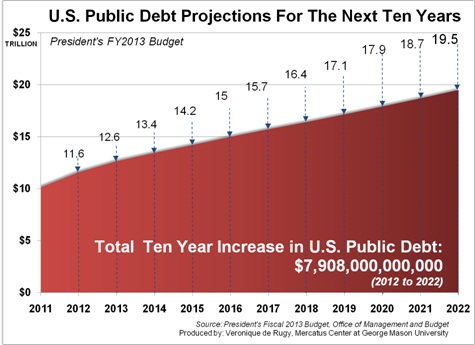
Obama’s new budget adds $8 trillion to the debt over the next 10 years

Obama 2013 Budget Debt Projection

What does the liberal Associated Press think?

Excerpt:

Taking a pass on reining in government growth, President Obama unveiled a record $3.8 trillion election-year budget plan Monday, calling for stimulus-style spending on roads and schools and tax hikes on the wealthy to help pay the costs. The ideas landed with a thud on Capitol Hill.

Though the Pentagon and a number of Cabinet agencies would get squeezed, Obama would leave the spiraling growth of health care programs for the elderly and the poor largely unchecked. The plan claims $4 trillion in deficit savings over the coming decade, but most of it would be through tax increases Republicans oppose, lower war costs already in motion and budget cuts enacted last year in a debt pact with GOP lawmakers.

[…]By the administration’s reckoning, the deficit would drop to $901 billion next year – still requiring the government to borrow 24 cents of every dollar it spends – and would settle in the $600 billion-plus range by 2015.The deficit for the current budget year, which ends Sept. 30, would hit $1.3 trillion, a near record and the fourth straight year of trillion-plus red ink.

Obama’s budget blueprint reprises a long roster of prior proposals: raising taxes on couples making more than $250,000 a year; eliminating numerous tax breaks for oil and gas companies and approving a series of smaller tax and fee proposals. Similar proposals failed even when the Democrats controlled Congress.

The Pentagon would cut purchases of Navy ships and F-35 Joint Strike Fighters – and trim 100,000 troops from its rolls over coming years – while NASA would scrap two missions to Mars.

But there are spending increases, too: The Obama plan seeks $476 billion for transportation projects including roads, bridges and a much-criticized high-speed rail initiative.

The Heritage Foundation has more.

Excerpt:

Spending in the President’s budget rises inexorably from today’s $3.8 trillion to $5.8 trillion in 2022. Throughout the decade, outlays hold stubbornly above 22 percent of gross domestic product (GDP), more than twice the New Deal’s share of the economy in its peak years. In constant dollars, outlays are more than three times the peak of World War II.

In 2012, his budget results deliver a fourth consecutive annual deficit exceeding $1 trillion and then make it worse with another round of not-so-shovel-ready construction projects and government “investments” totaling $178 billion. Among these are the typical road, bridge, and school construction, but then they go alarmingly beyond the usual “infrastructure” arguments to fund teachers’ pay.

Obama’s future deficit reduction comes mainly from Budget Control Act cuts already in place, $848 billion in discredited phantom “savings” from the wind-down of operations in Iraq and Afghanistan, taking credit for reductions in 2011 appropriations, and roughly $1.8 trillion in unnecessary tax increases on those earning above $250,000 and the oil and gas industry.

Yet even with the hefty tax increases and illusory savings, the President’s deficits over the next decade never fall below $575 billion (in 2018) and climb back to $704 billion (in 2022)—but again only assuming the tax increases and mystical savings cited above.

Debt held by the public in the President’s budget rises from 74.2 percent of GDP today to an economically hazardous 76.5 percent of GDP in 2022. These are historically high debt levels: the post–World War II average is just 43 percent. Moreover, the President’s debt estimates are low because of the unreal nature of much of his proposed deficit reduction.

Regarding the most critical fiscal challenge of the day—the need to restructure Medicare, Medicaid, and Social Security—the President has once again taken a pass. By the middle of this century, these three programs and Obamacare will consume about 18 percent of GDP, soaking up all the historical average of federal tax revenue. The notion of “protecting” them through benign neglect only ensures their collapse, and the longer Congress and the President wait to address the problem, the more wrenching will be the consequences. But the President merely reruns previous ideas, such as more cuts to medical providers, ignoring the need for fundamental reform.

For other entitlements, the President repeats a range of mere chipping-around-the-edges proposals from last year’s budget, many of which are really tax or fee increases, not spending reductions.

In short, the President’s budget is the same worn-out collection of higher spending and higher taxes he has offered three times before—with the same inevitable result of more spending, higher taxes, and still more government debt.

Here’s a Republican reaction from Senator Bob Corker:

The libertarian Reason magazine has more budget charts.