Tag Archives: Debt

Obama’s fiscal cliff plan would increase debt to $20 trillion by 2016

Forbes magazine explains why Obama’s plan doesn’t solve our long-term spending problem.

Excerpt:

The President, while not presenting concrete proposals, has been quite clear on what he wants: to raise taxes on the top two percent, keep the Bush tax cuts for everyone else, offer only vague promises of future spending cuts, and gain the unprecedented authority to raise the debt limit without Congressional approval. He does not plan to reform the entitlements so dear to his heart and his base’s. Instead of less spending, he would like to spend more on “stimulus” and “investments.” Obama knows that physicians will desert Medicare if he cuts their compensation by the scheduled 26.5 percent. That is simply not going to happen.

Here are Obama’s desired alternative fiscal policies to avoid the fiscal cliff in order of their effect on the five-year budget as estimated by the CBO:

1. Preserve Bush tax cuts and other tax provisions for everyone except the top 2 percent: Raises the five-year deficit by $2.0 trillion.

2. Drop the fiscal-cliff sequestration of spending and expand discretionary spending by the rate of inflation: Raises the five-year deficit by another trillion dollars.

3. Raise the tax rate on the top 2 percent:  Lowers the five-year deficit by $300 billion.

4. Extend enhanced unemployment benefits: Raises the five-year deficit by $200 billion.

5. Do not cut Medicare payment rates to physicians: Raises the five-year deficit by some $100.

Four of the five fiscal policies on Obama’s wish list raise the deficit. Only one – the vaunted tax on the rich on which he based his campaign – lowers the deficit, but only by a miniscule $300 billion ($60 billion per year). If Obama gets the tax and spending changes he wants, his 2017 successor will inherit a national debt in excess of  $20 trillion.

A warning: The 2013-2017 budget deficits could be much higher. No one knows what the costs of Obama Care will be. By 2017, the federal government will be spending more on health care than on social security. The CBO projection assumes that the costs of Obama Care come in on target. If Obama Care cannot contain health care costs, we could easily see a five-year deficit well in excess of $5 trillion, for an annual deficit of more than a trillion dollars. The CBO also uses a historically low rate of increase of discretionary non-defense spending equal to the rate of inflation. If we return to “business as usual” in Washington, the discretionary spending figure could also be blasted out of the water.

Obama based his re-election campaign on “the rich should pay their fair share” and “I killed Osama.” Well before the election, it was clear from the government’s own figures that taxing the top two percent would make only a tiny contribution to solving our deficit problems.

Why was this not pointed out by the media, who played along with the “tax the rich” fairy tale?  Why was this not the central theme of the Republican campaign?

I think that point I highlighted in bold deserves emphasis. Obama ran up over $6 trillion in new debt – pushing us to a $16.5 trillion dollar debt. His “balanced approach” will generate a measly $60 billion a year in “new revenues”, assuming that “the rich” don’t just curtail their productive activities and shift their operations elsewhere (Canada). If you generate $60 billion in revenues, there is NO WAY that this is going to pay for a trillion dollars a year in new debt. So we are on track to hit over $20 trillion in national debt in Obama’s second term, taking us into Greece-like territory.

And that is according to the official CBO numbers.
Conservative Party MP Pierre Poilievre explains how Canada escaped the recession

Conservative M.P. Pierre Poilevre (Nepean-Carleton), a member of the majority government in Canada, explains how Canada embraced the free entreprise system that America has rejected, and the results they got.

Here is the speech that went viral on Youtube:

And here is his article in the liberal Huffington Post.

Excerpt:

In a few days the “fiscal cliff” deadline will arrive and potentially bring massive automatic spending cuts and tax increases. Even if Congress and the President agree to avoid the cliff, the next crisis awaits. Treasury Secretary, Timothy Geithner, wrote the Senate this week to report that the “statutory debt limit will be reached on December 31, 2012,” which will require extraordinary measures to prevent a mass default. These measures will give the government 60 days before it runs out of money and Uncle Sam’s head smashes into the so-called “debt ceiling.”

It has long been said that when the U.S. sneezes, Canada catches a cold. So why have these debt-related ailments in the U.S. not afflicted the Canadian government?

The answer is that Canada has been practicing what the U.S. always preached: free markets, low taxes and minimal state interference. And it is working.

For example, Canada avoided the interventionist policies that led the U.S. to the sub-prime crisis.

In an attempt to expand home ownership, administrations from Carter to Bush Jr. forced banks to offer mortgages to people who would otherwise not qualify for them. Washington then ordered government-sponsored enterprises such as Freddie Mac and Fannie Mae to insure these “sub-prime” mortgages.

According to a 2010 Report on the U.S. Financial Crisis by the World Bank’s Development Research Group, Freddie and Fannie bought an estimated 47 per cent of these toxic mortgages. Harvard financial historian Niall Ferguson indicates that the amount of mortgage debt backed by these government-sponsored enterprises grew from $200-million in 1980 to $4-trillion in 2007.(1) The government pumped so much air into the housing bubble that it burst in 2008. The resulting financial crisis led to government bailouts of the banking sector.

Big government caused the economic crisis. So we are told the solution is more big government. Funny how the problem becomes the solution.

Because the Canadian government did not impose sub-prime mortgages on the country’s charter banks, we avoided the crisis and did not bailout a single financial institution. To keep it that way, Canada’s Finance Minister has ended all government-backed insurance of low-down payment and long-amortization mortgages. In other words, if you want to take on risky debt, taxpayers will not insure you.

Governments must lead by example when managing their own debt and spending. Low debt is the result of low spending. Federal government spending as a share of the overall economy is 15 per cent in Canada (2) and 24 per cent in the U.S. (3). The numbers are not merely the result of prodigious U.S. military spending, though that is certainly a factor. Non-military federal government spending is 14 per cent of Canada’s economy (4), and 18 per cent of America’s (5).

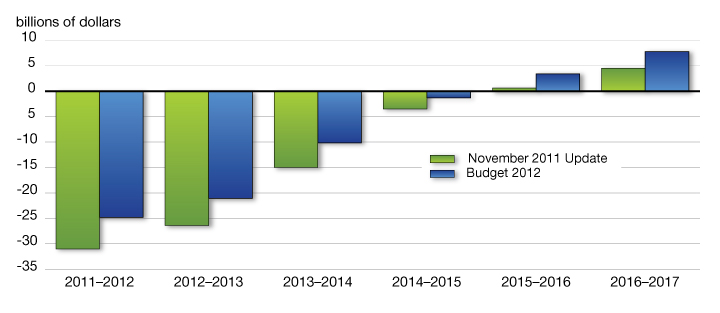
Take a look at some of these graphs from earlier in the year about the Canadian 2012 budget. (This is straight from their government’s web site – they have new transparency/anti=corruption measures now, so the citizens know everything that government does). When comparing the deficit and debt of Canada to the United States, always multiply the Canadian number by 10 to get a benchmark to compare. For example, Canadian GDP is 1.7 trillion, and the US GDP is 15 trillion.

Canada’s budget deficit is around 30 billion, but ours is 1.2 trillion:

Canada Federal Budget Deficit / Surplus 2012

If we were doing as well as Canada, our deficit would be about $300 billion. But we have run up about 6 trillion in debt over 4 years! Not only that, but Canada’s national debt is only $600 billion. If we multiple that by 10, we would expect ours about $6 trillion. And it was that – during the Bush Presidency. But then the Democrats took over the House and Senate in 2007 and everything went wrong and we packed trillions and trillions onto the debt, including about $6 trillion during Obama’s first term.

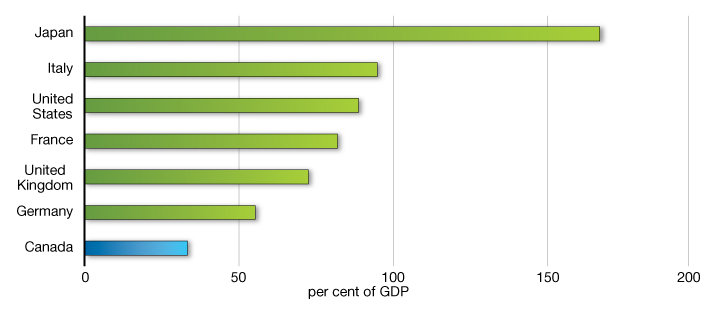
Canada’s Debt to GDP ratio is 34%:

Canada vs US Debt to GDP

But things are even worse for the United States, now. The current United States Debt to GDP is 105%, according to official U.S. government figures. We are due for yet another credit downgrade, and should see Greece-like levels of Debt to GDP during Obama’s second term. We are spending too much, and we aren’t going to be able to make up trillion dollar deficits even if we confiscate every penny that rich people earn. (And they won’t be daft enough to keep working as hard if we did that – they would move, and probably to Canada)

What is happening to us here in the United States is self-inflicted. We are – and have been – voting to impoverish ourselves and generations of children born and unborn, by punishing those who work hard and play by the rules, and rewarding those who don’t work and don’t play by the rules. It didn’t have to be this way. We could have elected a President who actually knew something about business and economics. Knowledge matters. We can’t just choose a President who gives us the “tingles” and then expect him to perform the actual duties of being President. Competence is more important than confidence. Substance is more important than style.

Surprise! Social Security ran a $47.8 billion dollar deficit in 2012

CNS News reports.

Excerpt:

The Social Security program ran a $47.8 billion deficit in fiscal 2012 as the program brought in $725.429 billion in cash and paid $773.247 for benefits and overhead expenses, according to official data published by Social Security Administration.

The Social Security Administration also released new data revealing that the number of workers collecting disability benefits hit a record 8,827,795 in December–up from 8,805,353 in November.

The overall number of Social Security program beneficiaries—including retired workers, dependent family members and survivors and disabled workers and their dependent family members—also hit a record in December, climbing from 56,658,978 in November to 56,758,185 in December.

In 2011, according to the Bureau of Labor Statistics, there was an average of 112.556 million full-time workers in the United States, of whom 17.806 million worked full-time for local, state or federal government. That left an average of only 94.750 million full-time private sector workers in the country.

That means that for every 1.67 Americans who worked full-time in the private sector in 2011, there is now 1 person collecting benefits from the Social Security administration.

There are about 310 million people in the United States.

Now consider that the same people who make you wait in line at the post office and the department of motor vehicles are teaching your children in public schools. What are the children learning there? Are they learning marketable skills so that they will be able to get private sector jobs and pay for these programs? No, they are learning about recreational sex, global warming, feminism, gay activism and other leftist dogma. They learn how to feel offended, how to blame men, how to blame white people, how to blame job creators (“the rich”), and how to blame the our armed forces.

We have borrowed over one trillion dollars from future generations to pay for these entitlement programs, and there is no reason to believe that a bunch of brainwashed children will be up to the task of paying for those entitlements. We shouldn’t be aborting 1 million unborn children a year either – we should be marrying and raising them with two opposite sex parents. The welfare state is just not sustainable when we destroy the supply line of new law-abiding productive workers. We have a growing public sector parasite feeding on a shrinking private sector host. It just won’t work for much longer.