
Tag Archives: Debate

William Lane Craig lectures on the evidence for the resurrection of Jesus

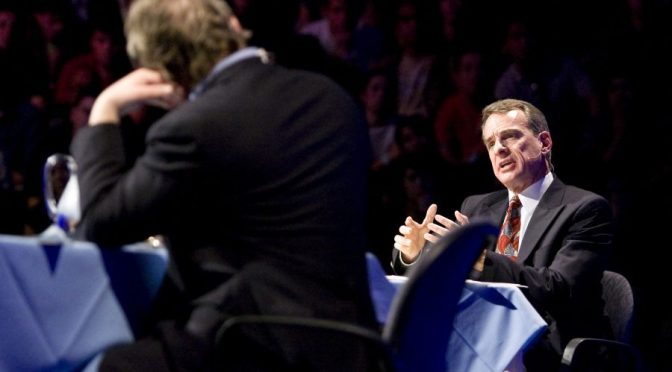
Here is Dr. William Lane Craig giving a long-form argument for the historical event of the resurrection of Jesus, and taking questions from the audience.

The speaker introduction goes for 6 minutes, then Dr. Craig speaks for 35 minutes, then it’s a period of questions and answers with the audience. The total length is 93 minutes, so quite a long period of Q&A. The questions in the Q&A period are quite good.

Introduction:

  • Many people who are willing to accept God’s existence are not willing to accept the God of Christianity
  • Christians need to be ready to show that Jesus rose from the dead as a historical event
  • Private faith is fine for individuals, but when dealing with the public you have to have evidence
  • When making the case, you cannot assume that your audience accepts the Bible as inerrant
  • You must use the New Testament like any other ancient historical document
  • Most historians, Christian and not, accept the basic minimal facts supporting the resurrection of Jesus

Fact #1: the burial of Jesus following his crucifixion

  • Fact #1 is supported by the early creed found in Paul’s first letter to the Corinthians (1 Cor 15)
  • Fact #1 is supported by the early Passion narrative which was a source for Mark’s gospel
  • Fact #1 passes the criterion of enemy attestation, since it praises one of the Sanhedrin
  • Fact #1 is not opposed by any competing burial narratives

Fact #2: on the Sunday following his crucifixion, Jesus’ tomb was found empty by some women

  • Fact #2 is supported by the early Passion narrative which was a source for Mark’s gospel
  • Fact #2 is implied by the early creed found in Paul’s first letter to the Corinthians (1 Cor 15)
  • Fact #2 is simple and lacks legendary embellishment, which argues for an early dating
  • Fact #2 passes the criterion of embarrassment, because it has female, not male, witnesses
  • Fact #2 passes the criterion of enemy attestation, since it is reported by the Jewish leaders

Fact #3: Jesus appeared to various people in various circumstances after his death

  • Fact #3 is supported by the early creed found in Paul’s first letter to the Corinthians (1 Cor 15)
  • Fact #3 is supported by multiple, independent reports of the events from all four gospels
  • Fact #3 explains other historical facts, like the conversion of Jesus’ skeptical brother James

Fact #4: the earliest Christians proclaimed their belief in the resurrection of Jesus

  • Fact #4 explains why the earliest Christians continued to identify Jesus as the Messiah
  • Fact #4 explains why the earliest Christians were suddenly so unconcerned about being killed

Dr. Craig then asks which hypothesis explains all four of these facts. He surveys a number of naturalistic hypotheses, such as the hallucination theory or various conspiracy theories. All of these theories deny one or more of the minimal facts that have been established and accepted by the broad spectrum of historians. In order to reject the resurrection hypothesis, a skeptic would have to deny one of the four facts or propose an explanation that explains those facts better than the resurrection hypothesis.

I listened to the Q&A period while doing housekeeping and I heard lots of good questions. Dr. Craig gives very long answers to the questions. One person asked why we should trust the claim that the Jewish leaders really did say that the disciples stole the body. Another one asked why we should take the resurrection as proof that Jesus was divine. Another asks about the earthquake in Matthew, which Mike Licona and I doubt is intended to be historical, but is more likely to be apocalyptic imagery. Dr. Craig is also asked about the Jewish scholar Geza Vermes, and how many of the minimal facts he accepts. Another questioner asked about the ascension.

You can see this evidence used in an actual debate, against a historian who disagrees with Dr. Craig. That post contains a point by point summary of the debate that I wrote while listening to it.

If you are looking for a good book to read on this topic, the best introductory book on the resurrection is “The Case for the Resurrection of Jesus” and the best comprehensive book is “The Resurrection of Jesus“.
If unborn babies don’t have consciousness or don’t feel pain, may we kill them?

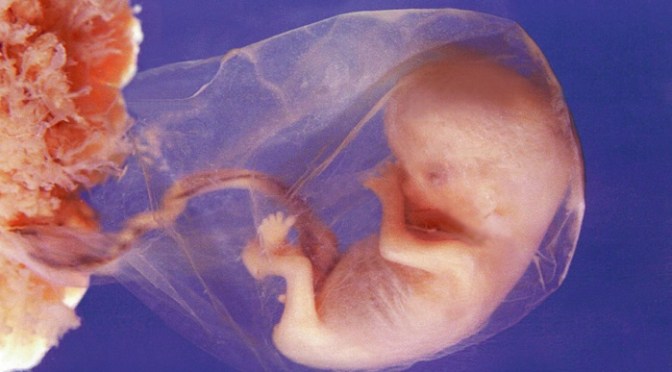
Was having a conversation by e-mail yesterday with a pro-abortion atheist, and he gave two reasons why he supported abortion in the first and second trimester. First, he said that unborn babies can’t feel pain, so it’s OK to kill them. Second, he said that unborn babies don’t have consciousness, so it’s OK to kill them. I thought it might be useful to link to something that answers both of these objections.

Frank Beckwith is the author of “Defending Life: A Moral and Legal Case Against Abortion Choice“, which was published by Cambridge University Press, a top academic press. But before Cambridge University Press, Beckwith wrote four easy-to-understand essays for the Christian Research Journal. Part IV is the one that has the response to the two questions raised by my atheist friend.

Part I. The Appeal to Pity

Part II. Arguments from Pity, Tolerance, and Ad Hominem

Part III. Is The Unborn Human Less Than Human?

Part IV. When Does a Human Become a Person?

Excerpt:

Some ethicists argue that the unborn becomes fully human sometime after brain development has begun, when it becomes sentient: capable of experiencing sensations such as pain. The reason for choosing sentience as the criterion is that a being that cannot experience anything (i.e., a presentient unborn entity) cannot be harmed. Of course, if this position is correct, then the unborn becomes fully human probably during the second trimester and at least by the third trimester. Therefore, one does not violate anyone’s rights when one aborts a nonsentient unborn entity. [13]

There are several problems with this argument. First, it confuses harm with hurt and the experience of harm with the reality of harm. [14] One can be harmed without experiencing the hurt that sometimes follows from that harm, and which we often mistake for the harm itself. For example, a temporarily comatose person who is suffocated to death “experiences no harm,” but he is nevertheless harmed. Hence, one does not have to experience harm, which is sometimes manifested in hurt, in order to be truly harmed.

Second, if sentience is the criterion of full humanness, then the reversibly comatose, the momentarily unconscious, and the sleeping would all have to be declared nonpersons. Like the presentient unborn, these individuals are all at the moment nonsentient though they have the natural inherent capacity to be sentient. Yet to countenance their executions would be morally reprehensible. Therefore, one cannot countenance the execution of some unborn entities simply because they are not currently sentient.

Someone may reply that while these objections make important points, there is a problem of false analogy in the second objection: the reversibly comatose, the momentarily unconscious, and the sleeping once functioned as sentient beings, though they are now in a temporary state of nonsentience. The presentient unborn, on the other hand, were never sentient. Hence, one is fully human if one was sentient “in the past” and will probably become sentient again in the future, but this cannot be said of the presentient unborn.

There are at least three problems with this response. First, to claim that a person can be sentient, become nonsentient, and then return to sentience is to assume there is some underlying personal unity to this individual that enables us to say that the person who has returned to sentience is the same person who was sentient prior to becoming nonsentient. But this would mean that sentience is not a necessary condition for personhood. (Neither is it a sufficient condition, for that matter, since nonhuman animals are sentient.) Consequently, it does not make sense to say that a person comes into existence when sentience arises, but it does make sense to say that a fully human entity is a person who has the natural inherent capacity to give rise to sentience. A presentient unborn human entity does have this capacity. Therefore, an ordinary unborn human entity is a person, and hence, fully human.

Second, Ray points out that this attempt to exclude many of the unborn from the class of the fully human is “ad hoc and counterintuitive.” He asks us to “consider the treatment of comatose patients. We would not discriminate against one merely for rarely or never having been sentient in the past while another otherwise comparable patient had been sentient….In such cases, potential counts for everything.” [15]

Third, why should sentience “in the past” be the decisive factor in deciding whether an entity is fully human when the presentient human being “is one with a natural, inherent capacity for performing personal acts?” [16] Since we have already seen that one does not have to experience harm in order to be harmed, it seems more consistent with our moral sensibilities to assert that what makes it wrong to kill the reversibly comatose, the sleeping, the momentarily unconscious, and the presentient unborn is that they all possess the natural inherent capacity to perform personal acts. And what makes it morally right to kill plants and to pull the plug on the respirator-dependent brain dead, who were sentient “in the past,” is that their deaths cannot deprive them of their natural inherent capacity to function as persons, since they do not possess such a capacity.

These four essays are a very good introduction to common responses to pro-abortion arguments. I recommend that people get familiar with this, as once you look into it, you will see that the abortion issue can be debated with as much confidence as William Lane Craig defends Christian theism. You will have the same access to scientific evidence and rational arguments on this topic, and so you will have the upper hand. And that’s fun.

The best introductory book on the abortion / right to life issue is “The Case for Life” by pro-life debater Scott Klusendorf. The best comprehensive book is a tie between “The Ethics of Abortion” by Christopher Kaczor, and Frank Beckwith’s “Defending Life: A Moral and Legal Case Against Abortion Choice“.

Is the acceleration of the universe’s expansion compatible with Hinduism?

First, a news story – and then we’ll see how the accelerating universe relates to the existence of God.

Excerpt:

Three astrophysicists who discovered that the universe’s expansion is accelerating rather than decelerating, as had been expected, win the Nobel Prize in physics.

Adam Riess was sure he’d spotted a blatant error in his results. It was 1997, and the young post-doc’s measurements of distant, exploding stars implied that the universe was expanding at a faster and faster rate, instead of slowing down, as he had expected.

It wasn’t an error at all. Instead, what was at fault were some basic assumptions about the workings of the universe.

On Tuesday, the Johns Hopkins University astrophysicist received the Nobel Prize in physics for the revolutionary discovery and its implications, along with team leader Brian Schmidt of Australian National University and astrophysicist Saul Perlmutter of UC Berkeley and Lawrence Berkeley National Laboratory, who had reached the same conclusion independently.

At the time of their work, astrophysicists believed that the rate of expansion of the universe — set in motion by the Big Bang 13.7 billion years ago — would be slowing down as matter was pulled together by gravity. The goal at the time was to figure out how rapid the deceleration was.

What the two teams found instead was that the expansion of the universe was accelerating — an observation that could best be explained by the existence of a mysterious “dark energy” that pushes matter farther and farther apart.

Many scientists had thought that, just as the universe started with the Big Bang, it would end with a Big Crunch — with gravity pulling all the matter in the universe inward.

Does anyone remember that week that I wrote those posts about “Why I am not a… <insert some religion here>”? I explained why I was not all kinds of different religions and denominations, including Roman Catholicism, Calvinism, Hinduism, Judaism, Islam, etc. Everyone was offended and we fought about it. Ah, I remember it well.

Now let’s apply science to the Hindu religion and see if they go together, especially this new discovery about the expansion of the universe.

Why I am not a Hindu

  1. Hindu cosmology teaches that the universe cycles between creation and destruction, through infinite time.
  2. The closest cosmological model conforming to Hindu Scriptures is the eternally “oscillating” model of the universe.
  3. The “oscillating” model requires that the universe exist eternally into the past.
  4. But the evidence today shows the the universe, and time itself, had a beginning at the big bang.
  5. The “oscillating” model requires that the expansion of the universe reverse into a collapse, (= crunch).
  6. In 1998, the discovery of the year was that the universe would expand forever. There will be no crunch.
  7. Therefore, the oscillating model is disconfirmed by observations.
  8. The oscillating model also faces theoretical problems with the “bounce” mechanism.

So that’s one reason why I am not a Hindu. And now we have more scientific confirmation that there is no cycle of universes coming into being and going out of being.

The absolute origin of the universe out of nothing is also incompatible with Buddhism and Mormonism and maybe other religions. They also require an eternally existing universe.

And modern cosmology disagrees with atheism, too

I think it’s important for all of you to be familiar with the scientific evidence for the Big Bang. It will help you with your cosmological argument, and it will help you to refute many, many other religions that require eternal universes, including atheism.

I wrote about how the Big Bang cosmology falsifies atheism before.

Excerpt:

According to the Secular Humanist Manifesto, atheism is committed to an eternally existing universe, (See the first item: “Religious humanists regard the universe as self-existing and not created.”). If something non-material brought all existing matter into being, that would be a supernatural cause, and atheists deny that anything supernatural exists. The standard Big Bang theory requires that all the matter in the universe come into being out of nothing. The Big Bang has been confirmed by experimental evidence such as redshift measurements, light element abundances and the cosmic microwave background radiation. This falsifies eternal models of the universe, which are required by atheist Scriptures.

The experimental evidence that confirms the Big Bang creation out of nothing falsifies many worldviews. Those who care about evidence will have to choose some other religion that is compatible with what we know from science today.