Tag Archives: Credit

How to easily develop your knowledge of the way the world works

If you’re not reading IBD editorials every day, you are missing out. I agree with them on practically everything they write. I try to stay in touch with what’s happening in the world, with respect to economics and foreign policy, and Investors Business Daily is indispensable. (And sometimes, they even cover social issues like school choice, affirmative action and stem cell research). It’s not just the news that I want, it’s the analysis. They fit every data point into an argument – and that makes the world a very interesting place.

Here are four sample articles.

Did the latest European bailout fix anything?

Excerpt:

Led by the Fed, top central banks added dollars to the global financial system on Wednesday as Europe’s crisis deepened. We hate to rain on anyone’s parade, but this won’t solve the EU’s problems.

The central banks’ bold action, though met with wild enthusiasm by financial markets, amounts to little more than a multibillion dollar Band-Aid on a deep, dangerous wound.

[…]But even as they juggle and sell off their portfolios of bad loans, major banks in Europe, the U.S. and Asia are being forced to raise capital to meet new international banking standards. The result: a credit crunch.

In short, the global financial system is near collapse, and the central banks are madly pumping dollars into it to keep the collapse from happening.

It’s an emergency, we get it. But while such actions might help in the short run, they won’t in the long run.

The EU faces the same problems today as it did yesterday, and no amount of central bank money-printing changes that.

Namely, its 17 members, used to an ever-expanding welfare state and leisure-class lifestyle, can’t sustain that way of life with their chronically weak economies and aging, low-productivity workforces.

Contrary to recent actions, the EU’s problems aren’t short-term and financial, but long-term and fiscal.

The same kind of problems that we are having USA, as we have moved from 160 billion dollar deficits under Bush in 2007 to approximately 1.4 trillion dollar deficits in ever year that Obama has been President. Maybe we can learn some lessons from the mistakes that others have made and are making instead of making those mistakes again ourselves?

If global warming is real, where are all the hurricanes?

Excerpt:

Sunday will be the 2,232nd consecutive day that the U.S. has gone without being hit by a major hurricane. This is a big enough deal to be covered by the mainstream media. But of course it won’t be.

On Dec. 4, a new record will be set for the number of days between landfalls of category 3 or stronger storms. The previous streak, according to Roger Pielke Jr., began on Sept. 8, 1900, and ended on Oct. 19, 1906, when the Great Galveston Hurricane hit.

The record won’t be broken by just a day or even a week. Pielke, a professor of environmental studies at University of Colorado, says it will be crushed.

“Since there won’t be any intense hurricanes before next summer, the record will be shattered, with the days between intense hurricane landfalls likely to exceed 2,500 days,” he writes in his blog.

Why is this significant? Because the global warming alarmists have been telling us that man’s carbon dioxide emissions would bring bigger storms.

[…]The mainstream media has happily trafficked this nonsense, but it’s not likely to mention Pielke’s point even though it would be appropriate in stories covering our very mild hurricane season, which ended Wednesday.

Why won’t they do it? Because it’s inconsistent with their narrative. It’s like the latest batch of Climategate emails, which show again a group of scientists manipulating the process for political gain. News that contradicts the alarmists’ tale simply isn’t news to the media.

If you think that global warming alarmism has no effect on you, then you need to realize that it is being used to justify all kinds of job-killing regulations. If you want to know why companies ship jobs overseas and expand their operations outside the United States, then look no further than the EPA.

Is existing U.S. oil drilling in the EPA’s crosshairs?

Excerpt:

The latest salvo in the administration’s war on energy may be new rules and permits to regulate a process to get oil and gas from porous rock, sacrificing jobs and economic growth while under review.

There are a few areas of the U.S. that are booming. Two of these are in North Dakota and Pennsylvania, states that sit atop two massive shale rock formations, the Bakken and the Marcellus.

Extraction of oil and natural gas from these formations have created jobs and economic growth in the midst of a stagnant and parched economy.

[…]Yet the Environmental Protection Agency, bowing to environmentalists’ pressure and faithful to the administration mantra that fossil fuels are harmful and obsolete, is preparing to nip this economic boom in the bud by regulating it to death.

[…]Pennsylvania’s Department of Labor and Industry estimates fracking in the Marcellus created 72,000 jobs between the fourth quarter of 2009 and the first quarter of 2011. Drilling in the Bakken formation along the North Dakota-Montana border helps explain North Dakota’s unemployment rate of 3.2%, the nation’s lowest.

The Gulf Coast energy industry has never fully recovered from a similar moratorium and a new glacial permitting process.

Similarly, the job-creating Keystone XL pipeline project to bring Canadian tar sands oil to American refineries is stalled on environmental grounds.

It’s not enought that Obama blocks the creation of hundreds of thousands of new energy sector jobs – and wastes money on alternative energy companies connected to his campaign fundraisers – but now he might be going after existing energy production jobs, too.

Should we continue to send our “ally” Pakistan foreign aid?

Excerpt:

In what’s become a common occurrence, the Pakistani military — in an unprovoked attack — fired on coalition troops based across the border in Afghanistan. We responded by hitting two Pakistani border posts. The airstrikes killed two dozen Pakistani soldiers, sparking anti-American riots and threats of reprisal by Islamabad.

[…]So why still coddle Pakistan, diplomatically? Several reasons, not the least of which is Pakistan’s arsenal of nuclear weapons and cold war with India. But it’s mainly because we need its permission to transport military supplies across its border into landlocked Afghanistan, the terror swamp believed most worthy of draining.

More than 40% of the fuel, food, ammunition, equipment and other supplies sent to U.S. forces in Afghanistan are shipped via Pakistani ports and roads. Islamabad also gives us access to airspace — including landing rights at three air bases, where we launch the Predator drone aircraft targeting Pakistani-based terrorist camps in lieu of U.S. boots on the ground.

Islamabad could easily deny us those landing rights and cut off supply routes at any time, hamstringing our Afghan operations. Sure enough: Islamabad did exactly that over the weekend. After the coalition air strike that killed 24 of its troops, Pakistan blocked two coalition supply routes running through Pakistan. It also gave the U.S. two weeks to vacate the Shamsi air base in Balochistan, which has been used for drone sorties.

These moves make reducing our dependence on Pakistan all the more critical.

The Pentagon should hike supplies coming into Afghanistan from the north through Central Asia. To fund the added expense, it could use the billions in aid Pakistan is secretly using against us by funding and arming Afghan insurgents. It could also use a chunk of U.S. aid dollars to build larger fuel-storage facilities on the ground in Afghanistan, so that military operations can withstand major disruptions to supplies.

So there you have it – four great articles on the European crisis, global warming science, the employment situation at home, and foreign policy. And you get this analysis for free every day with Investors Business Daily. You can check out their editorials at this link, and bookmark it. Even if you don’t read the Heritage Foundation’s blog “The Foundry” and the American Enterprise Institute blog “The American”, you can still stay well informed by reading IBD every day. If you are interested in raw news without the analysis, then read CNS News.

It’s very important for Christians to understand that we have to be seen by others as aware and informed on other topics in order to be seen as aware and informed on religious issues. Part of that involves studying apologetics and being familiar with opposing arguments and evidence. Part of it is being informed about social issues like abortion, marriage and education. But part of it is just being a well-informed person in general. When topics like politics and economics and national security come up, our goal should not be to take whatever position is popular, or whatever position will make us look “nice”. We should have our own position, and we should be informed enough about the world to participate in – and even to dominate – conversations on those topics. We have to be the people who know how the world works.
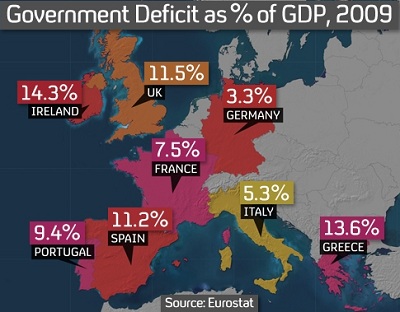
Bank run in socialist Europe begins

Europe: Annual Budget Deficit as % of GDP

From CNBC.

Excerpt:

Money-market funds in the United States have quite dramatically slammed shut their lending windows to European banks. According to the Economist, Fitch estimates U.S. money market funds have withdrawn 42 percent of their money from European banks in general.

And for France that number is even higher — 69 percent. European money-market funds are also getting in on the act.

Bond issuance by banks has seized up because buyers have gone on strike.

From the Economist’s Free Exchange Blog:

In the third quarter bonds issues by European banks only reached 15 percent of the amount they raised over the same period in the past two years, reckon analysts at Citi Group. It is unlikely that European banks have sold many more bonds since.

Corporate depositors are also pulling their cash.

Free Exchange:

“We are starting to witness signs that corporates are withdrawing deposits from banks in Spain, Italy, France and Belgium,” an analyst at Citi Group wrote in a recent report. “This is a worrying development.”

And there are troubling signs that banks are even running out of collateral to back their borrowings from the European Central Bank .

So far the liquidity of the European Central Bank (ECB) has kept the system alive. Only one large European bank, Dexia, has collapsed because of a funding shortage. Yet what happens if banks run out of collateral to borrow against?

And from the leftist New York Times.

Excerpt:

The flight from European sovereign debt and banks has spanned the globe. European institutions like the Royal Bank of Scotland and pension funds in the Netherlands have been heavy sellers in recent days. And earlier this month, Kokusai Asset Management in Japan unloaded nearly $1 billion in Italian debt.

At the same time, American institutions are pulling back on loans to even the sturdiest banks in Europe. When a $300 million certificate of deposit held by Vanguard’s $114 billion Prime Money Market Fund from Rabobank in the Netherlands came due on Nov. 9, Vanguard decided to let the loan expire and move the money out of Europe. Rabobank enjoys a AAA-credit rating and is considered one of the strongest banks in the world.

American money market funds, long a key supplier of dollars to European banks through short-term loans, have also become nervous. Fund managers have cut their holdings of notes issued by euro zone banks by $261 billion from around its peak in May, a 54 percent drop, according to JPMorgan Chase research.

This is really disturbing. I wonder if any of my economics-minded commenters can explain to me what happens when there is a run on banks. I am guessing that there will be some rioting over benefits as austerity measures are imposed, and interest rates will go up.

Real greed is when adults force children to give them a bailout from debt

This is a must-read by Mark Steyn.

Excerpt:

While President Obama was making his latest pitch for a brand new, even more unsustainable entitlement at the health care “summit,” thousands of Greeks took to the streets to riot. An enterprising cable network might have shown the two scenes on a continuous split screen – because they’re part of the same story. It’s just that Greece is a little further along in the plot: They’re at the point where the canoe is about to plunge over the falls. America is further upstream and can still pull for shore, but has decided instead that what it needs to do is catch up with the Greek canoe. Chapter One (the introduction of unsustainable entitlements) leads eventually to Chapter 20 (total societal collapse): The Greeks are at Chapter 17 or 18.

What’s happening in the developed world today isn’t so very hard to understand: The 20th century Bismarckian welfare state has run out of people to stick it to. In America, the feckless insatiable boobs in Washington, Sacramento, Albany and elsewhere are screwing over our kids and grandkids. In Europe, they’ve reached the next stage in social democratic evolution: There are no kids or grandkids to screw over. The United States has a fertility rate of around 2.1, or just over two kids per couple. Greece has a fertility rate of about 1.3: 10 grandparents have six kids have four grandkids – i.e., the family tree is upside down. Demographers call 1.3 “lowest-low” fertility – the point from which no society has ever recovered. And compared to Spain and Italy, Greece has the least worst fertility rate in Mediterranean Europe.

So you can’t borrow against the future because, in the most basic sense, you don’t have one. Greeks in the public sector retire at 58, which sounds great. But, when 10 grandparents have four grandchildren, who pays for you to spend the last third of your adult life loafing around?

By the way, you don’t have to go to Greece to experience Greek-style retirement: The Athenian “public service” of California has been metaphorically face-down in the ouzo for a generation. Still, America as a whole is not yet Greece. A couple of years ago, when I wrote my book “America Alone,” I put the Social Security debate in a bit of perspective: On 2005 figures, projected public pensions liabilities were expected to rise by 2040 to about 6.8 percent of GDP. In Greece, the figure was 25 percent. In other words, head for the hills, Armageddon, outta here, The End. Since then, the situation has worsened in both countries. And really the comparison is academic: Whereas America still has a choice, Greece isn’t going to have a 2040 – not without a massive shot of Reality Juice.

Is that likely to happen? At such moments, I like to modify Gerald Ford. When seeking to ingratiate himself with conservative audiences, President Ford liked to say: “A government big enough to give you everything you want is big enough to take away everything you have.” Which is true enough. But there’s an intermediate stage: A government big enough to give you everything you want isn’t big enough to get you to give any of it back. That’s the point Greece is at. Its socialist government has been forced into supporting a package of austerity measures. The Greek people’s response is: Nuts to that. Public sector workers have succeeded in redefining time itself: Every year, they receive 14 monthly payments. You do the math. And for about seven months’ work – for many of them the workday ends at 2:30 p.m. When they retire, they get 14 monthly pension payments. In other words: Economic reality is not my problem. I want my benefits. And, if it bankrupts the entire state a generation from now, who cares as long as they keep the checks coming until I croak?

We hard-hearted, small-government guys are often damned as selfish types who care nothing for the general welfare. But, as the Greek protests make plain, nothing makes an individual more selfish than the socially equitable communitarianism of big government. Once a chap’s enjoying the fruits of government health care, government-paid vacation, government-funded early retirement, and all the rest, he couldn’t give a hoot about the general societal interest. He’s got his, and to hell with everyone else. People’s sense of entitlement endures long after the entitlement has ceased to make sense.

The perfect spokesman for the entitlement mentality is the deputy prime minister of Greece. The European Union has concluded that the Greek government’s austerity measures are insufficient and, as a condition of bailout, has demanded something more robust. Greece is no longer a sovereign state: It’s General Motors, and the EU is Washington, and the Greek electorate is happy to play the part of the United Auto Workers – everything’s on the table except anything that would actually make a difference. In practice, because Spain, Portugal, Italy and Ireland are also on the brink of the abyss, a “European” bailout will be paid for by Germany. So the aforementioned Greek deputy prime minister, Theodoros Pangalos, has denounced the conditions of the EU deal on the grounds that the Germans stole all the bullion from the Bank of Greece during the Second World War. Welfare always breeds contempt, in nations as much as inner-city housing projects. How dare you tell us how to live! Just give us your money and push off.

This is the real character of people who avoid having to care about producing goods and services to please customers – people who join public sector unions and work for the government. They elect candidates who will provide them with a standard of living much higher than what they can produce by their own efforts, and pass the bill down to real workers in the private sector, or worse, workers who are not even born. It’s a shame. It’s a shame that parasites should enslave children who are not yet born so that they can have a standard of living they haven’t paid for. And it’s laughable that they impugn the character of productive private sector workers and business owners by talking about “Greed”. The parasites in the public sector unions are the greedy ones. What could be more greedy than intergenerational theft?