Tag Archives: Costs

NHS hospital director dies on surgery waiting list

From Newsbusters.

Excerpt:

James Taranto at the Wall Street Journal editorial page caught this story about Britain’s National Health Service.

“A former NHS director died after waiting for nine months for an operation–at her own hospital,” London’s Daily Mail reports:

Margaret Hutchon, a former mayor, had been waiting since last June for a follow-up stomach operation at Broomfield Hospital in Chelmsford, Essex.

But her appointments to go under the knife were cancelled four times and she barely regained consciousness after finally having surgery.

Her devastated husband, Jim, is now demanding answers from Mid Essex Hospital Services NHS Trust–the organisation where his wife had served as a non-executive member of the board of directors.

He said: “I don’t really know why she died. I did not get a reason from the hospital. We all want to know for closure. She got weaker and weaker as she waited and operations were put off.”

Dance with the devil, and you get burned.

Here is a recent post I wrote from the libertarian Cato Institute explaining why health care in the USA is superior to health care in socialist countries like the UK and Canada.

Related posts

Stephen Harper’s Conservative Party cuts federal spending by 6.2%

Prime Minister Stephen Harper

More news from up north. (H/T Ben)

Excerpt:

Federal government expenditures are set to fall next fiscal year by $16.5-billion, or 6.2%, with big cuts to regional development and environment programs, according to documents tabled Tuesday.

That would leave total expenditures for the 2011-12 year at $250-billion, with the bulk taken up by transfer payments to individuals and governments, and operating costs. Just over $30-billion of that expense is attributed to refinancing Canada’s debt.

The figures, contained in spending estimates provided by the Treasury Board, sees budget increases for departments entrusted with security and law enforcement – such as a 21% boost to jails — but cuts of roughly 20% to Environment Canada, Natural Resources Canada and Agriculture and Agri-Food Canada.

Government is supposed to be concerned with security and law enforcement, not with environmentalist wastefulness.

Here’s Paul Ryan. He would like to cut our budget by 6.2% – and maybe even more.

If Canada is cutting their government waste, then why can’t we?

There are a lot of programs that we could be cutting.

Excerpt:

The federal government could save billions in taxpayer dollars annually by consolidating duplicative government programs, according to a new report.

The newly-released report from the Government Accountability Office “makes us all look like jackasses,” Sen. Tom Coburn (R-Okla.) told reporters Monday night.

The conservative senator said the report — which identifies redundancies in more than 546 individual programs — reveals why the United States is $14 trillion in debt.

“Anybody who says we don’t look like fools up here hasn’t read the report,” he said.

[…]The GAO reviewed 34 areas (among them agriculture, defense and social services) where agencies, offices or initiatives have similar or overlapping objectives. The report also looked at 47 additional cost-saving opportunities related to more general government efficiency. For instance, the report said, “Improved corrosion prevention and control practices could help [the Defense Department] avoid billions in unnecessary costs over time.”

Addressing duplicative efforts on even a single issue could save billions, the report found. For instance, the GAO says the government could save up to $5.7 billion annually by addressing potentially duplicative policies designed to boost domestic ethanol production. Additionally, the Defense Department could save $460 million annually by making broader changes to the governance of its military health care system.

The report finds that there are 15 agencies involved in food safety, 80 programs involved in economic development and more than 100 involved in surface transportation. There are 10 agencies and 82 programs involved in teacher quality, and more than 20 agencies and about 56 programs involved in financial literacy efforts. There are about 2,300 investments across the Defense Department to modernize its business operations.

House Majority Leader Eric Cantor (R-Va.) said today that in order to foster long term economic growth, “we’re going to deal with the pressing issues of regulatory waste in our agencies, as well as long term issues facing our country with entitlement programs.”

This is why we have to stop giving private sector money to government. They don’t earn any money by making things or helping people – they don’t sell anything useful. They just steal money from the productive workers and businesses and then they waste it and run up trillion dollar deficits. This kind of corruption, fraud and waste would not survive in small businesses, and probably not even in big businesses. Business have to be efficient or they go bankrupt. They have to perform or their competitors will have them for lunch. The consumer is king in the private sector.

Related posts

Democrat lawmakers flee state to avoid voting on spending cuts

Video from Gateway Pundit.

Story from the Wall Street Journal.

Excerpt:

Democratic lawmakers fled the state in an effort to torpedo a closely watched vote on what would be the nation’s first major overhaul of union laws in years, as government workers flooded the statehouse for a third day seeking to block passage of the bill.

Surrounded by thousands of tightly packed protesters, including teachers who had been encouraged by union leaders to show up in force, state senators gathered around 11 a.m. to vote on Republican Gov. Scott Walker’s proposal to limit collective-bargaining rights for most state employees.

The governor’s proposal, part of a bill aimed at overcoming a $137 million deficit in the current budget and a projected $3.6 billion hole in the next two years, would allow collective bargaining on wages, but not pensions and health care. Workers would be required to pay more for both.

But a roll call revealed that the 14 Senate Democrats were absent, leaving the chamber short of the 20 votes needed to conduct business.

[…]Late Thursday, Gov. Walker, who could hear chanting every time he opened his office door, blasted the Democrats’ move as a “stunt” and urged them to return to vote on what he called as a “bold political move but a modest, modest proposal” that would preserve benefits for public employees that remained “better than what most people are getting across the state.”

The extraordinary scene was being followed in statehouses across the country, as a test case of both union clout and the political will of newly elected legislators. Wisconsin was at the front edge of voter discontent in 2010, with voters agitated about public spending electing Gov. Walker to succeed Democrat Jim Doyle and handing both houses of the legislature to the GOP.

[…]If the governor’s efforts succeed, other states are expected to try to follow, as governors grapple with deepening deficits. Many new governors in both parties have blamed the states’ fiscal crisis in part on what they say are overly generous benefits and pension obligations granted over many years to organized government workers.

Proposals similar to Gov. Walker’s have been made in New Jersey and Ohio. In Columbus, Ohio, thousands gathered Thursday to protest a Republican proposal that would eliminate collective-bargaining rights for many of that state’s 400,000 public-sector workers.

[…]Gov. Walker first introduced his “budget repair” bill just a week ago, setting off the firestorm that has swept the Capitol. Besides limiting collective-bargaining right for most workers—excepting police, firefighters and others involved in public safety—it would require government workers, who currently contribute little or nothing to their pensions, to contribute 5.8% of their pay to pensions, and pay at least 12.6% of health-care premiums, up from an average of 6%.

In exchange, Gov. Walker has pledged no layoffs or furloughs for the state’s 170,000 public employees. He has said 5,500 state jobs and 5,000 local jobs would be saved under his plan, which would save $30 million in the current budget and $300 million in the two-year budget that begins July 1.

The lawmakers are required by law to report to their posts to vote on all legislation, which is why the police were dispatched to locate them.

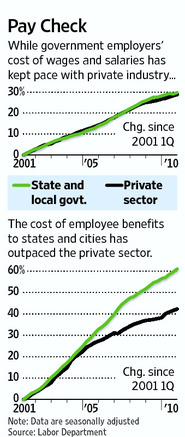
Here’s what the fuss is about:

Public Sector Benefits

And Gov. Walker is not the only one trying to stop the massive transfers of wealth from the productive private sector to non-productive public sector.

Excerpt:

Lawmakers around the country are looking at new ways to prevent budget disasters by changing the rules for overburdened state employee pension funds. But they are meeting stiff resistance from public employee unions.

Two Arizona state lawmakers this week, including the speaker of the House, introduced their plan to salvage the state’s budget by significantly changing the public retirement system.

Following the lead of Gov. Chris Christie, R-N.J., a pair of New Jersey assemblymen on Monday put forth their legislative solution to make solvent a fund that’s $54 billion in the red.

Also on Monday, in his first budget address as governor, Florida’s Rick Scott announced his effort to “stabilize and secure” government employee pensions.

The moves are part of a larger battle over pension reform between conservative budget hawks and government worker unions.

The national debt is currently over 14 trillion, and scheduled to be at 26 trillion by 2021.

Michelle Malkin has a breakdown of teacher salaries and benefits here.