Tag Archives: Cosmology

Why is the universe so big, and why is so much of it hostile to life?

Christianity and the progress of science

Review: In case you need a refresher on the cosmological and fine-tuning arguments, as presented by a professor of particle physics at Stanford University, then click this link and watch the lecture.

If you already know about the standard arguments for theism from cosmology, then take a look at this post on Uncommon Descent.

Summary:

In my previous post, I highlighted three common atheistic objections to to the cosmological fine-tuning argument. In that post, I made no attempt to answer these objections. My aim was simply to show that the objections were weak and inconclusive.

Let’s go back to the original three objections:

1. If the universe was designed to support life, then why does it have to be so BIG, and why is it nearly everywhere hostile to life? Why are there so many stars, and why are so few orbited by life-bearing planets? (Let’s call this the size problem.)

2. If the universe was designed to support life, then why does it have to be so OLD, and why was it devoid of life throughout most of its history? For instance, why did life on Earth only appear after 70% of the cosmos’s 13.7-billion-year history had already elapsed? And Why did human beings (genus Homo) only appear after 99.98% of the cosmos’s 13.7-billion-year history had already elapsed? (Let’s call this the age problem.)

3. If the universe was designed to support life, then why does Nature have to be so CRUEL? Why did so many animals have to die – and why did so many species of animals have to go extinct (99% is the commonly quoted figure), in order to generate the world as we see it today? What a waste! And what about predation, parasitism, and animals that engage in practices such as serial murder and infant cannibalism? (Let’s call this the death and suffering problem.)

Here’s an excerpt for the size argument:

(a) The main reason why the universe is as big as it currently is that in the first place, the universe had to contain sufficient matter to form galaxies and stars, without which life would not have appeared; and in the second place, the density of matter in the cosmos is incredibly fine-tuned, due to the fine-tuning of gravity. To appreciate this point, let’s go back to the earliest time in the history of the cosmos that we can meaningfully talk about: the Planck time, when the universe was 10^-43 seconds old. If the density of matter at the Planck time had differed from the critical density by as little as one part in 10^60, the universe would have either exploded so rapidly that galaxies wouldn’t have formed, or collapsed so quickly that life would never have appeared. In practical terms: if our universe, which contains 10^80 protons and neutrons, had even one more grain of sand in it – or one grain less – we wouldn’t be here.

If you mess with the size of the universe, you screw up the mass density fine-tuning. We need that to have a universe that expands at the right speed in order for the matter to clump together to form galaxies, stars and planets. Too fast, and you get no clumping. Too slow, and the whole thing re-collapses into a hot fireball. You need stars and planets to have a place to form life – a place with liquid water at the surface, and more.

And an excerpt for the age argument:

(a) One reason why we need an old universe is that billions of years were required for Population I stars (such as our sun) to evolve. These stars are more likely to harbor planets such as our Earth, because they contain lots of “metals” (astronomer-speak for elements heavier than helium), produced by the supernovae of the previous generation of Population II stars. According to currently accepted models of Big Bang nucleosynthesis, this whole process was absolutely vital, because the Big Bang doesn’t make enough “metals”, including those necessary for life: carbon, nitrogen, oxygen, phosphorus and so on.

Basically, you need heavy elements to make stars that burn slow and steady, as well as to make PEOPLE! And heavy elements have to be built up slowly through several iterations of the stellar lifecycle, including the right kinds of stellar death: supernovae.

Read the rest! These arguments come up all the time in debates with village atheists like Christopher Hitchens and Richard Dawkins. It’s a smokescreen they put up, but you’ve got to be able to answer it using the scientific evidence we have today. They always want to dismiss God with their personal preferences about what God should or should not do. But the real issue is the design of the cosmological constants that allow life to anywhere. That’s the part that’s designed. And that’s not a matter of personal preference, it’s a matter of mathematics and experimental science.

William Lane Craig lectures on naturalism at the University of St. Andrews

Lets take a closer look at a puzzle

Note: even if you have heard Dr. Craig’s arguments before, I recommend jumping to the 48 minutes of Q&A time, which starts 72 minutes in.

About Dr. William Lane Craig:

William Lane Craig (born August 23, 1949) is an American analytic philosopher, philosophical theologian, and Christian apologist. He is known for his work on the philosophy of time and the philosophy of religion, specifically the existence of God and the defense of Christian theism. He has authored or edited over 30 books including The Kalam Cosmological Argument (1979), Theism, Atheism and Big Bang Cosmology(co-authored with Quentin Smith, 1993), Time and Eternity: Exploring God’s Relationship to Time (2001), and Einstein, Relativity and Absolute Simultaneity (co-edited with Quentin Smith, 2007).

Craig received a Bachelor of Arts degree in communications from Wheaton College, Illinois, in 1971 and two summa cum laudemaster’s degrees from Trinity Evangelical Divinity School in Deerfield, Illinois, in 1975, in philosophy of religion and ecclesiastical history. He earned a Ph.D. in philosophy under John Hick at the University of Birmingham, England in 1977 and a Th.D. underWolfhart Pannenberg at the University of Munich, Germany in 1984.

Dr. Craig was in Scotland to lecture at a physics conference, but a local church organized this public lecture at the University of St. Andrews.

Here is the full lecture with Q&A: (2 hours)

Summary:

  • Naturalism defined: the physical world (matter, space and time) is all that exists
  • Dr. Craig will present 7 reasons why naturalism is false
  • 1) the contingency argument
  • 2) the kalam cosmological argument
  • 3) the fine-tuning of the universe for intelligent life
  • 4) the moral argument
  • 5) the ontological argument
  • 6) the resurrection of Jesus
  • 7) religious experience

Dr. Craig does mention an 8th argument early in the Q&A – the argument from the non-physicality of mental states (substance dualism), which is an argument that I find convincing, because a materialist conception of mind is not compatible with rationality, consciousness and moral agency.

Questions and Answers

He gets a couple of questions on the moral argument early on – one of them tries to put forward an evolutionary explanation for “moral” behaviors. There’s another question the definition of naturalism. There is a bonehead question about the non-existence of Jesus based on a Youtube movie he saw – which Craig responds to with agnostic historian Bart Ehrman’s book on that topic. There’s a question about God as the ground for morality – does morality come from his will or nature.

Then there is a question about the multiverse, which came up at the physics conference Dr. Craig attended the day before. There is a good question about the Big Bang theory and the initial singularity at time t=0. Another good question about transfinite arithmetic, cardinality and set theory. One questioner asks about the resurrection argument. The questioner asks if we can use the origin of the disciples belief as an argument when other religions have people who are willing to die for their claims. One of the questioners asks about whether the laws of nature break down at 10^-43 after the beginning of the universe. There is a question about the religious experience argument, and Craig has the opportunity to give his testimony.

I thought that the questions from the Scottish students and faculty were a lot more thoughtful and respectful than at American colleges and universities. Highly recommended.

How the WMAP satellite confirmed nucleosynthesis predictions and falsified atheism

Christianity and the progress of science

Prior to certain scientific discoveries, most people thought that the universe had always been here, and no need to ask who or what may have caused it. But today, that’s all changed. Today, the standard model of the origin of the universe is that all the matter and energy in the universe came into being in an event scientists call “The Big Bang”. At the creation event, space and time themselves began to exist, and there is no material reality that preceded them.

So a couple of quotes to show that.

An initial cosmological singularity… forms a past temporal extremity to the universe. We cannot continue physical reasoning, or even the concept of spacetime, through such an extremity… On this view the big bang represents the creation event; the creation not only of all the matter and energy in the universe, but also of spacetime itself.

Source: P. C. W. Davies, “Spacetime Singularities in Cosmology,” in The Study of Time III, ed. J. T. Fraser (Berlin: Springer Verlag ).

And another quote:

[A]lmost everyone now believes that the universe, and time itself, had a beginning at the big bang.

Source: Stephen Hawking and Roger Penrose, The Nature of Space and Time, The Isaac Newton Institute Series of Lectures (Princeton, N. J.: Princeton University Press, 1996), p. 20.

So, there are several scientific discoveries that led scientists to accept the creation event, and one of the most interesting and famous is the discovery of how elements heavier than hydrogen were formed.

Nucleosynthesis: forming heavier elements by fusion

Here’s the history of how that discovery happened, from the National Aeronautics and Space Administration (NASA) web site:

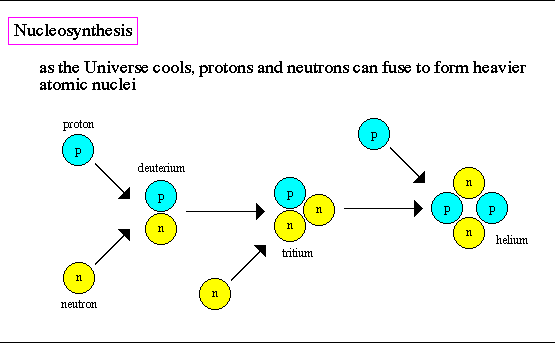
The term nucleosynthesis refers to the formation of heavier elements, atomic nuclei with many protons and neutrons, from the fusion of lighter elements. The Big Bang theory predicts that the early universe was a very hot place. One second after the Big Bang, the temperature of the universe was roughly 10 billion degrees and was filled with a sea of neutrons, protons, electrons, anti-electrons (positrons), photons and neutrinos. As the universe cooled, the neutrons either decayed into protons and electrons or combined with protons to make deuterium (an isotope of hydrogen). During the first three minutes of the universe, most of the deuterium combined to make helium. Trace amounts of lithium were also produced at this time. This process of light element formation in the early universe is called “Big Bang nucleosynthesis” (BBN).

The creation hypothesis predicts that there will be specific amounts of these light elements formed as the universe cools down. Do the predictions match with observations?

Yes they do:

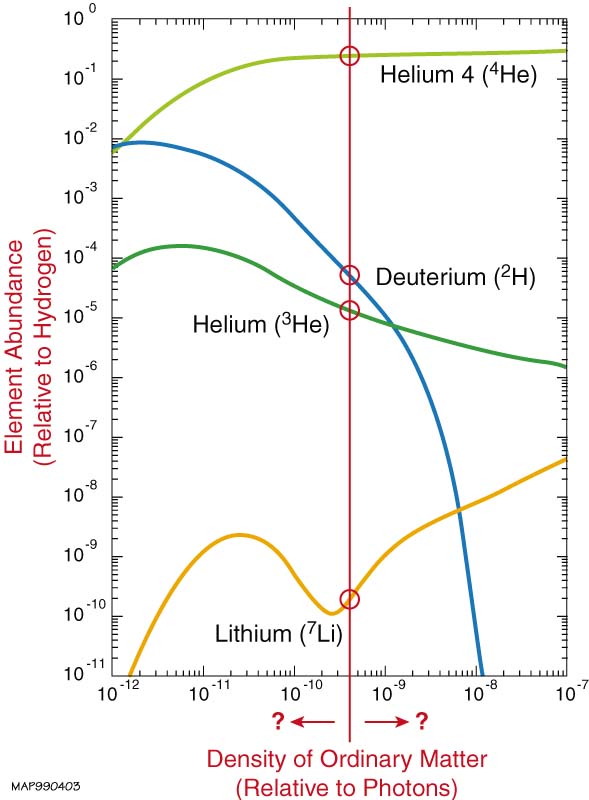
The predicted abundance of deuterium, helium and lithium depends on the density of ordinary matter in the early universe, as shown in the figure at left. These results indicate that the yield of helium is relatively insensitive to the abundance of ordinary matter, above a certain threshold. We generically expect about 24% of the ordinary matter in the universe to be helium produced in the Big Bang. This is in very good agreement with observations and is another major triumph for the Big Bang theory.

Moreover, WMAP satellite measurements of mass density agree with our observations of these light element abundances.

Here are the observations from the WMAP satellite:

Scientific observations match predictions

And here is how those WMAP measurements confirm the Big Bang creation event:

However, the Big Bang model can be tested further. Given a precise measurement of the abundance of ordinary matter, the predicted abundances of the other light elements becomes highly constrained. The WMAP satellite is able to directly measure the ordinary matter density and finds a value of 4.6% (±0.2%), indicated by the vertical red line in the graph. This leads to predicted abundances shown by the circles in the graph, which are in good agreement with observed abundances. This is an important and detailed test of nucleosynthesis and is further evidence in support of the Big Bang theory. 

“An important and detailed test”.

For completeness, we should learn how elements heavier than these light elements are formed:

Elements heavier than lithium are all synthesized in stars. During the late stages of stellar evolution, massive stars burn helium to carbon, oxygen, silicon, sulfur, and iron. Elements heavier than iron are produced in two ways: in the outer envelopes of super-giant stars and in the explosion of a supernovae. All carbon-based life on Earth is literally composed of stardust.

That’s a wonderful thing to tell a young lady when you are on a date: “your body is made of stardust”. In fact, as I have argued before, this star formation, which creates the elements necessary for intelligent life, can only be built if the fundamental constants and quantities in the universe are finely-tuned.

Now, you would think that atheists would be happy to find observations that confirm the origin of the universe out of nothing, but they are not. Actually, they are in denial.

Here’s a statement from the Secular Humanist Manifesto, which explains what atheists believe about the universe:

Religious humanists regard the universe as self-existing and not created.

For a couple of examples of how atheistic scientists respond to the evidence for a cosmic beginning, you can check out this post, where we get responses from cosmologist Lawrence Krauss, and physical chemist Peter Atkins.

You cannot have the creation of the universe be true AND a self-existing, eternal universe ALSO be true. Someone has to be wrong. Either the science is wrong, or the atheist manifesto is wrong. I know where I stand.

Positive arguments for Christian theism