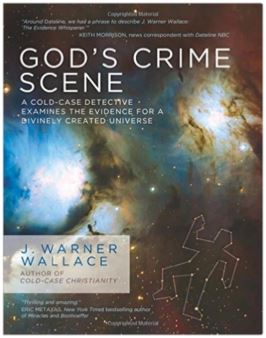
God’s Crime Scene: A Cold-Case Detective Examines the Evidence for a Divinely Created Universe
I’ve been spending some time going over J. Warner Wallace’s splendid book “God’s Crime Scene” with a friend of mine over Skype. Last week we did chapter 1 on the origin of the universe. We were both struck at Wallace’s statement about Alexander Vilenkin, a non-theist who thinks that the universe had a beginning out of nothing.
Wallace writes:
If you’re a bit confused by all the alternatives offered by those who deny the universe had a beginning, perhaps it’s time to call an expert witness. In this case, there’s no one better than Alexander Vilenkin, theoretical physicist, cosmologist, professor of physics, and director of the Institute of Cosmology at Tufts University. Partnering with mathematician Arvind Borde, cosmologist Alan Guth, and graduate researcher Audrey Mithani, Vilenkin has written several papers demonstrating demonstrating any model of the universe in which expansion is occurring, regardless of the early conditions of the cosmos, must have a beginning.[8] Vilenkin’s work addresses all the models we’ve already described, plus any future proposals in which the expansion of the universe is acknowledged. [9]Vilenkin is a critical expert witness because he simplifies and makes sense of the diverse, sometimes-confusing scientific data.’
This week, my friend asked me why Vilenkin was still not ready to become a theist. Well, Dr. William Lane Craig got asked that same question in his question of the week, and his answer was interesting.
Vilenkin’s view affirms the nothing that precedes the universe:
Modern physics can describe the emergence of the universe as a physical process that does not require a cause. Nothing can be created from nothing, says Lucretius, if only because the conservation of energy makes it impossible to create nothing [sic; something?] from nothing. . . .
There is a loophole in this reasoning. The energy of the gravitational field is negative; it is conceivable that this negative energy could compensate for the positive energy of matter, making the total energy of the cosmos equal to zero. In fact, this is precisely what happens in a closed universe, in which the space closes on itself, like the surface of a sphere. It follows from the laws of general relativity that the total energy of such a universe is necessarily equal to zero. . . .
If all the conserved numbers of a closed universe are equal to zero, then there is nothing to prevent such a universe from being spontaneously created out of nothing. And according to quantum mechanics, any process which is not strictly forbidden by the conservation laws will happen with some probability. . . .
What causes the universe to pop out of nothing? No cause is needed.[1]
Dr. Craig replies at length, here is the part I liked best:
Finally, Vilenkin’s inference that because the positive and negative energy in the universe sum to zero, therefore no cause of the universe’s coming into being is needed is hard to take seriously. This is like saying that if your debts balance your assets, then your net worth is zero, and so there is no cause of your financial situation! (Vilenkin would, I hope, not agree with Peter Atkins that because the positive and negative energy of the universe sum to zero, therefore nothing exists now, and so “Nothing did indeed come from nothing.”[2] For as Descartes taught us, I, at least, undeniably exist, and so something exists.) Christopher Isham, Britain’s premier quantum cosmologist, rightly points out that there still needs to be “ontic seeding” to create the positive and negative energy in the first place, even if on balance its sum is naught.[3]
Vilenkin’s interaction with the kalam cosmological argument is, as I say, fascinating because we see here so clearly how philosophical faux pas, not scientific mistakes, invalidate the objections of an eminent scientist to the argument. This should be an object lesson to all those who, like Stephen Hawking or Lawrence Krauss, naïvely think that philosophy is a sterile and irrelevant discipline compared to science. Philosophy can help all of us, including scientists, to avoid the logical mistakes and conceptual confusions that are all too prevalent in discussions taking place on the borderland of physics, metaphysics, and theology.
That’s a very simple refutation of a famous scientist’s speculative cosmology that anyone can understand. Christians are on very good ground when it comes to the science of origins.
You would think that more Christians would be aware of this evidence and the difficulties that naturalists have in accounting for the origin of the universe in their worldview. But, for some reason, it’s not a real hot topic in most churches. Nor is the fine-tuning or the origin of life or the Cambrian explosion. It’s really strange! If you haven’t yet picked up Wallace’s book, I highly recommend it. It’s the best book for blue collar workers who like evidence. The book touches on virtually every piece of evidence relevant to the God question, including some I had never seen before.
The topic: What are the arguments that make belief in God reasonable or unreasonable?
First speech: arguments for reasonableness of belief in God
Second speech: respond to arguments against reasonableness of belief in God
Eight arguments:
Contingency argument: God – a transcendent, personal being – is the explanation of why a contingent universe exists.
Cosmological argument: God is the cause of the beginning of the universe, which is attested by physics and cosmology.
Applicability of mathematics to nature: God is the best explanation for the applicability of mathematics to nature.
Fine-tuning argument: God is the best explanation of the fine-tuning of the universe to permit life.
Intentionality of conscious states: God is the best explanation of the intentionality of our mental states.
The moral argument: God is the best explanation for the existence of objective moral values and duties.
The resurrection of Jesus: God is the best explanation for the core of historical facts accepted by most ancient historians across the ideological spectrum.
Religious experience: God is the best explanation of our immediate experience and knowledge of his existence.
Dr. Rosenberg’s opening speech
First argument: The fallacy of ad hominem
I don’t know whether to laugh or to cry
Dr. Craig has said all of that before in other debates
You didn’t need to come out on this cold night
Craig’s arguments have all been refuted
Dr. Craig just doesn’t listen
Dr. Craig is not interested in getting at the truth
Dr. Craig is just interested in scoring debate points
The adversarial system is the wrong approach to decide truth
Dr. Craig is very confident about his take of physics
Second argument: The fallacy of arguing from authority
95% of members of the NAS are atheists
Therefore Dr. Craig cannot use science
Third argument: Effects don’t require causes
I am going to pretend that Craig said that “every effect requires a cause”
Quantum mechanics shows that some effects occur without causes
A particle of uranium (which is not nothing, it is something) decays without a cause
This uncaused effect is the same as the universe coming into being out of nothing uncaused
Therefore the principle of sufficient reason is false
Fourth argument: Silicon-based life and the multiverse
If these constants had been different, maybe we would have other kinds of intelligent life, like silicon-based life
Carbon-based life is not the only kind of life, maybe you can have other kinds of life, none of which have been observed
There could be different kinds of life in other areas of the universe that we can’t see
There are things we can’t see that disprove the current physics that we can see
Quantum foam is evidence that a multiverse exists
The multiverse would solve the problem of fine-tuning
Fifth argument: The Euthyphro dilemma
The moral argument is refuted by Euthyphro dilemma
Dr. Craig is such a moron that he has never heard of the Euthyphro dilemma ever before
This is found in the first and simplest of Plato’s dialogs
Why is Dr. Craig so stupid that he has not read this simple dialog ever before?
Evolution explains why humans evolve arbitrary customs and conventions that vary by time and place
Alternative moral theories: utilitarianism, social contract, etc. that don’t require God
Sixth argument: Mormonism undermines Dr. Craig’s three minimal facts about Jesus
Why is Dr. Craig so stupid and ignorant to persist in pushing such an ignorant, stupid argument?
Mormonism is a silly religion that is not historically well founded
Therefore, Jesus was not buried
Islam is a silly religion that is not historically grounded
Therefore, the tomb was not found empty
Scientology is a silly religion that is not historically grounded
Therefore, the eyewitnesses didn’t have post-mortem appearances
Eyewitness testimony is unreliable in some cases
Therefore, eyewitness testimony was unreliable in this case
Apparitions of Mary are bizarre
Therefore, the majority of historians are wrong to think that the disciples saw post-mortem appearances
Seventh argument: Deductive problem of evil
Evil and suffering are logically incompatible with an all good, all powerful God
Eight argument: God is not just to allow evil and suffering
God cannot make the evils of this life right in the afterlife
Dr. Craig’s first rebuttal
Dr. Rosenberg sketched the deductive argument from evil.
Dr. Rosenberg presupposes naturalism. Naturalism is a false theory of knowledge:
1. It’s too restrictive: There are truths that cannot be proved by natural science.
2. It’s self-refuting: no scientific proof for naturalism exists.
That’s why epistemological naturalism is considered false by most philosophers of science.
But more importantly than that: Epistemological naturalism does not imply metaphysical naturalism. (E.g. – W. Quine)
Dr. Rosenberg has to present arguments in favor of (metaphysical) naturalism, not just assume that (metaphysical) naturalism is true.
Dr. Craig presented eight arguments against metaphysical naturalism taken from Rosenberg’s own book:
1. The argument from the intentionality (aboutness) of mental states implies non-physical minds (dualism), which is incompatible with naturalism
2. The existence of meaning in language is incompatible with naturalism, Rosenberg even says that all the sentences in his own book are meaningless
3. The existence of truth is incompatible with naturalism
4. The argument from moral praise and blame is incompatible with naturalism
5. Libertarian freedom (free will) is incompatible with naturalism
6. Purpose is incompatible with naturalism
7. The enduring concept of self is incompatible with naturalism
8. The experience of first-person subjectivity (“I”) is incompatible with naturalism
Metaphysical naturalism is false: it is irrational and it contradicts our experience of ourselves.
And epistemological naturalism is compatible with theism.
Rebutting Dr. Rosenberg’s responses:
1. Contingency: no response
2. Cosmological: he mis-states the first premise to say every effect… when it is whatever begins to exist…, the origin of the universe was not from a vacuum, virtual particles come from a vacuum not nothing, there are interpretations of QM that are compatible with determinism. Rosenberg has to believe that the entire universe popped into being from non-being.
3. Mathematics: no response
4. Fine-tuning: the multiverse is refuted by empirical observations of the universe. Without fine-tuning, it’s not that we still have silicon to make life out of. It’s that we lose basic minimal things like chemical diversity, matter, stars, planets, etc. No life of any kind, not just no carbon-based life.
5. Intentionality: no response.
6. Moral argument: the answer to the dilemma is that you split the dilemma: God is the standard of good, and the commands flow from his unchanging moral nature. The commands are not arbitrary, and the standard is not external to God. Dr. Rosenberg is a nihilist and he cannot ground good and evil on his nihilistic view.
7. Resurrection: The Gospels are early eyewitness testimony. Mormonism and Islam have nothing to do with the minimal set of historical facts about Jesus agreed to by the majority of ancient historians across the ideological spectrum, general statements against eyewitnesses do not refute the specific eyewitness testimony in this case.
8. Religious experience: No response.
Dr. Rosenberg’s first rebuttal
I wrote a book and you should buy it, because it got me invited to this debate. Let me repeat the title a few times for you. Please buy it.
Dr. Craig is right, there are multiple interpretations of QM, not just the one I presented, including deterministic ones.
All the disturbing implications of naturalism that Dr. Craig stated follow from metaphysical naturalism, and metaphysical naturalism is true. (Note: he equates science with metaphysical naturalism)
Science proves that metaphysical naturalism is true, but I won’t say what specific scientific tests prove my philosophical assumption of metaphysical naturalism.
I’ll pretend that the Big Bang (science) doesn’t disprove naturalism, like Dr. Craig said. Again. (covers ears) La la la, there is no Big Bang.
We didn’t come here to debate epistemological naturalism and metaphysical naturalism.
Let me explain the problem of intentionality since I’m so smart and no one knows what it means.
There are many answers to this problem of intentionality.
My answer is that most scientists are naturalists, therefore naturalism is true, regardless of the argument from intentionality of mental states.
That’s how I would respond to one of the eight problems with naturalism that Dr. Craig raised. I won’t answer the other seven problems.
It is an argument from ignorance to argue that the applicability of mathematics to the universe requires a designer, because there are non-Euclidean geometries. Craig’s argument, which he gets from people like respected physicists like Eugene Wigner, is bizarre. It is bizarre, therefore I refute Eugene Wigner and all the other scholars who make that argument. It is bizarre! Bizarre!
Deductive problem of evil: there is no response to this argument, certainly not Alvin Plantinga’s free will defense. The deductive argument from evil has not been entirely abandoned at all! It’s not like arch-atheist J.L. Mackie himself admits that the deductive problem of evil doesn’t lead to a logical inconsistency between evil and God.
Dr. Craig has to tell me why God allows evil or God doesn’t exist.
It is offensive that Dr. Craig cannot tell me why God allows every evil and suffering that occurs.
He literally said this: “I will become a Christian if Dr. Craig can tell me why God allowed EVERY EVIL THAT OCCURRED IN THE LAST 3.5 BILLION YEARS”
Dr. Craig’s second rebuttal
We are not in a position to know why God allows specific instances of evil and suffering.
God cannot force people to freely do anything – freedom is not compatible with determinism. Freedom is a good, but freedom opens up the possibility of moral evil. You cannot have the good of free will without allowing people to choose to do morally evil things.
God can permit evil and suffering in order to bring more people into a relationship with him.
The atheist has to show that God could allow less evil and achieve more knowledge of God in order to say there is too much evil.
The purpose of life is not happiness, but knowledge of God.
Dr. Craig quotes agnostic Paul Draper (Purdue) and Peter Van Inwagen (Notre Dame) to state that the deductive problem of evil is dead because of free will and morally sufficient reasons for permitting evil.
1. Contingency: no response.
2. Cosmological: QM does not apply, because the universe came from nothing, not a vacuum, and QM only works in a vacuum.
3. Mathematics: He mentions alternatives like non-Euclidean geometry, but we have to explain the structure of THIS universe.
4. Fine-tuning: ???
5. Intentional states: intentional mental states proves that minds exist, which fits with theism better than it fits with atheism.
6. Moral argument: You need God to ground morality, and Dr. Rosenberg believes in morality. He needs God to ground objective moral values and duties.
7. Historical argument: He has to respond to the minimal facts supported by the consensus of ancient historians across the ideological spectrum.
8. The problems of naturalism: He says that you can’t have science without naturalism, but you can have science with EPISTEMOLOGICAL NATURALISM, and theists accept science and methodological naturalism. We don’t accept METAPHYSCIAL NATURALISM because of the eight problems Craig presented, like intentionality, first-person, persistence of self, etc. You can believe in both science and theism, by embracing epistemological naturalism, while rejecting methaphysical naturalism.
Dr. Rosenberg’s second rebuttal
Dr. Craig hasn’t answered many of my points, I won’t say which ones though.
Debates don’t work as a way of deciding what’s true, so we should overturn the entire criminal justice system.
The principle of sufficient reason is false because it is disconfirmed by quantum mechanics. And quantum mechanics (vacuum and virtual particles that exist for a short time) is similar to the origin of the universe (nothing and entire universe and 14 billion years).
We know that alpha particles come into being without cause all the time from a quantum vacuum for a tiny sub-second duration before going out of existence, so we can say that the entire physical universe came into being for 14 billion years from absolute nothing which is not a quantum vacuum.
Peter Van Inwagen is the best metaphysician working today, and he says that my deductive argument from evil is not decisive, it’s not a successful argument. (Why is he undermining his own problem of evil argument????!)
Dr. Craig invoked Plantinga’s free will defense to the deductive POE. Freedom allows us to do evil. God could have given us free will without evil and suffering. I won’t show how, but I’ll just assert it, because debates are such a bad forum for supplying evidence for my speculative assertions.
If you answer the question 3 + 5 as being 8, then you don’t have free will – you are biologically determined if you answer 8, because everyone answers 8, and that means everyone is biologically determined with no free will.
Why can’t God give us free will and then prevent us from making a free choice?
No scholars date the gospels earlier than 60-70 AD, especially not atheists like James Crossley who dates Mark to 40 AD. Therefore Jesus’ burial isn’t historical, like the majority of scholars across the broad spectrum of scholarship agree it is.
The original New Testament documents were written in Aramaic.
All New Testament scholars are orthodox Christians, like atheist Robert Funk for example.
Dr. Craig’s concluding speech
In order to sustain the deductive argument from evil, Dr. Rosenberg must show that God could create a world of free creatures with less evil.
Principle of Sufficient Reason: not using the general principle of sufficient reason, but a more modest version of this states that contingent things should have an explanation for their existence. And we know that the universe is a contingent.
The New Testament was not written in Aramaic, they were written in Greek. Dr. Rosenberg is wrong there too.
(Dr. Craig spends the rest of his concluding speech giving his testimony and urging people to investigate the New testament).
Dr. Rosenberg’s concluding speech
Some long-dead French guy named Laplace said that he has no need of that (God) hypothesis. He did not know about any of Dr. Craig’s arguments made in this debate tonight when he said that, though.
There is no need to explain how the universe began or how the universe is finely-tuned if you just assume metaphysical naturalism on faith.
The Easter Bunny, therefore atheism.
Most scientists are atheists, therefore atheism.
You can do a lot of science without God, just don’t look at the origin of the universe, the fine-tuning of the universe, or the other parts of science that Craig mentioned, as well as the origin of life, the Cambrian explosion, the habitability argument, and so on.
You can be a Christian, but good Christians should not use arguments and evidence.
Good Christians should be irrational and ignorant. Bad Christians look for arguments and evidence from science and history.
Good Christians should embrace the absurd. Bad Christians want to search for truth and use logic and evidence.
Dr. Michael Strauss is a practicing particle physics employed as a professor at University of Oklahoma. He does research in particle physics at CERN, a large hadron collider. It’s safe to assume that he knows something about experimental physics.
When my children were young, I would often drive to the home of the person babysitting my kids, usually a young teenage girl, pick her up, then drive her back to my house. In the car I would ask questions about her interests or her school. In addition, I would sometimes ask a question that intrigued me since I am a scientist and a Christian, “Do you think the Big Bang is a theistic theory or an atheistic theory?” Now that question is not on most people’s list of babysitter interview questions, but I was interested to know their answer even though it would not affect their monetary tip. Every time I asked this question I always got the same answer, that the Big Bang is an atheistic theory. This is just one example of the fact that many kids growing up in an evangelical church environment have the perception that the Big Bang is an idea which removes God as the creator. It seems that many Christians may disdain the Big Bang.
Subsequent conversations with people of all ages have shown me that many individuals (1) don’t really understand what the Big Bang is, (2) don’t know the scientific evidence for the Big Bang, and (3) don’t comprehend the theistic significance of the Big Bang. So let’s explore these ideas a little bit.
Here is his overview of the scientific evidence for the Big Bang:
There are three primary observations that are best explained by the Big Bang. First, the universe is expanding so that it must have had a beginning of expansion in the past. Second, because the universe was once very hot, we can still see the remnants of that heat in the Cosmic Microwave Background (CMB) radiation. The latest measurements of the CMB spectrum made by the Planck satellite (shown above) agrees almost perfectly with theoretical calculations using the standard Big Bang cosmological model (see the plot at the end of this post). Third, the theory predicts the amount of primordial light elements that should have been created in the first few minutes of the Big Bang, like hydrogen and helium. Again the observations and the theoretical calculations align almost exactly. A few other observations are supported by Big Bang predictions, like the distribution of galaxies and primordial gas. The agreement between what we measure and what is expected from a Big Bang is so remarkable that just about all scientists accept the Big Bang as the origin of our universe, despite its implication that the universe had a beginning.
Does this scientific evidence support theism, or atheism?
Because we don’t have any observations that tell us exactly what happened “in the beginning” of our universe, we can only speculate. But let me point out the obvious. All of the observations we do have, and all the theoretical calculations, and even some projective calculations like the Borde-Guth-Vilenkin theorem… give credence to the conclusion that all of the space, time, matter, and energy of this universe had a beginning. The Big Bang is a misnomer for it is not some kind of explosion since there was nothing that existed to explode. It is the origin of the universe. So if this universe had a beginning, then the cause of the universe can not be a part of the universe. The cause must be transcendent, like the Christian idea of God. Is the fact that all the evidence points to our universe having a transcendent cause proof for God? No, but it is extremely powerful evidence. If one hundred years ago you had predicted that scientists would obtain unambiguous evidence about the history of the universe for 13.8 billion years, all of its lifetime except the first fraction of a second, and that all of the evidence would point to an actual beginning consistent with a transcendent cause, I don’t think anyone would have taken you seriously. But that is exactly what has happened. Theists could not have outlined a better scenario to support theism. The scientific facts are completely consistent with the statement, “In the beginning God created the heavens and the earth.”
I know how I account for this scientific discovery in my worldview: a non-physical mind that existed eternally created the physical universe at time t=0. But how do atheists, who can only explain the world by appealing to matter, explain the origin of matter itself?
Here’s Oxford University professor of physical chemistry (and atheist) Peter Atkins explaining how he grounds the Big Bang cosmology:
Easy! Nothing actually exists, according to Peter Atkins.
Each of us has to come to terms with this scientific evidence. What could have caused the beginning of the universe? It can’t be matter, because this was the beginning of all the matter in the universe. It has to be a mind.
Although most theists have no problem with this scientific evidence, atheists really hate it. When I tell them about this evidence, they tell me that in a few years or decades, all the evidence for a beginning we have now will have gone away. “How do you know that?” I ask. We have faith” they reply. I don’t think anyone should deny the objective reality we all share just because it’s what they want to believe.



 WINTERY KNIGHT